Quick Info
Curated Experiences
Volubilis, Moulay Idriss and Meknes Day Trip from Fez
Private Day Tour to Volubilis and Meknes from Fes
Where Berber, Roman, and Islamic Histories Converge
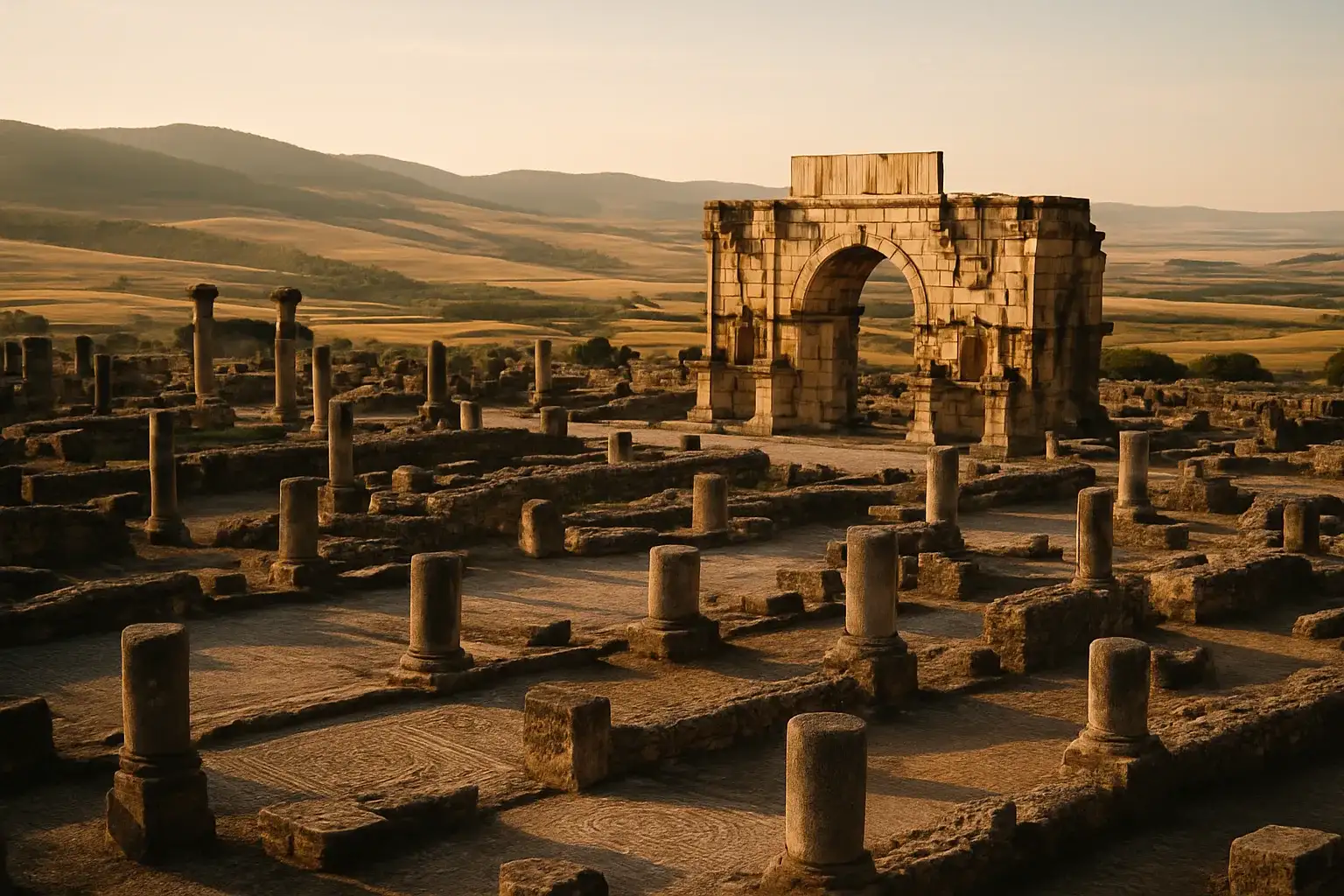
On a fertile plateau beneath the Zerhoun Mountains, where olive groves stretch toward the horizon and the calls to prayer echo from Morocco’s holiest town nearby, lie the evocative ruins of Volubilis—Rome’s westernmost outpost in Africa and the best-preserved archaeological site in Morocco. Unlike the monumental grandeur of Rome’s Mediterranean cities, Volubilis offers something more intimate: a provincial Roman town frozen in time, where the houses of olive merchants still display exquisite mosaic floors, where the forum and basilica speak to civic ambition, and where the Arch of Caracalla stands as a triumph of imperial propaganda in a distant land. Founded by Berber peoples, developed under Carthaginian influence, and transformed into the capital of Roman Mauretania, Volubilis bore witness to the cross-cultural pollination that defined the ancient world. Later, it became the refuge of Idris I, founder of Morocco’s first Islamic dynasty, linking antiquity to the modern kingdom. Today, the site offers one of North Africa’s most atmospheric archaeological experiences—wandering streets where Romans once walked, admiring mosaics that have survived 2,000 years of sun, and contemplating the layers of history that make Morocco one of the world’s most culturally complex nations.
The Rise of Volubilis: From Berber Settlement to Roman Capital
The history of Volubilis extends far deeper than its visible Roman remains suggest. The site was inhabited from at least the 3rd century BCE, when Berber peoples established a settlement that took advantage of the region’s fertile soil and strategic position. These early inhabitants cultivated the olive groves that still characterize the landscape and established trade connections that reached across North Africa.
Carthaginian influence became significant from the 2nd century BCE, bringing urban planning concepts, architectural techniques, and economic integration into Mediterranean trade networks. When Roman forces conquered the region in the mid-1st century CE, they found a prosperous settlement ready to be transformed into an imperial showcase. Emperor Claudius officially annexed the territory in 44 CE, granting Volubilis municipal status and initiating the building programs that produced the ruins visible today.
The city’s peak came during the 2nd and early 3rd centuries CE, when extensive construction created the forum, basilica, temples, and private houses that visitors explore today. Olive oil production formed the economic foundation of this prosperity, with Volubilis oil exported throughout the Roman world. The city’s merchants grew wealthy enough to commission the elaborate mosaic floors that now rank among the site’s principal attractions.
The Arch of Caracalla: Gateway to the Ancient City
The Arch of Caracalla stands as the most visible landmark at Volubilis, a triumphal gateway built in 217 CE to honor the emperor and his mother Julia Domna. Though partially ruined—the top portion collapsed in an 18th-century earthquake—the arch retains sufficient structure to convey its original grandeur and the propagandistic message it was designed to communicate.
The arch’s inscription, still partially legible, dedicated the structure to the “divine emperor” and celebrated the grant of Roman citizenship to all free men of the empire—a revolutionary decree issued by Caracalla that fundamentally transformed the nature of Roman identity. For the inhabitants of this remote provincial capital, the arch proclaimed their full membership in the imperial community, despite the thousands of kilometers separating them from Rome itself.
The arch’s design followed standard Roman triumphal architecture, with a central passageway for vehicles and smaller side passages for pedestrians. Decorative elements included sculpted figures, captured weapons, and symbolic imagery celebrating imperial power. Positioned where the main road entered the city, the arch created a dramatic transition from rural landscape to urban civilization, announcing Volubilis’s participation in the greatest empire of the ancient world.
The Capitoline Temple: Jupiter, Juno, and Minerva
The Capitoline Temple dominated Volubilis’s religious life, dedicated to the triad of Jupiter, Juno, and Minerva that formed the core of Roman state religion. Though only the foundations and reconstructed columns remain visible today, the temple’s position at the highest point of the forum area proclaimed its importance in civic affairs. This was not merely a house of worship but a symbol of Rome’s cultural and political presence in Africa.
The temple’s design followed the standard Roman pattern, with a raised podium approached by a frontal staircase and a deep porch leading to the cella where the cult statues stood. The structure was built during the early 2nd century CE, when imperial building programs across the provinces sought to create visible symbols of Roman power and piety. Local stone provided most of the building material, though decorative elements may have incorporated imported marbles.
Religious ceremonies at the Capitoline Temple would have included the sacrifices and festivals that marked the Roman calendar, conducted by priests drawn from the city’s elite families. These rituals reinforced social hierarchy while connecting provincial citizens to the imperial center through shared religious practice. The temple’s prominence in the urban landscape ensured that no resident could forget their city’s Roman identity.
Roman Mosaics: Artistry Preserved in the Floor
While Tunisia’s Dougga and Algeria’s Timgad preserve impressive Roman urban forms, Volubilis distinguishes itself through exceptional mosaic art—intricate floor paintings in polychrome that have survived North Africa’s harsh sun for two millennia. These aren’t mere geometric patterns; they’re sophisticated narrative artworks that reveal the cultural aspirations of Rome’s provincial elite.
The Mosaic Experience:
Unprotected Authenticity: Unlike museums where mosaics are displayed on walls, at Volubilis you walk beside and around them in their original locations. No glass barriers; direct viewing of ancient craftsmanship. Natural lighting reveals the shimmer of original colored stones.
Narrative Complexity:
- Orpheus: The most famous—depicts the mythical musician whose song charmed all creatures; symbolized civilization taming nature
- Bacchic Scenes: Wine-making, revelry, and ecstasy—indicating the wealthy owners’ participation in Roman aristocratic culture
- Hunting Scenes: Visual displays of elite leisure and connection to land ownership
- Mythological Episodes: Stories from Greek and Roman mythology demonstrating cultural education
Artistic Quality: The mosaics here rival those of Pompeii in technique and often surpass them in preservation. Polychrome work (multiple colors) rather than simple black-and-white. Evidence of traveling mosaicists or local workshops trained in Roman traditions.
Cultural Significance: These floors testify to the Romanization of Mauretania’s elite—Berber or mixed families who adopted Roman names, gods, and artistic preferences while living on Rome’s furthest frontier. The mosaics prove that provincial life could be just as cultured as Rome itself.
The House of Orpheus: Mythology in Mosaic
The House of Orpheus preserves Volubilis’s most celebrated mosaic, depicting the mythological musician charming wild beasts with his lyre playing. This large residence, situated near the center of the ancient city, preserves multiple mosaic floors that illustrate different aspects of Roman provincial culture and artistic achievement.
The Orpheus mosaic occupies a central position in the house’s main reception room, where the homeowner would have entertained guests and conducted business. The image carries symbolic weight: Orpheus represented the civilizing power of culture and the arts, taming the wildness of nature through music and poetry. For a wealthy olive merchant in Roman Africa, this imagery proclaimed his participation in the refined culture of the imperial elite, despite his geographical distance from Rome itself.
Other mosaics in the house include scenes of dolphins, marine life, and geometric patterns that demonstrate the range of decorative options available to affluent homeowners. The quality of these floors suggests that the house belonged to one of Volubilis’s most prosperous families, able to commission work from skilled mosaicists who may have traveled from major urban centers like Carthage.
The Olive Oil Economy: Wealth from the Land
Understanding Volubilis requires appreciating the economic foundation that made its prosperity possible: olive oil production. The fertile plains surrounding the city were planted with olive groves that have continued production for two millennia, and the processing of this crop created the wealth visible in the city’s fine houses and public buildings.
Archaeological evidence for this industry includes the remains of olive presses found throughout the site and its surroundings. These installations used mechanical leverage to extract oil from crushed olives, with the resulting product stored in amphorae for local consumption or export. Volubilis oil likely reached markets across the Roman Mediterranean, carrying the city’s name to distant consumers.
The olive economy shaped social organization as well as material culture. Land ownership determined wealth and status, creating the class of prosperous merchants whose houses visitors admire today. Seasonal labor requirements for harvesting and processing created employment relationships and economic interdependencies that structured community life. Even the city’s religious life reflected agricultural concerns, with festivals marking planting and harvest seasons.
Moulay Idriss Zerhoun: Morocco’s Holiest Town
No visit to Volubilis is complete without exploring nearby Moulay Idriss Zerhoun, the town that shares the mountain ridge with the Roman ruins and holds profound significance in Moroccan history and Islamic spirituality. This whitewashed town cascading down the hillside is the burial place of Idris I, founder of Morocco’s first Islamic dynasty and the figure credited with bringing Islam to the region in the late 8th century.
The town’s significance extends beyond historical importance to active religious devotion. As Morocco’s holiest town, it attracts pilgrims seeking blessings at the tomb of the sharif (descendant of the Prophet Muhammad) who established the religious and political foundations of the modern Moroccan state. Non-Muslim visitors cannot enter the shrine itself but can appreciate the town’s distinctive architecture and atmosphere from its surrounding streets and viewpoints.
The round minaret of Moulay Idriss represents a distinctive architectural feature—only one other cylindrical minaret exists in Morocco. This unique design element, along with the town’s whitewashed buildings and terraced gardens, creates visual interest that complements the archaeological wonders of Volubilis. Many visitors find the combination of Roman antiquity and Islamic spirituality uniquely moving, spanning Morocco’s layered history in a single day trip.
The Idrisid Dynasty: Birthplace of Islamic Morocco
The connection between Volubilis and Moulay Idriss Zerhoun reflects the continuity of habitation and sanctity across centuries of historical change. When Idris I fled political persecution in the Abbasid caliphate during the late 8th century, he found refuge among the Berber tribes of the Zerhoun Mountains. From this base, he established the first independent Islamic state in Morocco, laying the foundations for the kingdom that persists today.
Idris I made his capital near the ruins of Volubilis (which had been abandoned following the end of Roman rule), using the existing infrastructure while establishing new religious and political institutions. Though the Idrisid capital eventually moved to Fes, the association between the dynasty founder and the Volubilis region remained significant. His tomb at Moulay Idriss became a pilgrimage destination that has continued to draw visitors for over a millennium.
This historical layer adds depth to any visit to Volubilis, transforming it from a site of purely Roman interest into a place where multiple chapters of Moroccan history intersect. The ruins that witnessed Roman civic life later sheltered the founder of the Moroccan state, linking antiquity to the present through continuous habitation and memory.
Getting to Volubilis: Fes, Meknes & Rabat Routes
Volubilis is most commonly visited as a day trip from Fes, the imperial city that lies approximately 70 kilometers to the east. The journey takes about 1.5 hours by car, passing through varied landscapes of agricultural land and rolling hills before reaching the Zerhoun Mountains. Organized tours from Fes typically combine Volubilis with visits to Moulay Idriss Zerhoun and Meknes, creating a comprehensive day of cultural exploration.
Meknes, located just 30 kilometers from Volubilis, provides a closer base for those wishing to spend more time at the site. This smaller imperial city offers excellent accommodations and dining options with less tourist pressure than Fes or Marrakech. Staying in Meknes allows early morning visits to Volubilis, when the light is best for photography and the site is nearly empty of other visitors.
For independent travelers, rental cars provide the greatest flexibility, with good roads connecting all three cities to the archaeological site. Grand taxis (shared long-distance taxis) operate between Meknes and Moulay Idriss, from where Volubilis is a short walk or taxi ride. Public buses serve the region but require more time and patience than most visitors prefer.
Practical Guide: Timing, Tickets & Photography Tips
Essential Planning FAQs
How do I get to Volubilis?
Organized tour from Fes or Meknes (most convenient; includes guide; $40–80), Grand taxi from Meknes (~30 min; negotiate fare), Rental car (easy driving; parking at site), or Public bus to Moulay Idriss then taxi (budget option but time-consuming). Most visitors stay in Fes and take a full-day tour that includes Volubilis, Moulay Idriss, and Meknes.
How long should I spend at Volubilis?
Minimum 2 hours to see the main sights and mosaics. Plan 3–4 hours for thorough exploration including all houses with mosaics and the forum area. Combine with 1–2 hours in nearby Moulay Idriss for a half-day excursion, or with Meknes for a full day.
Do I need a guide at Volubilis?
Recommended but not essential. A guide brings the mosaics to life by explaining mythological scenes and Roman daily life. However, the site is well-signposted in multiple languages, and a good guidebook suffices for independent visitors. Official guides available at entrance (100–200 MAD). Avoid unofficial “guides” who may provide inaccurate information.
What is the best time to visit Volubilis?
Spring (March–May) when surrounding hills are green and wildflowers bloom among the ruins. Autumn (September–November) offers mild temperatures and golden light. Summer is extremely hot with no shade—visit early morning (8 AM opening) if traveling June–August. Winter can be cold and rainy but offers dramatic skies for photography.
What should I combine with Volubilis?
Moulay Idriss Zerhoun is essential—it’s adjacent and culturally significant as Morocco’s holiest town. Meknes (30 km away) is a UNESCO imperial city with impressive gates and granaries. Many itineraries do a Fes–Meknes–Volubilis–Moulay Idriss loop. Avoid combining with Fes medina in one day—too rushed.
Quick Facts
| Attribute | Details |
|---|---|
| Location | Fès-Meknès, Morocco |
| Country | Morocco |
| Region | Fès-Meknès |
| Civilization | Roman / Berber (Mauretania) |
| Historical Period | c. 3rd century BCE – 7th century CE |
| Established | c. 3rd century BCE |
| Coordinates | 34.0717, -5.5547 |
Explore More Ancient Wonders
- Jerash: The best-preserved Roman city in Jordan
- Baalbek: Rome’s most monumental temple complex in Lebanon
- Ephesus: The magnificent Roman city on Turkey’s Aegean coast
- Great Zimbabwe: Africa’s greatest ancient stone city
For photography tips at ancient sites, see our guide to photographing ruins. Planning your first archaeological trip? Read our beginner’s guide.
|-----------|---------| | Location | Meknes Prefecture, Fès-Meknès region, northern Morocco | | Ancient Name | Volubilis (Latin); Walili (Arabic: وليلي) | | UNESCO Status | World Heritage Site (1997) | | Foundation | 3rd century BCE (Berber/Carthaginian) | | Roman Period | 1st–3rd centuries CE (Mauretania capital) | | Distance from Fes | 70 km (43 miles); 1.5 hours | | Distance from Meknes | 30 km (19 miles); 45 minutes | | Best Time | March–May, September–November | | Entry Fee | 70 MAD (approximately $7 USD) | | Suggested Stay | Half day |
Frequently Asked Questions
What is Volubilis and where is it located?
Volubilis is a remarkably preserved Roman city in northern Morocco, 33 km north of Meknes in the foothills of the Atlas Mountains. It served as the capital of the Roman province of Mauretania Tingitana and is home to some of the finest in-situ Roman mosaics anywhere in the world—surprisingly better preserved than most Italian Roman sites.
How do I get to Volubilis?
Volubilis is best visited as a day trip from Meknes (33 km, 45 minutes by taxi or tour) or combined with nearby Moulay Idriss (the first Islamic city in Morocco, 5 km away). From Fes, it's 75 km (1.5 hours). Grand taxis from Meknes run to Moulay Idriss from where you can arrange local transport to Volubilis. Most visitors combine both sites in a day.
Why are the Volubilis mosaics so well preserved?
The city was abandoned gradually following the Muslim conquest of Morocco in the 7th-8th centuries CE, then struck by the 1755 Lisbon earthquake which toppled standing structures but left mosaic floors largely intact under rubble. Much of the site remains unexcavated. The ongoing excavations and hot, dry climate have preserved the mosaics in exceptional condition—vivid colors and complete scenes visible without entering buildings.
What are the highlights of Volubilis?
The highlight mosaics include the House of Orpheus (Orpheus charming animals), the House of the Labours of Hercules (twelve labours in medallions), and the House of the Ephebus (erotic scenes). The Arch of Caracalla (217 CE) marks the main entrance to the forum area. The Basilica and Capitol remain standing. The combination of standing architecture and intact floor mosaics is unique.
Can I combine Volubilis with Meknes and Fes?
Yes—this is the classic Imperial Cities route. Meknes has one of Morocco's most impressive medieval medinas and the Bab Mansour gate. Volubilis is 33 km north. Moulay Idriss, Morocco's holiest city, is 5 km from Volubilis. Fes is 75 km east. Most tour operators offer a day trip combining Meknes + Moulay Idriss + Volubilis departing from Fes, returning via the same route.
Nearby Ancient Sites
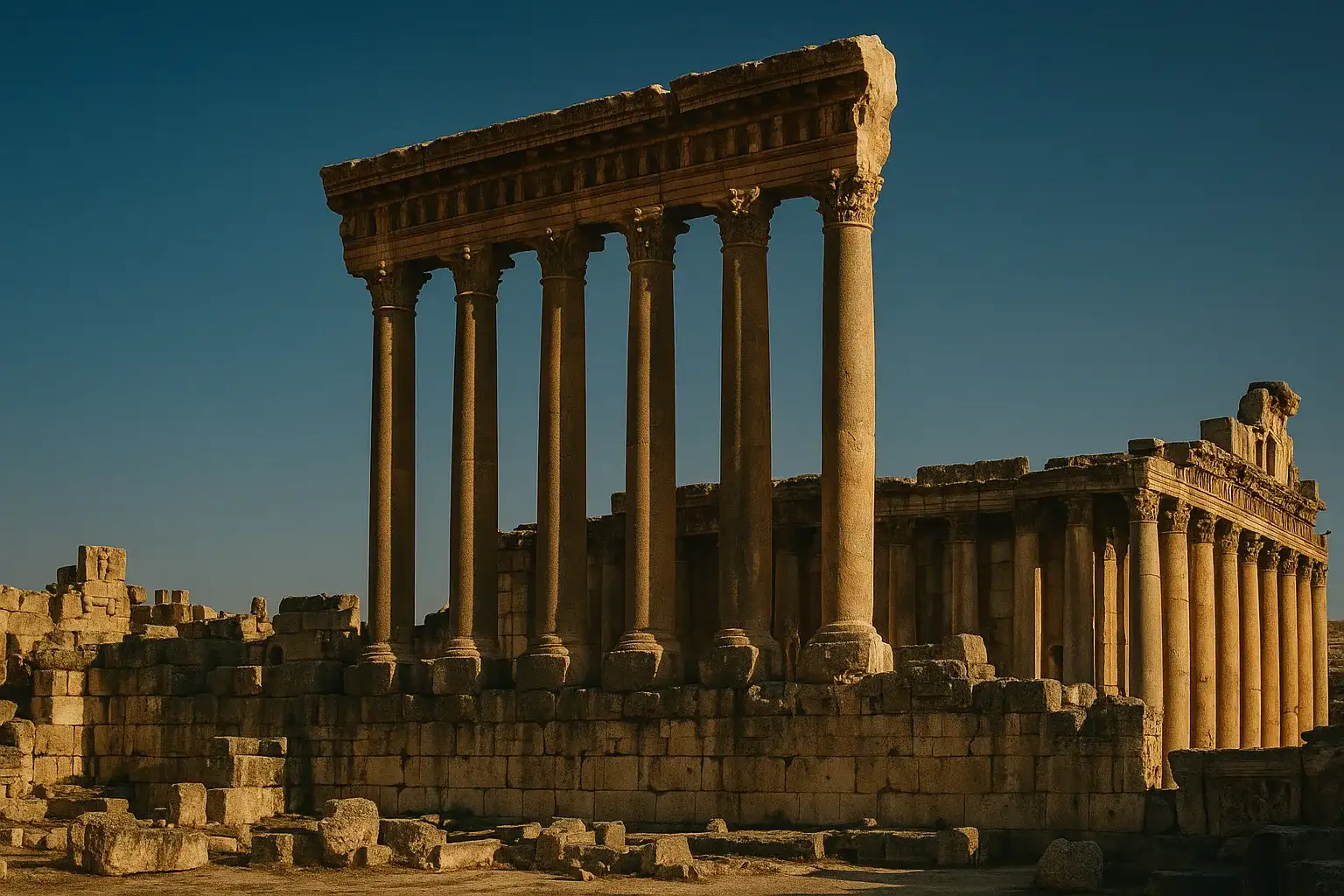
Baalbek: Rome's Mightiest Temple Complex in Lebanon's Beqaa
Roman / PhoenicianExplore Baalbek's colossal Roman temples, including the best-preserved Temple of Bacchus. Discover t...
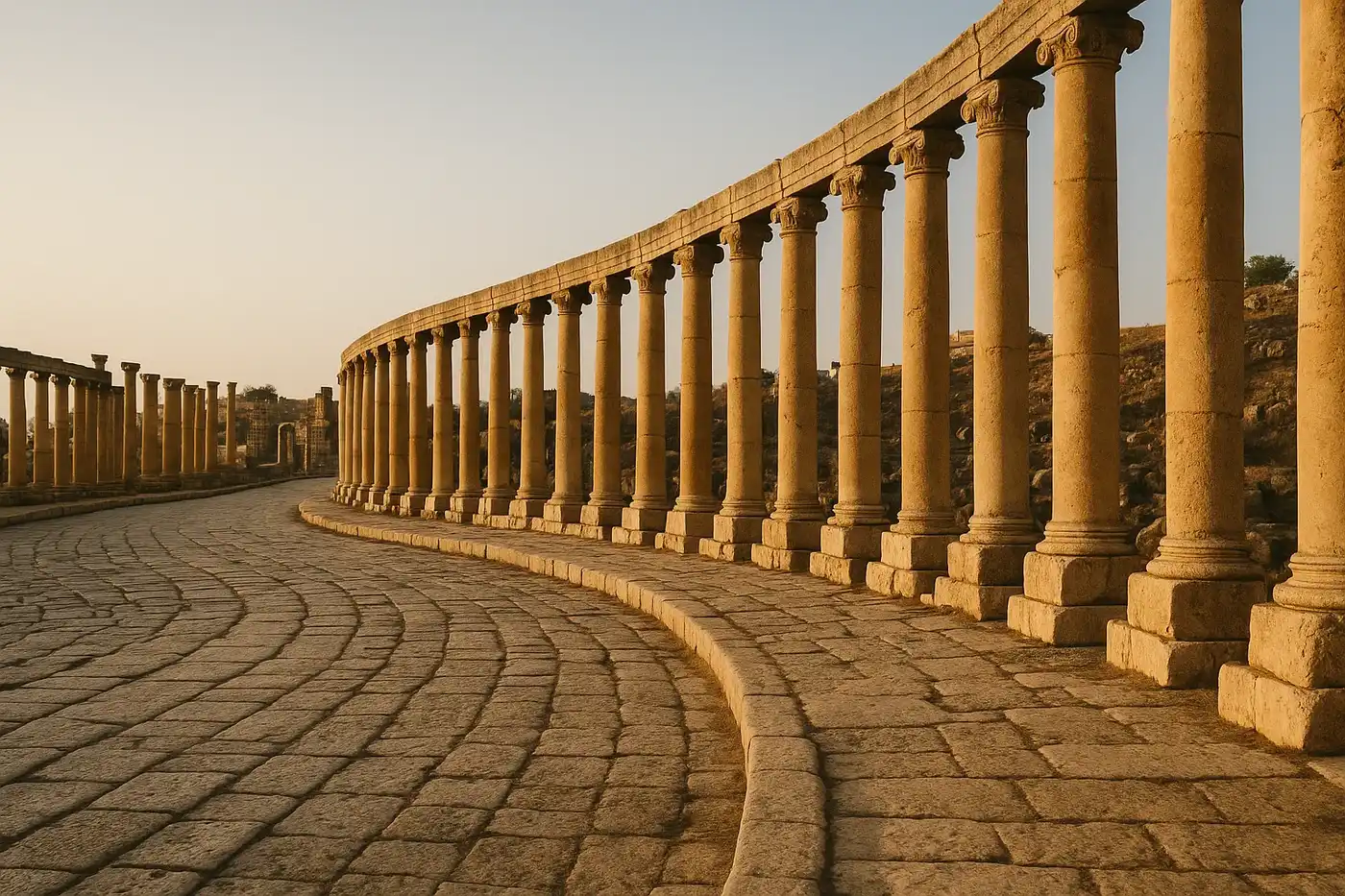
Jerash: The Pompeii of the East and Jordan's Best-Preserved
Roman / NabataeanDiscover Jerash, Jordan's remarkable Roman ruins. Walk the colonnaded streets of ancient Gerasa, exp...