Quick Info
At a glance
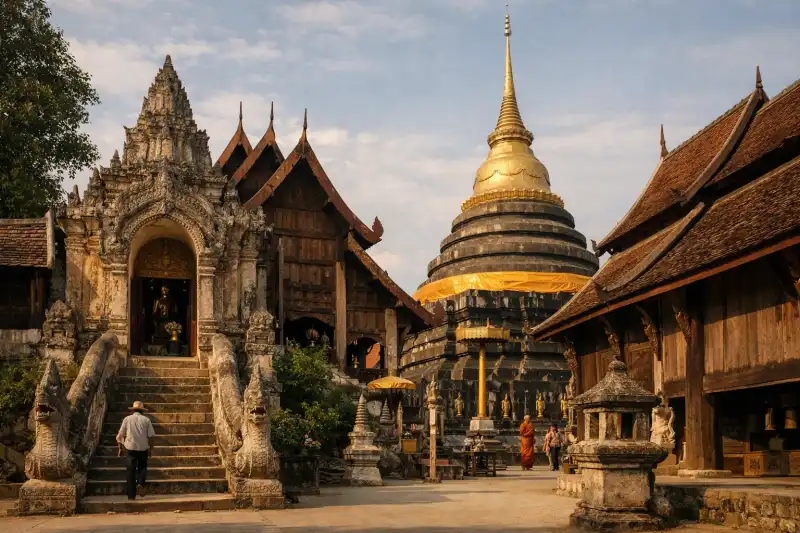
Wat Phra That Lampang Luang in Thailand rises from the plain of Lampang Province like a memory of the old Lanna world, enclosed by walls, crowned by a gleaming chedi, and surrounded by the slower rhythm of northern village life. Unlike many major temples that sit amid dense urban streets, this monastery still feels connected to an earlier landscape of pilgrimage routes, rice fields, and regional kingdoms. Its elevated compound, approached by a ceremonial stair and watched over by weathered wooden buildings, gives visitors the sense of entering not just a sacred place but a preserved cultural atmosphere.
For many travelers, the appeal begins with the temple’s visual harmony. The complex is one of Thailand’s most admired examples of traditional Lanna religious architecture, with timber viharns, intricately carved details, and layered rooflines that seem to float above the courtyard. Yet Wat Phra That Lampang Luang is not merely picturesque. It remains an active center of devotion, especially because of the holy relic enshrined in its main stupa. Pilgrims come to pray, local worshippers come to make merit, and curious visitors arrive to understand why this temple is so often described as one of the most important in northern Thailand.
The atmosphere shifts throughout the day. In the morning, sunlight falls softly across the white walls and gilded surfaces. By midday, the chedi shines intensely against the northern sky. Toward evening, the timber halls take on deeper tones, emphasizing the age and texture of the site. Whether you come for history, architecture, photography, or spiritual interest, Wat Phra That Lampang Luang offers a rare combination of continuity and beauty that makes it one of the most rewarding temple visits in Thailand.
History
Early foundations in the Lanna world
The origins of Wat Phra That Lampang Luang are generally traced to the 13th century, during the period when the Lanna Kingdom was emerging as a major political and cultural force in northern Thailand. Lampang itself was an important regional center, positioned along routes linking upland communities, neighboring principalities, and the larger Lanna capitals. As Buddhism spread and royal patronage strengthened monastic institutions, temples became symbols of both spiritual legitimacy and political authority.
According to local tradition, the site may stand on even earlier sacred ground, though the core monument visible today belongs to the historical development of the Lanna era. The temple’s importance grew around the enshrinement of a relic of the Buddha, reflected in the name “Phra That,” a term used for revered relic stupas. Such relic shrines were central to religious geography in the region, drawing worshippers and helping rulers assert their connection to Buddhist merit and cosmic order.
What makes Wat Phra That Lampang Luang especially significant is that it preserves the feeling of an early northern Thai monastery more successfully than many other major temples. While numerous historic sites were heavily rebuilt or transformed over time, this complex retained substantial elements of its older layout and character. Its fortified enclosure, raised platform, and arrangement of halls suggest a sacred space designed both for ritual importance and for visibility within the surrounding landscape.
Expansion and artistic flourishing
During the 14th and 15th centuries, the temple likely underwent major expansion as Lampang’s prestige increased within the orbit of Lanna power. This was the period when much of the region’s distinctive temple art and architecture matured. Multi-tiered roofs, carved wood ornament, mural traditions, and elegant Buddha images developed into forms now recognized as hallmarks of the Lanna style.
The temple’s main chedi, with its impressive golden appearance and commanding position, became the ritual and visual center of the complex. Around it grew supporting buildings for worship, teaching, and ceremonial use. The viharns, ordination hall, gateways, and subsidiary shrines reflected the wealth and devotion of patrons ranging from rulers and nobles to local communities.
This was also a period of artistic exchange. Lanna culture interacted with Sukhothai, Ayutthaya, Mon traditions, and influences moving through mainland Southeast Asia. At Wat Phra That Lampang Luang, those broader currents were adapted into a distinctly northern expression. The temple’s Buddha images, decorative motifs, and spatial organization all reveal the confidence of a regional tradition that was both connected and self-assured.
Survival through political change
Northern Thailand did not remain politically stable. Over the centuries, Lanna faced internal rivalries, outside pressure, and periods of Burmese influence. Many temples in the region suffered neglect, alteration, or damage during times of war and political transition. The continued survival of Wat Phra That Lampang Luang is therefore notable.
Its importance as a relic shrine likely contributed to its preservation. Sacred sites with active ritual significance often had stronger community support than monuments valued only for their historical standing. Even as regimes changed, worshippers continued to maintain the temple, repair structures, and uphold festivals associated with merit-making and local identity.
Some buildings and artworks at the temple date from later restoration phases, and like many living religious sites, it evolved rather than remaining frozen in a single century. Yet the cumulative result still feels remarkably coherent. Instead of losing its historical identity through repeated rebuilding, the complex retained an unmistakable Lanna core.
Modern recognition and conservation
In the modern era, Wat Phra That Lampang Luang came to be recognized not only as a revered temple but also as one of Thailand’s architectural treasures. Scholars, conservators, and travelers have celebrated the site for its surviving wooden halls, important murals, and comparatively intact historic compound. It is often cited as one of the finest examples of a Lanna Buddhist temple anywhere in the country.
Today, the temple continues to function as both a place of worship and a heritage destination. That dual role shapes the visitor experience. Monks, worshippers, and caretakers sustain daily religious life, while conservation efforts help protect fragile artistic features from weathering and mass tourism. The balance is not always simple, but it is part of what makes the site meaningful. Wat Phra That Lampang Luang is not a ruin in the archaeological sense. It is a living monument where history remains visible because devotion never entirely ceased.
Key Features
The first striking feature of Wat Phra That Lampang Luang is its setting within a walled and elevated compound. Visitors ascend toward the temple rather than simply walking into it at street level, and that ascent creates a subtle psychological transition. The outer walls and entrance sequence give the complex a fortified, ceremonial quality, reminding visitors that many historic temples in the region were once both sacred centers and prominent symbols of communal power. Entering the grounds feels like crossing into a more ordered and symbolic world.
At the heart of the temple stands the great chedi, the reliquary monument that gives the site its name and spiritual importance. Covered in gold-toned surfaces that catch the light vividly, it dominates the courtyard without overwhelming it. The chedi’s proportions are elegant rather than massive, and its prominence reflects the centrality of relic worship in northern Thai Buddhism. For pilgrims, this is the focus of prayer and circumambulation. For visitors, it is the anchor around which the rest of the architecture makes sense. The surrounding open space allows the monument to breathe visually, making it especially photogenic in morning and late afternoon light.
The temple is equally celebrated for its wooden viharns and other historic structures, which preserve the texture of traditional Lanna building techniques. Their roofs descend in layered tiers, creating silhouettes that are graceful from a distance and highly detailed up close. Carved gables, dark timber beams, lacquered surfaces, and restrained ornament produce a more intimate aesthetic than the heavily mirrored and brightly tiled style seen in many later Thai temples. There is warmth in the materials here: wood that has aged, surfaces that reveal repairs and continuity, and columns that seem shaped by centuries of ritual use.
Inside the main halls, visitors encounter Buddha images and decorative programs that speak to both artistry and devotion. Some of the murals are especially valued for their historical and cultural significance, offering insight into regional religious imagery and local narrative traditions. As in many active temples, interior access and photography may be controlled, but when visible, the painted walls and dim sacred spaces provide a powerful contrast to the sunlit courtyard outside. The interiors are not designed for spectacle alone. Their atmosphere is contemplative, with architecture directing attention toward the Buddha image, the sermon space, and the ritual axis of the hall.
One of the site’s most unusual and fascinating features is the famous shadow image phenomenon associated with a small chamber near the temple. Through a pinhole effect, an inverted image of the chedi can appear inside, functioning almost like a natural camera obscura. This detail has long intrigued visitors because it combines sacred architecture, observation, and optical wonder in a way that feels unexpectedly modern. Yet it also fits the temple’s broader appeal: Wat Phra That Lampang Luang rewards slow looking. Beyond the famous monuments, there are doors, lintels, guardian figures, roof finials, and paving details that reveal themselves gradually.
Another defining quality is the balance between monumentality and lived spirituality. Unlike some historic compounds that feel separated from ordinary religious life, this temple remains visibly active. Offerings, incense, prayer, and local visitors are part of the landscape. The result is not museum-like perfection but a richer sense of continuity. Wat Phra That Lampang Luang is beautiful because it has endured, and because the community around it still treats it as sacred rather than merely historical.
Getting There
Wat Phra That Lampang Luang is located in Ko Kha District, roughly 18 kilometers southwest of Lampang city, making it an easy half-day trip from the provincial capital. The most convenient route for most travelers is by road. From central Lampang, a taxi or ride-hailing trip typically takes around 25 to 35 minutes depending on traffic and can cost about 250 to 500 THB one way if arranged privately. Some hotels can also help organize a round-trip car with waiting time, often in the 800 to 1,500 THB range for a flexible visit.
If you are traveling on a tighter budget, local songthaews or buses may run toward Ko Kha, with fares often around 20 to 50 THB, though schedules can be irregular and may require asking locally for the most current stop and departure information. This is the cheapest option, but it also demands more time and patience. For travelers comfortable driving, renting a scooter in Lampang can cost around 250 to 400 THB per day, while a compact rental car may start from about 900 to 1,500 THB per day. Roads are straightforward, and self-driving gives you the freedom to combine the temple with other nearby sites.
From Chiang Mai, Lampang is reachable by train, bus, or private transfer. Trains and buses usually take 2 to 3 hours, with fares varying from roughly 50 THB for basic local options to several hundred baht for faster or more comfortable services. Once in Lampang, continue by taxi or local transport to the temple. Visitors flying into northern Thailand usually arrive via Chiang Mai or Lampang Airport, then complete the journey overland.
When to Visit
The best time to visit Wat Phra That Lampang Luang is generally during the cool and dry season from November to February. At this time, northern Thailand enjoys more comfortable daytime temperatures, clearer skies, and lower humidity, making it easier to walk around the temple compound and appreciate architectural details without the fatigue of intense heat. Morning visits are especially rewarding, as the light is soft, the grounds are quieter, and the golden chedi glows beautifully.
From March to May, temperatures rise sharply across northern Thailand. Midday can feel very hot, and this period may also coincide with seasonal haze caused by agricultural burning in parts of the region. The temple remains visitable, but early morning or late afternoon is strongly recommended. Carry water, dress lightly but respectfully, and allow extra time to rest in shaded areas.
The rainy season, usually from June to October, brings greener scenery and fewer crowds, but also occasional heavy downpours. Rain can make travel plans less predictable, especially if you are relying on local transport rather than a private car. On the other hand, wet-season visits can be atmospheric, with dramatic skies and lush surroundings enhancing the temple’s setting. Just bring an umbrella and footwear suitable for damp surfaces.
If possible, try to avoid major midday holiday rushes unless you specifically want to experience the temple during a festival or pilgrimage period. Religious occasions can be deeply memorable, with processions and increased devotional activity, but they also mean larger crowds. For photography, reflection, and a calmer pace, weekday mornings are often ideal.
| Quick Facts | Details |
|---|---|
| Location | Ko Kha District, Lampang Province, Thailand |
| Nearest City | Lampang |
| Best For | Lanna architecture, Buddhist heritage, photography, pilgrimage |
| Main Highlight | Golden relic chedi and historic wooden temple halls |
| Historical Period | Primarily Lanna era, with later restorations |
| Time Needed | 1-2 hours |
| Access | Best reached by taxi, private car, scooter, or local transport from Lampang |
| Best Season | November to February |
| Dress Code | Modest clothing covering shoulders and knees |
| Visitor Tip | Arrive early for cooler weather, softer light, and a quieter atmosphere |
Wat Phra That Lampang Luang endures because it offers more than a checklist of monuments. It preserves a complete mood: a sense of sacred elevation, regional identity, and architectural continuity that is increasingly rare. In northern Thailand, many temples are beautiful, but few communicate the historic Lanna world with such clarity. The fortified enclosure, the radiant chedi, the venerable timber halls, and the continued rhythm of worship all combine to make the site feel both grand and intimate.
For travelers interested in ancient places, the temple stands at an appealing middle ground between archaeological fascination and living tradition. You do not come here to see ruins disconnected from their purpose. You come to witness a historic sanctuary that still functions as intended, while carrying the marks of centuries in its wood, walls, and ritual spaces. Even a relatively short visit can leave a strong impression, especially if you take time to move slowly, observe the details, and appreciate how the architecture shapes the experience of devotion.
Whether approached as a spiritual destination, a masterpiece of Lanna art, or a rewarding stop on a wider northern Thailand itinerary, Wat Phra That Lampang Luang is one of the country’s essential temple visits. It is not simply a landmark of Lampang Province. It is one of the clearest windows into the historical culture of the north, and one of the rare places where that history still feels vividly alive.
Guided tours: worth it?
Self-guided works here, but a guide can add real value if you want the ruins explained as a living place rather than just a sequence of monuments.
Best for
- First-time visitors who want context, not just photos
- Short visits where a planned route saves time
When to go self-guided
Go independently if you prefer setting your own pace, reading as you go, and checking official hours or ticket rules directly before you arrive.
What I’d avoid
Skip paid tours that bundle unrelated stops you do not actually want. The best option should either save meaningful planning time or add historical context you would miss on your own.
Lampang temple tours
Useful when: you want to compare guided formats before deciding
Chiang Mai to Lampang day trips
Useful when: transport or pickup logistics matter
Northern Thailand cultural tours
Useful when: you want to compare guided formats before deciding
Some tour links are affiliate links, which may earn Ancient Travel a small commission at no extra cost to you. I try to surface options that make practical sense for the site—not just anything bookable.
Frequently Asked Questions
Where is Wat Phra That Lampang Luang located?
Wat Phra That Lampang Luang is in Ko Kha District, Lampang Province, in northern Thailand, about 18 kilometers southwest of Lampang city.
Why is Wat Phra That Lampang Luang important?
It is one of the finest surviving Lanna temples in Thailand, revered for its sacred relic stupa, traditional wooden architecture, and long religious history.
How much time should I spend at Wat Phra That Lampang Luang?
Most visitors spend 1 to 2 hours exploring the temple compound, though those interested in architecture, murals, or photography may want longer.
Is there an entrance fee at Wat Phra That Lampang Luang?
Fees can change, but foreign visitors usually pay a modest admission charge while Thai worshippers may enter freely or under a different pricing system.
What should I wear when visiting Wat Phra That Lampang Luang?
Wear respectful temple clothing that covers shoulders and knees, and remove shoes before entering sacred interior spaces where required.
Can I take photographs inside Wat Phra That Lampang Luang?
Photography is generally allowed in outdoor areas, but some halls may restrict interior photography, so always follow posted rules and staff guidance.
Nearby Ancient Sites
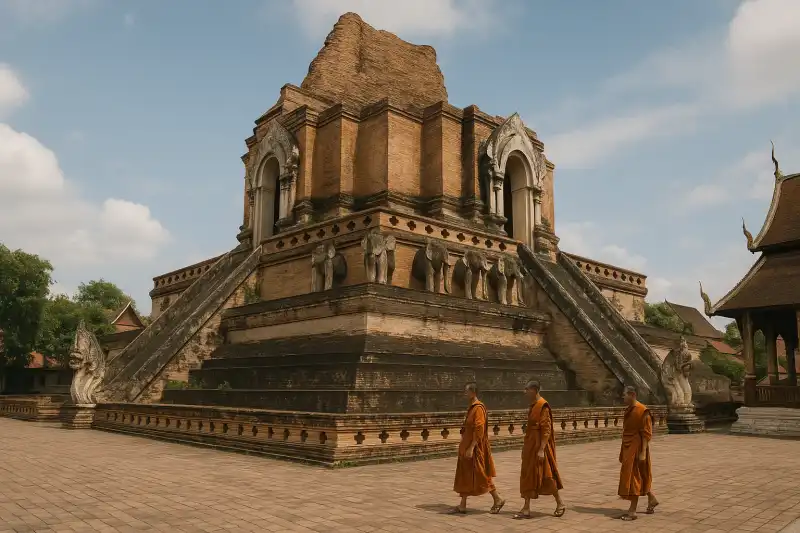
Wat Chedi Luang Travel Guide 2026: Chiang Mai's Ruined Stupa, Monks, and Visit Timing
Lanna KingdomPlan a focused Wat Chedi Luang visit with practical timing, temple etiquette, and old-city route tip...
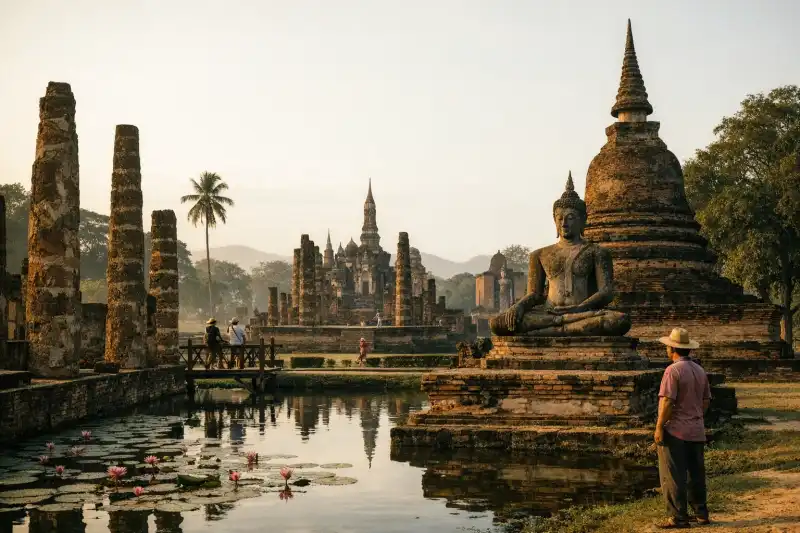
Sukhothai
Sukhothai, in northern Thailand's Sukhothai Province, is famed as the cradle of Thai civilization an...
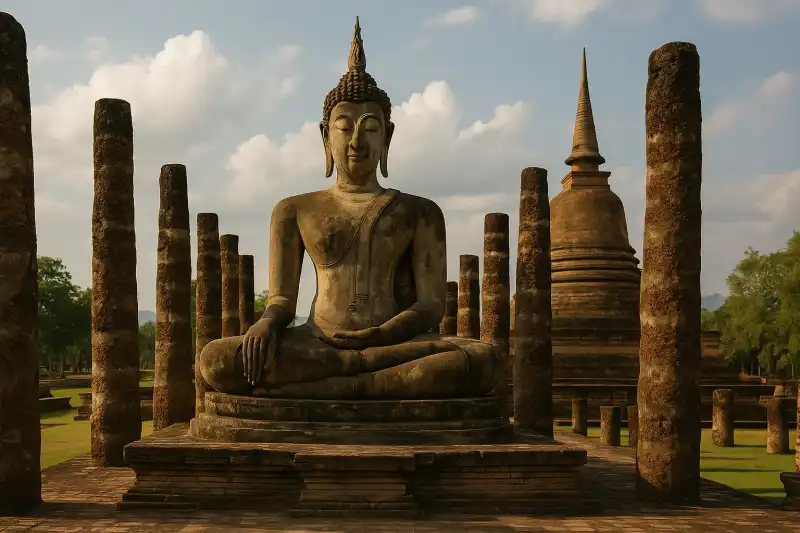
Sukhothai Historical Park Travel Guide 2026: Thailand’s First Capital Without the Crowds
Sukhothai KingdomPlan a smarter Sukhothai Historical Park visit with route tips, key ruins, and practical timing for ...
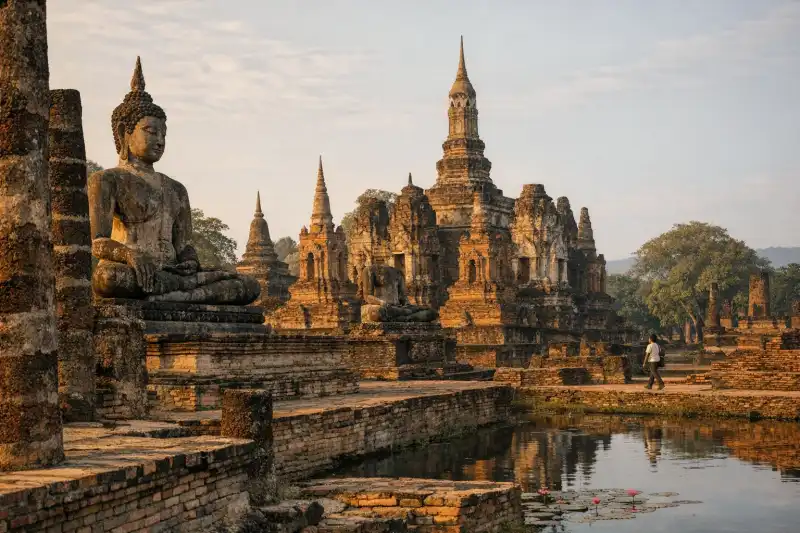
Wat Mahathat (Sukhothai)
Wat Mahathat in Sukhothai, Thailand, is a stunning World Heritage temple complex and the spiritual h...