Quick Info
At a glance
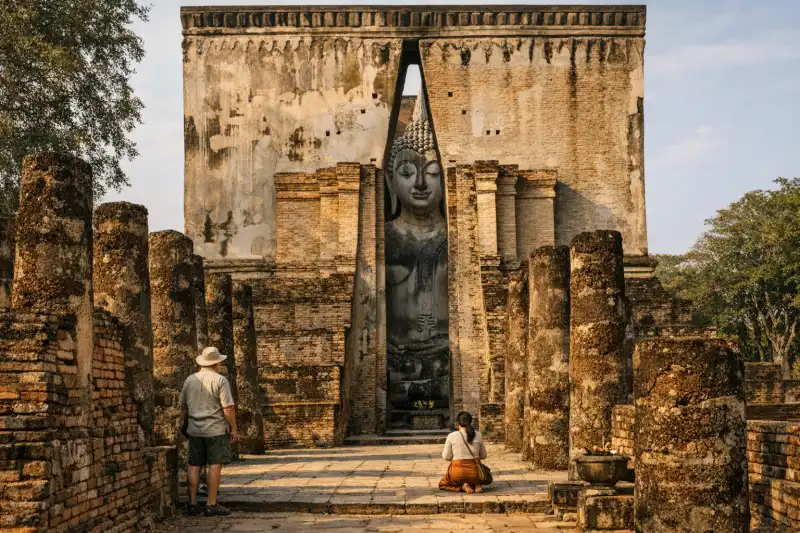
Wat Si Chum in Thailand is one of those places that feels larger than its physical size, not because the temple complex sprawls endlessly, but because a single encounter there can stay with you for years. Hidden within the wider sacred landscape of Sukhothai, the monument is most famous for its colossal seated Buddha, a figure so calm and self-possessed that many visitors fall silent as soon as they see it. The approach is part of the experience: low ruins, open ground, and then the sudden emergence of a towering image enclosed within a massive stone structure. That contrast between simplicity and grandeur is central to Wat Si Chum’s appeal.
Unlike temple sites that impress through intricate layers of ornament, Wat Si Chum works through atmosphere, scale, and the careful shaping of space. The Buddha is not revealed all at once from afar. Instead, the architecture frames the image in a way that heightens anticipation and devotion. The result is deeply theatrical, though clearly designed for religious reverence rather than spectacle. Today, travelers come for many reasons: to understand the artistic achievements of the Sukhothai Kingdom, to photograph one of Thailand’s most iconic Buddhist monuments, or simply to experience a place where sacred architecture still communicates power across centuries. Even among the many historic treasures of Sukhothai, Wat Si Chum stands apart as one of the most memorable and emotionally resonant.
History
Origins in the Sukhothai Kingdom
Wat Si Chum dates to the flourishing period of the Sukhothai Kingdom, generally in the late 13th or early 14th century, when Sukhothai was emerging as one of the most important political and cultural centers in mainland Southeast Asia. This era is often described as formative for Thai art, religion, and kingship, and many of the monuments within the region reflect a confident local style that balanced Khmer influence, Sri Lankan Buddhist connections, and innovations that became distinctly Sukhothai.
The temple was likely established as part of a wider sacred and ceremonial landscape around the capital. Sukhothai rulers and elites sponsored numerous monasteries, Buddha images, and hydraulic works, creating an environment where royal legitimacy and Buddhist merit-making were tightly linked. Wat Si Chum’s monumental scale suggests that it was not a minor local shrine but an important religious foundation. Its immense mandapa and giant seated Buddha indicate both substantial patronage and a strong desire to create a visually commanding sacred image.
Scholars have long associated the site with the artistic and devotional ambitions of the Sukhothai court. Although exact documentary evidence for its foundation is limited, the temple’s architecture and sculpture place it clearly within the peak centuries of Sukhothai urban and religious development. The image inside, known as Phra Achana, became the heart of the site and remains its defining feature.
Religious significance and royal associations
In the centuries when Sukhothai prospered, temples like Wat Si Chum served more than one function. They were monasteries, ritual spaces, teaching centers, and symbols of political order. Buddhism in Sukhothai was closely tied to kingship, and monumental Buddha images expressed not only spiritual ideals but also the capacity of rulers to sponsor merit and uphold the faith. A temple of this scale would have reinforced the prestige of the kingdom and its devotion to Theravada Buddhism.
Wat Si Chum is also associated in Thai historical memory with stories of royal inspiration and martial resolve. Later traditions suggest that the temple or its great Buddha image may have played a role in encouraging troops or legitimizing authority through sacred presence. While such stories can be difficult to verify in precise historical terms, they show how deeply the monument entered the cultural imagination. The Buddha at Wat Si Chum was not just an object of worship but a presence that people believed could speak to power, morality, and destiny.
The temple may also have contained important narrative and educational elements. Fragments of decorative slate panels discovered at the site have been linked to Jataka tales, the stories of the Buddha’s previous lives. If these were indeed part of the original decorative scheme, they would have added a didactic dimension, helping worshippers connect visual storytelling with moral and religious teaching.
Decline, abandonment, and rediscovery
Like much of Sukhothai, Wat Si Chum gradually declined as political power shifted southward and the kingdom was absorbed into larger regional states, especially Ayutthaya. As dynastic priorities changed and older urban centers lost prominence, many temples fell into partial disuse. Monastic communities may have shrunk, buildings deteriorated, and maintenance became irregular. Over time, tropical vegetation, weathering, and structural collapse altered the appearance of many sites in the region.
Yet Wat Si Chum was never entirely erased. The scale of its central structure and the enduring power of its giant Buddha meant that the monument remained visible in local memory even when much of the surrounding complex decayed. Travelers, pilgrims, and later antiquarians took note of it. By the modern period, the site had become recognized as one of the great historic monuments of old Sukhothai.
Systematic conservation and archaeological work in the 20th century helped stabilize Wat Si Chum and place it within a broader framework of heritage management. As Sukhothai Historical Park developed and received international recognition, the temple became one of its most celebrated stops. Today, Wat Si Chum is appreciated both as a masterpiece of Sukhothai art and as part of a UNESCO-recognized cultural landscape that preserves the remains of one of Thailand’s earliest great kingdoms.
Key Features
The defining feature of Wat Si Chum is the enormous seated Buddha image, Phra Achana, housed within a giant square mandapa. The image is among the most unforgettable in Thailand. Seated in the attitude of subduing Mara, with one hand reaching toward the earth, the Buddha projects steadiness rather than motion. The face is serene, the proportions balanced, and the scale deliberately overwhelming. What makes the experience so striking is not only the size of the figure but the way the architecture reveals it. You do not encounter the statue in a broad open courtyard. Instead, the narrow gap in the mandapa creates a controlled view, framing the Buddha with a sense of suspense and intimacy.
The mandapa itself is a powerful structure. Its thick masonry walls rise around the image like a monumental shell, emphasizing both protection and focus. Even in ruin, the building conveys engineering ambition. It was designed not merely to shelter a statue but to shape the emotional response of devotees approaching it. The walls once likely supported upper passages and decorative elements, and some scholars have drawn attention to an internal stair-like corridor within the structure. That hidden architectural complexity adds another layer to the monument, suggesting that Wat Si Chum was carefully planned to create ritual movement and perhaps ceremonial access beyond what is immediately visible from the ground.
Another notable feature lies in the expressive details of the Buddha itself. Visitors often remember the long, elegant fingers of the right hand, which rest downward in a gesture associated with enlightenment. Gold leaf is often applied by worshippers in modern times, creating a subtle interplay between the ancient monument and ongoing devotion. This tactile act of reverence helps explain why Wat Si Chum feels alive rather than museum-like. It remains a place of respect, not just observation.
Around the main monument are the remains of the temple complex, including foundations and traces of auxiliary buildings that once supported religious life. Though less visually dramatic than the central image, these ruins help place the site in context as a functioning monastery rather than an isolated sculpture. The open surroundings also matter. Wat Si Chum sits within the broader historical landscape of Sukhothai, where ponds, tree-lined paths, and widely spaced monuments produce a feeling of spaciousness uncommon at more densely built heritage sites.
Archaeological discoveries have added intellectual interest to the site as well. Slate relief fragments found here, many interpreted as scenes from Buddhist narratives, suggest that the original temple environment was richer in decoration than the surviving ruins alone might imply. These fragments are important evidence for the artistic world of Sukhothai, where sculpture, architecture, and storytelling were integrated into a single devotional environment.
For photographers, Wat Si Chum offers one of the most iconic compositions in Thai heritage travel: the towering Buddha glimpsed through the vertical opening of the mandapa. For students of art history, it demonstrates the refinement and spiritual clarity often associated with Sukhothai style. For general travelers, it delivers something simpler but equally valuable: a moment of awe that does not require specialist knowledge to appreciate. The site’s greatness lies in how effectively it combines monumentality with stillness.
Getting There
Wat Si Chum is located within the Sukhothai Historical Park area in Sukhothai Province, and most visitors reach it via the modern city of New Sukhothai or from nearby transport hubs such as Phitsanulok. If you are coming from Bangkok, long-distance buses to Sukhothai usually take around 6 to 7 hours, with fares commonly ranging from about 350 to 700 THB depending on class and operator. Domestic flights to Sukhothai Airport can save time, though they are usually more expensive than bus travel. From Phitsanulok, buses or vans to Sukhothai are frequent and often cost roughly 100 to 200 THB.
Once in the Sukhothai area, the easiest way to visit Wat Si Chum is by bicycle, tuk-tuk, rented scooter, or private car. Bicycle rental is especially popular and often costs around 30 to 60 THB per day, making it an affordable and enjoyable option if the weather is not too hot. Tuk-tuks and local drivers can be hired for half-day or full-day circuits of the ruins; expect prices that may begin around 300 to 800 THB depending on distance, duration, and negotiation. Scooter rental often falls in the range of 250 to 350 THB per day.
Wat Si Chum lies slightly northwest of the main central zone of the historical park, so it is manageable by bike but may feel easier with motorized transport if you plan to cover multiple zones in one day. Entry arrangements for Sukhothai Historical Park can vary by zone, so bring cash and check the latest ticket options at the site entrance or visitor area before setting out.
When to Visit
The best time to visit Wat Si Chum is generally during Thailand’s cool and dry season, from November to February. During these months, temperatures are more comfortable, skies are often clearer, and exploring the wider Sukhothai Historical Park is far more pleasant than in the hotter parts of the year. Early mornings are especially rewarding. The light is soft, the air is cooler, and the temple’s quiet atmosphere feels more pronounced before tour groups arrive. Late afternoon is also excellent for photography, as the low sun gives texture to the brick and stone surfaces.
March to May is the hottest period in central and northern Thailand, and midday visits can be draining. If you travel during these months, aim to arrive right after opening time, carry water, and wear a hat or use sun protection. The exposed landscape around the ruins offers limited shade, so heat can build quickly. Even so, the site remains impressive year-round if you pace your visit wisely.
The rainy season, roughly from June to October, brings greener scenery and fewer crowds, which some travelers appreciate. Short downpours can interrupt cycling or photography, but they also add drama to the landscape. Wet ground and cloud cover can make the ruins feel especially atmospheric. If you do visit in this season, bring a light rain jacket and allow extra flexibility in your schedule.
For the best balance of comfort, color, and crowd levels, many travelers find November through January ideal. Whatever the season, the most important timing advice is simple: avoid the harsh midday heat whenever possible and give yourself enough time to absorb the monument rather than rushing through it.
| Quick Facts | Details |
|---|---|
| Location | Sukhothai Historical Park, Sukhothai Province, Thailand |
| Famous for | The giant seated Buddha image Phra Achana |
| Historical era | Sukhothai Kingdom, late 13th-14th century |
| Religion | Theravada Buddhism |
| Best visit length | 30-60 minutes |
| Best time of day | Early morning or late afternoon |
| Typical transport | Bicycle, tuk-tuk, scooter, or private car |
| Nearest base | New Sukhothai / Sukhothai city area |
| UNESCO context | Part of the historic Sukhothai cultural landscape |
| Atmosphere | Monumental, contemplative, and highly photogenic |
Wat Si Chum rewards both quick visits and deeper study, which is part of what makes it such an essential stop in Sukhothai. Even if you have already seen many Buddhist monuments across Thailand, the experience here feels distinct. The temple does not rely on extensive restoration or dense decorative programs to impress. Instead, it uses one of the oldest tools in sacred architecture: carefully managed space. As you approach, the massive walls conceal and reveal at the same time. When the Buddha finally comes into full view, the effect is immediate and quieting.
That lasting impression helps explain why Wat Si Chum has become one of the signature images of Sukhothai and, more broadly, of ancient Thailand. It captures the refinement of Sukhothai art, the religious devotion of the kingdom that built it, and the ability of ruins to remain emotionally powerful long after their original world has passed. Whether you arrive by bicycle in the morning mist, by tuk-tuk under a bright blue sky, or in the green hush of the rainy season, the monument has a way of slowing you down. In a destination rich with historic temples, that alone makes Wat Si Chum extraordinary.
Guided tours: worth it?
Self-guided works here, but a guide can add real value if you want the ruins explained as a living place rather than just a sequence of monuments.
Best for
- First-time visitors who want context, not just photos
- Short visits where a planned route saves time
When to go self-guided
Go independently if you prefer setting your own pace, reading as you go, and checking official hours or ticket rules directly before you arrive.
What I’d avoid
Skip paid tours that bundle unrelated stops you do not actually want. The best option should either save meaningful planning time or add historical context you would miss on your own.
Sukhothai Historical Park tours
Useful when: you want to compare guided formats before deciding
Sukhothai temple and heritage tours
Useful when: you want to compare guided formats before deciding
Private day trips to Sukhothai from Phitsanulok
Useful when: you want flexible timing or a private guide
Some tour links are affiliate links, which may earn Ancient Travel a small commission at no extra cost to you. I try to surface options that make practical sense for the site—not just anything bookable.
Frequently Asked Questions
What is Wat Si Chum famous for?
Wat Si Chum is best known for its enormous seated Buddha image, Phra Achana, which is framed dramatically by a narrow opening in a massive mandapa.
Where is Wat Si Chum located?
Wat Si Chum is located in Sukhothai Historical Park in Sukhothai Province, northern Thailand, just outside the old walled city area.
Do I need a separate ticket for Wat Si Chum?
Ticketing policies can change, but Wat Si Chum is generally visited as part of the Sukhothai Historical Park zones, so check current zone and combined pass options at the entrance.
How much time should I spend at Wat Si Chum?
Most travelers spend 30 to 60 minutes at Wat Si Chum, though photographers and history enthusiasts often stay longer to explore the temple grounds and details.
Is Wat Si Chum suitable for a sunrise or sunset visit?
Yes, early morning and late afternoon are excellent times to visit for softer light, cooler temperatures, and fewer visitors.
Can I reach Wat Si Chum by bicycle?
Yes, cycling is one of the most popular ways to explore the Sukhothai ruins, and Wat Si Chum is commonly included on bike routes around the historical park.
Nearby Ancient Sites
Sukhothai Historical Park Travel Guide 2026: Thailand’s First Capital Without the Crowds
Sukhothai KingdomPlan a smarter Sukhothai Historical Park visit with route tips, key ruins, and practical timing for ...
Wat Mahathat (Sukhothai)
Wat Mahathat in Sukhothai, Thailand, is a stunning World Heritage temple complex and the spiritual h...
Sukhothai
Sukhothai, in northern Thailand's Sukhothai Province, is famed as the cradle of Thai civilization an...
Ayutthaya Travel Guide 2026: Temple Ruins, Day Trip Planning, and What to Prioritize
Ayutthaya KingdomPlan a focused Ayutthaya visit with practical temple routing, timing, and transport guidance from Ba...