Sicily is not one archaeological destination. It is a sequence of competing coastlines, city-states, Roman estates, Byzantine and Islamic traces, and Norman rulers who built their own argument on top of all of it. A good route accepts that the island is large. It does not pretend Palermo and Syracuse are neighboring neighborhoods with different coffee.
Start in Palermo, but do not stop there
Give Palermo a full day before moving east or south. The UNESCO-listed Arab-Norman ensemble joins nine civic and religious structures from the Norman Kingdom of Sicily, dated 1130 to 1194 on UNESCO’s record. Use that list as a framework rather than a checklist. Palermo’s palaces, churches, and cathedral explain the island’s medieval synthesis with more clarity than a hurried drive to a temple ever could.
If you have extra time, add Segesta as a western detour. Its temple and theater make sense with an overnight in western Sicily; they do not belong wedged between a Palermo checkout and an Agrigento dinner reservation.
Make Agrigento the Greek anchor
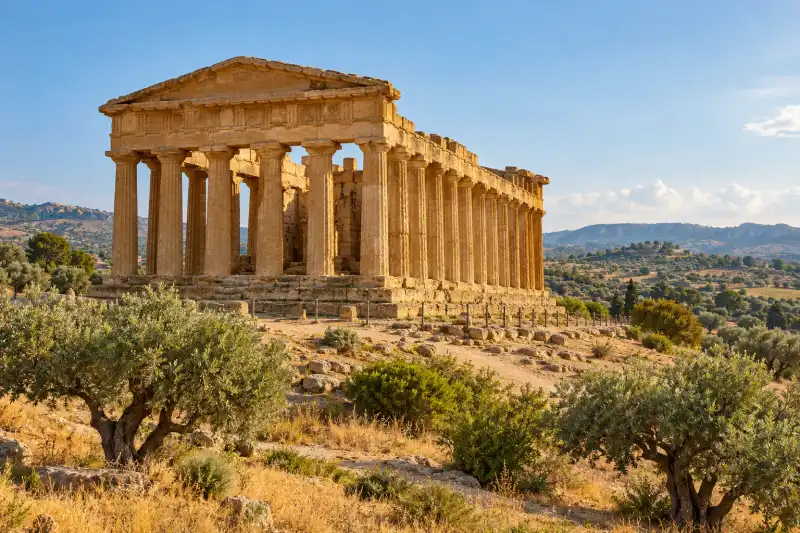
The Valley of the Temples deserves a dedicated day. The temples are spread across a landscape, and the value is in seeing their position, surviving form, and relationship to the ancient city, not merely collecting facades. Bring sun protection, choose sturdy shoes, and check the official park information close to travel for current access rules and any timed-entry arrangements.
Stay nearby after the visit when you can. Driving onward after hours outdoors in intense heat is a classic way to turn an excellent site into a blur.
Use the interior for Roman Sicily
Piazza Armerina gives the route a different register. Villa Romana del Casale is less about temples and more about the domestic scale, luxury, and imagery of a late Roman estate. Put it between the south coast and Syracuse only if the transfer sequence is realistic. Otherwise, make it an interior overnight and enjoy the fact that the itinerary has stopped impersonating a relay race.
Finish in Syracuse and Taormina
Syracuse Archaeological Park works best with time for the city beyond the ticketed area. Ancient Syracuse was a major Greek city, and the archaeology makes more sense when paired with Ortigia’s streets, waterfront, and museums. Keep the schedule loose enough to distinguish the theater, quarry landscapes, and civic remains instead of speed-walking them into one memory.
Taormina’s Greek Theatre is a logical final stop for travelers continuing toward Catania. Treat it as a compact but significant theater visit, not evidence that all Sicilian Greek sites are the same. Its setting is part of the interpretation, and the surrounding town is often busier than the archaeological map implies.
A seven-day practical shape
Days one and two: Palermo and, if wanted, Segesta. Days three and four: transfer to Agrigento and visit the Valley of the Temples. Day five: Piazza Armerina as an interior stop or a carefully planned transfer day. Days six and seven: Syracuse, then Taormina or Catania departure. Add an eighth day for Selinunte, the southeast coast, or simply less driving.
Rental cars can make rural connections easier, but rail and bus decisions depend on the exact season, operator, and route. Verify the official or carrier source shortly before departure. Do not use a static guide as a live timetable, fare sheet, or proof that a connection exists.
Read the island with care
Sicily’s sites are exposed, uneven, and often embedded in working towns and landscapes. Carry water, use shade deliberately, follow barriers, and avoid touching painted, mosaic, or fragile surfaces. The practical payoff of a slower route is not only comfort. It gives you the chance to see how Greek, Roman, Byzantine, Arab, and Norman histories overlap without compressing them into “old stuff, nice view.”
Continue with Pompeii, Paestum, Selinunte, and our budget travel guide.