Quick route summary
This 5-day route starts in Split and ends in Pula, with two bases: Split for Diocletian’s Palace and Pula for Pula Arena. It is a compact ancient Croatia itinerary built around two unusually legible Roman survivals: an emperor’s fortified retirement palace that became a city, and an amphitheater that still dominates its harbor town.
The pace is moderate, not lazy. The hard part is not the sightseeing. It is the transfer from Dalmatia to Istria, which can look simple on a map and feel longer in real life. Give Split two nights, Pula two nights, and protect Day 3 from overplanning.
Who this itinerary is for
This itinerary is for travelers who want Roman Croatia without turning the trip into a country-wide checklist. It works well if you like ancient sites that are still part of daily urban life: laundry lines above Roman walls, cafe tables beside imperial columns, and an amphitheater that remains a public venue rather than a fenced-off relic.
It is not ideal if you want a beach-first Croatia trip, island hopping, or a fast greatest-hits loop through Dubrovnik, Plitvice, and Zagreb. Those can be good trips, but this route is narrower and better for travelers who are willing to give two ancient urban places enough time to make sense.
Route at a glance
- Day 1: Overnight in Split. Arrive, settle near the old city, and take a first slow walk through Diocletian’s Palace.
- Day 2: Overnight in Split. Spend a full walking day with the palace cellars, gates, Peristyle, cathedral area, and waterfront.
- Day 3: Overnight in Pula. Use the morning in Split, then transfer north to Istria by flight, bus, or car.
- Day 4: Overnight in Pula. Visit Pula Arena and walk the Roman city around it.
- Day 5: Overnight in Pula or depart. Keep a lighter Pula day for the arena area, old streets, and onward travel.
Practical logistics before you go
Use Split and Pula as your bases. Do not try to sleep in a different town every night for this version. Split is best when you stay inside or just outside the palace core, because the Roman plan is most interesting when you can wander it at different hours. Pula is easiest near the old town or harbor, within walking distance of the arena.
The Split to Pula transfer is the planning pinch point. In some seasons, flying via Zagreb or another connection may be the least tiring option. Buses can work but are long. Driving gives flexibility, but it is still a real travel day, especially if you are not used to Croatian coastal and highway distances. A ferry-based fantasy route is not the thing to rely on here unless you have checked current seasonal schedules carefully.
Guided tours make the most sense in Split on Day 2, because Diocletian’s Palace is not a palace in the neat museum sense. It is a late Roman imperial complex that became the skeleton of a medieval and modern city. In Pula, a guide is useful if you want the arena tied into the wider Roman town rather than visited as one impressive building.
Day 1: Arrive in Split and enter Diocletian’s Palace slowly
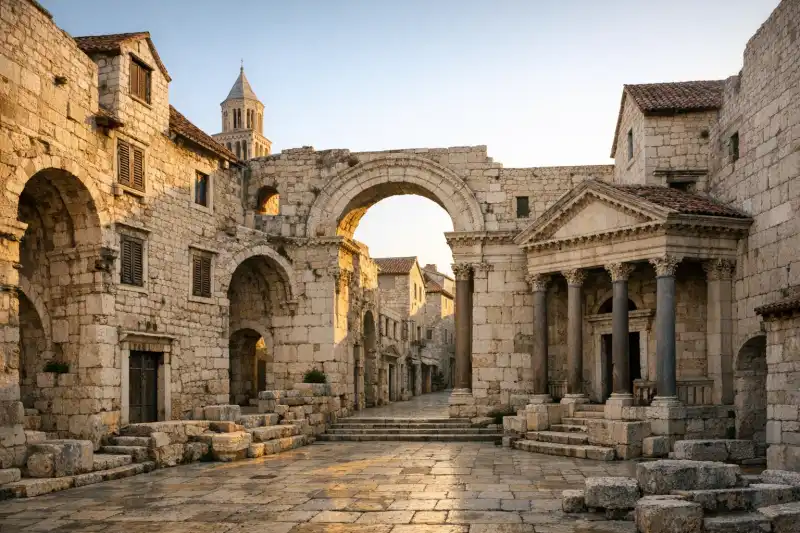
Arrive in Split and resist the urge to treat the old town as something to “cover” in one evening. Diocletian’s Palace is better on a first pass when you do less: enter through one of the old gates, find the Peristyle, notice the walls, and let the weirdness of the place settle in.
Diocletian had the complex built around the turn of the 4th century CE after he became the rare Roman emperor who retired rather than died violently in office. The plan mixed military, residential, ceremonial, and service spaces. That matters because Split is not preserving a palace beside the city. The city grew inside the palace.
Keep the logistics simple today. Check into a hotel or apartment within walking distance, eat nearby, and take a short evening loop through the palace lanes. If you arrive late, do not force a historical deep dive. The stone is not going anywhere, and the next day works better if you are not already tired.
Day 2: Diocletian’s Palace below, above, and after dark
Give Diocletian’s Palace a full day. Start early around the Peristyle, when the central court is easier to read before the thickest crowds arrive. Then move into the substructures, where the lower halls help explain the footprint of the emperor’s apartments above. The underground spaces are not just atmospheric stone vaults. They preserve the shape of the lost upper palace more clearly than much of the city above them.
This is a good day for a Diocletian’s Palace walking tour in Split, especially if you want help separating Roman fabric from later medieval additions. The palace has been reused for so long that the interesting question is often not “what is original?” but “how did this survive by being useful?”
Pay attention to the cathedral area. The structure began as Diocletian’s mausoleum, which gives Split one of its sharpest historical ironies: a Roman emperor associated with persecution of Christians was buried in a building later converted into a Christian cathedral. The stones are quiet now, but the religious reversal is not subtle.
Take a long break in the afternoon. Split’s palace core can be crowded and reflective stone makes heat feel stronger than the forecast suggests. Return after dinner for another walk. At night the Roman geometry shows up differently, and the lanes feel less like a tourist zone and more like an ancient plan still doing everyday work.
Day 3: Split morning, then transfer north toward Istria
Use the morning for one final Split loop, not a major new excursion. Revisit the gates of Diocletian’s Palace, look again at how the palace walls fold into shops and apartments, and pick up anything you skipped on Day 2. This is a good moment for people who like their ruins lived-in rather than polished. Split makes Roman architecture feel less dead because people kept adapting it.
Then transfer to Pula. This is the day that keeps the itinerary honest. Split and Pula are both on the Croatian coast, but they are not neighbors. If schedules line up, a flight can reduce fatigue. A bus is usually cheaper but long. A car gives you control, though it still consumes the better part of the day once pickup, driving, breaks, and arrival are counted.
Do not schedule Pula Arena for this afternoon unless your transfer is unusually smooth and you arrive with energy. Check into your Pula base, take a short walk toward the harbor or old town, and save the arena for a clear-headed morning. Roman amphitheaters deserve better than being squeezed in after a transportation day.
Day 4: Pula Arena and the Roman city
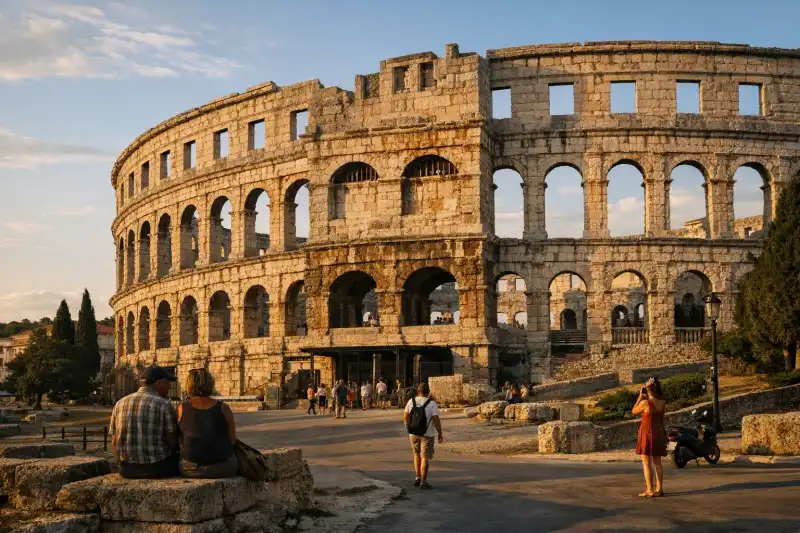
Start with Pula Arena. Built in the 1st century CE, it is one of the best-preserved Roman amphitheaters surviving today, and its position near the harbor gives it a different feel from the inland arenas of Italy and southern France. The outer wall is the thing to study first. Those tiers of arches were designed for mass movement, spectacle, and civic pride, not just for a dramatic skyline.
Do not rush inside and out in twenty minutes. Walk the exterior, then enter and give yourself time to understand the scale. Amphitheaters were machines for crowd control as much as entertainment. The architecture tells you how Rome organized bodies, views, entrances, status, and spectacle.
A Roman Pula tour with Pula Arena can be useful if you want the amphitheater connected to the rest of the town. Pula was more than an arena with houses around it. Its Roman street pattern, gates, and public spaces belonged to a colonial city tied into Adriatic trade and imperial culture.
Keep the afternoon walkable. Base yourself in Pula’s old center, eat nearby, and avoid adding a long Istrian road trip today. The arena is most satisfying when you leave enough time to circle back past it later, especially if there is an event setup or evening light changing the stone.
Day 5: A slower Pula finish around the arena
Keep the final day gentle. If you have not gone inside Pula Arena yet, do it now. If you visited on Day 4, return for a slower exterior circuit and use the rest of the day to understand the arena in its town setting. The building is famous, but its placement matters: it sat close to the harbor, visible to people arriving by sea, and it still announces Pula before the rest of the old city has time to explain itself.
This is also the day to let the two halves of the route talk to each other. Split shows late Roman power becoming urban fabric. Pula shows Roman public spectacle surviving as a monumental shell, still used for concerts and events. Neither site is frozen in a clean archaeological past. Both survived because later cities kept finding uses for them.
If you depart today, avoid booking a painfully early onward connection unless you have slept in Pula the night before and know the transfer. If you stay one more night, this becomes a low-pressure day, which is not a bad thing. After the Split to Pula move, a little slack is part of the plan.
The historical thread: Roman power reused on the Adriatic
This route works because Split and Pula show two different kinds of Roman survival. Diocletian’s Palace was private imperial architecture on a fortified scale, built for an emperor who tried to stabilize Rome through administrative reform and controlled succession. Pula Arena was public architecture, made for crowds, spectacle, and the civic identity of a Roman city on the Adriatic.
The more interesting thread is reuse. Split’s palace became a living city, with medieval churches, homes, shops, and streets packed into Roman bones. Pula’s arena remained legible because its outer shell endured and the town kept orbiting around it. In both places, antiquity is not sealed behind glass. It is underfoot, overhead, and occasionally in the way.
Transportation notes
Split and Pula are easy cities to walk once you are there. The hard transportation question is the middle of the itinerary.
For the Split to Pula transfer, compare three options before committing. Flying may be fastest if schedules are kind. Bus travel can be straightforward but long, and it may eat the day. Driving works if you want flexibility, but do not mistake it for a scenic little hop. Build in breaks and avoid arriving in Pula too late to check in comfortably.
Do not self-drive into Split’s palace core. Stay nearby and walk. In Pula, you also want a walkable base because the arena and old town reward repeated passes. A car is more useful for broader Istria than for the ancient core of this itinerary.
If you want to compress the route, cut the final light day in Pula before cutting Split’s full palace day. The palace needs time because it is confusing in the best way. If you want less fatigue, add a sixth night rather than adding more stops.
Optional add-ons and swaps
If you want a wider Roman amphitheater route, add Verona Arena before or after Croatia and remove the slower Day 5 in Pula. This turns the trip into an Adriatic and northern Italy Roman spectacle route, but it adds a border crossing and more transport planning.
For a southern France extension, pair Pula with Nîmes Roman Arena or Arles Amphitheatre. These are not casual add-ons to a 5-day Croatia trip. Treat them as a separate chapter if you are building a longer Roman amphitheater itinerary.
If you need a Croatia-only swap, keep Split and reduce Pula to one full day. The painful cut is Day 5, not the arena itself. Do not cut the full Split day unless you are comfortable seeing Diocletian’s Palace as a quick old-town walk rather than the main historical argument of the route.
Shorter and longer itinerary options
For a shorter 3-day version, stay in Split and focus entirely on Diocletian’s Palace. You can make a strong long weekend out of the palace core, the waterfront, and the Roman-to-medieval reuse story without adding the Istria transfer.
For a tighter 4-day version, use two nights in Split and one or two nights in Pula, with Day 3 as the transfer and Day 4 for Pula Arena. It works, but it leaves less room for delays.
For a longer 7-day version, keep this structure and add more Istria time after Pula rather than adding another distant Croatian region. The best improvement is not more ancient-site name collecting. It is reducing transfer pressure and giving Pula a fuller second day.
Related ancient sites
FAQ
The most common planning questions for this route are answered below.