Quick route summary
This 3-day ancient Cyprus route uses Paphos as the main base and builds one ambitious day around Salamis, the great ruined city near the island’s eastern coast. It starts gently in Paphos, crosses the island for Salamis on Day 2, then returns to a slower final day rather than pretending Cyprus can be “finished” in a weekend.
The pace is compact but honest. Paphos gives you coastal archaeology, Roman mosaics, tomb landscapes, and an easy place to sleep. Salamis adds a larger ancient city feel, with gymnasium ruins, baths, columns, mosaics, and the layered history of a place that kept changing hands and identities.
Who this itinerary is for
This itinerary is for travelers who want a short Cyprus trip with ancient history at the center, not just beaches and harbor dinners. It suits people who can handle one long transport day and who like the idea of seeing how Cyprus sat between Greek, Phoenician, Roman, Byzantine, and eastern Mediterranean worlds.
It is not ideal if you want a slow resort break, a no-car itinerary, or three equal sightseeing days with no fatigue. Salamis is worth the effort, but the map is a little deceptive. The road time matters.
Route at a glance
- Day 1: Overnight in Paphos. Arrive, settle in, and keep the ancient sites local so the trip starts with context rather than exhaustion.
- Day 2: Overnight in Paphos. Drive or hire a driver across Cyprus for Salamis, then return west in the evening.
- Day 3: Overnight in Paphos. Stay local again for a slower Paphos finish, using the day for mosaics, tombs, a museum, or a coastal walk.
Practical logistics before you go
Paphos is the easiest base for this version because it gives you hotels, restaurants, airport access, and several ancient sites close together. The tradeoff is Day 2. Salamis sits far to the east, so the day needs an early start and a realistic tolerance for driving.
A rental car is the simplest option for independent travelers, but check current access rules, insurance conditions, and border or checkpoint requirements before planning the Salamis day. If you are unsure, use a guided archaeology tour or a private driver. This is one of those days where a tour can solve a real planning problem, not just add commentary.
Do not overpack the route. Cyprus has more ancient material than a 3-day trip can absorb. The best version of this itinerary accepts that and gives Salamis enough breathing room instead of stuffing every inland sanctuary, museum, and coastal ruin into the same afternoon.
Day 1: Paphos arrival and the ancient city layers
Use the first day to settle into Paphos and stay close to your base. The city’s ancient appeal is not one single monument. It is the layering: Hellenistic and Roman elite houses, mosaics, tomb landscapes, harbor defenses, and later Christian remains all sitting close to a modern resort town that can feel oddly casual about its archaeological weight.
Start with the main archaeological area if timing works. The Roman mosaics in Paphos are the kind of site where it pays to slow down. They were not just decoration. In elite houses, mythological scenes helped owners display education, taste, status, and a comfortable relationship with the Greek past under Roman rule.
Keep logistics easy today. Walk where practical, use taxis for short hops, and do not schedule a major inland drive after arrival. If you land late, make this a museum and harbor day instead. The point is to start reading Cyprus as a crossroads, not to win a checklist before dinner.
This is also the day to prepare for Salamis. Confirm your transport, check opening hours, pack water, and set a hard departure time. Day 2 is the one that can go sideways if you treat Cyprus like a small island where everything is casually nearby.
Day 2: Salamis and the eastern coast
Leave early for Salamis. This is the big ancient-city day, and it deserves more than a rushed stop. Salamis was one of the most powerful city kingdoms on Cyprus, traditionally linked with Greek foundation stories after the Trojan War, then reshaped by Phoenician, Persian, Hellenistic, Roman, and Byzantine pressures over many centuries.
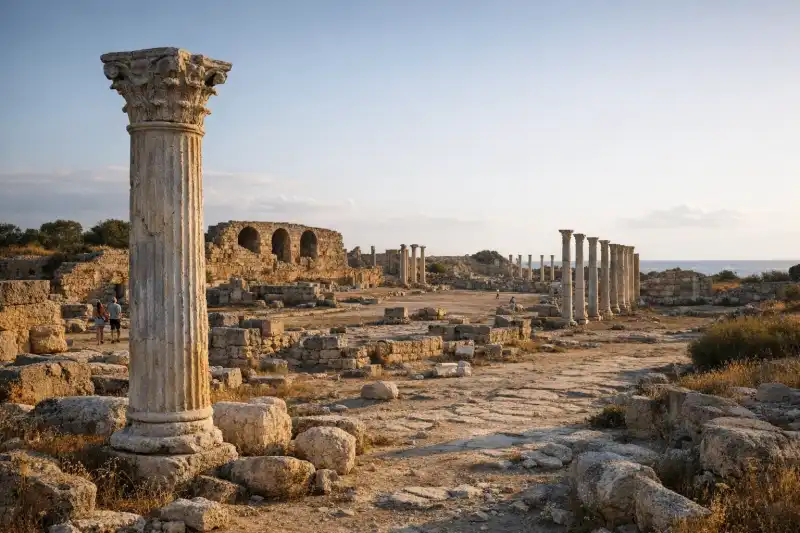
The Roman remains are often the easiest to read on the ground. The gymnasium and baths show a city invested in public display, social life, and the body as much as in temples or walls. Look for mosaic floors and reused columns, and give yourself time to notice how the site feels like a city rather than a single monument.
Salamis is also useful because it pushes Cyprus out of the “Greek island” mental shortcut. The island sat in the sea lanes between Anatolia, the Levant, Egypt, and the Aegean. Control of Cyprus mattered because ships, copper, timber, armies, merchants, and cults moved through it. The stones are quiet now, but the geography was never passive.
Plan this as a full-day excursion from Paphos, or shorten the driving pressure by sleeping one night in the east if that fits your trip. If you want one arranged solution, a Cyprus archaeology day tour from Paphos toward Salamis can make sense, especially if you do not want to handle the long transfer and site context yourself.
Do not add too much after Salamis. The return west is enough. Get dinner near your base and leave the evening loose.
Day 3: A slower Paphos finish
After the long Salamis day, stay in Paphos. This is not laziness. It is good route design. A slower final day lets the ancient city material settle and gives you time for the sites you skipped on arrival.
If you focused on mosaics on Day 1, use today for tombs, a local museum, or a walk through the coastal archaeological zone with fewer targets. If you arrived late on Day 1, make today your main Paphos archaeology day. The city rewards a second look because its history is not only Greek and Roman. It also carries older Cypriot traditions, later Christian layers, and the long afterlife of a port city tied to wider Mediterranean movement.
The best historical comparison today is with Salamis. Paphos feels more compact and coastal, while Salamis feels more like a spread-out civic landscape. Together they show why ancient Cyprus should not be treated as a side note between Greece and the Near East. It had its own cities, cults, rulers, and trade logic.
Keep the afternoon flexible. If the weather is hot, split sightseeing between morning and late day. If you are tired, choose one good site and stop. Ancient travel works better when you leave room to notice things.
The historical thread: Cyprus between Greek memory and eastern Mediterranean power
Paphos and Salamis make sense together because they show two different faces of ancient Cyprus. Paphos is intimate, coastal, and layered, with elite Roman domestic art and deep religious associations. Salamis is larger and more civic, with the ruins of a city that mattered in island politics and regional power struggles.
The route also makes a useful correction. Cyprus was not just a stepping stone between bigger civilizations. Its cities negotiated with, borrowed from, and resisted the powers around them: Assyrians, Egyptians, Persians, Ptolemies, Romans, Byzantines, and others. That is why the island’s ancient sites can feel familiar and strange at the same time. Greek myths appear, Roman buildings stand, eastern trade routes press in, and the local Cypriot story keeps refusing to disappear.
Transportation notes
Use Paphos as the single base if you want the simplest 3-day structure. It keeps hotel changes out of the trip and makes the first and last days easy.
For Salamis, plan carefully. Driving from Paphos to the east is the demanding part of the itinerary, and you should check current route, access, insurance, and border conditions before committing. If anything feels uncertain, hire a driver or book a guided tour. Do not leave this day to last-minute taxis.
Public transport is not a good fit for this route. It may work for pieces of Paphos, but it will not give you a clean Salamis day. If you dislike long drives, split the route with one night in the east, or skip Salamis and make this a Paphos-only ancient sites trip.
Optional add-ons and swaps
If Salamis is your priority, swap the single-base plan for one night in eastern Cyprus. That removes some fatigue and lets you see Salamis with less clock pressure. The tradeoff is an extra hotel move, which may not be worth it on such a short trip.
If you want a lighter version, cut Salamis and make all three days Paphos-based. You lose the strongest ancient city contrast, but the trip becomes much easier without a car.
If you want a more ambitious archaeology route, add a fourth day rather than forcing more into these three. Cyprus has enough ancient material for a longer circuit, and the island gets less rewarding when you treat every ruin as a quick pin on a map.
Shorter and longer itinerary options
For a shorter trip, use two nights in Paphos and skip the cross-island Salamis day unless you are comfortable with a very long excursion. A two-day version works best as Paphos only.
For a longer trip, turn this into a 5-day Cyprus route with one or two nights in the east. That gives Salamis more space and makes room for inland sanctuaries, museums, and coastal sites without making every day feel like a transfer.
Related ancient sites
FAQ
The most common planning questions for this route are answered below.