Quick Info
Curated Experiences
Aachen Cathedral Guided Tour
Charlemagne's Aachen Walking Tour
Aachen Old Town and Cathedral Tour
At the geographical center of Charlemagne’s empire, in a city whose hot springs had drawn Romans and Franks alike for centuries, a chapel rose in the late eighth century that would reshape the religious and political architecture of Europe. Aachen Cathedral is not simply old. It is foundational. This is where the idea of a unified Christian Europe found its first monumental expression in stone, mosaic, and bronze, and where for six centuries afterward the kings of Germany came to claim their crowns.
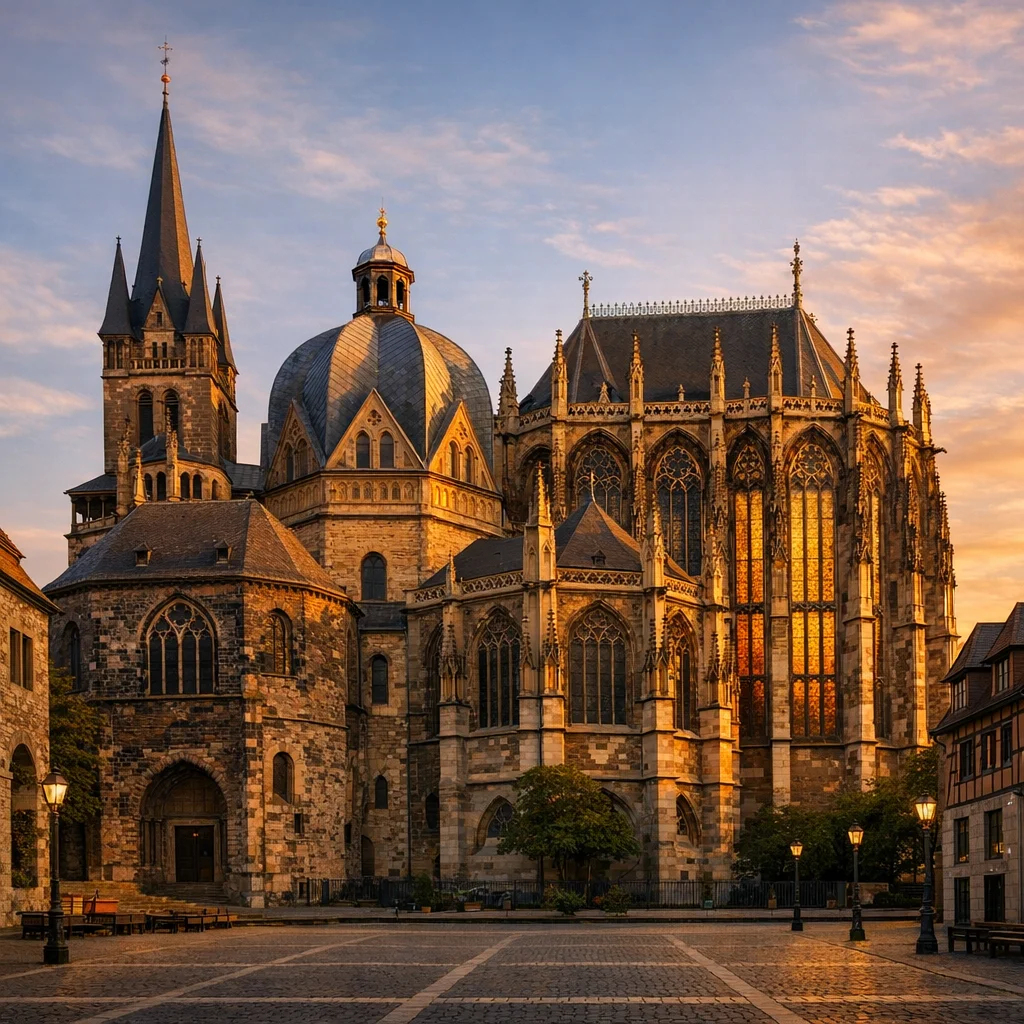
The building stands in the heart of Aachen’s compact old town, its octagonal dome visible above the rooftops from almost every approach. From the outside, the cathedral presents a layered silhouette: the original Carolingian octagon, dark and muscular, capped by a seventeenth-century baroque cupola, flanked by the soaring glass walls of the fourteenth-century Gothic choir. These additions tell the story of a building that was never finished, never abandoned, and never allowed to become merely historical. It has been a functioning church for over twelve hundred years, and the accumulated weight of worship, coronation, and pilgrimage presses against every surface.
Charlemagne’s Chapel: A New Rome in the North
When Charlemagne chose Aachen as the seat of his court in the 790s, he was making a deliberate statement. The Frankish king who would be crowned Emperor of the Romans on Christmas Day 800 CE wanted a capital that could rival Rome and Constantinople. The hot springs that the Romans had called Aquae Granni gave the site a classical pedigree; its central location within the Frankish realm gave it strategic logic. But it was the Palatine Chapel, designed by the architect Odo of Metz, that gave it spiritual and political gravity.
Odo drew on the architectural vocabulary of late antiquity. The chapel’s octagonal plan echoes the Church of San Vitale in Ravenna, which Charlemagne had visited and admired. Columns and capitals were brought from Rome and Ravenna, some with explicit imperial permission, others by less documented means. The result was a building that quoted the Roman past while creating something new: a tall, centralized space where the earthly ruler sat in the upper gallery, directly across from the altar, with a clear sightline to both the throne of God and the congregation below.
The interior proportions are striking even today. The central octagon rises through two stories of arched colonnades to a dome originally decorated with a vast mosaic of Christ enthroned among the twenty-four elders of Revelation. That mosaic was lost and replaced in the nineteenth century with a version that attempts to reconstruct the original program, but the spatial effect remains powerful. Bronze railings from Charlemagne’s era still encircle the upper gallery. The massive bronze doors at the west entrance, cast around 800 CE, are among the largest surviving examples of Carolingian metalwork.
Charlemagne died in Aachen on January 28, 814, and was buried in the chapel, reportedly seated upright on his marble throne. His remains were later moved to the gilded shrine that now sits behind the high altar in the Gothic choir, completed in 1215 after fifty-two years of work. The shrine, decorated with figures of the apostles and scenes from Charlemagne’s life, remains one of the great works of medieval goldsmithing.
The Coronation Church
The chapel’s role as a coronation site began in 936, when Otto I chose Aachen to legitimize his claim to the Frankish imperial tradition. Over the following centuries, the ritual became fixed: the new king was led to Charlemagne’s throne in the upper gallery, seated there to symbolize continuity with the first emperor, and then descended to the altar to receive his crown. Thirty German kings and twelve queens were crowned here between 936 and 1531, making Aachen Cathedral the Westminster Abbey of the Holy Roman Empire.
Each coronation deposited new treasures. The Lothar Cross, a tenth-century processional cross studded with gems and bearing an ancient Roman cameo of Emperor Augustus, was likely made for Otto III. The Pala d’Oro, a gold altar frontal, dates from around 1020. These objects, along with dozens of reliquaries, chalices, and illuminated manuscripts, now fill the Cathedral Treasury adjacent to the main building.
The most important relics are the four Great Relics displayed every seven years during the Aachen Pilgrimage: the cloak of the Virgin Mary, the swaddling clothes of Jesus, the loincloth worn at the Crucifixion, and the cloth that held the head of John the Baptist. The septennial display, documented since 1349, draws hundreds of thousands of pilgrims and remains one of the oldest continuous religious events in Europe.
The Gothic Choir and Later Additions
By the fourteenth century, the original Carolingian chapel could no longer accommodate the growing numbers of pilgrims. Between 1355 and 1414, the Gothic choir hall was added to the east end of the building, a soaring glass-walled structure consciously modeled on the Sainte-Chapelle in Paris. The choir is almost entirely window, its walls dissolved into tracery and stained glass that floods the interior with colored light. The contrast with the heavy, enclosed Carolingian octagon is dramatic and intentional: visitors move from the muscular darkness of the eighth century into the luminous ambition of the fourteenth, experiencing eight hundred years of architectural evolution in a few steps.
Subsequent centuries added side chapels, the baroque dome covering the octagon (replacing an earlier roof), and extensive nineteenth-century restorations. The cathedral suffered damage during World War II but was not destroyed, and post-war restorations have been careful and well-documented.
The Cathedral Treasury
The Domschatzkammer (Cathedral Treasury) occupies a purpose-built gallery adjacent to the cloister and houses one of the most important collections of medieval ecclesiastical art north of the Alps. The Bust of Charlemagne, created around 1349, is the collection’s most famous object: a life-sized gold and silver reliquary containing a fragment of Charlemagne’s skull, wearing a crown set with jewels. The expression is stylized but strikingly human, and the bust has become Aachen’s unofficial symbol.
Other highlights include the Persephone Sarcophagus, a second-century Roman marble coffin depicting the abduction of Persephone, in which Charlemagne was originally interred. The quality of the carving surpasses most Roman sarcophagi in Italian museums. The Lothar Cross, the ivory situla (holy water bucket) carved with scenes from the life of Christ, and a collection of Carolingian textiles round out a treasury that justifies a visit to Aachen on its own merits.
Getting There
Aachen sits at the westernmost edge of Germany, roughly 80 kilometers west of Cologne and just 5 kilometers from the Belgian border. The city’s position at the junction of Germany, Belgium, and the Netherlands makes it easily accessible from multiple directions.
By rail, Aachen Hauptbahnhof receives direct high-speed services from Cologne (50 minutes), Brussels (1 hour 40 minutes), and Paris Gare du Nord (approximately 3 hours via Thalys/ICE). Regional trains connect to Liege, Maastricht, and Dusseldorf. From the station, the cathedral is a 15-minute walk through the pedestrianized old town, following signs toward the Marktplatz.
By car, Aachen is well served by the German Autobahn network (A4, A44) and the Belgian E40. Parking in the old town is limited and expensive; the Parkhaus Rathaus or Parkhaus Couven are the closest options. For day visitors from Cologne or Dusseldorf, the train is faster and less stressful.
Aachen’s small size makes it an excellent day trip from Cologne, Brussels, or even Amsterdam (2.5 hours by train). The entire old town is walkable, and most major sights are within a 10-minute radius of the cathedral.
When to Visit
Aachen Cathedral is open year-round, though hours vary by season and religious calendar. The interior is best appreciated on a weekday morning, when visitor numbers are lower and natural light fills the Gothic choir.
Spring and early summer (April through June) offer the most pleasant weather for combining a cathedral visit with exploration of the surrounding old town. The Karlsfest in late January/early February celebrates Charlemagne’s death anniversary with special services and events.
The Aachen Pilgrimage (Heiligtumsfahrt), held every seven years, is the cathedral’s most extraordinary event. The next pilgrimage is scheduled for 2028. During the ten-day display, the Great Relics are shown from the gallery of the choir to crowds gathered in the Katschhof square below. If your travel dates coincide with a pilgrimage year, this is an event without parallel in European religious tradition.
Winter brings Christmas markets to the squares surrounding the cathedral, transforming the old town into one of Germany’s most atmospheric holiday destinations. The cathedral interior, lit by candles during Advent services, takes on a quality that photography cannot capture.
Nearby Sites
Aachen’s position at the three-country point makes it a natural hub for exploring the wider region. The old town itself rewards a half-day of wandering: the Rathaus (town hall), built on the foundations of Charlemagne’s palace, contains replicas of the imperial regalia and a fourteenth-century coronation hall with nineteenth-century frescoes depicting scenes from Charlemagne’s life.
For travelers continuing through the Rhineland, Cologne Cathedral (approximately 80 km east) offers a striking contrast: where Aachen is intimate and layered, Cologne is vast and vertical, its twin Gothic spires among the tallest structures of the medieval world.
Quick Facts
| Detail | Information |
|---|---|
| Location | Aachen, North Rhine-Westphalia, Germany |
| Built | c. 796-805 CE (Palatine Chapel); expanded 14th-19th centuries |
| Builder | Charlemagne / Architect: Odo of Metz |
| Type | Cathedral / Former Palatine Chapel |
| UNESCO Status | World Heritage Site since 1978 (first site in Germany) |
| Coronations Held | 30 kings, 12 queens (936-1531) |
| Admission | Free (cathedral); ~5 EUR (treasury); ~5 EUR (guided tour) |
| Opening Hours | Daily, typically 7:00 AM - 7:00 PM (varies seasonally) |
| Best Time to Visit | Spring/Summer; Pilgrimage years (next: 2028) |
| Nearest Major City | Cologne (80 km east, 50 min by train) |
Frequently Asked Questions
When was Aachen Cathedral built?
Construction of Aachen Cathedral began around 796 CE under the direction of Charlemagne, King of the Franks and later Emperor of the Romans. The core structure, the Palatine Chapel, was completed around 805 CE, making it one of the oldest cathedrals in Northern Europe. The building has been expanded and modified many times since, most significantly with the addition of the Gothic choir hall in the fourteenth century, but the original octagonal chapel remains structurally intact after more than twelve hundred years.
Why is Aachen Cathedral historically significant?
Aachen Cathedral served as the coronation church for thirty German kings and twelve queens over a span of nearly six hundred years, from 936 to 1531. It was the heart of the Carolingian Empire, the place where Charlemagne worshipped, held court, and was ultimately buried in 814 CE. The building represents one of the finest surviving examples of Carolingian architecture and was the first site in Germany to receive UNESCO World Heritage status, in 1978.
Can visitors see Charlemagne's throne?
Yes. Charlemagne's marble throne sits in the upper gallery of the Palatine Chapel. It is a remarkably plain seat made of white marble slabs, reportedly sourced from the Church of the Holy Sepulchre in Jerusalem. Visitors can view the throne during guided tours of the cathedral, which are the only way to access the upper gallery. The throne was used by every king crowned in Aachen and remains in its original position.
What is in the Aachen Cathedral Treasury?
The Aachen Cathedral Treasury is considered one of the most important church treasuries in northern Europe. It houses a collection of liturgical objects, reliquaries, and art spanning from the late Roman period through the medieval era. Key items include the Bust of Charlemagne (a fourteenth-century gold reliquary containing a piece of Charlemagne's skull), the Lothar Cross, and the Persephone Sarcophagus, a second-century Roman marble sarcophagus in which Charlemagne was originally buried.
How do I get to Aachen Cathedral?
Aachen is located in western Germany, close to the borders with Belgium and the Netherlands. The city is well connected by rail, with direct high-speed trains from Cologne (about 50 minutes), Brussels (about 1 hour 40 minutes), and Paris (about 3 hours). The cathedral is in the center of the old town, roughly a 15-minute walk from Aachen Hauptbahnhof (central station). Parking in the city center is limited, so public transport is recommended.
Is there an entrance fee for Aachen Cathedral?
Entry to the main cathedral is free. Guided tours of the upper gallery (required to see Charlemagne's throne) cost approximately 5 euros. The Cathedral Treasury has a separate admission fee of around 5 euros. Combined tickets are sometimes available. Hours vary seasonally, and the cathedral may be closed during religious services.
How long should I spend visiting Aachen Cathedral?
Plan for 1.5 to 2 hours to see the cathedral interior, take the guided upper gallery tour, and visit the Treasury. If you are particularly interested in Carolingian history or medieval architecture, you could easily spend half a day exploring the cathedral and the surrounding old town, which includes the Rathaus (town hall) built on the foundations of Charlemagne's palace.