Quick Info
Curated Experiences
Akrotiri & Ancient Thira Guided Half-Day Tour
Santorini Ancient Sites & History Tour
Santorini Small-Group Archaeological Tour
Santorini sells postcards of sunsets and blue-domed churches. What the postcards leave out is the thing sitting quietly on the island’s southern tip: a complete Bronze Age city, still standing three stories high in places, sealed under volcanic ash for more than three and a half millennia. Akrotiri is the closest the ancient world comes to a time capsule — a place where you can walk down a paved street, peer into a ground-floor storeroom stacked with giant storage jars, and look up at the mud-brick walls of someone’s second floor, all of it frozen in the moments before catastrophe.
For travelers with any interest in ancient history, Akrotiri is not a side trip from Santorini. It is a reason to come.
Why Visit Akrotiri
Most visitors to Santorini spend their hours jostling for a caldera view in Oia or shuffling between wine estates. Akrotiri offers something rarer: quiet, substance, and an encounter with a civilization that has no direct parallel in the Greek world.
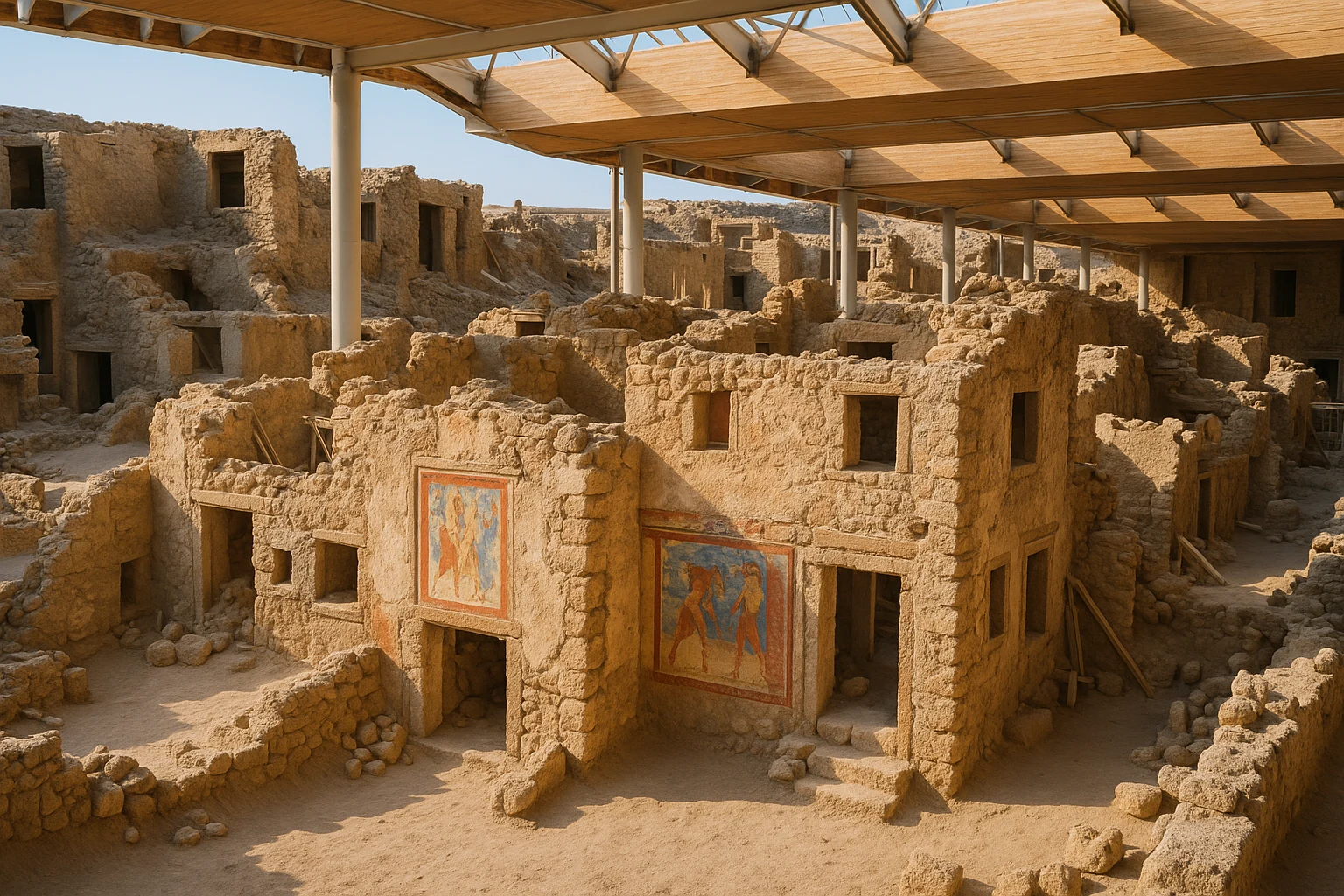
The site is protected under a large modern canopy, which means it is accessible and comfortable regardless of weather — an underrated advantage on an island where summer afternoons can be genuinely brutal. Admission is modest. Tour groups do arrive, but they move through quickly, and it is entirely possible to find yourself alone on a walkway above a Bronze Age alley with nothing but the sound of your own footsteps.
What sets Akrotiri apart from nearly every other prehistoric site in Europe is preservation. The same volcanic tephra that erased this city also protected it. Walls stand. Doorways frame actual rooms. Stairwells survive. The density of standing architecture means you are not reconstructing Akrotiri in your imagination — you are walking through it.
Historical Context
Akrotiri was a prosperous Aegean trading settlement that flourished during the Late Bronze Age, roughly 2000 to 1613 BCE, reaching its peak between about 1700 and the eruption. Its culture was closely linked to Minoan Crete — the frescoes, pottery styles, and urban planning all share deep affinities with the great palaces at Knossos and Akrotiri — but the settlement also maintained connections to mainland Greece, Egypt, and the Levant, making it one of the most cosmopolitan communities in the ancient Aegean.
The eruption of the Thera volcano, now dated by most scientists to approximately 1613 BCE (with a margin of roughly two decades), was among the most powerful volcanic events in the past ten thousand years. The explosion collapsed the center of the island, formed the present caldera, and blanketed Akrotiri under meters of pumice and ash. This same eruption may have contributed to climate disruptions recorded across the Eastern Mediterranean and possibly North Africa.
The city was rediscovered in 1867 during quarrying for volcanic material used in the construction of the Suez Canal. Systematic excavation began in 1967 under the Greek archaeologist Spyridon Marinatos, who had long theorized that Minoan culture was disrupted by a catastrophic volcanic event. What he found exceeded expectations: not scattered ruins but entire city blocks, multi-story buildings with intact staircases, and walls still bearing painted plaster. Work continues today under the Greek Archaeological Service.
Crucially, no human remains have been found at Akrotiri. The population apparently received sufficient warning from preceding earthquakes to evacuate, taking their valuables with them but leaving furniture, tools, storage vessels, and the architecture itself. The city was, in a sense, abandoned rather than destroyed — which is why it survives.
What to See
The Street Grid and Urban Layout
Akrotiri was a planned city, not a village. Walkways above the excavations give you an elevated view of intersecting streets, some still showing their original paving stones. The urban density, with buildings sharing walls and rooms opening directly onto lanes, reads as unmistakably metropolitan.
Multi-Story Buildings
Several structures preserve two and three stories, an extraordinary survival for a site of this age. The so-called Xeste 3 building and the West House are among the most studied. Ground-floor rooms typically served as storage or workshops; upper floors were living and ceremonial spaces.
Storage Jars (Pithoi)
The storerooms contain enormous ceramic storage jars, many still in situ where they were left. Some are taller than a person. They would have held wine, oil, grain, and other commodities, evidence of a wealthy settlement deeply integrated into Mediterranean trade networks.
Frescoes in Context
The original frescoes have been removed for conservation, but you can still see the architectural spaces where they were found — the room in the West House where the famous Flotilla Fresco once covered three walls, the stairwell of Xeste 3 where the Spring Fresco’s blue monkeys and red lilies were discovered. Understanding where the paintings came from makes seeing them in Fira or Athens significantly more meaningful.
The Site Museum
A small interpretive area near the entrance provides orientation panels and rotating display cases with ceramic finds. It is worth fifteen minutes before entering the main excavation area.
Practical Tips
Getting There. Akrotiri is approximately 12 km from Fira and 18 km from Oia. Public buses from Fira’s main station run several times daily in season (journey time roughly 30 minutes); timetables are posted at the bus terminal. Rental cars and ATVs are readily available on Santorini and give you the freedom to combine Akrotiri with Red Beach and Ancient Thira on a single half-day circuit. Taxis are plentiful but can be expensive during peak season.
Hours and Tickets. The site is generally open daily except Tuesdays, typically 8:00–20:00 in summer and reduced hours in winter. Ticket prices are modest; a combined ticket with other regional sites is sometimes available. Always verify current hours before traveling, as they adjust seasonally and the site occasionally closes for ongoing excavation work.
On-Site Logistics. Wear closed-toe shoes — the walkways are metal grating and gravel, and some sections require short staircases. The protective canopy keeps the temperature manageable, but it can be warm on summer afternoons. There is a small café and gift shop at the entrance. Photography is permitted throughout.
The Museum of Prehistoric Thira in Fira. This is the essential companion to Akrotiri. The museum houses the island’s best frescoes and a superbly organized collection of pottery, tools, and objects from the site. Visit it before or after Akrotiri — ideally before, so you arrive at the dig with the imagery already in mind. It is within walking distance of Fira’s main square.
Nearby Pairings
Red Beach is a ten-minute walk from the Akrotiri site entrance. The beach’s striking red and black volcanic cliffs make for an unusual swimming stop and reinforce the geological drama of the island in a visceral way.
Ancient Thira, perched on the ridge of Mesa Vouno between Kamari and Perissa, offers a complementary experience: a Hellenistic and Roman-era settlement with sweeping views over the southern caldera. The two sites together make a rewarding full-day excursion for history-focused visitors.
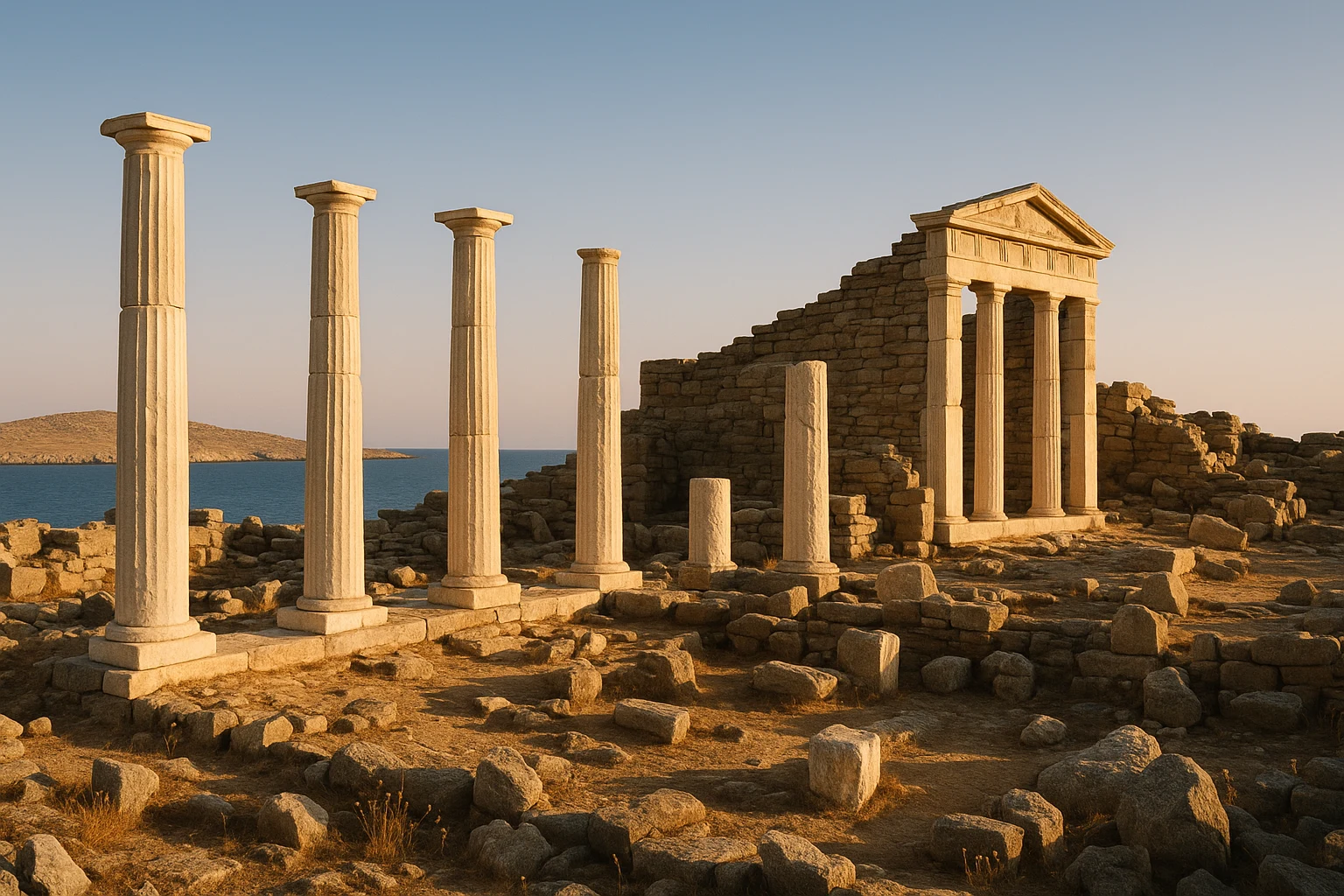
Delos, accessible by ferry from Mykonos (approximately two hours by fast boat from Santorini to Mykonos), is the logical extension for travelers with more days in the Cyclades. Delos was the sacred center of the ancient Aegean world and preserves Archaic through Roman layers — a fitting chronological sequel to Akrotiri’s Bronze Age story.
Why Akrotiri Matters
The eruption that buried Akrotiri reshaped the Bronze Age Mediterranean. It may have triggered famines, destabilized regional trade networks, and contributed to the decline of Minoan Crete. It almost certainly generated the tsunamis and ash clouds that ancient Egyptians recorded as climatic disasters. Some scholars have argued, with varying degrees of confidence, that Thera’s eruption is the historical seed of Plato’s Atlantis legend.
Whether or not any of that is true, what survives at Akrotiri is extraordinary on its own terms: a wealthy, sophisticated, cosmopolitan city that met its end not through conquest or decay but through the indifferent violence of the earth itself — and that has waited, intact, for us to find it.
| Quick Facts | |
|---|---|
| Location | Southern Santorini (Thira), South Aegean, Greece |
| Civilization | Minoan-affiliated Cycladic |
| Period | Late Bronze Age, c. 2000–1613 BCE |
| Destroyed | Volcanic eruption, c. 1613 BCE |
| Discovered | 1867 (quarrying); systematic excavation from 1967 |
| Site Type | Covered urban excavation |
| Nearest Town | Akrotiri village (1 km); Fira (12 km) |
| Entrance Fee | Modest; check current rates |
| Typical Visit | 1.5–2 hours |
| Combined With | Museum of Prehistoric Thira (Fira), Red Beach, Ancient Thira |
Frequently Asked Questions
Is Akrotiri worth visiting on Santorini?
Yes — unambiguously. Akrotiri is one of the best-preserved Bronze Age sites in the world, yet it draws only a fraction of the crowds at Santorini's caldera viewpoints. The modern protective roof lets you walk among 3,500-year-old multi-story buildings in any weather, and the sheer density of standing architecture makes it feel more like a frozen city than a typical dig site.
How long does it take to visit Akrotiri?
Most visitors spend 1.5 to 2 hours inside the site. If you combine it with Red Beach (10-minute walk) and a stop at the Museum of Prehistoric Thira in Fira, budget a full half-day.
Are the famous Akrotiri frescoes still on-site?
The original frescoes — including the celebrated Spring Fresco, the Boxing Boys, and the Fleet Fresco — are displayed at the National Archaeological Museum in Athens and the Museum of Prehistoric Thira in Fira. The site itself preserves the architecture, street layout, and ceramic finds. Visiting the Fira museum before Akrotiri greatly enriches what you see on the ground.
Why were no human remains found at Akrotiri?
The absence of skeletal remains suggests the population evacuated before the catastrophic eruption, likely after a series of major earthquakes that preceded it. The city was apparently sealed mid-repair — tools, storage jars, and furniture were left in place, but the people escaped.
How do I get to Akrotiri from Fira or Oia?
Akrotiri is roughly 12 km southwest of Fira. Options include a rental car or ATV (20 minutes), public bus from Fira's main bus terminal (about 30 minutes, several departures daily in season), taxi, or a guided island tour. There is a small car park at the site entrance.
What is the best time of year to visit Akrotiri?
April to early June and September to October offer ideal conditions: mild temperatures, manageable crowds, and full site access. The protective canopy makes the dig itself comfortable year-round, but July and August bring peak tourist volume and sharp heat outdoors. Winter sees reduced hours and occasional closures — check ahead.