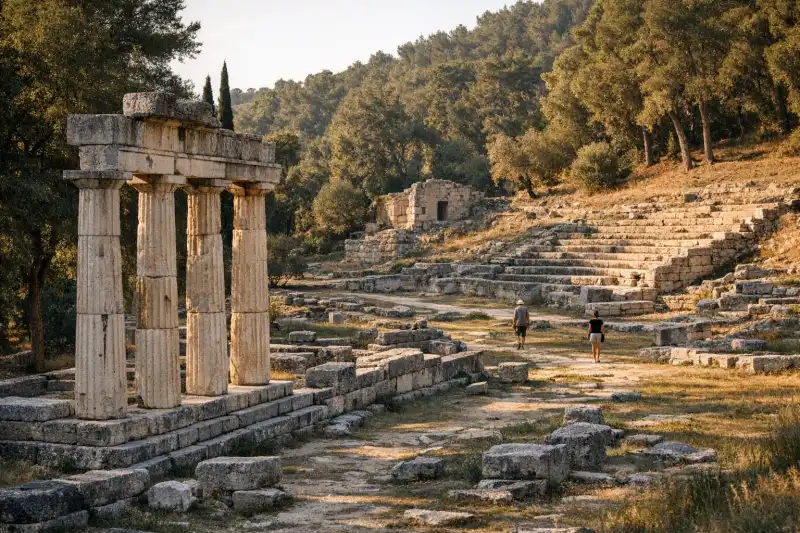
Quick Info
At a glance
In a green valley not far from the coast of northeastern Attica, the Amphiareion of Oropos in Greece feels quieter and more intimate than many of the country’s headline ruins. Instead of a hilltop citadel or a monumental urban center, you arrive at a sanctuary tucked into nature, where the rhythm of the landscape still helps explain the site’s original purpose. This was a place of healing, prayer, ritual sleep, and hopeful expectation. Pilgrims came here to seek the aid of Amphiaraos, a hero, seer, and healer whose powers were believed to continue after death.
That unusual combination gives the Amphiareion its distinctive character. It was neither only a temple nor only an oracle. It was a sacred complex where religion, medicine, theater, athletic competition, and personal devotion all blended together. Ancient visitors offered sacrifices, purified themselves in sacred waters, slept within the sanctuary in hopes of receiving a dream revelation, and left behind inscriptions and dedications after a cure or prophecy. Today, the remains are modest compared with the Acropolis or Delphi, yet they reward patient travelers with something those more famous places sometimes struggle to preserve: stillness. Walking among the foundations, the theater, and the long stoa, it is easy to imagine people arriving with illness, anxiety, or questions about the future, trusting that this secluded valley could bring an answer. For visitors interested in the lived experience of ancient Greek religion, the Amphiareion of Oropos is one of Attica’s most evocative sites.
History
Mythic origins and the cult of Amphiaraos
The sanctuary’s identity begins with Amphiaraos, a heroic figure from Greek myth. He was remembered as a seer and a participant in the expedition of the Seven Against Thebes. According to later tradition, rather than dying in ordinary fashion, he was swallowed by the earth and transformed into a chthonic, or underworld-linked, power. This made him especially suited to prophecy and healing, since communication with divine forces often involved liminal spaces between the living world and the world below.
By the Classical period, Amphiaraos had become the focus of a cult in which sufferers sought remedies and guidance. His worship drew together familiar strands of Greek religious life: heroic veneration, oracular consultation, and practical healing. Unlike the purely civic cults centered on public sacrifice alone, this sanctuary offered a deeply personal religious experience. People visited not just to honor a deity, but to ask for a specific outcome, whether relief from pain, interpretation of a dream, or advice about a decision.
The rise of the sanctuary in the Classical period
The Amphiareion developed into a significant sanctuary during the 5th and 4th centuries BCE, especially as the borderland of Oropos became strategically and politically important. Oropos itself sat in a contested zone between Attica and Boeotia, and control over the region shifted repeatedly between Athens, Thebes, and local powers. Even so, the sanctuary managed to flourish, suggesting that its religious prestige crossed political boundaries.
The 4th century BCE appears to have been a major building phase. During this period, the sanctuary gained the architectural form visitors recognize today: a temple area, an altar, bathing and water installations, a theater, and a long stoa associated with ritual incubation. Pilgrims would purify themselves, make offerings, and then sleep in the sacred precinct, hoping Amphiaraos would appear in a dream with instructions or a cure. Inscriptions from the site refer to healings and dedications, evidence that the sanctuary’s reputation extended well beyond its immediate region.
Athletic and dramatic contests also formed part of the sanctuary’s life. Like many major Greek religious centers, the Amphiareion was not only a place for solemn ritual. Festivals drew communities together and strengthened the site’s status. This blend of sacred and social activity made it a true pilgrimage destination rather than an isolated shrine.
Hellenistic adaptation and continued prestige
After the conquests of Alexander and the reconfiguration of the Greek world in the Hellenistic age, the Amphiareion continued in use. Sanctuaries across Greece often adapted to new political realities while retaining traditional functions, and Oropos was no exception. Rulers and civic authorities understood the value of established cult centers, both as sources of local legitimacy and as gathering places with regional influence.
The sanctuary’s role as a healing center remained central. In the wider Greek world, healing sanctuaries such as those of Asklepios were growing in prominence, and the Amphiareion shared some of that religious atmosphere while preserving its own distinct identity. Visitors still came not only for a cure, but for contact with a prophetic hero whose powers could reveal hidden truths. Architectural repairs and additions likely reflect this continued prestige, even if the sanctuary never rivaled the largest Panhellenic sites in scale.
Roman-era survival and decline
Under Roman rule, many Greek sanctuaries experienced a long afterlife. Some benefited from renewed patronage, while others gradually diminished. The Amphiareion seems to have remained active into the Roman period, supported by the enduring appeal of healing and divination. Roman elites, like Greeks before them, were often fascinated by ancient cults and local sacred traditions.
Over time, however, social and religious shifts weakened the sanctuary’s role. As imperial priorities changed, local fortunes fluctuated, and traditional pagan worship came under increasing pressure in Late Antiquity, many Greek sanctuaries entered decline. Buildings were abandoned, dismantled, or repurposed. The valley that had once welcomed pilgrims slowly became a field of ruins.
Rediscovery and archaeology
Modern archaeological work gradually revealed the layout and significance of the Amphiareion. Excavation identified the stoa, theater, temple zone, and water features, allowing scholars to reconstruct how visitors moved through the sacred complex. Inscriptions and dedications have been especially important in clarifying the site’s healing function.
Today, the Amphiareion of Oropos stands as one of the most informative sanctuaries for understanding personal religion in ancient Greece. It may not possess the overwhelming monumentality of more famous sites, but its remains preserve the outline of an experience that mattered deeply to ordinary ancient people: arriving in hope, performing ritual acts, and waiting for a dream that might change a life.
Key Features
What makes the Amphiareion of Oropos so memorable is the way its architecture is inseparable from its landscape. The sanctuary lies in a shallow valley with a stream and lush surroundings, and that setting is not incidental. Water, shade, and relative seclusion were essential to its ritual atmosphere. Even in ruin, the site feels restorative, which helps explain why a healing cult took root here.
One of the most important structures is the long stoa, a colonnaded building where pilgrims are thought to have undergone incubation, the practice of sleeping within the sanctuary to receive a revelatory dream. This is one of the clearest physical reminders that the Amphiareion was not simply a place to observe formal ceremonies from a distance. It was designed for extended, embodied participation. Visitors purified themselves, settled into the sacred environment, and waited for contact with the divine during sleep. Standing beside the stoa today, you can sense the deeply personal nature of these rituals.
Nearby were the altar and temple area, the formal sacred heart of the complex. Sacrifice played a major role in the cult of Amphiaraos, and literary sources suggest that worshippers followed a sequence of actions before seeking a dream oracle. Offerings of animals and valuable objects helped structure the relationship between petitioner and hero. The altar zone would have been the place where anxiety, gratitude, and expectation were made public through ritual performance.
The theater is another striking feature and often surprises first-time visitors. At a healing sanctuary, many expect only temples and sleeping chambers, yet Greek sanctuaries were often multifunctional. The small but elegant theater at Oropos reflects the festival life of the site, where dramatic performances and communal gatherings accompanied religious observance. Rather than feeling out of place, the theater reveals how deeply religion was woven into civic celebration. Healing did not exist apart from society; it was part of a wider sacred calendar that brought people together through spectacle, music, and competition.
Water is central to understanding the sanctuary as well. The sacred spring and related hydraulic features were not decorative additions but active participants in ritual life. Purification before consultation was a serious matter in Greek religion, and the presence of fresh water reinforced the sanctuary’s role as a liminal zone where one passed from ordinary concerns into sacred encounter. The natural setting gave this process a powerful sensory dimension: the sound of water, the cooler air of the valley, and the separation from urban noise all helped shape a pilgrim’s mental state.
Scattered architectural remains also help visitors imagine the practical organization of a sanctuary serving real crowds. Foundations, retaining walls, and pathways hint at the movement of worshippers between purification, sacrifice, consultation, and communal events. Although much of the elevation is gone, the site is readable enough to reward slow exploration. It is less about singular monuments than about how all the parts fit together.
Perhaps the sanctuary’s most compelling feature, however, is intangible. The Amphiareion preserves the emotional logic of ancient healing better than many grander ruins. This was a place for people who were worried, ill, uncertain, or desperate. The inscriptions discovered here, recording dedications and cures, point to acts of trust and thanksgiving. Even without those texts in front of you, the valley itself communicates why a person in antiquity might have believed help could be found here.
For photographers and reflective travelers, the site also offers a more natural visual experience than central Athens. Instead of dense urban backdrops, you see low ruins framed by trees, slopes, and open sky. That can make a visit feel less like checking off a monument and more like entering a historical landscape. If your interest in ancient Greece extends beyond political history and monumental architecture to ritual, medicine, and private belief, the Amphiareion of Oropos is unusually rewarding.
Getting There
The Amphiareion of Oropos is most easily reached from Athens, and a rental car is the most practical option for most travelers. The drive typically takes about 1 to 1.5 hours depending on traffic and your starting point in the city. Expect to pay roughly €25 to €45 per day for a small rental car in standard season, plus fuel and possible tolls depending on your route. Having your own vehicle also makes it easier to combine the sanctuary with Marathon or coastal stops in northern Attica.
A taxi or ride-hailing transfer from central Athens is faster but much more expensive. One-way fares can range from about €70 to €120, with return arrangements costing more if the driver waits. This can be worthwhile for small groups, especially if you want a flexible half-day trip without navigating regional roads.
Public transport is possible but requires patience. Travelers can usually take an intercity or regional bus toward the Oropos area from Athens, then continue by local taxi to the archaeological site. Combined transport costs are often around €15 to €30 per person each way depending on the exact route and taxi segment. Because schedules can change seasonally, it is wise to verify current bus times in Athens before setting out.
Organized day tours that specifically include the Amphiareion are less common than standard Athens excursions, but private drivers and custom archaeology tours can sometimes be arranged. If you prefer not to self-drive, searching for northern Attica or Marathon-area day trips is often the best starting point. Bring water, sun protection, and comfortable shoes, as facilities immediately around the site can be limited compared with major tourist hubs.
When to Visit
Spring is arguably the best time to visit the Amphiareion of Oropos. From March through May, the valley is greener, temperatures are pleasant, and walking the site is far more comfortable than in the height of summer. Daytime conditions often range from around 16°C to 26°C, ideal for lingering among the ruins and appreciating the sanctuary’s landscape setting. This is also when the contrast between stone remains and surrounding vegetation is especially attractive.
Autumn, particularly September through early November, is another excellent window. The intense heat of midsummer begins to ease, and the site tends to feel calm and uncrowded. Temperatures often remain warm enough for a comfortable day trip from Athens without the fatigue that comes from long exposure to peak summer sun.
Summer visits are certainly possible, but they require more planning. In June, July, and August, midday heat in Attica can be strong, often exceeding 30°C. Because the Amphiareion is an open-air archaeological site with limited shade in some areas, the best strategy is to arrive early in the morning or later in the afternoon. Carry plenty of water and avoid the hottest hours if you are sensitive to heat.
Winter offers a different appeal. The site is often very quiet, and the softer light can be ideal for photography. Cooler temperatures make walking easy, though rainy days can reduce comfort and make the landscape feel less inviting. Winter is best for travelers who value solitude and do not mind variable weather.
Whenever you go, weekdays are usually more peaceful than weekends, and early arrival improves both lighting and atmosphere. This is a place best enjoyed slowly, so choose a time when you can hear the birds, notice the contours of the valley, and absorb the sanctuary’s reflective mood rather than rushing through it.
| Quick Facts | Details |
|---|---|
| Location | Near Oropos, northeastern Attica, Greece |
| Type of site | Ancient healing and oracular sanctuary |
| Dedicated to | Amphiaraos, hero-seer and healer |
| Main period | 5th-4th centuries BCE, with later Hellenistic and Roman use |
| Best known for | Dream incubation, healing rituals, theater, and sacred spring |
| Time needed | 1-2 hours |
| Best base | Athens or Oropos |
| Best season | Spring and autumn |
| Access | Easiest by rental car or private transfer from Athens |
| Atmosphere | Quiet, rural, and highly evocative |
Guided tours: worth it?
Most travelers can visit Amphiareion of Oropos independently. Compare a tour only if you want a tighter history-focused visit, easier logistics, or a guide who can answer questions on the spot.
Best for
- Short visits where a planned route saves time
When to go self-guided
Go independently if you prefer setting your own pace, reading as you go, and checking official hours or ticket rules directly before you arrive.
What I’d avoid
Skip paid tours that bundle unrelated stops you do not actually want. The best option should either save meaningful planning time or add historical context you would miss on your own.
Athens Full-Day Private Tour with Oropos Area Search
Useful when: you want flexible timing or a private guide
Athens Archaeology Day Trips and Ancient Sites
Useful when: transport or pickup logistics matter
Athens to Marathon and Northern Attica Tours
Useful when: you want to compare guided formats before deciding
Some tour links are affiliate links, which may earn Ancient Travel a small commission at no extra cost to you. I try to surface options that make practical sense for the site—not just anything bookable.
Frequently Asked Questions
What is the Amphiareion of Oropos?
The Amphiareion of Oropos is an ancient Greek sanctuary dedicated to the hero-healer and oracle Amphiaraos, known for incubation rituals in which visitors slept at the site seeking divine dreams.
Where is the Amphiareion of Oropos located?
It lies in northeastern Attica, Greece, near the modern town of Oropos and within day-trip distance of Athens.
How do you visit the Amphiareion of Oropos from Athens?
Most visitors reach it by rental car or taxi from Athens in roughly 1 to 1.5 hours, though combinations of regional buses and local taxis are also possible.
What made the sanctuary famous in antiquity?
The sanctuary was renowned for healing, dream oracles, athletic festivals, and offerings dedicated by people who believed Amphiaraos had cured them.
How much time should you allow for a visit?
Plan for 1 to 2 hours on site to walk through the theater, stoa, sacred spring, altar area, and the quiet valley setting.
Is the Amphiareion of Oropos suitable to combine with other sites?
Yes, it works well as part of a wider northern Attica day trip that can include Marathon, coastal stops, or a return to Athens for major classical sites.
Nearby Ancient Sites
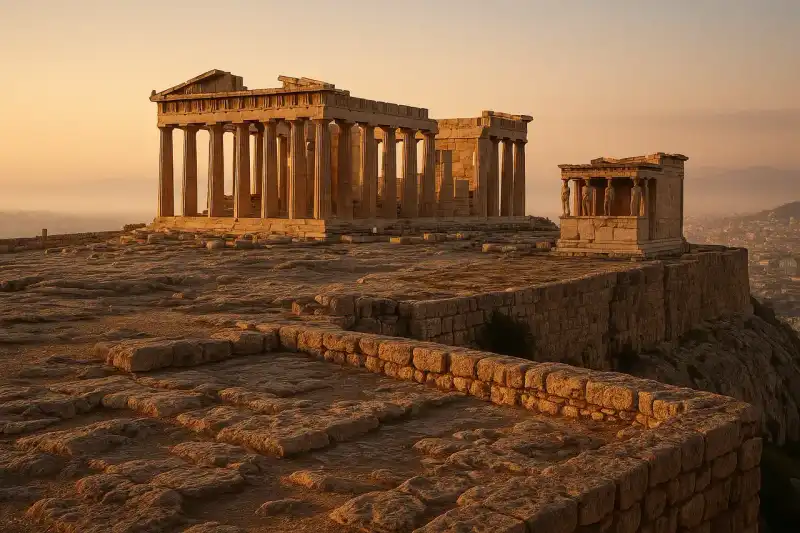
The Complete Acropolis Athens Travel Guide: Temples
Ancient GreecePlan the perfect visit to the Acropolis of Athens with our 2026 guide. Discover the Parthenon, best ...
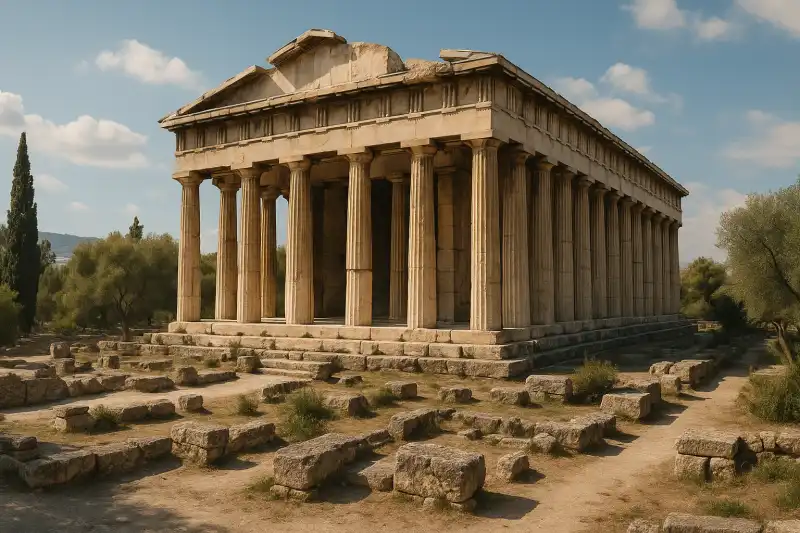
Ancient Agora of Athens Travel Guide 2026: Route, Tickets, and Context
Classical GreekPlan a better Ancient Agora visit with practical timing, monument priorities, and clear historical c...
Acropolis Travel Guide 2026: Parthenon, Tickets, and Best Time
Ancient GreecePlan an efficient Acropolis visit with practical ticket timing, key monuments, and museum pairing ti...