Quick Info
At a glance
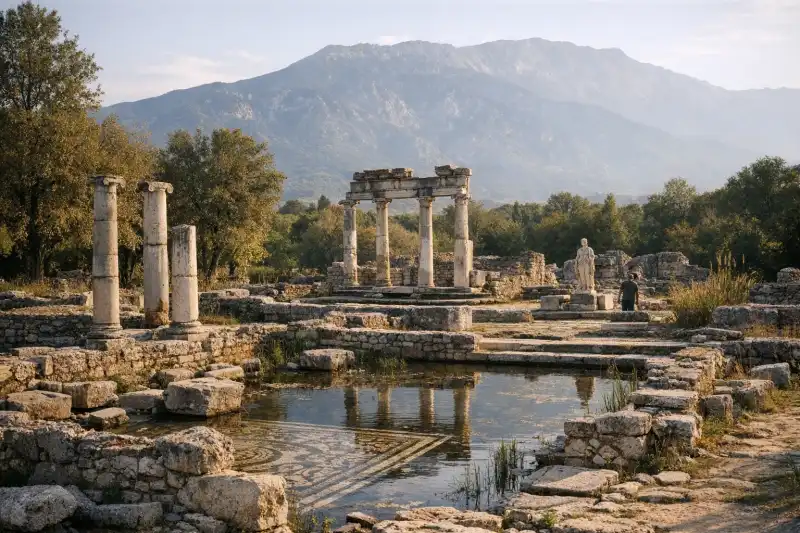
Ancient Dion in Greece lies at the foot of Mount Olympus, where myth, kingship, and daily life once met in a landscape of water, stone, and sacred ritual. Unlike many ancient sites perched on dry hilltops, Dion unfolds across a fertile plain threaded with streams and shaded by trees, giving the ruins an atmosphere that feels unusually alive. Here, the Macedonians honored Zeus and the Olympian gods before military campaigns, festivals animated the theaters, and Roman builders later overlaid the city with baths, villas, and engineering works that still shape the visitor experience today.
For travelers arriving in northern Greece, Dion offers something distinctive: not only major archaeological remains, but a sense of place deeply tied to both religion and power. The city was more than a provincial settlement. It was a ceremonial center for the Macedonian kingdom, closely associated with Philip II and Alexander the Great, and later became a flourishing Roman city with public monuments, paved streets, and elaborate homes. Today, the archaeological park and museum reveal a site where mud, marsh, sanctuaries, and empire all left their mark. Walking through Ancient Dion, with Mount Olympus rising in the distance, you are not simply visiting ruins. You are stepping into a landscape where the political ambitions of Macedonia and the spiritual imagination of Greece once came together in one of the most evocative settings in the country.
History
Early Sacred Origins
Dion appears to have emerged first and foremost as a religious center rather than merely an urban settlement. Its name is linked to Zeus, and from an early period the area served as a sanctuary for the chief god of the Greek pantheon and for other deities worshiped by the Macedonians. The site’s location was meaningful. Positioned near the sea routes of the Thermaic Gulf and beneath Mount Olympus, the legendary home of the gods, Dion occupied terrain that invited sacred interpretation. Springs, wetlands, and rich vegetation likely reinforced its character as a place of divine presence.
Archaeological evidence suggests that the sanctuary was already important by the Archaic and Classical periods. Before Dion developed into a substantial city, pilgrims and rulers came here to conduct sacrifices and festivals. Macedonian identity was still taking shape in relation to the wider Greek world, and Dion helped express that identity through public worship. In a kingdom where royal authority and religion were closely connected, the sanctuary had both spiritual and political value.
Dion Under the Macedonian Kings
The city’s fame grew dramatically under the Macedonian monarchy, especially during the reign of Philip II in the 4th century BCE. Philip used Dion as a ceremonial center for victories and public celebrations, reinforcing the bond between kingship and divine favor. The site became one of the symbolic hearts of the kingdom, where military success, dynastic prestige, and communal worship were staged before Macedonian elites and visiting Greeks.
Alexander the Great also had a close association with Dion. Before launching his Asian campaign, he is said to have celebrated here and offered sacrifices to Zeus and the Muses. Such acts were not mere formalities. They projected legitimacy, invoked divine support, and connected Macedonian expansion to the heroic and religious traditions of Greece. Dion thus became part of the ideological framework behind one of history’s most consequential imperial ventures.
During the Hellenistic era that followed Alexander, Dion continued to develop as an urban and sacred center. Sanctuaries multiplied, civic spaces expanded, and the city took on a more formal structure. Temples, stoas, and public buildings reflected the prosperity of a community supported by both its religious prestige and its strategic position in the region of Pieria.
Roman Conquest and Urban Transformation
In 169 BCE, following the Roman victory over the Macedonians at the Battle of Pydna, the political world around Dion changed decisively. Macedonia passed into Roman control, and although Dion retained regional importance, its role was gradually reshaped within a new imperial framework. Roman administration brought different priorities, but also fresh investment in urban life.
Under the Romans, Dion became more architecturally complex and materially prosperous. Baths, villas, streets, drainage systems, and entertainment buildings transformed the city into a classic Romanized urban center while preserving parts of its earlier sacred identity. The large bath complex, in particular, points to the adoption of Roman social habits and engineering expertise. Mosaics, sculpture, and domestic architecture found at the site indicate an affluent population with access to Mediterranean artistic trends.
The Roman period also expanded the range of cults practiced at Dion. Traditional Greek worship continued, but new deities and mystery religions appeared as well, reflecting the cosmopolitan religious life of the empire. This layering of beliefs is one of the site’s most compelling historical features: Dion was never frozen in a single era but evolved continually over centuries.
Late Antiquity, Decline, and Rediscovery
Like many ancient cities, Dion entered a period of disruption in Late Antiquity. Natural disasters, changes in trade, shifting political structures, and the broader transformations of the eastern Roman world weakened the city over time. Earthquakes and flooding seem to have affected the site repeatedly, and the watery environment that once made Dion fertile and sacred also contributed to the preservation and burial of its remains.
By the Byzantine period, the ancient city had diminished significantly. Settlements shifted, monuments collapsed, and parts of Dion disappeared beneath alluvial deposits and marshland. For centuries, the once-famous sacred city remained largely silent, its significance remembered more in texts than in visible grandeur.
Modern archaeological work brought Dion back into historical view. Excavations in the 20th century revealed an extensive urban and sacred complex, including sanctuaries, theaters, baths, villas, and fortifications. Because of the site’s wet conditions, archaeologists also uncovered unusual organic remains and waterlogged contexts that enriched understanding of everyday life. Today, Dion stands as one of northern Greece’s most important archaeological landscapes, valued not only for monumental ruins but for the way it reveals the intersection of religion, monarchy, and environment over a long historical arc.
Key Features
Ancient Dion is best appreciated as a broad archaeological landscape rather than a single monument. The site spreads through a green, low-lying plain where paths lead visitors between sanctuaries, civic areas, and residential quarters. Water is everywhere, whether in visible channels, marshy ground, or the lush vegetation that frames the ruins. This gives Dion a softer, more atmospheric quality than many stone-dominated Greek sites.
Among the most important remains are the sanctuaries that made Dion famous in antiquity. The sanctuary of Zeus anchored the city’s sacred identity, while other cult spaces were dedicated to Demeter, Isis, and additional deities whose worship reflects the site’s long religious history. The sanctuary of Isis is especially memorable because of its evocative setting near water, which suits the goddess’s associations and creates one of the most photogenic corners of the archaeological park. Here, architecture and landscape combine to suggest the ritual atmosphere of the ancient city.
The theaters of Dion also deserve careful attention. The Hellenistic theater, associated with the age of Macedonian kings, connects the site directly to festivals and public performances that once celebrated divine and royal power. A later Roman theater demonstrates how entertainment evolved under imperial rule, when urban audiences expected different forms of spectacle. Together, these structures show how Dion adapted over time while preserving its role as a public gathering place.
Roman Dion is perhaps most vividly encountered in the bath complex. More than just a place to wash, the baths were social and political spaces where architecture, decoration, and engineering expressed urban sophistication. Visiting these remains helps explain how deeply Roman habits shaped city life in Macedonia. Nearby streets and domestic structures continue that story. Villas with mosaic floors point to wealth and taste, while traces of workshops and infrastructure reveal the practical systems that supported the city.
One of Dion’s most admired archaeological discoveries is the mosaic of Dionysus, now protected and displayed with care. Its artistry offers a window into elite domestic culture and the symbolic language of myth in Roman Macedonia. The local museum complements what you see outside by housing sculptures, inscriptions, ceramics, and small finds that would otherwise be difficult to interpret in the open air. Particularly striking are the statues from sanctuaries and the artifacts that illuminate religious practices across different periods.
The city walls and gates, though less dramatic at first glance than temples or theaters, help visitors understand Dion as a functioning urban center rather than only a pilgrimage destination. Their presence reminds you that this was a real city with defenses, neighborhoods, and administrative organization. When viewed alongside the sacred precincts, they reveal how closely religion and civic life were intertwined.
Perhaps the greatest feature of all, however, is the setting beneath Mount Olympus. On clear days, the mountain rises beyond the plain as a constant backdrop, connecting the archaeological remains to the mythic landscape that helped shape their meaning. This relationship between city and mountain is essential to the experience of Dion. The ruins are impressive in their own right, but they become unforgettable when seen in the context of the terrain that made them sacred to the Macedonians.
Getting There
Ancient Dion is located in Pieria, in Central Macedonia, and is most easily reached from Thessaloniki or Katerini. If you are driving from Thessaloniki, the journey is usually around 1 to 1.5 hours via the A1 motorway, depending on traffic. Car rental is the most flexible option, especially if you want to combine Dion with the Mount Olympus area, Litochoro, or nearby beaches. Expect fuel and toll costs together to be roughly €15 to €25 round trip from Thessaloniki, depending on your vehicle and route.
Public transport is possible but requires a bit more planning. From Thessaloniki, intercity KTEL buses run to Katerini, with one-way fares often around €8 to €12. From Katerini, you may need a local bus, taxi, or pre-arranged transfer to reach Dion village and the archaeological site. A taxi from Katerini to Dion typically costs about €15 to €25 one way, depending on time of day and season. If you are staying in Litochoro or another town near Mount Olympus, local taxi rides are shorter and often more convenient than waiting for infrequent connections.
Organized day tours from Thessaloniki sometimes combine Ancient Dion with Mount Olympus highlights, making them a good choice for travelers who prefer not to navigate transport changes. These can range from about €50 to €120 per person depending on inclusions, group size, and whether lunch or guided museum entry is part of the package.
Once at the site, allow time for both the outdoor archaeological park and the museum. Comfortable shoes are essential, as the paths can be uneven and occasionally damp.
When to Visit
The best times to visit Ancient Dion are spring and autumn, when temperatures are mild and the landscape is at its most appealing. In April, May, September, and October, the site’s greenery, water channels, and mountain views create a particularly rewarding atmosphere. These months are ideal for walking slowly through the park, reading interpretation panels, and pairing the visit with other destinations in the Mount Olympus region. Daytime temperatures are usually comfortable, often ranging from the mid-teens to mid-20s Celsius.
Summer brings long daylight hours and generally reliable weather, but it can be hot and humid, especially around midday. Because Ancient Dion is spread out and includes open areas with limited shade in some sections, early morning or late afternoon visits are much more pleasant in July and August. Bring water, sunscreen, and a hat. Mosquitoes can also be more noticeable in warmer months because of the site’s wet environment.
Winter visits are quieter and can be atmospheric, especially when Mount Olympus is snow-capped, but conditions are less predictable. Rain may make some paths muddy, and cooler temperatures can shorten the amount of time you want to spend outdoors. That said, if you prefer fewer visitors and enjoy moody landscapes, winter has its own charm.
If possible, avoid rushing through Dion in the hottest part of the day. A smart plan is to tour the archaeological park in the morning, pause for lunch in the village or nearby Katerini, and then continue with the museum. This gives you a fuller sense of the site without fatigue dulling the experience.
| Quick Facts | Details |
|---|---|
| Location | Near Dion village, Pieria, Central Macedonia, Greece |
| Nearest City | Katerini |
| Best For | Macedonian history, sanctuaries, Roman ruins, Mount Olympus views |
| Main Periods | Classical, Hellenistic, Roman, Late Antique |
| Estimated Visit Time | 3 to 4 hours for site and museum |
| Nearest Major Hub | Thessaloniki |
| Best Seasons | Spring and autumn |
| Terrain | Flat archaeological park with some damp or uneven paths |
| Good To Combine With | Mount Olympus, Litochoro, Pieria coast |
| Why It Matters | Sacred city of the Macedonians linked to Philip II and Alexander the Great |
Ancient Dion rewards travelers who enjoy places where landscape and history are inseparable. It is not a site of overwhelming vertical monuments or one instantly recognizable ruin. Its power comes from accumulation: a sanctuary by water, a Roman bath, a mosaic floor, a theater, a distant mountain, and the knowledge that Macedonian kings once stood here to honor the gods before changing the ancient world. For visitors to northern Greece, that combination makes Dion one of the country’s most quietly compelling destinations.
Guided tours: worth it?
Self-guided works here, but a guide can add real value if you want the ruins explained as a living place rather than just a sequence of monuments.
Best for
- First-time visitors who want context, not just photos
- Short visits where a planned route saves time
When to go self-guided
Go independently if you prefer setting your own pace, reading as you go, and checking official hours or ticket rules directly before you arrive.
What I’d avoid
Skip paid tours that bundle unrelated stops you do not actually want. The best option should either save meaningful planning time or add historical context you would miss on your own.
Ancient Dion and Mount Olympus tours
Useful when: you want to compare guided formats before deciding
Dion archaeological park day trips
Useful when: transport or pickup logistics matter
Thessaloniki to Ancient Dion tours
Useful when: you want to compare guided formats before deciding
Some tour links are affiliate links, which may earn Ancient Travel a small commission at no extra cost to you. I try to surface options that make practical sense for the site—not just anything bookable.
Frequently Asked Questions
What is Ancient Dion known for?
Ancient Dion is known as the sacred city of the Macedonians, famous for its sanctuaries, Roman baths, theaters, mosaics, and its setting below Mount Olympus in northern Greece.
How far is Ancient Dion from Thessaloniki?
Ancient Dion is roughly 85 kilometers south of Thessaloniki, and the drive usually takes about 1 to 1.5 hours depending on traffic.
Do you need a ticket to visit Ancient Dion?
Yes, visitors generally need an entry ticket for the archaeological park and museum, with reduced rates often available for eligible travelers and seasonal changes possible.
Can you visit Ancient Dion and Mount Olympus on the same day?
Yes, many travelers combine Ancient Dion with a visit to the Mount Olympus region in a single day, especially when traveling by car or on an organized tour.
Is Ancient Dion suitable for a half-day visit?
Yes, a half-day visit is possible, but many visitors prefer allowing at least 3 to 4 hours to see both the archaeological park and the museum comfortably.
What should I bring to Ancient Dion?
Bring comfortable walking shoes, water, sun protection, and insect repellent in warmer months, as the site includes open-air ruins, shaded paths, and wetter areas.
Nearby Ancient Sites
Acropolis Travel Guide 2026: Parthenon, Tickets, and Best Time
Ancient GreecePlan an efficient Acropolis visit with practical ticket timing, key monuments, and museum pairing ti...
The Complete Acropolis Athens Travel Guide: Temples
Ancient GreecePlan the perfect visit to the Acropolis of Athens with our 2026 guide. Discover the Parthenon, best ...
Ancient Agora of Athens Travel Guide 2026: Route, Tickets, and Context
Classical GreekPlan a better Ancient Agora visit with practical timing, monument priorities, and clear historical c...