Quick Info
At a glance
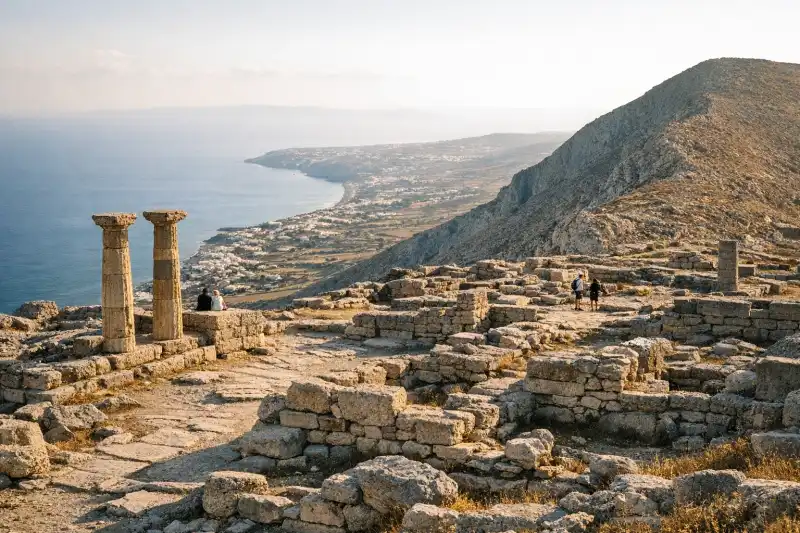
Ancient Thera in Greece crowns a long ridge of dark rock high above the southeast coast of Santorini, where broken walls, temples, streets, and terraces still cling to the mountain as if refusing to yield to wind and time. Reached by a twisting road or a demanding uphill trail, the site feels dramatically set apart from the whitewashed villages and caldera viewpoints that define most images of the island. Here, the landscape is harsher, more exposed, and somehow more revealing. The sea spreads out in two directions, the black-sand beaches lie far below, and the ruins appear suspended between earth and sky.
That setting is a large part of Ancient Thera’s appeal, but not the whole of it. This was once a functioning city with sanctuaries, homes, public buildings, markets, and military significance, not merely a lookout point with old stones. Founded by Dorian settlers and inhabited through Hellenistic, Roman, and Byzantine times, it preserves a long story of adaptation on a volcanic island whose geography shaped every aspect of life. Visitors often arrive expecting a short archaeological stop and leave with a much stronger sense of Santorini’s deeper past. Away from the island’s luxury hotels and sunset crowds, Ancient Thera offers something rarer: a direct encounter with a mountain city that held its ground for centuries above the Aegean.
History
Early settlement and Dorian foundations
The origins of Ancient Thera are usually traced to the early first millennium BCE, after the upheavals that followed the Late Bronze Age. According to ancient tradition, Dorian settlers led by a figure named Theras gave the island and the city their name. Whether legend preserves exact facts or not, the archaeological picture does support the emergence of a significant community here by the 9th century BCE. The choice of Mesa Vouno, a steep mountain ridge rising above the coast, was strategic. It offered natural defenses, broad views across the sea, and a protected, elevated position in a world where security mattered.
This early settlement belonged to the wider Greek world but retained a distinctly insular character. Life on Santorini was shaped by limited resources, maritime contact, and the island’s volcanic landscape. The city developed as a compact settlement laid out along the contours of the mountain, with buildings adapted to the steep terrain. Over time it gained sanctuaries and civic spaces that signaled its role as more than a defensive refuge. Ancient inscriptions, architectural remains, and votive material show that religion, public identity, and local governance were already important features of community life.
Thera also had connections beyond the island. Ancient literary sources link it with the colonization of Cyrene in North Africa, a reminder that even relatively small Aegean communities participated in larger networks of migration and exchange. The people of Thera were not isolated mountaineers; they were seafarers, traders, and colonists whose city stood at a crossroads of maritime movement.
Hellenistic growth and urban life
The city reached one of its most visible and archaeologically legible phases during the Hellenistic period, especially from the 4th century BCE onward. This was the era in which many of the remains now seen by visitors took recognizable form. Streets, terraces, stoas, sanctuaries, gymnasium areas, and domestic quarters developed into a more organized urban fabric. The influence of broader Hellenistic culture is clear in the architecture and public institutions. Thera was not among the giant cities of the Mediterranean, but it was an active regional center with a civic identity expressed in stone.
The island’s position in the Aegean gave it military and economic importance. Control of sea routes mattered greatly in the centuries after Alexander the Great, and island communities could benefit from alliances and garrisons. Evidence suggests that foreign soldiers, including Ptolemaic troops from the Hellenistic kingdoms, were at times present in Thera. Their presence likely strengthened the city’s strategic role and influenced local society.
Religious life also flourished. Sanctuaries dedicated to deities such as Apollo and Artemis served not only devotional functions but also reinforced civic continuity. Public inscriptions from Thera are especially valuable to historians, since they provide names, dedications, offices, and glimpses of social organization. Through them, the city emerges not as an anonymous ruin but as a place inhabited by real communities with institutions, loyalties, and ambitions.
Roman adaptation and continuity
Under Roman rule, Ancient Thera remained inhabited and adapted rather than disappearing abruptly. Like many Greek cities, it absorbed new political realities while retaining much of its local character. The urban plan persisted, and buildings were reused, modified, or repaired. Roman influence is visible in parts of the architecture, in the administrative framework, and in aspects of daily life, yet the city did not lose its Greek identity.
Its continuing occupation during this period reflects both practicality and resilience. The mountain settlement still provided defensive advantages and remained tied to agricultural and maritime activity on the island. Roman peace and imperial networks may even have supported a degree of stability. Visitors today can see traces of this continuity in the layered nature of the ruins: structures do not belong to a single moment, but to a city repeatedly adjusted to changing needs.
This continuity is one of Ancient Thera’s most compelling qualities. Unlike a site frozen after a single catastrophe, it shows long-term urban life unfolding over centuries. Streets continued to be walked, houses continued to be inhabited, and sacred spaces continued to matter, even as political rulers changed.
Byzantine decline and rediscovery
By the Byzantine era, patterns of settlement on Santorini were shifting. Mountain strongholds could still offer security, especially in uncertain times, but economic and social life gradually moved elsewhere. Ancient Thera eventually declined and was abandoned, likely in stages rather than all at once. Earthquakes, changing trade patterns, and the practical limitations of sustaining life on a high ridge all probably contributed.
For many centuries the site lay largely silent, known locally but no longer functioning as a city. Modern archaeological interest revived in the late 19th and early 20th centuries, when systematic excavations began to uncover its extent. Archaeologists, including Friedrich Hiller von Gaertringen, helped bring the city back into scholarly view. Their work revealed streets, shrines, inscriptions, public buildings, and domestic remains that transformed Ancient Thera from a scattered ruin into a clearly readable urban settlement.
Today, ongoing preservation and interpretation allow visitors to trace these many phases with unusual clarity. Ancient Thera is not only a scenic ruin above the sea; it is a site where the long arc of Greek island history remains etched into the mountain itself.
Key Features
The strongest first impression at Ancient Thera is its setting. The city stretches along the crest and slopes of Mesa Vouno, a narrow ridge that creates a natural spine for the archaeological remains. Because the terrain is so steep and elongated, the site unfolds differently from the broad, open plans of many mainland ruins. You do not simply enter and stand before one monumental centerpiece. Instead, you move through a sequence of terraces, pathways, platforms, and foundations, gradually assembling an image of a mountain city adapted to topography at every level. This gives the visit a sense of discovery and movement that suits the site perfectly.
Among the most notable remains are the religious structures. Sanctuaries dedicated to Greek deities, including Apollo Karneios, reveal the ritual life of the city and its Dorian roots. Though many survive only as low walls, cut foundations, and scattered architectural fragments, their placement and layout still communicate importance. They occupied visible positions and were integrated into civic space rather than hidden away. The remains of shrines and sacred precincts also help visitors understand that Ancient Thera was a place of ceremony and communal identity, not just defense or residence.
The urban fabric is another highlight. Sections of paved streets, stairways, drainage features, and house foundations make it possible to imagine everyday life more vividly than at sites where only isolated monuments survive. You can trace the alignment of buildings and get a sense of how people negotiated the mountain. Some structures are interpreted as houses, others as public buildings, and others still as spaces connected to trade, administration, or military presence. The remains of the agora area and nearby civic zones suggest a functioning city center where social and economic life converged.
Ancient Thera is also valued for its inscriptions and epigraphic material, even if much of what specialists study is now in museums or documented in academic publications rather than dramatically visible on the ground. The site’s inscriptions have been crucial for reconstructing local institutions, cults, and external ties. For general visitors, this scholarly importance adds another dimension: the ruins are not mute. They have yielded names, dedications, and official records that let historians reconstruct the community with unusual precision.
One of the site’s most memorable features, however, is impossible to separate from the ruins themselves: the panoramic view. From the ridge, you can look toward Kamari and Perissa, across the blue Aegean, and over the island’s rugged contours. The black volcanic beaches below emphasize how unusual this settlement’s position really was. These views are not incidental scenery. They explain the city. From here, surveillance, defense, communication, and orientation all become understandable. The mountain was chosen because it allowed inhabitants to command the surrounding landscape and sea.
The Hellenistic and Roman remains blend with this setting in a way that feels especially atmospheric during quiet hours. Low stone walls catch the light, paths wind between terraces, and the open sky gives a strong sense of exposure. There is little shade, little visual clutter, and very little to distract from the relationship between architecture and terrain. Visitors interested in photography often find Ancient Thera particularly rewarding because the ruins are dramatic without being overly crowded by reconstructed elements.
Finally, Ancient Thera stands out because it complements, rather than duplicates, the prehistoric site of Akrotiri elsewhere on Santorini. Akrotiri tells the story of the Bronze Age Aegean before the great volcanic eruption; Ancient Thera shows the island’s rebirth and long habitation in the Greek and later worlds. Together they reveal just how deep Santorini’s history runs. On its own, Ancient Thera offers a rare opportunity to walk through the remains of an ancient island city while seeing exactly why its builders chose this windswept summit.
Getting There
Ancient Thera is on Santorini, above the southeast coast between Kamari and Perissa. The easiest way to reach it is by road from Kamari. If you have a rental car, scooter, or ATV, you can drive the narrow switchback route up the mountain to the parking area near the entrance. Daily vehicle rental prices on Santorini vary by season, but scooters often start around €25-€40, ATVs around €40-€70, and small cars from about €45-€90 per day in shoulder and high season. Driving is convenient, though the road includes tight curves and steep sections, so cautious handling is essential.
Taxis are another straightforward option, especially from Fira, Kamari, or Perissa. A taxi from Fira to the site area may cost roughly €25-€35 one way, depending on demand and season, while shorter rides from Kamari or Perissa are usually cheaper. Some visitors arrange a taxi to the top and then continue to another beach or village afterward. Organized tours can also include Ancient Thera as part of a broader Santorini itinerary, combining transport with commentary.
Public buses on Santorini generally connect major towns rather than the archaeological entrance directly, so they work best if paired with a taxi or a walk. A KTEL bus from Fira to Kamari or Perissa usually costs only a few euros, often around €2-€3, after which you would need onward transport.
For walkers, the trail from Perissa is scenic but demanding. It climbs steeply and is best attempted in cooler hours with sturdy shoes, water, and sun protection. Many visitors choose to drive up and hike down, or vice versa, to balance effort with scenery.
When to Visit
The best times to visit Ancient Thera are spring and autumn, when Santorini’s weather is pleasant but not brutally hot. From April to early June, the island is usually green by local standards, the light is clear, and daytime temperatures are comfortable for walking among exposed ruins. September and October are similarly appealing, with warm seas, fewer peak-summer crowds, and softer heat on the mountain. These months offer the best combination of archaeological enjoyment and practical comfort.
Summer, especially July and August, is the most challenging season at the site. Ancient Thera has very limited shade, and the stone, dry earth, and open slope intensify the heat. Midday visits can be exhausting, particularly for families, older travelers, or anyone sensitive to sun exposure. If you go in high summer, aim for the earliest opening hours or later in the afternoon, and carry more water than you think you will need. A hat, sunscreen, and proper footwear are essential.
Winter can be rewarding for travelers who prefer solitude and cooler hiking conditions, though weather can be windier and services across Santorini may be reduced. Opening hours should always be checked in advance, as seasonal schedules can change.
In terms of time of day, morning is usually best. The light is beautiful, temperatures are lower, and tour traffic is lighter. Late afternoon can also be atmospheric, though winds may pick up. Try to avoid the central hours of the day unless the season is cool. Because the site is as much about landscape as ruins, clear weather significantly enhances the experience.
| Quick Facts | Details |
|---|---|
| Location | Mesa Vouno, Santorini, Greece |
| Region | South Aegean |
| Nearest main town | Fira |
| Nearest beach areas | Kamari and Perissa |
| Best known for | Mountaintop ruins of a Hellenistic, Roman, and Byzantine city |
| Earliest origins | Around the 9th century BCE |
| Main periods visible | Hellenistic, Roman, Byzantine |
| Ideal visit length | 1.5-2.5 hours |
| Access | By road from Kamari or hiking trail from Perissa |
| Best season | Spring and autumn |
| Terrain | Uneven, rocky, exposed, with steep sections |
| What to bring | Water, sun protection, sturdy walking shoes, camera |
Ancient Thera rewards travelers who want more than postcard Santorini. It is not the island’s easiest attraction, nor its most polished, but that is part of its power. The ascent, the wind, the volcanic stone, and the long views all prepare you for a site where history feels physically embedded in the landscape. Here, Greek, Roman, and Byzantine layers meet on a ridge above the sea, and the island’s past becomes larger than the familiar caldera image. For anyone interested in archaeology, ancient urbanism, or the deeper story of Greece’s islands, Ancient Thera is one of Santorini’s most meaningful places to visit.
Guided tours: worth it?
A guide can be genuinely useful at Ancient Thera, especially if you want help with transport, timing, tickets, or understanding a large site without losing half the day to logistics.
Best for
- First-time visitors who want context, not just photos
- Travelers who want transport, timing, or entry logistics handled
- Short visits where a planned route saves time
When to go self-guided
Go independently if you already have transport and tickets sorted, enjoy moving at your own pace, and are comfortable checking the latest official rules before you arrive.
What I’d avoid
Skip paid tours that bundle unrelated stops you do not actually want. The best option should either save meaningful planning time or add historical context you would miss on your own.
Santorini archaeology and history tours
Useful when: you want to compare guided formats before deciding
Ancient Thera and Santorini sightseeing tours
Useful when: you want to compare guided formats before deciding
Akrotiri and ancient sites of Santorini tours
Useful when: you want to compare guided formats before deciding
Some tour links are affiliate links, which may earn Ancient Travel a small commission at no extra cost to you. I try to surface options that make practical sense for the site—not just anything bookable.
Frequently Asked Questions
Where is Ancient Thera located?
Ancient Thera sits on Mesa Vouno mountain on the island of Santorini in Greece, between the modern beach areas of Kamari and Perissa.
How do you get to Ancient Thera?
Most visitors reach the site by car, taxi, scooter, or organized tour via the road from Kamari. A steep hiking trail also climbs up from Perissa.
How much time do you need at Ancient Thera?
Allow around 1.5 to 2.5 hours to explore the ruins, viewpoints, and interpretive signs at a comfortable pace.
Is Ancient Thera worth visiting?
Yes. It offers a striking combination of archaeology, panoramic island views, and a layered history spanning the Hellenistic, Roman, and Byzantine periods.
Can you visit Ancient Thera and Akrotiri on the same day?
Yes, many travelers combine Ancient Thera with Akrotiri in one day, especially if they have a rental car or join a guided island history tour.
Is the walk at Ancient Thera difficult?
The terrain is uneven and exposed, with rocky paths and some steep sections, so sturdy shoes, water, and sun protection are strongly recommended.
Nearby Ancient Sites
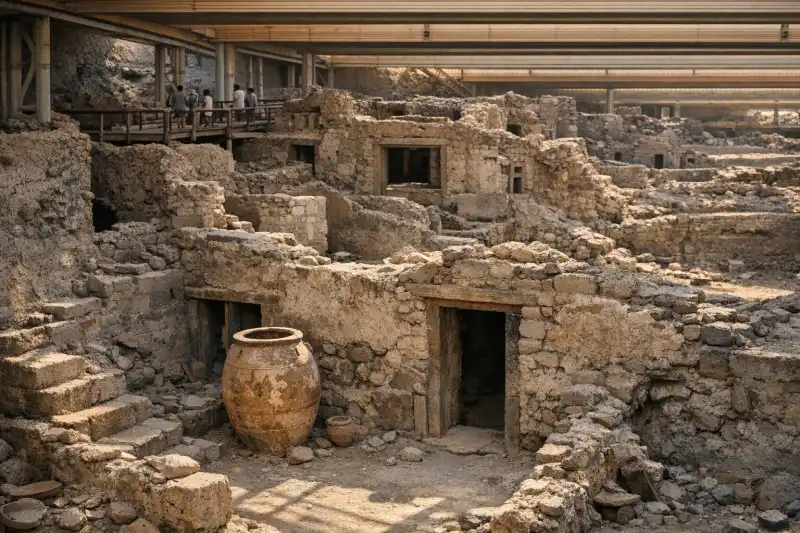
Ancient Akrotiri (Santorini)
Explore Ancient Akrotiri, the breathtaking Bronze Age settlement preserved in volcanic ash on Santor...
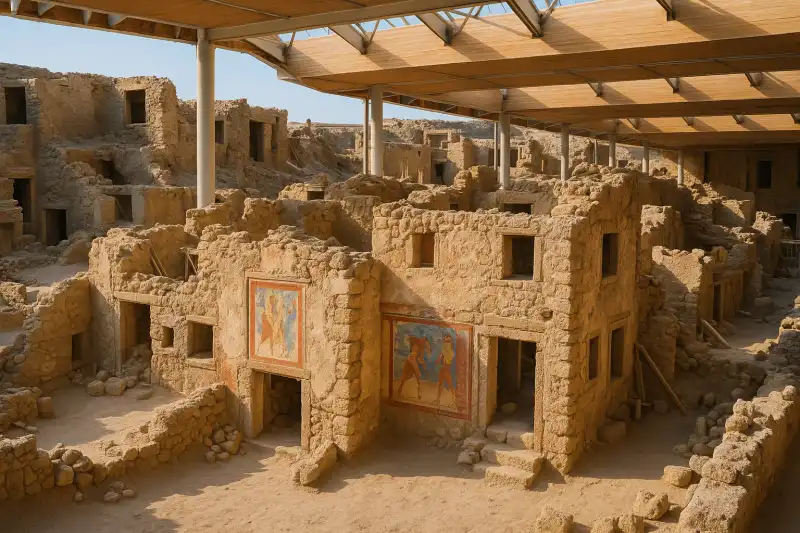
Akrotiri
Minoan / CycladicExplore Akrotiri, the Bronze Age Minoan city buried under volcanic ash on Santorini around 1613 BCE ...
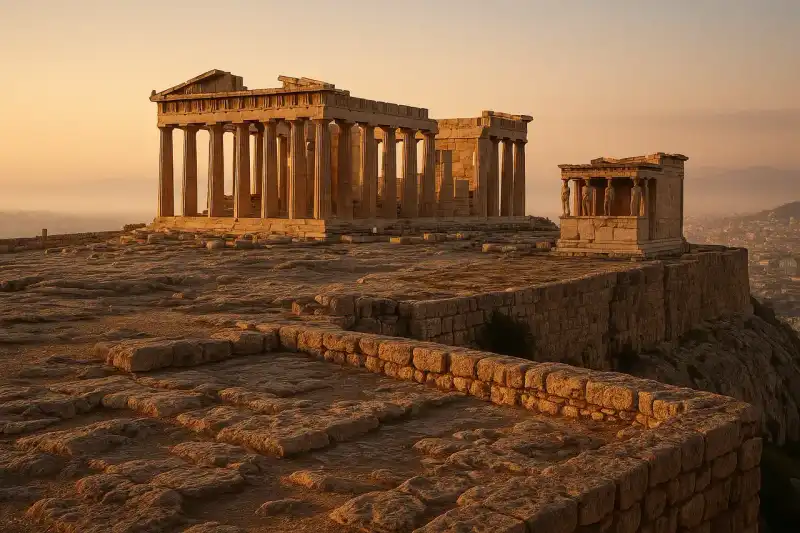
Acropolis Travel Guide 2026: Parthenon, Tickets, and Best Time
Ancient GreecePlan an efficient Acropolis visit with practical ticket timing, key monuments, and museum pairing ti...