Quick Info
At a glance
Ancient Thorikos in Greece is one of those places that surprises travelers who think Attica begins and ends with Athens. Set on the rugged southeastern coast near modern Lavrion, the site feels both remote and deeply connected to the wider story of the ancient Greek world. Hills streaked with mining traces descend toward the sea, and among them lie the remains of a settlement whose life stretched back into the Bronze Age. Here, tombs, houses, workshops, and one of the most distinctive ancient theaters in Greece reveal a community shaped not only by myth and politics, but also by stone, metal, and labor.
Unlike monumental sanctuaries built for spectacle, Thorikos rewards visitors who enjoy reading a landscape. Its archaeology is dispersed across slopes and terraces, with the famous theater tucked into the hillside and industrial installations speaking quietly of the silver-rich Laurion region that helped finance Athenian power. The atmosphere is often peaceful, especially compared with the busiest classical sites around Athens. Wind moves across the grasses, the coast glints in the distance, and the setting makes it easy to imagine why people lived and worked here for so many centuries.
A visit to Ancient Thorikos is less about a single overwhelming monument and more about understanding an ancient place in full: a mining town, a coastal settlement, and a community whose fortunes were tied to the resources beneath the earth. For travelers exploring beyond the capital, it offers one of the most rewarding archaeological excursions in Attica.
History
Early settlement and the Bronze Age
Thorikos has one of the longest occupation histories in Attica. Archaeological evidence suggests that the area was inhabited as early as the 3rd millennium BCE, and it became especially important during the Mycenaean period. This long continuity matters because it distinguishes Thorikos from sites that rose to prominence only in the classical era. Here, settlement developed gradually in response to both geography and resources: access to the sea, defensible hills, and nearby mineral wealth.
The region appears in ancient tradition as one of the old communities of Attica, and later Greek writers linked Thorikos to heroic and mythic narratives. Such associations were common in Greece, where communities anchored themselves in legendary pasts, but the archaeological evidence is what truly gives Thorikos its weight. Tombs and habitation remains indicate that this was not a minor outpost. It was a functioning and durable settlement with social organization, burial customs, and economic activity extending far back before the classical age.
Archaic growth and the rise of mining
By the Archaic period, Thorikos was closely connected to the exploitation of the Laurion mines, one of the most important mineral zones in the Greek world. Silver and lead extracted from southeastern Attica transformed local communities and, in time, the state of Athens itself. Thorikos stood at the edge of this industrial landscape. Ore was mined in the hills, processed through washing and smelting, and moved through networks of labor, trade, and administration that linked the countryside to the polis.
This economic role gave Thorikos unusual importance. While many ancient Greek sites are remembered for temples or urban planning, Thorikos is inseparable from production. The wealth generated in the Laurion district helped support Athenian naval expansion, especially in the early 5th century BCE, when silver revenues were famously directed into the building of warships. Although Athens became the political center of that wealth, the landscapes around Thorikos remind visitors where the raw material originated.
The settlement itself likely grew in complexity during this period. Domestic buildings, roads, industrial features, and burial zones point to a community integrated into the expanding economic life of Attica. Workers, families, traders, and officials would all have moved through this environment, making Thorikos a place where extraction and daily life met directly.
Classical Thorikos and the theater
In the Classical period, Thorikos continued as an active deme of Attica. Under the reorganization associated with Cleisthenes, demes became key civic units of Athenian democracy, and Thorikos gained a formal place within that wider political system. Yet it retained a local identity rooted in its own terrain and industries.
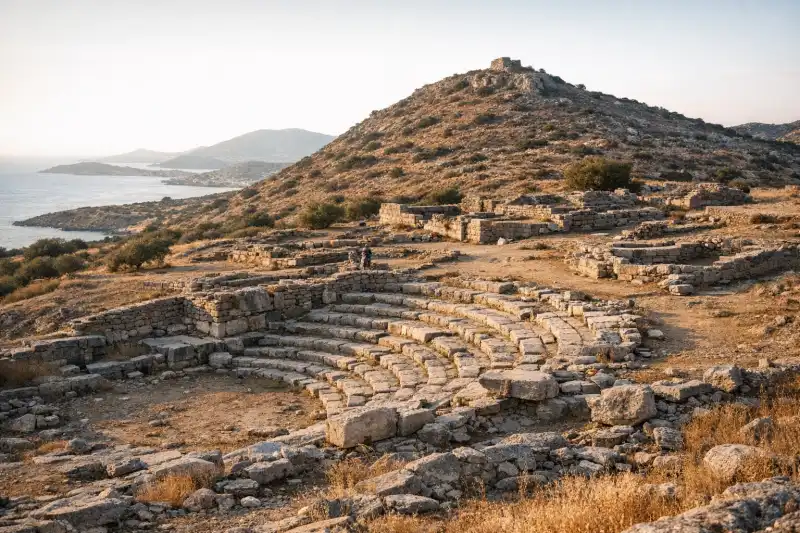
The most famous surviving monument from this broad era is the theater, whose plan is unlike the later, more standardized semicircular theaters that many visitors expect. Thorikos’s theater is elongated and irregular, a form that may reflect an early stage in the development of Greek theatrical architecture or adaptation to the local slope. Its shape alone makes it one of the most intriguing ancient theaters in Greece.
The existence of such a structure shows that Thorikos was not merely an industrial camp. It possessed communal and perhaps ceremonial life substantial enough to require gathering space. Drama, public meetings, and civic performances all formed part of Greek social life, and a theater in a mining district underlines how culture and economy were never entirely separate in antiquity.
Hellenistic, Roman, and later decline
Thorikos remained occupied into the Hellenistic and Roman periods, though changing political and economic conditions gradually altered the site’s significance. Mining activity in Laurion fluctuated over time, influenced by war, labor availability, and market demand. As regional priorities shifted and older civic frameworks weakened, Thorikos likely lost some of its former prominence.
Even so, the area was not simply abandoned overnight. Ancient sites often passed through long transitions, with older buildings reused, neglected, or adapted. The remains visible today belong to many phases layered across centuries. This is one reason Thorikos feels so textured: it is not the preserved snapshot of a single golden age, but the archaeological record of a long-lived community that evolved with the fortunes of Attica.
Modern excavation has helped bring that story into focus. Archaeologists have investigated the theater, houses, cemeteries, workshops, and mining-related structures, revealing a site of exceptional chronological depth. Today, Thorikos stands as a key place for understanding not just classical Greece, but the relationship between settlement, industry, and local identity over the long span of ancient history.
Key Features
The feature most visitors remember first is the theater. Cut into the slope with wide views across the surrounding landscape, it does not conform neatly to the image of the perfect Greek semicircle. Instead, its elongated orchestra and irregular cavea give it a strikingly distinctive character. For travelers interested in architecture, this difference is not a minor technicality but the site’s central fascination. The theater invites questions about how performance spaces developed in early Greece and how local conditions influenced design. Standing there, you become aware that Greek public architecture was not born fully standardized; it emerged through experimentation.
Beyond the theater, Thorikos reveals itself as a settlement embedded in an industrial environment. Scattered remains of habitation areas show where people lived in proximity to the work that sustained the region. These are not the grand urban blocks of a major city center, but they are invaluable for understanding daily life. Walls, terraces, and foundations hint at a community that was practical, durable, and closely tied to production. Visitors who take time to move slowly through the site can appreciate how homes, paths, and working areas fit together across the hillside.
Another essential feature is the mining landscape itself. Even where specific installations are not immediately obvious to a casual eye, the setting tells the story. Thorikos belongs to the Laurion district, and that context shapes everything. Ancient shafts, processing zones, and ore-related activity in the broader area help explain why the settlement mattered. This was not simply a town with a nearby resource; it was part of a regional system whose metals influenced the economy and military strength of Athens. The archaeology here therefore connects humble local remains to major historical developments in the eastern Mediterranean.
The cemeteries and tombs are also important. Burial evidence from Thorikos spans long periods, showing continuity of occupation and changing funerary customs. For archaeologists, these finds are indispensable because they anchor chronology and reveal how the community understood status, identity, and remembrance. For visitors, they add emotional depth. A mining district can be imagined too easily in purely economic terms, but the graves insist on the full human story: workers, families, children, elites, and generations who made lives in this demanding environment.
The natural setting is itself a feature worth noting. Thorikos overlooks the coast and sits within the dry, rocky beauty of southeastern Attica. The light can be brilliant, especially in the late afternoon, and the sea often appears as a calm blue backdrop to the stone remains. Unlike heavily urban archaeological sites, Thorikos still feels rooted in its original terrain. This enhances the experience because the site’s meaning depends so much on landscape. You are not just seeing ruins placed in a museum-like frame; you are standing inside the environmental logic that created the settlement.
Finally, Thorikos’s greatest feature may be its relative quiet. Even in a region visited by many day-trippers heading to Cape Sounion, this site often remains less crowded than the headline monuments of Athens. That gives travelers space to think, sketch, photograph, and absorb details. The theater can be appreciated without the crush of large groups, and the surrounding remains invite slower observation. For those who enjoy archaeology as a process of interpretation rather than a checklist of famous icons, Thorikos is especially rewarding.
Getting There
Ancient Thorikos is most easily reached from Athens by car. The drive is about 60 kilometers from central Athens and usually takes between 1 hour and 1 hour 20 minutes, depending on traffic and your starting point. A rental car offers the most flexibility, especially if you want to combine Thorikos with Lavrion, nearby beaches, or Cape Sounion in a single day. Expect fuel and toll-related costs to be modest overall, while a one-day economy car rental from Athens commonly starts around €35 to €60, rising in high season.
Public transport is possible but slower. Intercity and regional buses from Athens toward Lavrion are the main option. From central Athens, bus fares are generally in the range of €4 to €7 one way, though prices can change. Once in Lavrion, you may need a taxi to reach the archaeological site comfortably unless you are prepared for a longer walk in warm weather. A short taxi ride from Lavrion to Thorikos may cost roughly €8 to €15 depending on distance, time of day, and local availability.
Organized tours to Thorikos specifically are less common than tours to Cape Sounion, but private drivers and custom Attica excursions can include the site. This can be a good choice for travelers who want historical commentary without the stress of navigating rural roads. Private day tours from Athens often begin around €150 per person for small groups, with higher prices for fully customized itineraries.
If you drive, wear sturdy shoes and bring water, especially outside winter. The site is archaeological terrain rather than a polished urban attraction, and the final approach and walking surfaces can be uneven.
When to Visit
The best times to visit Ancient Thorikos are spring and autumn, when southeastern Attica is bright and clear but not oppressively hot. From March to May, wildflowers and green patches soften the rocky landscape, making the setting especially attractive for photography and longer walks. Temperatures are usually comfortable, often ranging from the mid-teens to mid-20s Celsius, which is ideal for an exposed hillside site.
Autumn, especially September through early November, is another excellent season. The sea remains visually striking, summer crowds have thinned, and the heat becomes more manageable. This is a particularly good time for travelers combining archaeology with coastal stops, since the region still feels lively but less intense than in peak summer.
Summer visits are certainly possible, but they require planning. From June through August, midday temperatures can climb sharply, and Thorikos offers limited shade. If you go in summer, aim for early morning or late afternoon. Bring plenty of water, sunscreen, a hat, and footwear with good grip. The strong sun can flatten the experience if you arrive at noon, while a later visit often reveals the site in much better light.
Winter can be rewarding for those who prefer solitude. Temperatures are cooler and walking is easier, though windy or rainy days can make the terrain less pleasant. The muted seasonal light also gives the ruins a different character, more austere but still beautiful. If your priority is atmosphere and space rather than beach weather, winter in Attica can be a very good time to explore lesser-known sites like Thorikos.
Whatever the season, visiting earlier in the day is usually wise. The open setting, historical complexity, and views all reward a slower pace, and cooler hours make that much easier.
| Quick Facts | Details |
|---|---|
| Location | Near Lavrion, Attica, Greece |
| Ancient role | Settlement and mining center in the Laurion district |
| Best-known monument | The unusual elongated ancient theater |
| Historical span | From the Bronze Age through Roman times |
| Distance from Athens | About 60 km southeast |
| Best seasons | Spring and autumn |
| Time needed | 1 to 2 hours on site, longer if combined with Lavrion or Sounion |
| Ideal for | Archaeology lovers, history travelers, photographers, day-trippers from Athens |
Ancient Thorikos may not have the instant global recognition of the Acropolis, but that is part of its appeal. It offers a more textured and grounded encounter with the ancient Greek world, where economy, labor, performance, and landscape all come into focus together. Here, the story of Greece is not told only through temples and imperial monuments, but through a working community that drew wealth from the earth and built a civic life beside the sea.
For travelers willing to go beyond Athens’s most famous landmarks, Thorikos provides rare depth. Its theater challenges assumptions about ancient architecture, its mining setting connects local remains to major historical change, and its long occupation reveals continuity across centuries that few sites can match. More than a stop on a scenic drive through Attica, Ancient Thorikos is a place where the practical and the cultural meet in enduring stone.
Guided tours: worth it?
Most travelers can visit Ancient Thorikos independently. Compare a tour only if you want a tighter history-focused visit, easier logistics, or a guide who can answer questions on the spot.
Best for
- Short visits where a planned route saves time
When to go self-guided
Go independently if you prefer setting your own pace, reading as you go, and checking official hours or ticket rules directly before you arrive.
What I’d avoid
Skip paid tours that bundle unrelated stops you do not actually want. The best option should either save meaningful planning time or add historical context you would miss on your own.
Ancient Thorikos and Lavrion Day Tours
Useful when: you want to compare guided formats before deciding
Athens to Lavrion and Temple of Poseidon Tours
Useful when: you want to compare guided formats before deciding
Attica Archaeology Private Tours
Useful when: you want flexible timing or a private guide
Some tour links are affiliate links, which may earn Ancient Travel a small commission at no extra cost to you. I try to surface options that make practical sense for the site—not just anything bookable.
Frequently Asked Questions
Where is Ancient Thorikos located?
Ancient Thorikos lies in southeastern Attica, Greece, near modern Lavrion and the mining district that was famous in antiquity for its silver and lead resources.
Why is Ancient Thorikos important?
The site is significant for its unusually early theater, long settlement history, cemeteries, industrial remains, and strong links to the mining economy of ancient Attica.
How far is Ancient Thorikos from Athens?
Ancient Thorikos is roughly 60 kilometers southeast of central Athens, and the drive usually takes about 1 to 1.5 hours depending on traffic.
Can you visit Ancient Thorikos with other sites in one day?
Yes. Many travelers combine Thorikos with Lavrion, nearby beaches, and Cape Sounion for a full-day archaeological and scenic excursion from Athens.
Is Ancient Thorikos suitable for casual visitors?
Yes, but expect an open-air archaeological landscape rather than a heavily developed museum complex. Good walking shoes and sun protection are recommended.
What is the main highlight at Ancient Thorikos?
The most memorable feature for many visitors is the hillside theater, whose unusual elongated shape and commanding view make it distinct from many other ancient Greek theaters.
Nearby Ancient Sites
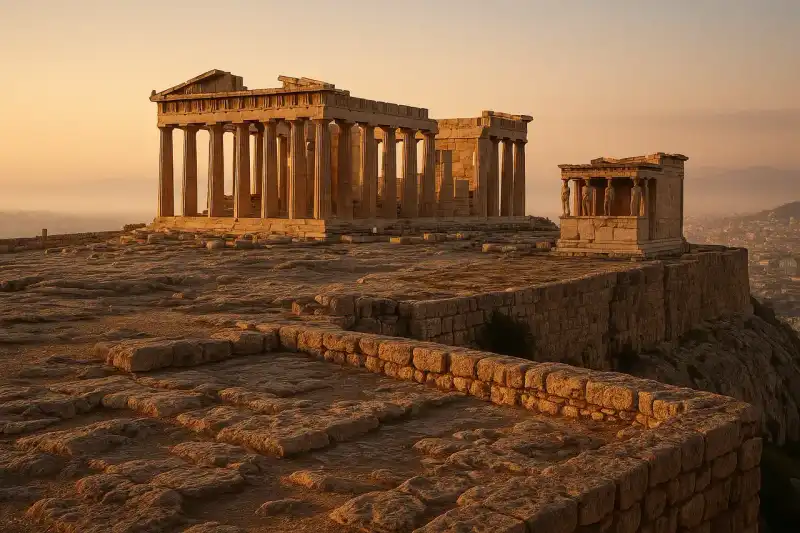
Acropolis Travel Guide 2026: Parthenon, Tickets, and Best Time
Ancient GreecePlan an efficient Acropolis visit with practical ticket timing, key monuments, and museum pairing ti...
The Complete Acropolis Athens Travel Guide: Temples
Ancient GreecePlan the perfect visit to the Acropolis of Athens with our 2026 guide. Discover the Parthenon, best ...
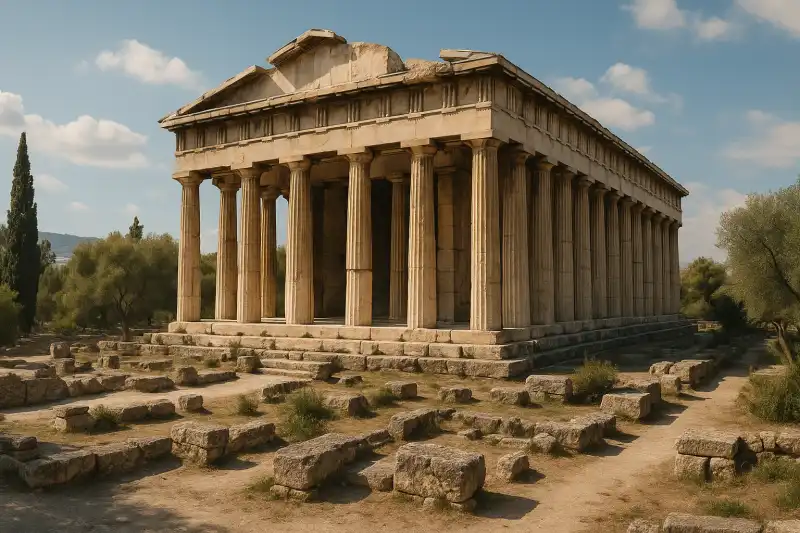
Ancient Agora of Athens Travel Guide 2026: Route, Tickets, and Context
Classical GreekPlan a better Ancient Agora visit with practical timing, monument priorities, and clear historical c...