Quick Info
Curated Experiences
Full-Day Angkor Thom, Bayon and Ta Prohm Guided Tour
Angkor Small Circuit Tour with Bayon Temple
Private Angkor Archaeological Park Day Trip
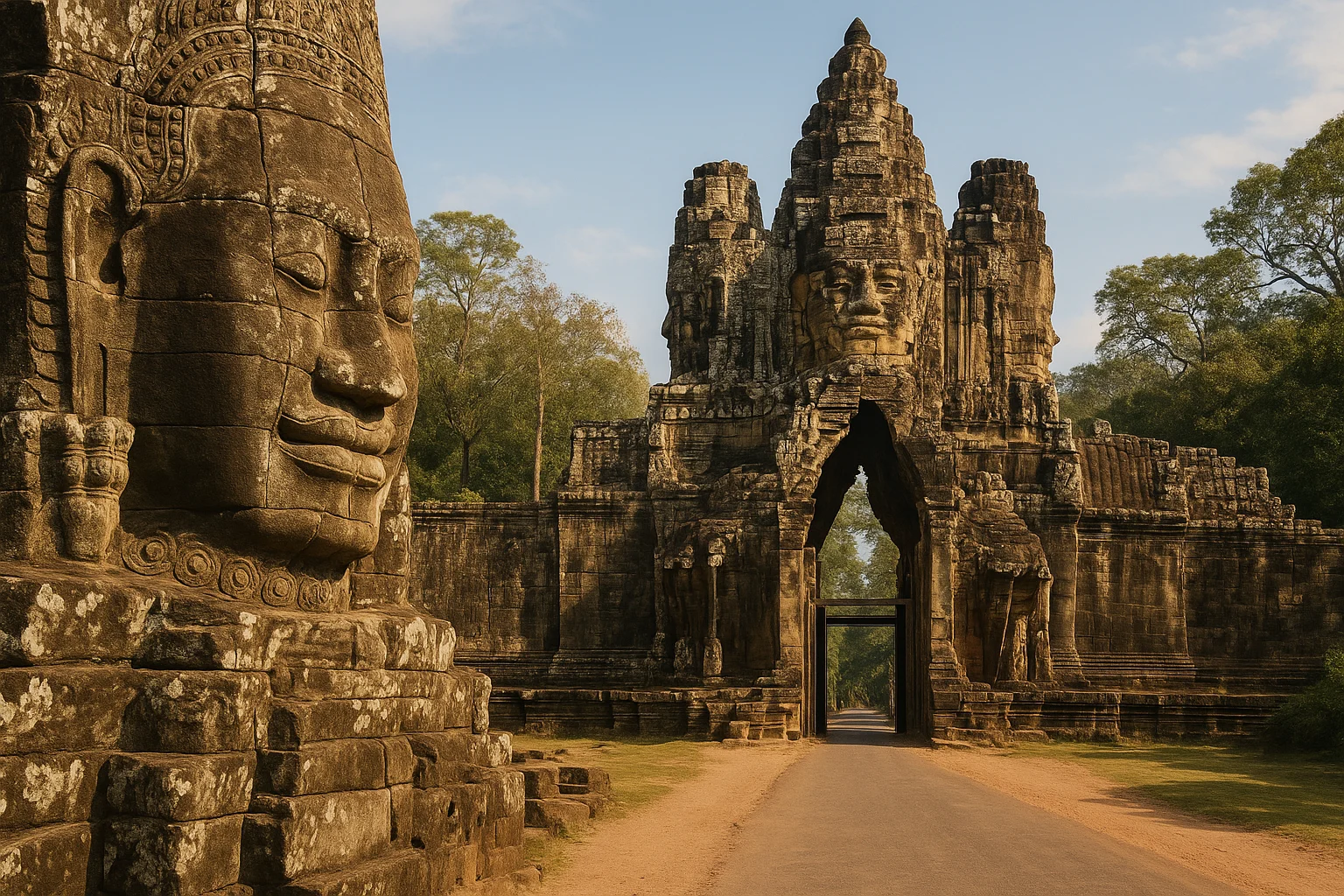
Angkor Thom is where the Khmer Empire staged its final act of power. Built by King Jayavarman VII in the late 12th century, this fortified royal city was designed as an imperial statement on a scale that still overwhelms: eight-meter walls running three kilometers per side, five monumental gates lined with stone giants, a wide moat, and at the exact center, a state temple crowned with massive carved faces that watch every direction at once.
For travelers already planning a visit to Angkor Wat, Angkor Thom is not a secondary stop. It is a fundamentally different experience. Instead of one iconic silhouette rising from a single axis, you move through an entire sacred urban landscape - gate to gate, terrace to terrace, tower to tower - covering roughly nine square kilometers of political and ceremonial architecture.
Why Angkor Thom Matters
At its peak in the 13th century, Angkor Thom was home to an estimated population approaching one million people across the greater Angkor region, making it one of the largest pre-industrial cities on earth. The walled enclosure functioned as both political capital and cosmological map: its layout mirrors Hindu-Buddhist models of the universe, with Mount Meru (represented by Bayon) at the center, cardinal gates aligned to the four directions, and the surrounding moat standing in for the cosmic ocean.
Where Angkor Wat communicates through singular perfection, Angkor Thom communicates through density and accumulation. Temples, terraces, reservoirs, causeways, and residential zones all overlap within the walls. You are not visiting a monument. You are walking through the operating system of a medieval empire.
Historical Context
Jayavarman VII came to power after a catastrophic Cham invasion sacked the previous Khmer capital in 1177. His response was extraordinary: a massive building campaign that produced Angkor Thom, Bayon, Ta Prohm, Preah Khan, and dozens of hospitals and rest houses across the empire. The construction was Mahayana Buddhist rather than Hindu, marking a significant religious shift for the Khmer court.
Angkor Thom remained the functioning capital through the 13th century and likely into the 15th, even as the empire contracted. The city outlasted most of the Angkor-period infrastructure around it. When Chinese diplomat Zhou Daguan visited in 1296, he described a thriving urban center with gold-covered towers, bustling markets, and elaborate royal processions along the terraces. His account remains one of the most detailed eyewitness descriptions of any medieval Southeast Asian city.
After the capital shifted to Phnom Penh in the 15th century, Angkor Thom was gradually reclaimed by forest, though Bayon and the gates were never fully forgotten by local populations.
What to Prioritize Onsite
Bayon Temple
Bayon is the headline structure and one of the most distinctive temple experiences in Southeast Asia. The upper level holds approximately 200 massive stone faces spread across 37 surviving towers, creating layered sightlines that shift with every step. Early morning side light is ideal for photography and atmosphere - the faces emerge from shadow in ways that feel deliberately theatrical.
Do not skip the lower galleries. The first-level bas-reliefs contain some of the most valuable historical records at Angkor: detailed carvings of naval battles against the Cham, market scenes, cooking, childbirth, cockfighting, and daily Khmer life. These reliefs are more candid and narrative than the mythological panels at Angkor Wat, and they reward slow attention.
Baphuon
Northwest of Bayon, Baphuon is a steep temple-mountain connected to the royal palace zone by a 200-meter elevated sandstone causeway. The temple was originally dedicated to Shiva and predates Jayavarman VII’s construction by about a century. Its rear wall was partially reshaped into a massive reclining Buddha, visible from the west side.
Baphuon draws fewer visitors than Bayon and gives a strong physical sense of the vertical sacred architecture that defined Angkor’s ceremonial core. The climb to the upper level is steep but manageable.
Terrace of the Elephants and Terrace of the Leper King
These two connected terraces define the royal reviewing zone along the eastern edge of the royal palace enclosure. The Terrace of the Elephants stretches roughly 300 meters, carved with life-size elephants, garudas, and lion figures that once formed the backdrop for military parades and public ceremonies.
The adjacent Terrace of the Leper King features deeply carved interior passageways with layered walls of apsaras and underworld figures. Many visitors walk right past the hidden corridors - look for the narrow entrance on the south side.
The Gates
Each of Angkor Thom’s five gates deserves attention. The South Gate is the most visited, flanked by 54 devas on one side and 54 asuras on the other, all pulling a giant naga in a representation of the Churning of the Ocean of Milk. The Victory Gate (east) connects directly to the royal terrace area and sees lighter traffic. The North Gate and the so-called Gate of the Dead are the quietest and photograph well in afternoon light.
Practical Visit Strategy
Timing
Arrive at the South Gate between 7:00 and 7:30 AM to reach Bayon before group tours peak around 9:00. Work through Baphuon and the terraces by mid-morning. If you want uncrowded gate photos, return in late afternoon via the North Gate or Victory Gate when tour buses have cleared.
Logistics from Siem Reap
Angkor Thom sits within the Angkor Archaeological Park, approximately 11 to 13 kilometers from central Siem Reap depending on your hotel. The same pass system covers all Angkor sites - a one-day pass costs $37 USD, three-day $62, seven-day $72 (2025 prices; verify current rates).
Transport options include tuk-tuk (most common, roughly $15-20 for a full day circuit), private car with driver, or e-bike rental for independent travelers. Budget two to four hours for Angkor Thom alone; a full day if combining with outer temples.
What to Bring
Water is essential - there is limited shade between structures. Wear lightweight clothing that covers shoulders and knees (required at active shrines). Footwear with grip matters: sandstone steps are steep and slick after rain. A small flashlight helps inside Bayon’s darker gallery passages.
Onsite Tips
- Prioritize Bayon’s upper level early when light is directional and crowds are thin
- Pause in shaded galleries during heat spikes rather than pushing through open plazas
- Keep temple etiquette near active Buddhist shrines and monks
- Budget time for the gates themselves, not just the temples between them
Route Pairing and Nearby Sites
Angkor Thom pairs naturally with Angkor Wat, located roughly 1.7 kilometers south of the South Gate. Most travelers visit both on the same day. Ta Prohm and Banteay Srei make strong additions for a second or third day. The Bayon Temple entry in our guides covers the central temple in closer detail.
For broader Southeast Asia route planning, the Khmer temple circuit connects well with Sukhothai Historical Park in Thailand or Borobudur in Java - both offer complementary perspectives on Buddhist-Hindu monumental architecture in the region.
Final Take
Angkor Thom rewards travelers who read the space as a city rather than a temple checklist. The faces of Bayon, the battle reliefs, the processional terraces, and the giant-flanked gates all belong to a single integrated design - a king’s attempt to rebuild an empire’s identity in stone after near-destruction. Walking through it with that context transforms what could be a series of photo stops into one of the most layered historical experiences in Asia.
If you are visiting Angkor Wat, Angkor Thom is not optional. It is the context that makes the entire Angkor landscape legible.
Quick Facts
| Attribute | Details |
|---|---|
| Location | Angkor Archaeological Park, Siem Reap, Cambodia |
| Country | Cambodia |
| Region | Siem Reap |
| Civilization | Khmer Empire |
| Historical Period | Late Angkor period (late 12th - 13th centuries CE) |
| Established | c. 1181 CE by Jayavarman VII |
| Area | 9 sq km (walled enclosure) |
| Entry Pass | Angkor Pass ($37 / 1-day, $62 / 3-day, $72 / 7-day) |
| Coordinates | 13.4410, 103.8598 |
Frequently Asked Questions
Is Angkor Thom the same as Angkor Wat?
No. Angkor Wat is a single temple complex, while Angkor Thom is a walled royal city nearby. Bayon, Baphuon, and the Terrace of the Elephants are inside Angkor Thom.
How much time do I need for Angkor Thom?
Plan 2-4 hours for a focused visit and up to half a day if you want to explore Bayon, Baphuon, and both terraces at a slower pace.
Which gate is best to enter Angkor Thom?
Most visitors enter via the South Gate because it fits the standard circuit from Angkor Wat, but the North and East Gates are often quieter for photos.
Nearby Ancient Sites
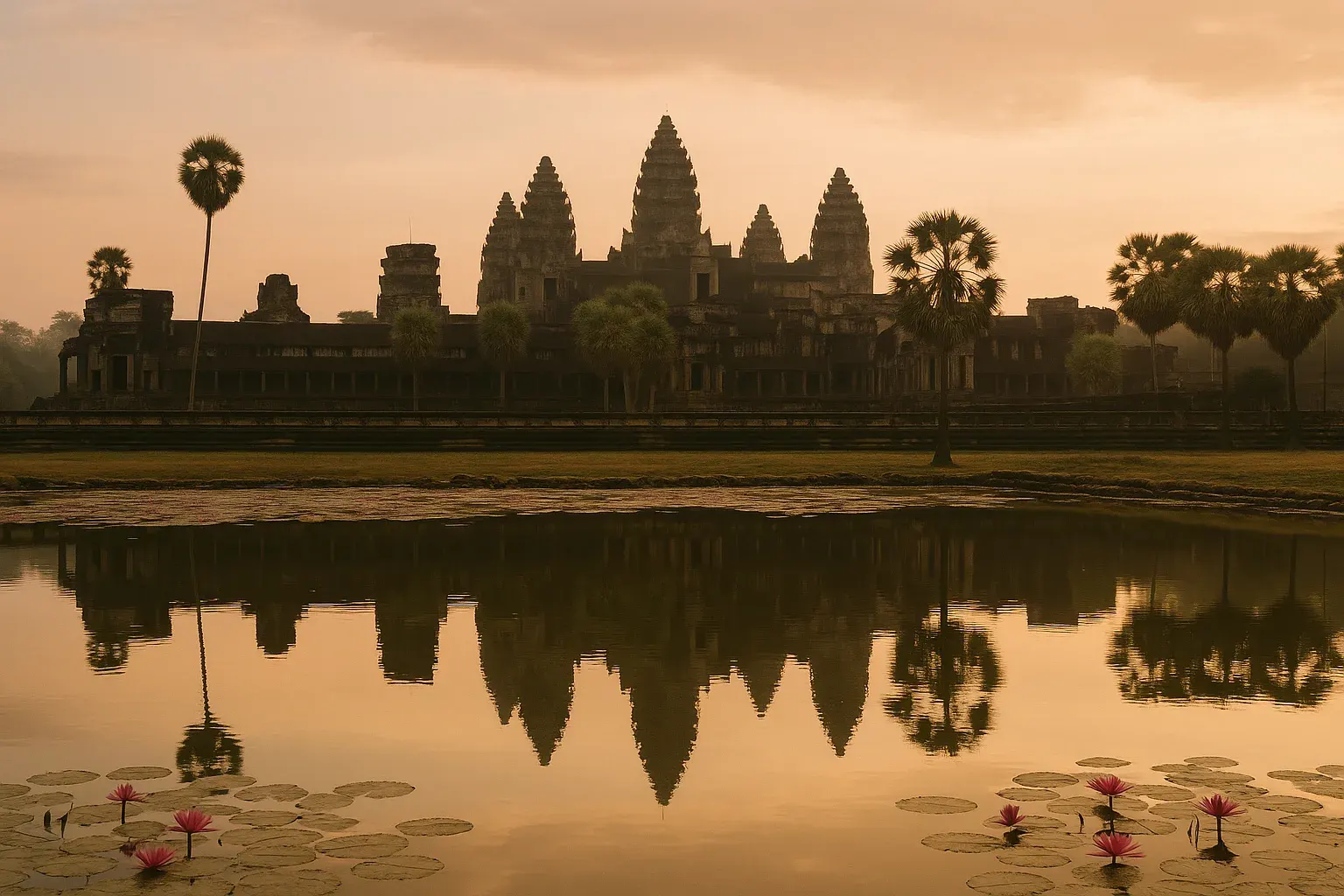
Angkor Wat Travel Guide 2026: Everything You Need to Know
KhmerAngkor Wat, the world's largest religious monument, spans over 400 acres in the heart of Cambodia. T...
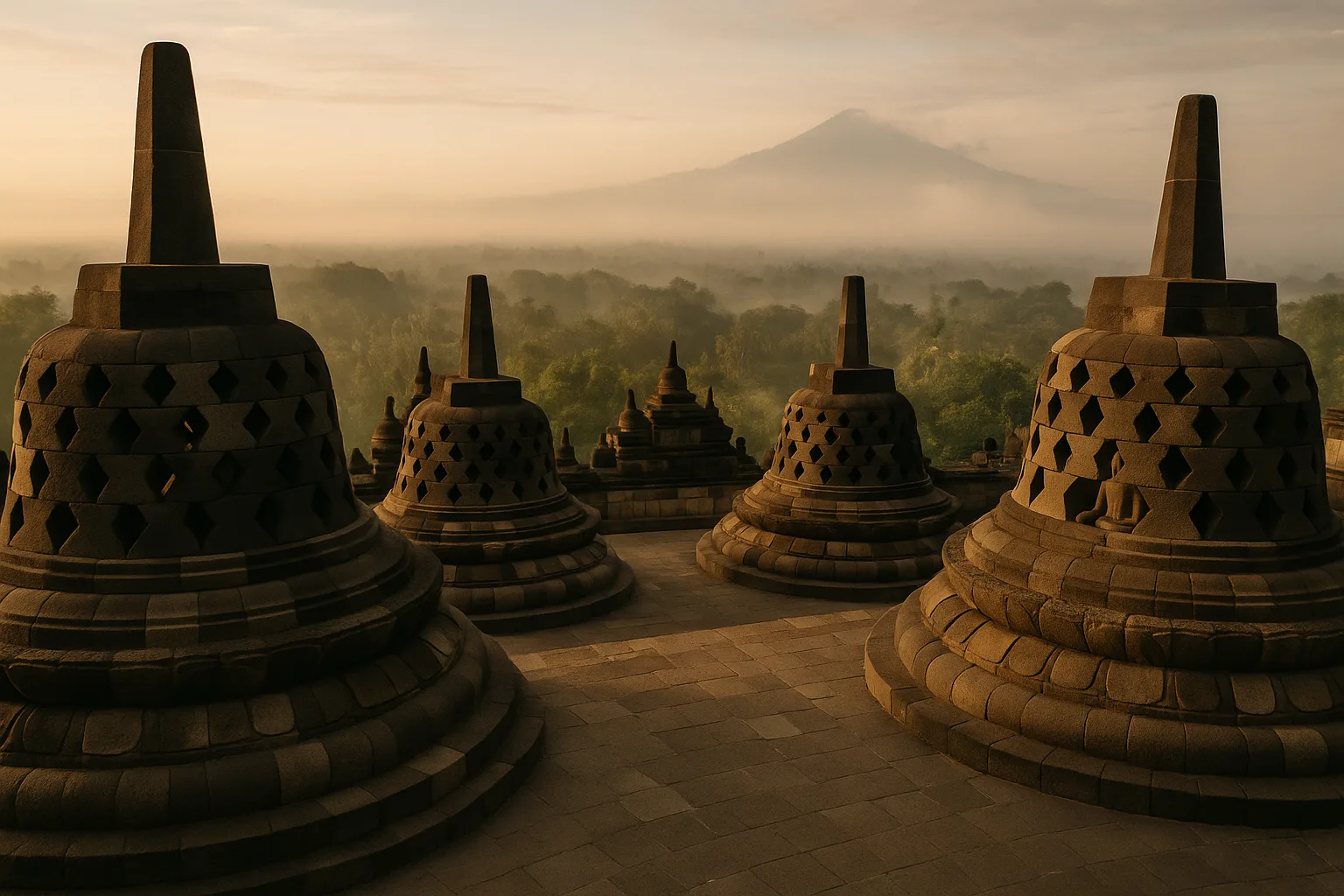
Borobudur Temple, Indonesia: The Sacred Mountain of a
Sailendra Dynasty (Buddhist)Discover Borobudur, the world's largest Buddhist temple and Indonesia's most visited attraction. Com...
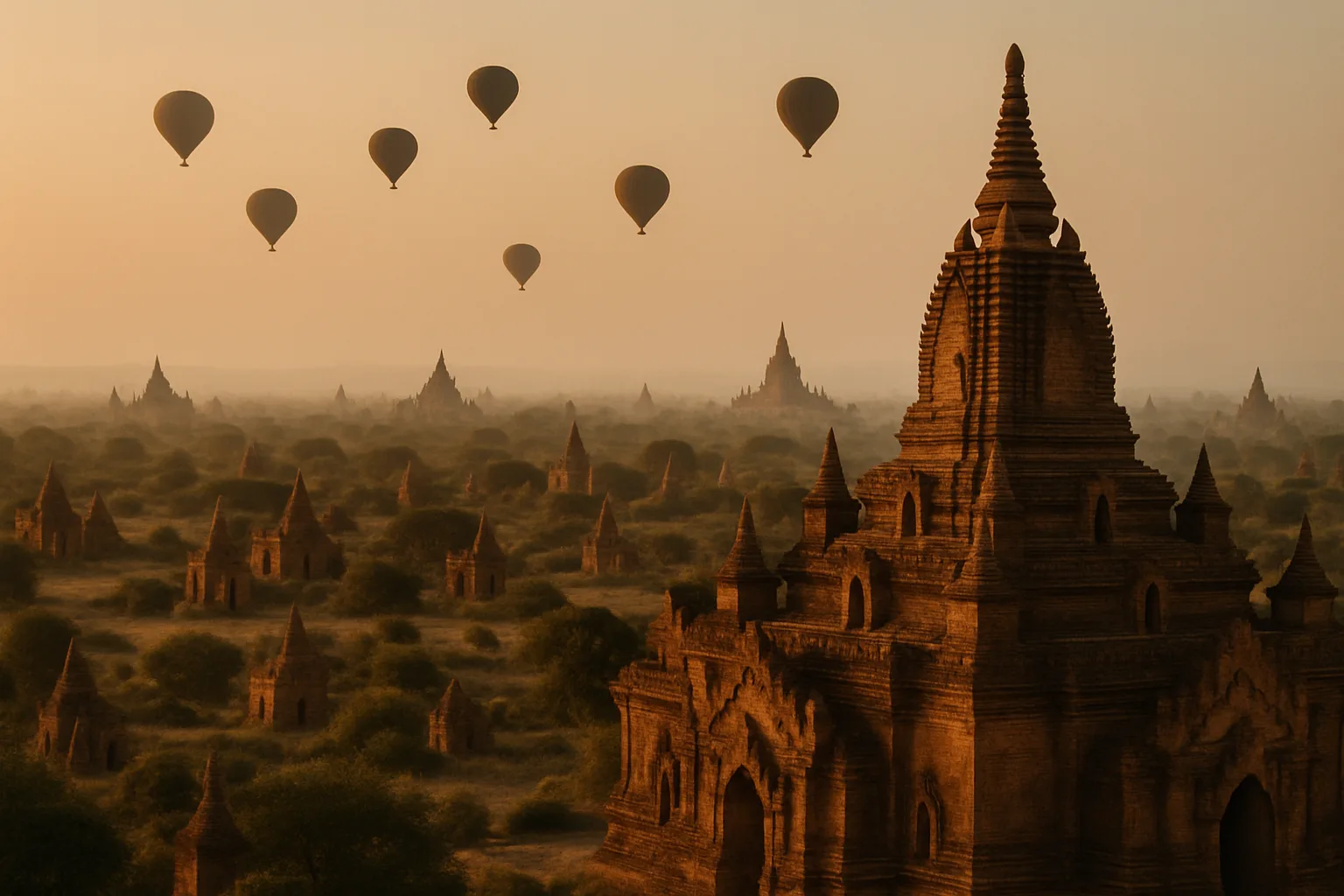
Bagan: 2,000 Temples Rising from the Myanmar Plains
Pagan Kingdom (Burmese)Explore Bagan, Myanmar's ancient temple city with over 2,000 surviving pagodas scattered across the ...