Quick Info
At a glance
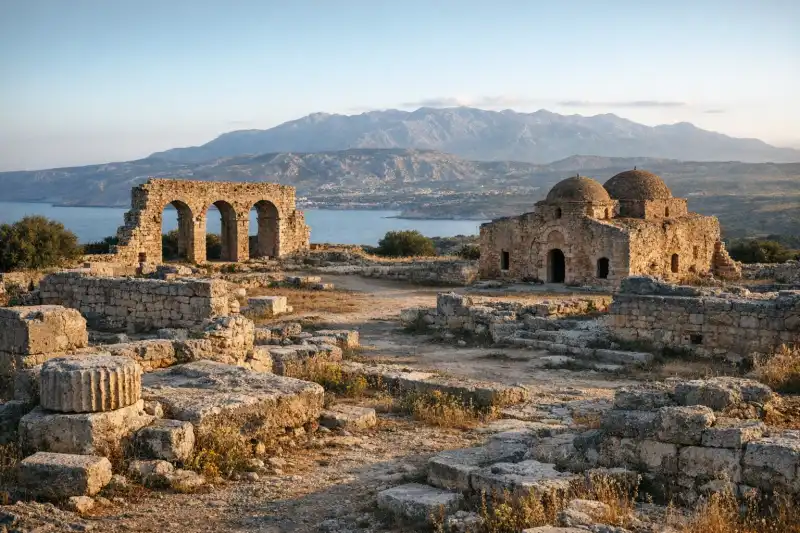
Aptera, Greece, rises above the northern coast of Crete with the kind of commanding presence that makes an ancient city immediately understandable. From its hilltop position over Souda Bay, the site still feels strategic, prosperous, and carefully chosen, even before you begin to trace its walls, cisterns, and public buildings. Wind moves through the grasses, the bay glitters below, and the White Mountains stand in the distance, creating one of the most dramatic archaeological settings on the island. Unlike some better-known Greek sites that can feel hemmed in by modern development or crowded by heavy visitor traffic, Aptera often offers something more spacious and reflective: ruins that remain legible in the landscape, and a setting that lets you imagine how power and geography once worked together.
That sense of place is one of Aptera’s greatest strengths. This was not an isolated outpost, but a city that watched routes inland and toward the sea, linking commerce, defense, and civic life. Walking here, you encounter not a single monument but a layered urban story. Hellenistic and Roman remains are especially visible, though the site’s life stretched across many centuries and changed with shifting empires and local fortunes. Today, Aptera is one of Crete’s most rewarding archaeological destinations for travelers who enjoy history without needing spectacle. Its remains are substantial, the views are unforgettable, and its atmosphere rewards patience. The more slowly you move through the site, the more clearly this ancient city begins to take shape.
History
Early settlement and the rise of the city
Aptera’s history reaches back well before the grand ruins most visitors see today. Archaeological evidence points to occupation in the area from the Bronze Age, and the location itself helps explain why. The hill commands a wide view over Souda Bay and the fertile surrounding countryside, making it an ideal place for settlement, surveillance, and exchange. By the Archaic and Classical periods, Aptera had emerged as one of the important city-states of western Crete.
Ancient writers connected the city’s name with myth. One tradition linked it to a contest between the Muses and the Sirens, in which the defeated Sirens lost their feathers, becoming “aptera,” or wingless. Such stories are less historical fact than cultural memory, but they show that the city’s identity was deeply rooted in Greek imagination. More importantly, inscriptions and coinage reveal a community confident enough to project itself politically and economically. Aptera minted its own coins and participated in the competitive world of Cretan poleis, where alliances, rivalries, and regional power mattered enormously.
Its strength came from both agriculture and trade. Although the city itself sat inland on elevated ground, it controlled access to nearby harbors connected to the bay. This gave Aptera an advantage in maritime exchange while preserving the defensive benefits of a hilltop settlement. By the Hellenistic period, it had become one of the region’s notable urban centers.
Hellenistic prosperity and Roman transformation
The Hellenistic age appears to have been a period of major growth for Aptera. Like many cities in Crete, it navigated a politically fragmented environment in which local powers competed and collaborated. The city’s strategic location ensured that it remained relevant, and its urban fabric expanded to reflect civic ambition. Public buildings, fortifications, and infrastructure all point to an organized and prosperous settlement.
When Crete eventually came under Roman control in the 1st century BCE, Aptera did not disappear. Instead, it adapted. Under Roman rule, many Cretan cities were absorbed into broader imperial networks, and Aptera seems to have benefited from that integration. The Roman period left some of the site’s most impressive remains, especially the large cisterns and other structures tied to urban management and daily life. These are reminders that Roman urbanism was not only about temples and theaters, but about engineering, storage, water systems, and practical resilience.
The theater, too, reflects the city’s continued importance. Public entertainment, civic display, and cultural life remained central to urban identity. Roman influence altered architecture and administration, but Aptera maintained a distinct local continuity. The city survived not because it resisted change, but because it incorporated it.
Earthquakes, Christianity, and Byzantine continuity
Like much of the eastern Mediterranean, Aptera faced the recurrent instability of earthquakes. Seismic events affected many Cretan settlements and likely damaged parts of the city at different times. Even so, occupation continued into Late Antiquity. As Christianity spread through the Roman Empire, urban landscapes changed, and older civic spaces were often repurposed or overshadowed by ecclesiastical buildings.
At Aptera, the remains of early Christian and later structures show this shift clearly. The city did not simply vanish at the end of the pagan classical world; it evolved. Churches and monastic elements suggest that the hill retained importance in the Byzantine era, even if the scale and character of occupation changed. This was a common pattern across Greece: ancient cities contracted, transformed, and sometimes took on new religious and defensive functions.
The endurance of settlement here speaks to the quality of the location. Even as old political frameworks fell away, the hill above the bay remained useful, visible, and worth inhabiting.
Decline, abandonment, and rediscovery
Over time, however, Aptera declined. The reasons were probably cumulative rather than singular: earthquakes, political disruption, shifts in trade, and changing settlement patterns all played a role. By the medieval and Ottoman periods, the ancient city was no longer functioning as a major urban center, though the broader landscape remained occupied and contested. Later fortifications in the area, including the Ottoman-era fortress nearby, show that the strategic value of the hill was never entirely forgotten.
Modern archaeological interest gradually brought the ancient city back into focus. Excavation and conservation have revealed a site that is both extensive and unusually atmospheric. Because Aptera was not built over by a major modern town, significant parts of its urban plan can still be appreciated in relation to the topography. Today, the site stands as one of western Crete’s most evocative windows into the island’s long historical continuum, from early settlement to Hellenistic power, Roman adaptation, Byzantine persistence, and eventual ruin.
Key Features
What makes Aptera memorable is not a single iconic structure but the way several major remains work together to evoke an entire city. The first element most visitors notice is the setting itself. The site unfolds across a broad plateau with long views over Souda Bay, and those views are not merely scenic decoration. They are essential to understanding Aptera. This city watched the coast, monitored movement, and drew strength from visibility. Looking outward from the ruins, you see what its inhabitants saw as opportunity and as risk.
Among the most impressive surviving structures are the Roman cisterns. These are vast, vaulted chambers that speak to the engineering demands of urban life on an exposed hilltop. Water management was always crucial in the Mediterranean, and at Aptera these cisterns become some of the clearest evidence of sustained planning and investment. Their scale is striking, but so is their atmosphere. Cool, shadowed, and architectural in a very functional way, they offer a strong contrast to the bright, open landscape above. They remind visitors that successful ancient cities depended on infrastructure as much as temples or administrative buildings.
The theater is another important feature, though it is more intimate than some of Greece’s grandest examples. Its importance lies in what it reveals about civic culture. Even in a city defined by strategic geography, public gathering and performance mattered. The theater would have hosted events that reinforced communal identity, social hierarchy, and participation in the broader traditions of Greek urban life. Its remains help restore a sense of Aptera as a living civic organism, not merely a military lookout.
Fortifications and city walls also shape the experience of the site. In some places they are fragmentary, in others more clearly legible, but they underscore the political realities of ancient Crete. This was a world in which cities protected themselves, marked their territory, and invested in defense. At Aptera, the relationship between walls and landscape is especially compelling. You can feel how architecture followed the hill’s contours and how defense relied on both masonry and elevation.
Scattered through the site are remains of houses, public buildings, roads, and later religious structures. Their exact interpretation varies, and not every ruin announces itself dramatically, but together they create a layered archaeological environment. Some areas suggest Roman domestic or civic adaptations; others point to Late Antique and Byzantine continuation. The result is a site that rewards attention to transitions. Aptera is not frozen in one historical moment. Instead, it displays the accumulated changes of many centuries.
One of the most enjoyable aspects of visiting is the rhythm of movement between open and enclosed spaces. You may pass from a sunlit stretch of stone and low vegetation into the dark mass of the cisterns, then back to panoramic terraces where sea and mountain dominate the horizon. This variation gives Aptera unusual texture as a destination. It is visually rich without being overwhelming.
There is also a sense of calm here that distinguishes it from more famous archaeological landmarks. The monuments are substantial, but the atmosphere remains contemplative. You are often able to stand for a while with little interruption, hearing wind, birds, and distant traffic from the modern world far below. That quiet allows the site’s scale to emerge gradually. Aptera does not force itself on the visitor; it unfolds.
Finally, the broader archaeological zone includes later historical layers that broaden the story beyond antiquity. Nearby defensive works from the Ottoman period remind you that commanding landscapes continue to attract power across eras. This continuity deepens the experience. Aptera is not only a ruined Greek and Roman city; it is a place where geography kept generating historical importance long after the ancient polis had faded.
Getting There
Aptera is easiest to reach from Chania, the main nearby city in western Crete. By car, the drive usually takes around 20 to 30 minutes depending on traffic and your starting point in the Chania area. A rental car is the most practical option for most travelers, especially if you plan to combine Aptera with other sites or beaches during the day. In high season, small rental cars often start around €35 to €60 per day, while fuel costs for the round trip from Chania are modest.
Taxis are a straightforward alternative if you do not want to drive. A one-way taxi fare from central Chania to Aptera is commonly around €25 to €40, depending on time of day and exact pickup point. If you want the driver to wait and return you after your visit, agree on the total fare in advance. This can be a good option for couples or small groups.
Public transport is more limited. Buses in Crete are generally reliable on major routes, but Aptera itself is not as directly served as larger destinations. You may be able to take a regional bus part of the way toward nearby villages and then continue by taxi, but this requires planning and checking current local schedules. If you depend on public transport, expect some inconvenience and allow extra time.
Organized tours from Chania or broader western Crete can also be worthwhile, especially if paired with historical stops or scenic drives. These often include hotel pickup and guide commentary, with half-day tours typically starting from around €50 to €90 per person depending on inclusions.
When to Visit
Spring is one of the best times to visit Aptera. From March through May, western Crete is usually green, the temperatures are mild, and the hilltop setting feels especially pleasant for walking. Daytime temperatures often range from about 17°C to 25°C, making it easier to explore open areas without the strain of intense summer heat. Wildflowers and clearer air can also enhance the landscape views over Souda Bay.
Autumn, especially September through early November, is another excellent season. The sea remains warm elsewhere on the island, but the peak summer crowds begin to thin. Temperatures commonly fall between 20°C and 28°C in early autumn, then become cooler later in the season. For travelers who want a balance of good weather and quieter conditions, this may be the ideal period.
Summer is entirely possible, but you should plan carefully. Aptera is exposed, with limited shade in many areas, and midday sun can be strong from June through August. Temperatures can climb above 30°C, especially in July and August. If you visit in summer, go early in the morning or later in the afternoon, bring water, and wear a hat and sunscreen. The advantage is long daylight and generally reliable weather, but the heat can reduce how long you want to stay.
Winter offers a quieter and more introspective experience. Temperatures are cooler, often around 10°C to 17°C during the day, and there may be wind or rain. On clear winter days, however, visibility can be excellent, and the site feels especially atmospheric. The main consideration is weather variability, so check opening times and conditions before setting out.
Whenever you visit, comfortable shoes are important. Uneven ground, stone paths, and exposed sections make Aptera better suited to deliberate walking than casual sandals-and-photo-stop tourism.
| Quick Facts | Details |
|---|---|
| Location | Above Souda Bay, near Chania, Crete, Greece |
| Best Base | Chania |
| Main Periods | Hellenistic, Roman, Byzantine |
| Known For | Hilltop ruins, Roman cisterns, theater, bay views |
| Typical Visit Length | 1.5 to 3 hours |
| Best Seasons | Spring and autumn |
| Transport | Rental car, taxi, or organized tour |
| Terrain | Uneven archaeological ground with limited shade |
| Nearby Landmark | Souda Bay |
| Visitor Experience | Quiet, scenic, historically layered |
Guided tours: worth it?
Self-guided works here, but a guide can add real value if you want the ruins explained as a living place rather than just a sequence of monuments.
Best for
- First-time visitors who want context, not just photos
- Short visits where a planned route saves time
When to go self-guided
Go independently if you prefer setting your own pace, reading as you go, and checking official hours or ticket rules directly before you arrive.
What I’d avoid
Skip paid tours that bundle unrelated stops you do not actually want. The best option should either save meaningful planning time or add historical context you would miss on your own.
Crete Archaeological Sites Tours
Useful when: you want to compare guided formats before deciding
Chania Ancient History Tours
Useful when: you want to compare guided formats before deciding
Souda Bay and Aptera Area Tours
Useful when: you want to compare guided formats before deciding
Some tour links are affiliate links, which may earn Ancient Travel a small commission at no extra cost to you. I try to surface options that make practical sense for the site—not just anything bookable.
Frequently Asked Questions
Where is Aptera located?
Aptera is located in western Crete, Greece, on a hill above Souda Bay, a short drive east of Chania.
How much time do you need to visit Aptera?
Most visitors spend 1.5 to 3 hours exploring the main ruins, museum area, theater, cisterns, and fortifications.
Is Aptera worth visiting?
Yes. Aptera combines extensive ruins, quieter surroundings than many major Greek sites, and excellent views over Souda Bay.
Can you reach Aptera by public transport?
Public transport options are limited, so most visitors reach Aptera by rental car, taxi, or organized tour from Chania.
What are the main highlights at Aptera?
Highlights include the Roman cisterns, theater, monasterial remains, city walls, and panoramic views across the Cretan landscape.
When is the best time to visit Aptera?
Spring and autumn are ideal for mild temperatures, green scenery, and comfortable walking conditions around the exposed hilltop ruins.
Nearby Ancient Sites
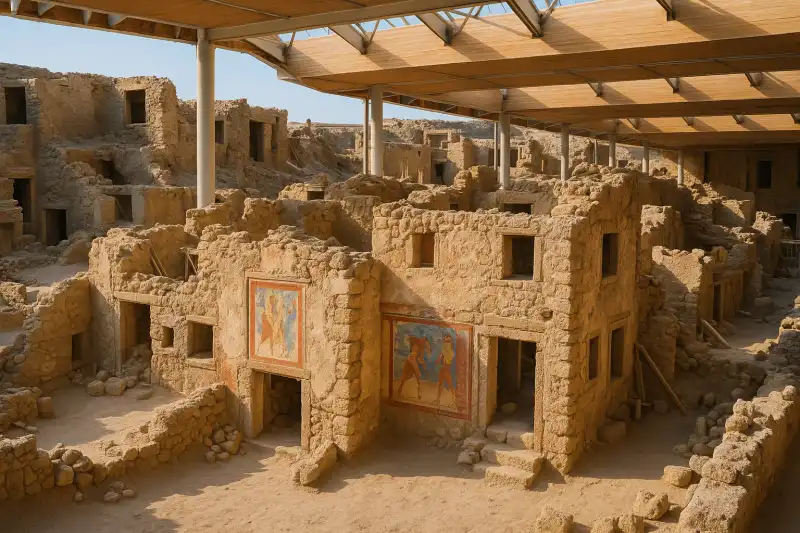
Akrotiri
Minoan / CycladicExplore Akrotiri, the Bronze Age Minoan city buried under volcanic ash on Santorini around 1613 BCE ...
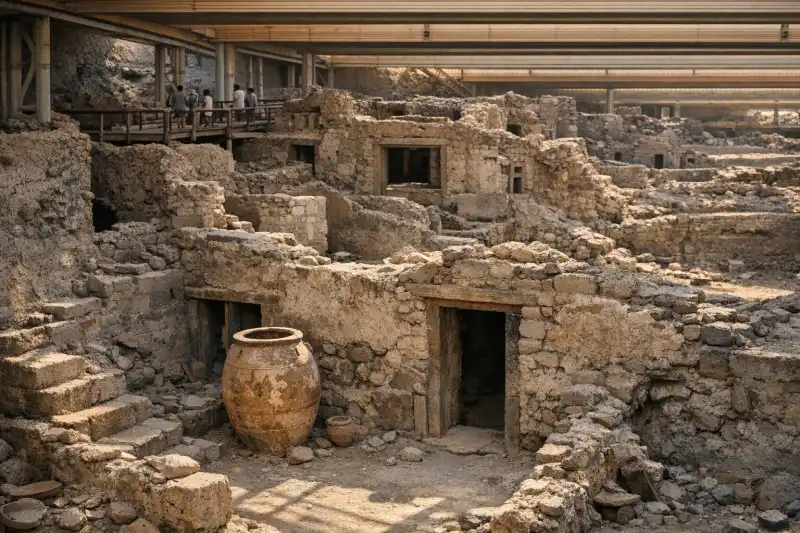
Ancient Akrotiri (Santorini)
Explore Ancient Akrotiri, the breathtaking Bronze Age settlement preserved in volcanic ash on Santor...
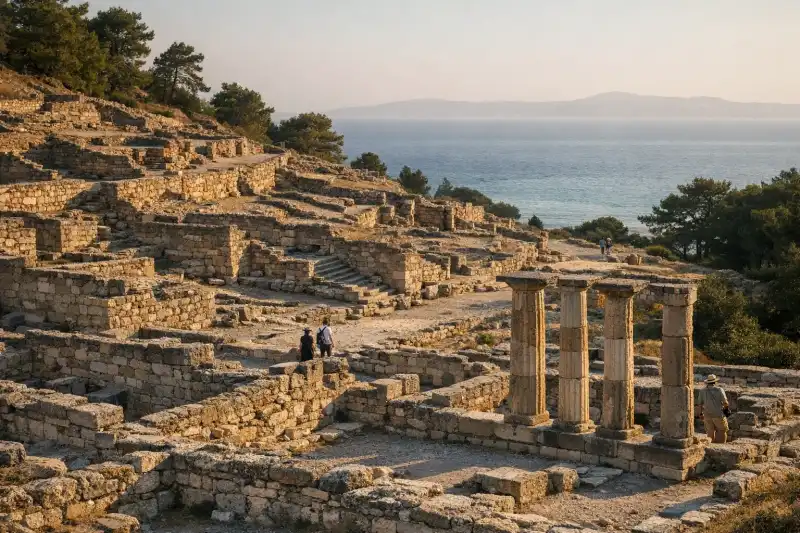
Ancient Kamiros
Ancient GreekExplore Ancient Kamiros, a remarkably preserved Hellenistic city on Rhodes offering terraces, temple...