Quick Info
Curated Experiences
Arles Roman Monuments Walking Tour
Provence Highlights: Arles, Avignon & Les Baux Small Group Tour
Arles Discovery Guided Tour
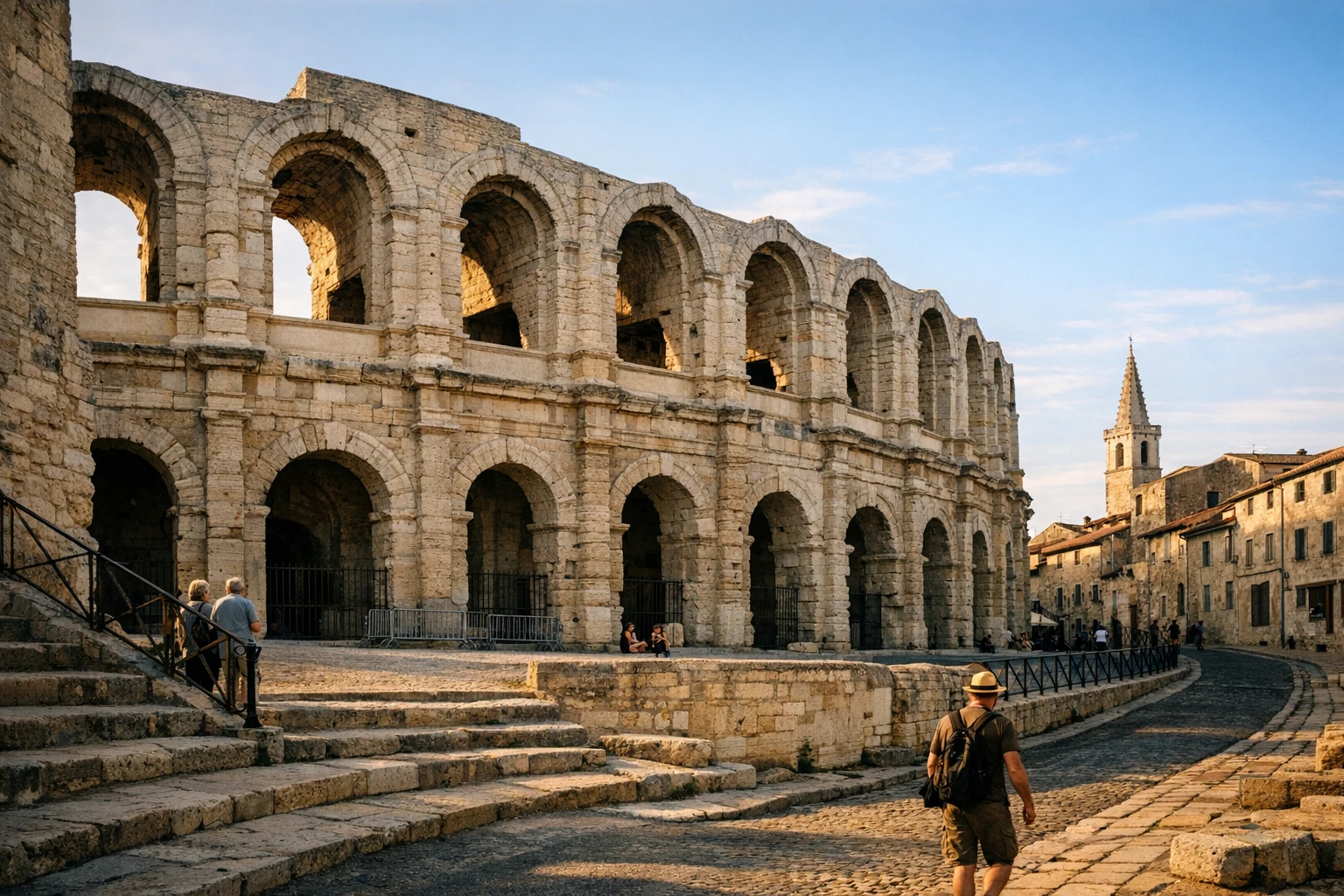
In the balmy southern reaches of France, where the sun beats down upon golden stones and the whispers of antiquity ride the warm Provençal breeze, stands the magnificent Arles Amphitheatre. Known in French as the “Arènes d’Arles,” this grand Roman arena dominates the heart of the historic city of Arles in the Provence-Alpes-Côte d’Azur region. For nearly two millennia, it has reigned as one of the finest examples of Roman architectural ambition outside Italy, bearing silent witness to the ebb and flow of history—from imperial spectacles to medieval fortifications, and now, as a beacon for travelers from around the world. As you approach its imposing outer walls, the echoes of the ancient crowds seem to linger, intermingled with the animated life of today’s Provençal markets and festivals. To visit the Arles Amphitheatre is to step into an ongoing story where the grandeur of Rome converges with the distinct imagination of southern France.
Sprawling across Arles’ historic quarter, the amphitheatre is much more than a relic or a ruin; it is a living monument, cradled by cobbled streets, vibrant cafés, and the magical, ever-changing light that so enchanted artists like Van Gogh. Its weathered arches and tiered seating are immediate reminders of the days when gladiators clashed in the dust, and thousands of citizens—Roman, Gothic, and Frankish—gathered to be thrilled, awed, and united in spectacle. Today, the Arles Amphitheatre invites visitors not only to picture these ancient scenes but to witness a modern city shaped by and still celebrating its Roman legacy. Venture within its storied walls, and you’ll find both the passage of centuries etched in stone and the enduring spirit of community alive in the present.
History
Roman Origins and Golden Age
The Arles Amphitheatre was erected in 90 AD during the reign of Emperor Domitian, a period marked by tremendous urban development across the Roman Empire. Drawing inspiration from the colossal Colosseum of Rome, the Arènes d’Arles was designed as a place for public entertainment—primarily gladiatorial games, hunts, and mock battles. Its impressive dimensions—136 meters long and 107 meters wide—allowed it to seat upwards of 20,000 spectators, making it a major social and cultural hub in Roman Gaul (modern-day southern France).
The arena was a symbol of imperial power and civic pride. Citizens from Arles and the surrounding countryside would throng its stone tiers for elaborate spectacles, ritual combats, and displays carefully staged for both entertainment and imperial propaganda. For the Roman authorities, the amphitheatre was a critical tool in establishing loyalty, celebrating military victories, and promoting Roman values through the spectacle of “bread and circuses.” The structure itself, constructed almost entirely from local limestone, echoed the design language of Roman imperial architecture, with double rows of sixty arches that provided structural strength and graceful symmetry.
Decline and Transformation in the Middle Ages
With the fall of the Western Roman Empire in the fifth century, the amphitheatre gradually lost its primary function. As Roman rule waned and Arles came under the sway of the Visigoths, then the Franks, the great games ceased and the city faced an era of instability. But the arena’s story was hardly over. In the turbulent centuries that followed, the amphitheatre’s sturdy construction, dominating position, and encircling walls made it a natural stronghold. During the early Middle Ages, the once-glorious arena was transformed into a fortified settlement. Four defensive towers were added, and the massive interior became packed with more than 200 houses, two chapels, and shops, sheltering residents from regional conflicts and invasions.
This period cemented the amphitheatre’s role as a stage for survival, adaptation, and reinvention, rather than mere entertainment. The medieval inhabitants built their lives within the ancient stone tier, forging a unique urban village within the ghostly outlines of the Roman past.
Rediscovery and Restoration
Interest in the amphitheatre’s history and beauty grew steadily in the modern era, particularly from the 18th century onwards as the Enlightenment sparked a fascination with ancient cultures. Systematic efforts to restore the arena began in the 19th century, led by figures like Prosper Mérimée and later, UNESCO, who recognized its global cultural significance. Gradually, medieval structures were cleared away, and extensive restoration programs were undertaken to preserve and showcase the Roman genius of the amphitheatre.
In 1981, the Arles Amphitheatre and other Roman monuments of Arles were inscribed as UNESCO World Heritage sites. Today, thanks to careful conservation, the arena stands as a testament to the city’s layered history, reflecting not only the grandeur of ancient Rome but the resilience and creativity of all who called it home in the centuries since. It continues to be a centre for community gatherings and events, fusing historical authenticity with vibrant local life.
Key Features
A visit to the Arles Amphitheatre reveals a masterwork of Roman engineering, cleverly adapted over time and lovingly restored in the modern era. Approaching the amphitheatre, the sheer scale of its limestone façade is awe-inspiring, with two stacked tiers of elegant arches that appear to ripple around the entire perimeter. Each level originally featured sixty arcades, designed both for visual effect and efficient movement of crowds, ensuring quick entry and exit for thousands of spectators.
Entering through the ancient gates, visitors encounter the arena’s vast elliptical interior; the original sand floor, or “arena,” rests slightly below ground level, encircled by steeply pitched rows of stone seating. Though many of the seat blocks have worn with age or been repaired, the overall structure is remarkably intact, giving a tangible sense of its former grandeur and the emotional intensity that must have pervaded the games. The “cavea,” or seating area, is divided into three horizontal sections, or “maeniana,” according to social status—a clever reminder of the rigidly hierarchical nature of Roman society.
Perhaps most striking are the four medieval stone towers that punctuate the outer ring of the amphitheatre, setting it apart from its Roman cousins and bearing witness to its centuries-long transformation into a fortified village. Inside, keen-eyed guests can also spot the foundations of the surviving medieval chapels, as well as traces of walls and doorways from the arena’s centuries as a walled residential community.
Exploring the staircases and corridors (“vomitoria”), visitors can savor a sense of anticipation mirroring that which once gripped ancient crowds. Brief passages open dramatically to the sunlight and the sweep of seats, while narrow stairways offer unexpected perspectives on the surrounding rooftops of Arles’ old town, the Rhône River, and even as far as the distant Alpilles mountains. Periodic exhibitions and interpretive signs throughout the amphitheatre illuminate its multifaceted history with models, restored artifacts, and illustrated panels, making even a self-guided wander richly informative.
Unlike many ancient monuments, the Arles Amphitheatre is not simply a relic but still serves as a vibrant community venue. Today, its arena once again hosts public spectacles, including Provençal bull games (courses camarguaises), concerts, and elaborate historical reenactments that transport modern audiences back to the days of the Roman Empire. The blending of ancient architecture and living tradition provides a unique experience—where you are both a guest in the past and a participant in the ongoing life of Arles.
Getting There
The Arles Amphitheatre lies in the heart of Arles, a well-connected city that’s easy to reach by various modes of transport, making it an accessible destination for those exploring southern France or the wider region of Provence-Alpes-Côte d’Azur. The city is served by a convenient railway station, Gare d’Arles, just a short 15-minute walk from the amphitheatre. The station sits on the main Marseille–Avignon–Nimes–Montpellier line, providing frequent TER regional train connections. From Marseille or Avignon, standard fares range from €10 to €25 one-way, with journeys typically lasting 20–50 minutes depending on direction.
For those traveling by air, the nearest major airport is Nîmes-Alès-Camargue-Cévennes Airport, about 22 kilometers away, or Marseille Provence Airport, roughly 55 kilometers distant. Each offers convenient rental car desks, regional shuttles, and taxi services into Arles; taxis from Nîmes Airport to central Arles run around €40–€60.
Arles is also easily accessible by car via the A54 autoroute, linking it efficiently to Nîmes, Avignon, and the coastal cities along the French Riviera. Metered street parking and several well-signposted city lots are available near the old town, though spaces fill quickly during peak season.
Once in the city, Arles is best explored on foot. The amphitheatre dominates the old town, its silhouette visible from many approach roads and squares. Public buses traverse the city, but visitors will find that nearly all ancient sites, including the amphitheatre, are within easy walking distance of hotels, restaurants, and other points of interest. For cyclists, Arles is a stop on the ViaRhôna greenway, making cycling a popular and scenic option, as well.
When to Visit
The Arles Amphitheatre welcomes visitors throughout the year, each season casting the ancient stones in a different light. The ideal time to visit depends on your priorities: spring and fall offer the best balance of mild weather, manageable crowds, and vibrant local festivals. From March to May and September to November, the sun is gentle, temperatures hover between 15°C and 25°C (59°F–77°F), and the city’s rhythm is relaxed yet lively.
Summer—June through August—is high season in Provence. This is when Arles hosts its internationally famous photography festival, Les Rencontres d’Arles, and a lively calendar of Provençal bull games and open-air events in the amphitheatre. Days are long, the air is warm (often exceeding 30°C/86°F), and the city buzzes with both tourists and locals. Though the increased number of visitors can mean busier streets and longer lines, the trade-off is a festive, energized atmosphere and the unique possibility of experiencing modern-day spectacles under the glow of the amphitheatre’s ancient arches. To avoid the midday heat and crowds, aim for early morning or late afternoon visits.
Winter in Arles, from December to February, is much quieter but still holds its charm, especially if you appreciate serene sightseeing without the bustle of tourists. Cool temperatures, fewer events, and occasional rain create a subdued but contemplative setting; at this time, you’ll often have the monument nearly to yourself for unhurried exploration and photography.
The amphitheatre remains open through most weather conditions, though some rooftop or upper-level access may be restricted during rain or strong winds. It’s always wise to check the official website for opening times, ticket information, and any special events that could enhance—or delay—your visit. Regardless of the season, the Arles Amphitheatre promises a dazzling encounter with the past, matched by the warm welcome and distinctive culture of southern France.
Quick Facts
| Fact | Details |
|---|---|
| Location | Arles, Provence-Alpes-Côte d’Azur, France |
| Coordinates | 43.6775° N, 4.6303° E |
| Date of Construction | 90 AD |
| Capacity (original) | Up to 20,000 spectators |
| Architectural Style | Roman, later modified in the Middle Ages |
| UNESCO World Heritage Site | Yes (since 1981, as part of Arles Roman Monuments) |
| Main Uses (past & present) | Gladiatorial combat, medieval fort, modern events |
| Accessibility | Partial; some areas are difficult for mobility-impaired |
| Notable Features | Two-tiered arcades, medieval towers, panoramic views |
| Recommended Visit Duration | 1–2 hours |
Frequently Asked Questions
What are the opening hours for Arles Amphitheatre?
Typically, the amphitheatre is open daily from 9:00 AM to 6:00 PM, but hours can vary seasonally. Check the official site before your visit.
Is the Arles Amphitheatre accessible for people with reduced mobility?
The site has some accessibility provisions, but due to steps and ancient structure, not all areas are accessible. Contact in advance for assistance.
Are guided tours available at the Arles Amphitheatre?
Yes, guided tours are available and recommended for deeper historical insight. You can book them online or onsite.
Can visitors attend events or reenactments at the amphitheatre?
Yes, the amphitheatre hosts various events, including bull games and historical reenactments, especially in spring and summer.
Is photography allowed inside the Arles Amphitheatre?
Yes, photography for personal use is allowed, but drones and commercial shoots require prior permission from the site management.
Nearby Ancient Sites
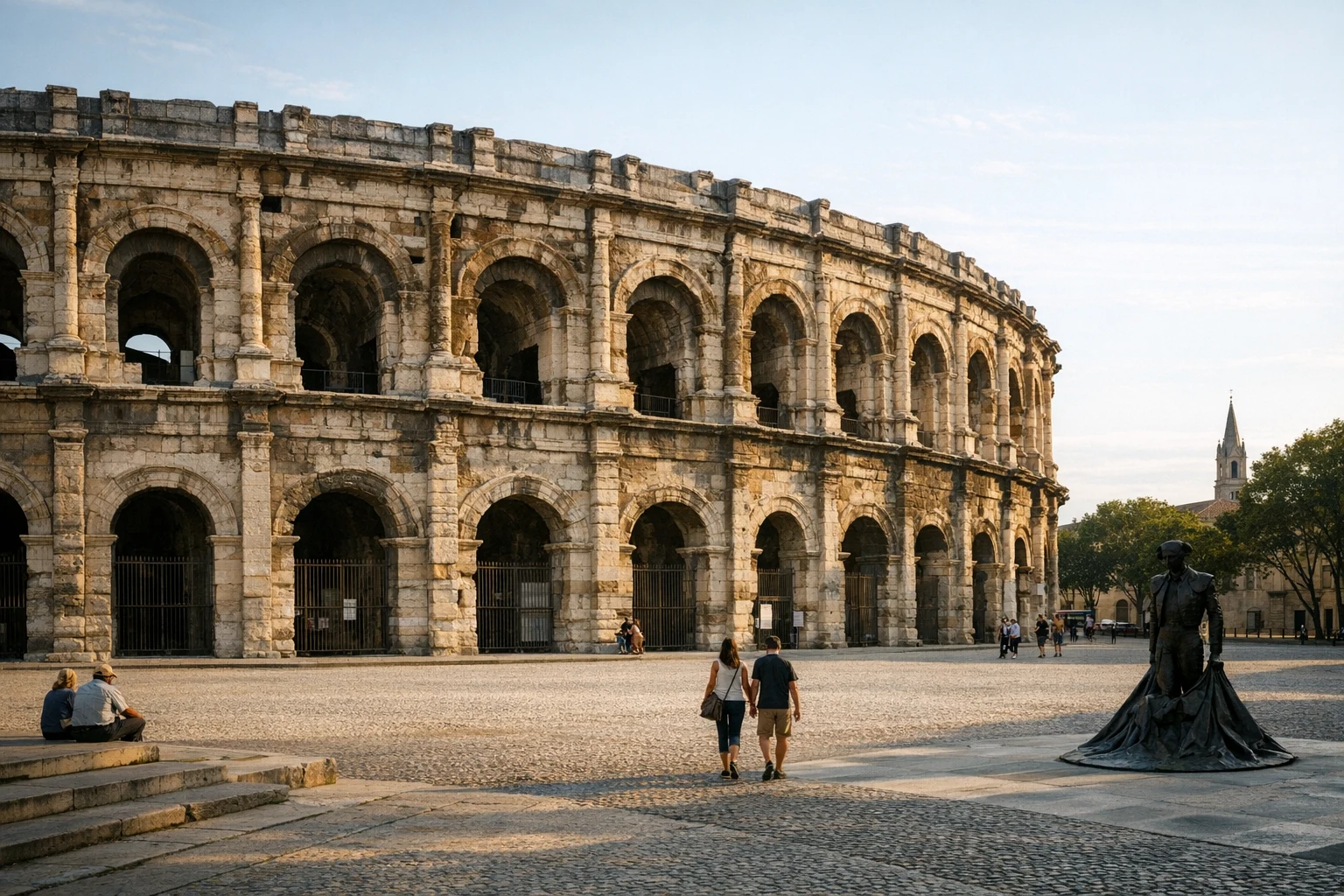
Nîmes Roman Arena
RomanExplore France’s Nîmes Roman Arena, one of the best-preserved amphitheaters in the Roman world and s...
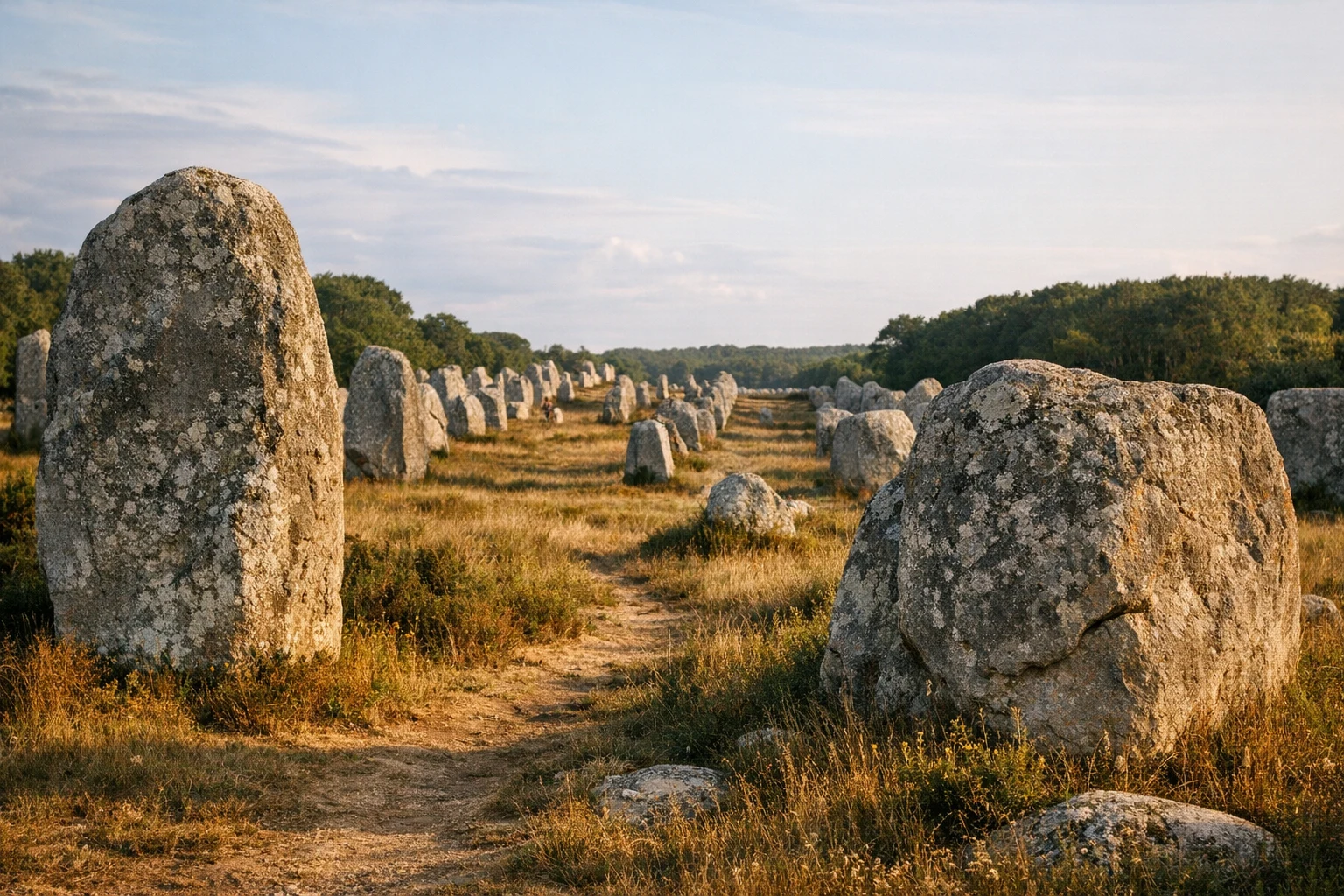
Carnac Stones
The Carnac Stones in Brittany, France, are a vast collection of Neolithic standing stones shrouded i...
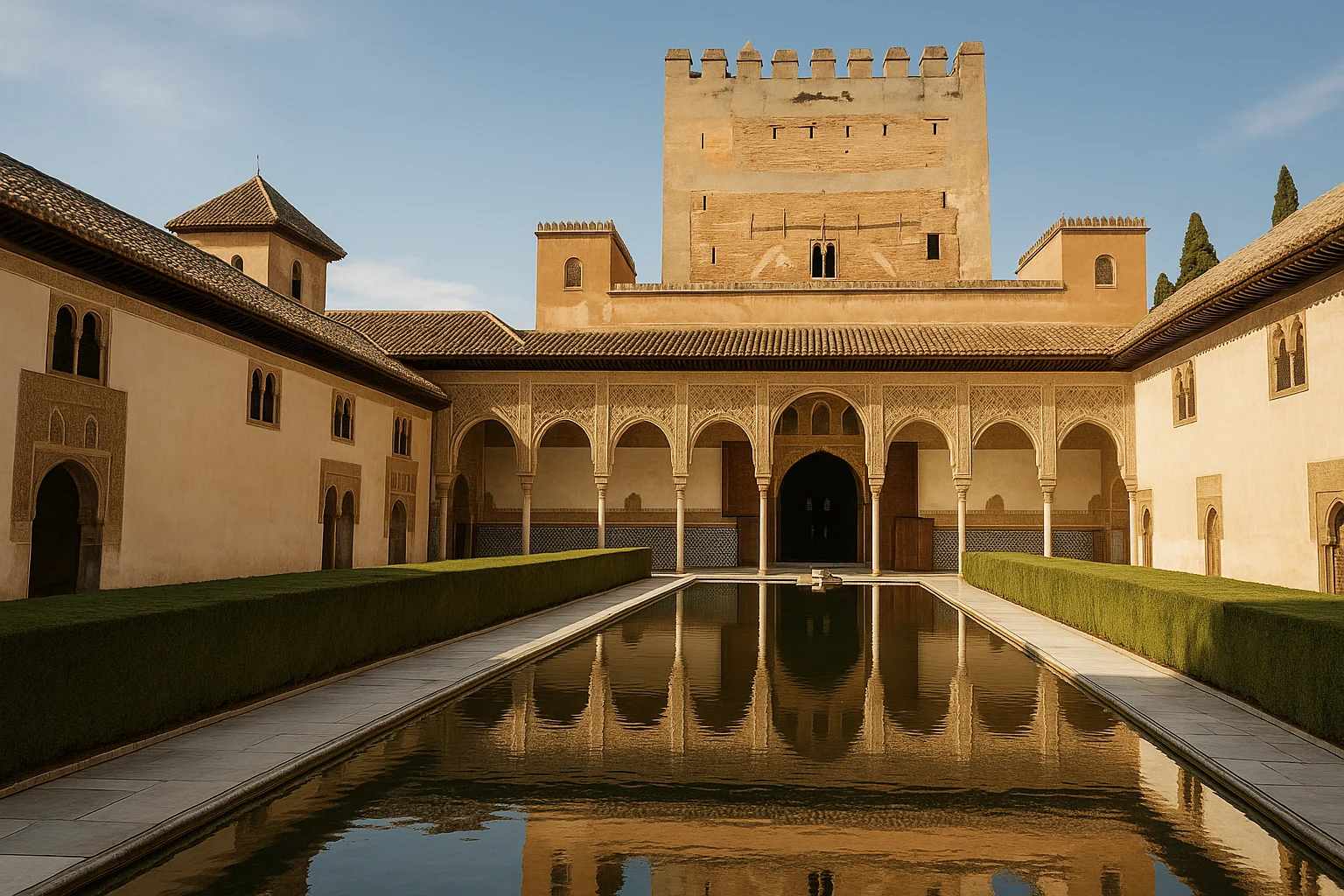
Alhambra Travel Guide 2026: Nasrid Palaces, Tickets, and Visit Strategy
Nasrid Dynasty (Moorish)Plan a well-timed visit to Granada's Alhambra with practical ticket advice, must-see highlights, and...