Quick Info
At a glance
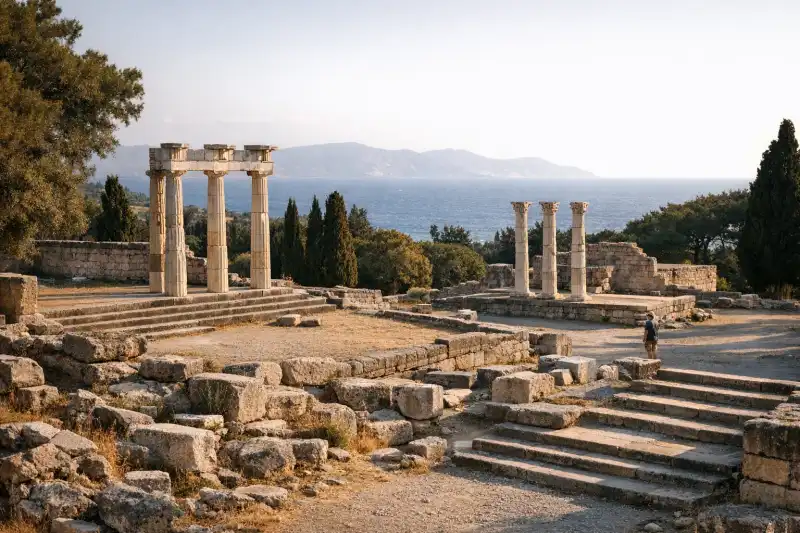
The Asklepieion of Kos in Greece is one of the most evocative ancient healing sanctuaries in the Aegean, a place where medicine, religion, and landscape were brought together with unusual care. Set on a hillside above modern Kos Town, the site unfolds across a series of terraces edged by pines and cypresses, with broad views toward the sea and the coast of Asia Minor. Even before you focus on the stones themselves, the setting helps explain why this place mattered. It was meant to heal not only through treatment and ritual, but also through air, light, order, and distance from the noise of ordinary life.
For many visitors, the Asklepieion is inseparable from the memory of Hippocrates, the physician long associated with Kos and with the foundations of rational medicine. While the sanctuary was dedicated to Asklepios, the god of healing, it also belonged to a real medical culture in which observation, regimen, bathing, rest, and environment played important roles. What survives today is a layered archaeological site rather than a single monument: stairways climbing between terraces, fragments of colonnades, altars, treatment rooms, Roman additions, and traces of sacred spaces where the sick once sought recovery. Walking here, you move through both a sanctuary and an idea: that healing could be practiced as a structured, thoughtful art within a setting designed to restore body and mind.
History
Origins of a healing sanctuary
The Asklepieion of Kos took shape in the 4th century BCE, during a period when sanctuaries devoted to Asklepios were growing in importance across the Greek world. The cult of Asklepios combined religious devotion with practical healing. Pilgrims came to such sanctuaries to pray, offer sacrifices, sleep in sacred precincts, and seek relief from illness through ritual and treatment. Kos was already well placed to support such a center. Its location on sea routes made it accessible, and the island had a reputation for medical knowledge that later tradition strongly linked to Hippocrates and his school.
The sanctuary was not built all at once. It developed gradually on a hillside west of the ancient city, organized in ascending terraces that gave the complex both visual dignity and functional separation. The lower areas may have served more practical and preparatory purposes, while upper terraces acquired increasingly sacred and prestigious roles. This arrangement mirrored the visitor’s journey from arrival to purification, treatment, worship, and contemplation.
Classical and Hellenistic expansion
During the Hellenistic period, the Asklepieion grew into one of the most celebrated healing sanctuaries in the eastern Mediterranean. Kos prospered after the synoecism of the island’s communities and the founding of the city of Kos in the late 4th century BCE. Political stability, maritime connections, and a flourishing civic identity helped support large-scale religious and public architecture, and the sanctuary benefited from that wider prosperity.
The site’s design reflects this moment of ambition. Monumental stairways connected terraces, stoas framed open spaces, and temples gave the sanctuary ceremonial focus. On the upper terrace stood the principal temple of Asklepios, while the middle terrace appears to have been a major gathering area with colonnaded structures and altar spaces. The lower level likely contained facilities connected to reception, treatment, and practical care. Such sanctuaries were not hospitals in the modern sense, but they did bring together priests, attendants, patients, and medical practitioners in a setting meant to encourage both divine favor and physical recovery.
The sanctuary also became a place of prestige for the city itself. Like theaters, agoras, and gymnasia elsewhere in the Greek world, an Asklepieion could project civic sophistication. The one at Kos expressed a local identity rooted in healing and learning, making it more than a religious center. It was a statement about what the island stood for.
Roman adaptations and continued use
Under Roman rule, the Asklepieion remained important, and the site saw further building and renovation. Roman patrons often respected older Greek sanctuaries while adapting them to changing tastes and needs. Architectural embellishments, repairs, and new facilities were added over time. Some of the remains visible today reflect these later phases as much as the original Classical layout.
The Roman period also helped spread the fame of healing cults. Travel became easier across the empire, and sanctuaries like this one attracted a broader range of visitors. Yet even as formal medical knowledge became more varied and urbanized, sacred healing retained its appeal. The Asklepieion continued to offer a blend of temple ritual, therapeutic environment, and inherited reputation. Inscriptions and architectural remains suggest a living institution rather than a relic frozen in its earliest form.
Decline, earthquakes, and rediscovery
Like many ancient sanctuaries, the Asklepieion declined gradually rather than disappearing overnight. Changes in religion during Late Antiquity reduced the role of pagan sanctuaries, and repeated earthquakes in the Aegean damaged buildings across Kos. Stone was often reused in later construction, leaving temples and stoas stripped of much of their original grandeur.
By the medieval and early modern periods, the sanctuary survived largely as a field of ruins known locally but no longer functioning in its ancient role. Modern archaeological work, especially under Italian administration in the early 20th century, brought the site back into scholarly and public view. Excavation, clearance, and partial restoration revealed the terraced plan and made the Asklepieion one of the island’s most important heritage sites. Today, what visitors encounter is the result of both ancient construction and modern archaeological presentation: a carefully interpreted ruin that still preserves the logic of ascent, healing, and sacred space.
Key Features
What makes the Asklepieion of Kos memorable is not a single intact building but the way its elements still work together. The sanctuary is arranged across three principal terraces, and this stepped composition gives the site a powerful rhythm. As you move upward, the perspective changes constantly. Looking back, the lower levels open toward the plain and the sea; looking ahead, each terrace frames the next stage of the ascent. The experience feels deliberate, almost ceremonial, and that sense of progression is one of the site’s strongest surviving qualities.
The lower terrace is often where visitors first begin to understand the practical side of the sanctuary. Here the remains are more fragmentary, but they point to the everyday operations of a healing center: access routes, service structures, and spaces likely connected to receiving visitors and supporting treatments. Even in ruin, the area suggests that this was a functioning institution that had to accommodate real people arriving with illness, hope, and expectations of care.
The middle terrace is among the most atmospheric parts of the sanctuary. This broad platform once included stoas and gathering spaces that brought order to the complex while offering shade and movement around open courts. Here you can imagine pilgrims waiting, conversing, making offerings, or preparing for ritual acts. The surviving columns and foundations do not fully reconstruct the original architecture, but they make clear that this was a formal, impressive zone where sacred and social life overlapped. The altar area added to the sense of religious focus, reminding visitors that healing here was not merely technical. It was embedded in prayer, sacrifice, and divine appeal.
Above all rises the upper terrace, where the principal temple of Asklepios stood. This was the symbolic summit of the sanctuary, both literally and spiritually. The remains are modest compared with what once existed, but the location still communicates authority. From here, the views are expansive, and the relationship between architecture and landscape becomes especially clear. Ancient visitors would have reached this level after a measured ascent through the sanctuary’s lower stages, and the culminating presence of the temple gave purpose to the entire composition.
Another defining feature is the sanctuary’s connection with nature. Trees now soften the site, but even in antiquity the hillside setting was central to its identity. Healing sanctuaries often relied on fresh air, quiet surroundings, and access to water or exercise. At Kos, the placement of the Asklepieion suggests a carefully chosen environment away from the urban center yet close enough to remain accessible. The balance of seclusion and visibility is striking. You feel removed from everyday bustle, but never isolated from the wider island landscape.
Architectural details also reward slow attention. Bases of columns, retaining walls, staircases, and reconstructed elements reveal how carefully the site was engineered. The terraces are not simply natural ledges; they are shaped spaces, disciplined by masonry and geometry. This structure reflects the sanctuary’s larger idea of healing through order. Even broken stones can convey that principle. The place was designed to calm, direct, and elevate those who entered it.
Finally, there is the intangible feature that draws many people here: the association with Hippocrates and the history of medicine. Whether every popular story can be documented precisely matters less, for many visitors, than the broader truth that Kos was a major center in the ancient healing tradition. The Asklepieion stands at the crossroads of mythic medicine and emerging clinical thought. In that sense, it is not only a ruin to look at, but a place to think about how ancient people understood sickness, care, environment, and recovery.
Getting There
The Asklepieion of Kos lies about 4 kilometers southwest of Kos Town, making it one of the island’s easiest major archaeological sites to reach. If you are staying in Kos Town, the simplest option is a taxi. A one-way ride usually takes around 10 to 15 minutes and often costs roughly €8 to €12, depending on season, luggage, and time of day. In summer, taxis are widely available around the port and central squares, though it is still wise to confirm the fare before departure.
Local buses are the most budget-friendly choice. Seasonal services from Kos Town commonly run toward the Asklepieion, with fares often around €2 to €3 each way. Timetables can vary outside the peak tourist months, so check the central bus station or ask your hotel for the latest schedule. If you miss a return bus, a taxi back into town is usually easy to arrange.
Many visitors also rent bicycles or scooters, which suit Kos well because much of the island is relatively easy to navigate. Bicycle rental can start at around €10 to €15 per day, while scooters often begin around €25 to €40 depending on model and season. If you drive a rental car, parking near the site is generally straightforward.
Walking from Kos Town is possible for travelers who enjoy a longer approach. The route takes about 50 to 70 minutes depending on your starting point and pace, with some uphill sections near the end. Bring water, especially from late spring through early autumn. Organized half-day tours are another convenient option, particularly if you want commentary on the sanctuary’s history and its link to Hippocratic medicine.
When to Visit
The best times to visit the Asklepieion of Kos are spring and autumn, especially from April to early June and from September to October. During these months, the weather is usually warm rather than oppressive, the light is clear, and the site’s hillside paths are more comfortable to explore. Spring adds wildflowers and fresh greenery to the surrounding landscape, while autumn often brings mellow temperatures and a calmer atmosphere after the high summer rush.
Summer is the busiest season on Kos, and the Asklepieion can become hot by late morning. July and August often see temperatures climbing above 30°C, with intense sun reflecting off the stone surfaces. If you visit in midsummer, aim to arrive early, ideally when the site opens, or later in the afternoon if operating hours allow. Early visits bring softer light for photography and a quieter experience among the terraces. A hat, sunscreen, and plenty of water are essential.
Winter is the least crowded period, and some travelers appreciate the more reflective mood of the ruins under cooler skies. Temperatures are generally mild compared with much of Europe, but rain and wind are more likely, and transport services may be less frequent. If you come in winter, check opening times in advance.
Whenever you visit, try to allow enough time to move slowly between terraces rather than rushing through. The Asklepieion is a site best appreciated through atmosphere and sequence. Light, air, and views are part of the monument, and the best visit is one that leaves room to notice them.
| Quick Facts | Details |
|---|---|
| Location | Near Kos Town, Kos Island, Greece |
| Region | South Aegean |
| Main Significance | Ancient healing sanctuary dedicated to Asklepios |
| Associated Figure | Hippocrates |
| Established | 4th century BCE |
| Civilization | Ancient Greek, later Roman use |
| Layout | Multi-terraced sanctuary on a hillside |
| Best Visit Length | 1.5 to 2.5 hours |
| Best Seasons | Spring and autumn |
| Access | Bus, taxi, car, scooter, bicycle, or walk from Kos Town |
A visit to the Asklepieion of Kos is rewarding precisely because the site asks for a different kind of attention than a single spectacular temple or theater. Its power lies in sequence, setting, and idea. You move uphill through spaces where ancient people sought relief from pain, guidance from a god, and perhaps confidence in the growing skills of physicians. The surviving ruins are fragmentary, but the sanctuary’s original logic still speaks clearly: healing was not confined to one chamber or one ritual but unfolded through architecture, movement, environment, and belief.
That makes the Asklepieion feel unexpectedly modern as well as ancient. Its emphasis on fresh air, calm surroundings, and the relationship between body and place still resonates today. Combined with its connection to the medical reputation of Kos, the sanctuary offers more than scenic ruins. It offers a lens onto how the ancient world understood wellness. For travelers interested in Greek archaeology, the history of medicine, or simply one of the most beautifully sited monuments in the Dodecanese, the Asklepieion is one of the island’s essential experiences.
Guided tours: worth it?
Most travelers can visit Asklepieion of Kos independently. Compare a tour only if you want a tighter history-focused visit, easier logistics, or a guide who can answer questions on the spot.
Best for
- Short visits where a planned route saves time
When to go self-guided
Go independently if you prefer setting your own pace, reading as you go, and checking official hours or ticket rules directly before you arrive.
What I’d avoid
Skip paid tours that bundle unrelated stops you do not actually want. The best option should either save meaningful planning time or add historical context you would miss on your own.
Kos Asklepieion Tours
Useful when: you want to compare guided formats before deciding
Kos Island Ancient Sites Tours
Useful when: you want to compare guided formats before deciding
Hippocrates and Asklepieion of Kos Tours
Useful when: you want to compare guided formats before deciding
Some tour links are affiliate links, which may earn Ancient Travel a small commission at no extra cost to you. I try to surface options that make practical sense for the site—not just anything bookable.
Frequently Asked Questions
What is the Asklepieion of Kos?
The Asklepieion of Kos is an ancient healing sanctuary dedicated to Asklepios, the Greek god of medicine, located on the island of Kos in Greece.
Is the Asklepieion of Kos connected to Hippocrates?
Yes. Kos is traditionally associated with Hippocrates, and the sanctuary reflects the island's long reputation for medical learning and healing practices.
How much time should I allow for a visit?
Most travelers spend 1.5 to 2.5 hours exploring the terraces, ruins, pathways, and museum displays at a comfortable pace.
Can I reach the Asklepieion of Kos without a car?
Yes. You can reach the site by local bus, taxi, bicycle, organized tour, or on foot from Kos Town if you are prepared for a longer uphill walk.
What should I bring when visiting?
Bring water, sun protection, comfortable walking shoes, and a camera. The site is exposed in places, especially during the warmer months.
When is the best time to visit the Asklepieion of Kos?
Spring and autumn are ideal for mild temperatures, but early mornings in summer also work well if you want fewer crowds and softer light.
Nearby Ancient Sites
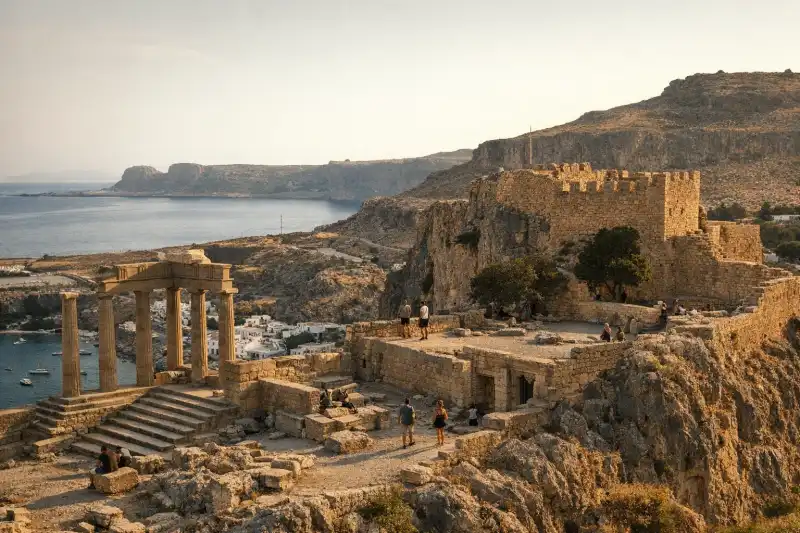
Acropolis of Lindos
Ancient Greek, Hellenistic, Roman, Byzantine, Knights HospitallerThe Acropolis of Lindos on Rhodes, Greece, is a spectacular ancient citadel blending Classical and m...
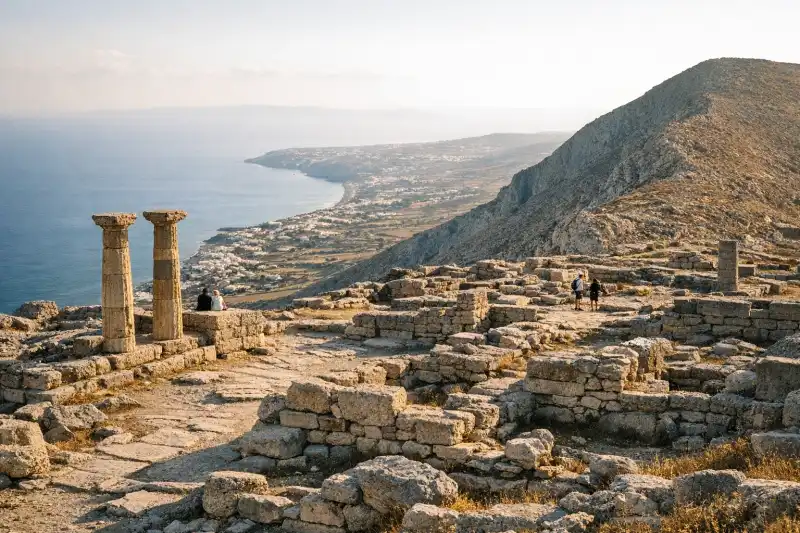
Ancient Thera
Ancient Greek, Roman, ByzantineExplore Ancient Thera in Greece, a dramatic mountaintop city on Santorini with Hellenistic, Roman, a...
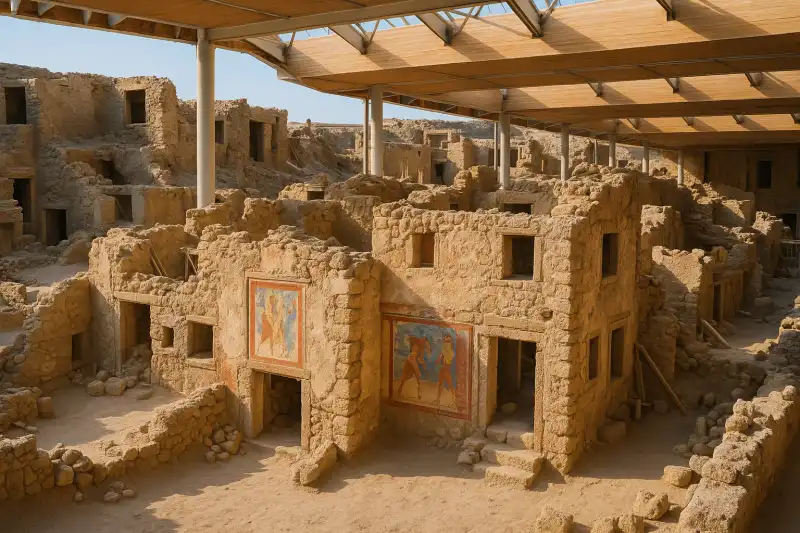
Akrotiri
Minoan / CycladicExplore Akrotiri, the Bronze Age Minoan city buried under volcanic ash on Santorini around 1613 BCE ...