Quick Info
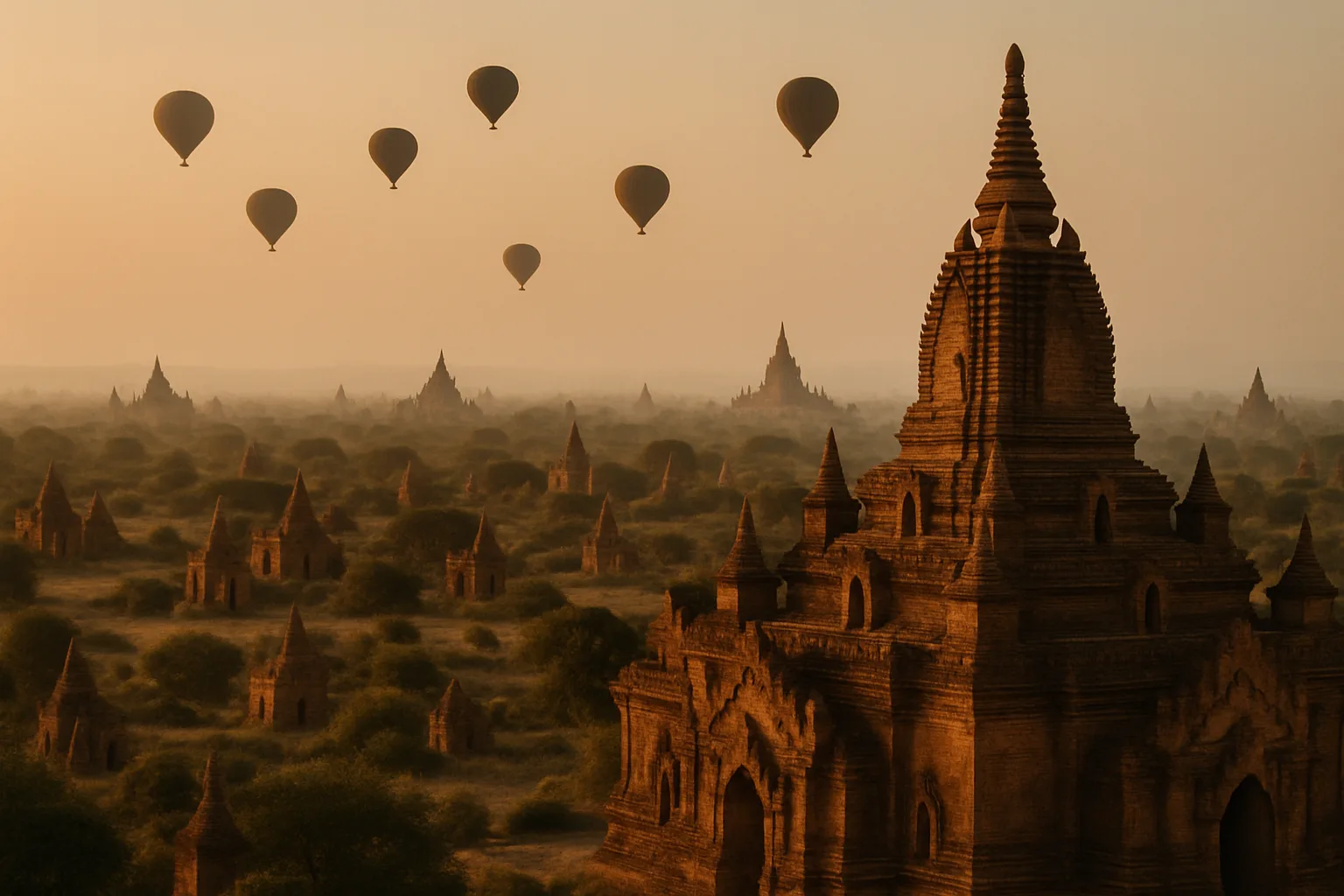
On the parched plains of central Myanmar, where the Irrawaddy River bends toward the distant Himalayas, thousands of brick-red temples and gilded pagodas pierce the dawn mist—a landscape so surreal it seems conjured from myth rather than history. This is Bagan (formerly Pagan), the ancient capital of the Pagan Kingdom and the birthplace of Burmese civilization.
Between the 11th and 13th centuries, Bagan’s kings and wealthy subjects constructed over 10,000 Buddhist monuments, creating the world’s densest concentration of religious architecture. Though earthquakes, invasion, and time have reduced that number to 2,200 surviving temples, the scale remains staggering: pagodas the size of cathedrals, temples with vaulted corridors predating Europe’s Gothic architecture, and frescoed interiors preserving 800-year-old murals.
Inscribed as a UNESCO World Heritage Site in 2019, Bagan offers what many travelers consider Southeast Asia’s most romantic temple experience—one best savored from a hot air balloon at sunrise, an e-bike on dusty trails, or a quiet temple rooftop as the sun bleeds gold across the Irrawaddy. Unlike Angkor’s jungle reclamation, Bagan’s temples stand exposed on open plains, creating a landscape of haunting, accessible beauty.
Where Is Bagan? Gateway to Ancient Burma
Bagan sits in the Mandalay Region of central Myanmar, approximately 600 kilometers north of Yangon and 180 kilometers southwest of Mandalay. The archaeological zone sprawls across 104 square kilometers of relatively flat terrain, making exploration easier than at many comparable sites.
Getting to Bagan:
By Air: Nyaung-U Airport (NYU) serves Bagan with daily flights from:
- Yangon (80 minutes)
- Mandalay (30 minutes)
- Heho (Inle Lake, 40 minutes)
By Bus:
- From Yangon: 9–10 hours overnight (most popular)
- From Mandalay: 4–5 hours
- Modern tourist buses offer reclining seats and air conditioning
By Train: Slow but scenic options connect from Yangon (16+ hours) or Mandalay (8+ hours). The tracks pass through countryside unchanged for generations.
By Boat: The Irrawaddy ferry from Mandalay (9–12 hours, dry season only) provides a leisurely approach through riverside villages and golden pagodas.
The Golden Age of Pagan (1044–1287): Empire & Faith
Bagan’s extraordinary temple-building spree emerged from a unique convergence of political power, religious devotion, and economic prosperity.
Foundation: While temples existed earlier, King Anawrahta (1044–1077) unified the region and established Theravada Buddhism as the state religion. His conquest of the Mon kingdom of Thaton brought scriptures, craftsmen, and architectural knowledge to Pagan.
The Building Boom: Successive kings competed to demonstrate their piety through temple construction. Over two centuries, 10,000+ structures rose across the plain. Wealthy subjects followed suit, believing temple-building generated merit for better rebirth. The result was a sacred landscape unprecedented in scale.
Architectural Innovation: Bagan’s architects developed sophisticated techniques for brick construction, vaulting, and mural painting. The city’s hollow temples (gu) with their corbelled vaults represent engineering achievements that predated European Gothic cathedrals by centuries.
The Fall: Mongol invasions under Kublai Khan (culminating in 1287) ended Pagan’s political dominance. Earthquakes—including major events in 1839, 1975, and 2016—claimed thousands of structures. Neglect, vandalism, and 19th-century “restorations” damaged many survivors.
Modern Revival: UNESCO World Heritage inscription in 2019 brought international attention and conservation standards. Modern restoration follows scientific principles, preserving Bagan for future generations.
Bagan’s Temple Architecture: Stupas vs. Hollow Temples
Understanding Bagan’s building types enhances appreciation of the landscape:
Stupas (Zedis): Solid structures containing relics or Buddha images. They cannot be entered. Examples include:
- Shwezigon Pagoda: The holiest, covered in gold leaf
- Dhammayazika Pagoda: Unique pentagonal design
- Shwesandaw Pagoda: Popular sunset viewpoint
Hollow Temples (Gu): Structures with interior chambers housing Buddha images. Visitors can enter and circumambulate. Key examples:
- Ananda Temple: Four standing Buddhas facing cardinal directions
- Thatbyinnyu Temple: The tallest, with five receding terraces
- Dhammayangyi Temple: The largest by mass, with mysterious bricked-up passages
Key Features to Observe:
- Jataka murals: Paintings depicting the Buddha’s previous lives
- Stucco work: Decorative elements on exteriors and around doorways
- Buddha images: Varying in mudra (hand position) and expression
- Bell-shaped zedis: The classic Myanmar pagoda profile
The Big 5 Temples: Ananda, Thatbyinnyu, Dhammayangyi & More
While Bagan rewards wandering, five temples stand out as essential:
1. Ananda Temple (1091 CE) The masterpiece of Bagan architecture, constructed by King Kyanzittha. Its cruciform design houses four standing Buddha statues, each facing a cardinal direction. The Gautama Buddha (facing west) features a fascinating optical illusion—the face appears sad up close but smiles from a distance. The temple’s corridors contain thousands of terracotta tiles depicting Jataka tales.
2. Thatbyinnyu Temple (1150 CE) At 66 meters, Bagan’s tallest temple dominates the skyline and is visible from virtually anywhere in the zone. King Alaungsithu’s creation represents a transition between earlier Mon-influenced styles and later Burmese aesthetics. The five receding terraces create an elegant profile, though the interior is less impressive than Ananda’s.
3. Dhammayangyi Temple (1167–1170) The largest temple by mass, this brooding structure was built by King Narathu in atonement (according to some accounts) for murdering his father and brother. Its mysterious bricked-up inner passages have never been fully explained—possibly unfinished, possibly concealing something, possibly structural reinforcement. The fine brickwork (no mortar visible) demonstrates the height of Bagan craftsmanship.
4. Shwezigon Pagoda (1102 CE) The most sacred pagoda in Bagan, believed to contain Buddha bone and tooth relics. Its golden stupa follows the classic bell-shaped design that influenced virtually all subsequent Burmese pagodas. Pilgrims gather here year-round, and the temple complex includes four bronze Buddha statues and numerous smaller shrines.
5. Sulamani Temple (1183 CE) Known as the “Crowning Jewel,” this temple showcases the height of Bagan’s interior decoration. Its frescoes—though damaged by the 2016 earthquake—still display sophisticated painting techniques and vibrant colors. The temple’s name means “Crown Jewel,” fitting for its refined architectural details.
Honorable Mentions:
- Htilominlo Temple (1218 CE): The last major temple built before the Mongol invasion
- Manuha Temple (1067 CE): Built by a captive Mon king; three seated Buddhas appear cramped in their chamber
- Mahabodhi Temple: A replica of the famous temple at Bodh Gaya, India
Bagan Hot Air Balloon: Southeast Asia’s Most Magical Flight
While Angkor has sunrise at Angkor Wat and Hampi has bouldering, Bagan’s signature experience is undoubtedly hot air ballooning over the temple plains at dawn. This is one of the world’s most spectacular balloon journeys and the activity that most justifies Bagan’s premium pricing.
The Experience:
- Timing: 5:30–7:00 AM launches for golden hour
- Duration: 45–60 minutes flight time
- Altitude: Tree-level to 2,000+ feet
- Views: Panoramic Irrawaddy River views; thousands of temples; distant mountains
- Champagne: Traditional landing toast included
Why It’s Special: The combination of scale (2,000+ temples visible), accessibility (open plains allow low flights), and atmosphere (morning mists rising from the Irrawaddy) creates an experience unmatched at other archaeological sites. Photographs barely capture the magic of floating silently above a sea of ancient spires as the sun paints them gold.
Operators (2026 Season):
- Balloons Over Bagan: Pioneer operator; 12 balloons; premium service with the longest track record
- Oriental Ballooning: Smaller baskets; more personalized experience
- Golden Eagle: Budget option; newer fleet
Pricing:
- Standard flight (12–16 passengers): $320–380 USD
- Premium flight (8 passengers): $420–480 USD
- Private charter: $2,500+ USD
Season: October–March only (wind conditions make summer flying unsafe)
Booking Tips:
- Reserve 2–3 months ahead for December–January peak season
- Reconfirm your flight 24 hours in advance (weather cancellations are common)
- Bring layers—it can be cold at altitude before sunrise
Budget Alternative: If balloons are out of reach, sunrise from temples like Pyathada, Bulethi, or North Guni offers 80% of the magic at 0% of the cost.
E-Bike Temple Hopping: DIY Exploration Guide
The most popular and practical way to explore Bagan is by electric bicycle (e-bike)—offering the freedom of independent exploration without the effort of pedaling in tropical heat.
Why E-Bikes:
- Range: 30–50 kilometers on a charge—sufficient for a full day of temple hopping
- Speed: Comfortable cruising at 25–30 km/h on flat terrain
- Accessibility: No license required; simple operation
- Cost: $5–8 per day for rental
- Environmental: Quiet and emission-free
Rental Tips:
- Test the battery level before departing; newer batteries are more reliable
- Carry the rental shop’s phone number for emergencies
- Bring sunscreen, water, and a scarf for dust protection
- Helmets are rarely provided but worth requesting
Navigation:
- Download offline maps (Maps.me has excellent temple locations)
- The main roads are paved; smaller temple paths are sandy
- Temples are everywhere—you can’t really get lost
- Popular temples have signs; hidden gems require exploration
Route Suggestions:
- The Classic Circuit: Ananda → Thatbyinnyu → Dhammayangyi → Shwesandaw (sunset)
- The Hidden Gems: Explore the area north of Old Bagan for lesser-visited temples
- The Riverside Route: Follow the Irrawaddy for scenic pagoda views
Safety:
- Watch for sandy patches that can cause skids
- Be cautious at intersections—local traffic rules are flexible
- Park at designated areas near major temples
- Lock your e-bike when exploring on foot
Best Sunrise & Sunset Spots (Away from the Crowds)
Bagan’s popularity means the most famous viewpoints can become uncomfortably crowded. Savvy travelers seek lesser-known alternatives:
Sunrise Spots:
- Shwesandaw Pagoda: The classic (and most crowded) choice; four-sided viewing terraces
- Pyathada Paya: Less crowded with excellent eastern views
- Bulethi Temple: Popular with photographers; three terraces
- Myauk Guni (North Guni): Requires a short climb but rewards with solitude
- From a Hot Air Balloon: The ultimate sunrise experience
Sunset Spots:
- Shwesandaw Pagoda: Again, the most popular (arrive 45 minutes early)
- Pyathada Paya: Excellent western exposure; fewer people
- Dhammayazika Pagoda: Pentagonal design with 360-degree views
- North Guni: Climb the narrow stairs for panoramic views
- Bupaya: Riverside location with Irrawaddy reflections
Photography Tips:
- Arrive 45–60 minutes before official sunrise/sunset times
- Bring a tripod for low-light shots
- Wide-angle lenses capture the landscape scale
- Telephoto lenses compress the temple layers
- The golden hour extends 30 minutes after sunset
Avoiding Crowds:
- Visit lesser-known temples like Thitsarwadi, Laymyethna, or Nandamannya
- Explore the “Central Plain” area between Old and New Bagan
- Consider visiting popular temples at midday when most tourists rest
Bagan vs. Angkor: Which Temple Destination Wins?
Travelers often debate which Southeast Asian temple complex offers the better experience. Here’s an honest comparison:
Bagan Advantages:
- Scale & Density: 2,200 temples across 104 km² vs. Angkor’s concentrated clusters
- Accessibility: Flat terrain and e-bikes make exploration easy
- Ballooning: The hot air balloon experience has no Angkor equivalent
- Open Landscape: Temples on exposed plains create sweeping vistas
- Lower Crowds: Outside peak season, you can find solitude
- Cost: Generally less expensive than Siem Reap
Angkor Advantages:
- Architectural Grandeur: Individual temples like Angkor Wat exceed Bagan’s largest
- Jungle Atmosphere: Trees engulfing temples create iconic photography
- Tomb Raider Mystique: Famous film locations add cultural resonance
- Infrastructure: Better roads, more luxury hotels, more dining options
- Cambodia Convenience: Easier visas, more international flights
- Ta Prohm: The “jungle temple” experience is unique
The Verdict:
- For romantic atmosphere and scale: Choose Bagan
- For architectural wow-factor and jungle mystique: Choose Angkor
- For the best experience: Visit both (many travelers do)
Our Take: Bagan’s hot air balloon sunrise and the ability to explore freely on e-bikes create a sense of discovery that Angkor’s structured circuit sometimes lacks. But Angkor Wat at dawn remains one of humanity’s greatest architectural achievements.
Where to Stay: Nyaung-U, Old Bagan & New Bagan
Bagan’s accommodation areas offer distinct experiences:
Nyaung-U (Recommended for most travelers): The best all-around base, offering the widest range of prices, the most restaurants, and easy airport access.
- Vibe: Lively, convenient, backpacker-friendly
- Budget: Guesthouses $15–30; mid-range $40–80; boutique $100–150
- Best for: Budget travelers; solo travelers; those prioritizing dining and nightlife
- Access: 4 km to main temple zone; e-bike or taxi required
- Top picks:
- Ostello Bello Bagan (social hostel with pool)
- Bagan Lodge (boutique with character)
- Shwe Poe Eain Hotel (mid-range with rooftop views)
Old Bagan: Staying inside the archaeological zone puts temples at your doorstep and offers the most atmospheric experience.
- Vibe: Resort-style, quieter, limited dining options
- Budget: Luxury resorts $150–400
- Best for: Honeymooners; luxury travelers; photographers wanting early access
- Note: Government regulations restricted new construction; options are limited
- Top picks:
- Aureum Palace Hotel & Resort (temple-view rooms, pool)
- Bagan Thiripyitsaya Sanctuary Resort (riverside, heritage property)
- Tharabar Gate Hotel (boutique, near old gate)
New Bagan: Purpose-built for tourism after the 1990 earthquake, this area offers mid-range comfort without the archaeological zone premium.
- Vibe: Quiet, residential, spread out
- Budget: Mid-range $50–100; some budget options
- Best for: Families; those wanting peace; longer stays
- Note: Furthest from main temple clusters; e-bike essential
- Top picks:
- Amazing Bagan Resort (family-friendly with pool)
- Kumudara Hotel (riverside sunset views)
Booking Tips:
- Book well ahead for December–January peak season
- Many hotels offer e-bike rental on-site
- Check reviews for “temple views”—some are better than others
- Pool access is worth the premium in hot season
3-Day Bagan Itinerary: Old, New & Secret Temples
Day 1: The Essential Bagan
- Sunrise: Shwesandaw Pagoda or hot air balloon
- Morning: Ananda Temple and Thatbyinnyu Temple
- Lunch: Restaurant in Nyaung-U or Old Bagan
- Afternoon: Dhammayangyi Temple and surrounding smaller temples
- Sunset: Pyathada Paya or riverside location
- Evening: Dinner at a Nyaung-U restaurant
Day 2: The Hidden Gems
- Sunrise: Bulethi Temple or Myauk Guni
- Morning: Explore temples north of Ananda (Thitsarwadi, Laymyethna)
- Lunch: Picnic at a quiet temple; many have shaded areas
- Afternoon: Visit Shwezigon Pagoda and nearby workshops
- Sunset: Dhammayazika Pagoda
- Evening: Sunset river cruise on the Irrawaddy
Day 3: Deeper Exploration
- Sunrise: Your favorite spot from previous days
- Morning: Minnanthu area temples (Payathonzu, Nandamannya, Kyat Kan Kyaung)
- Lunch: Try traditional Myanmar cuisine at a local restaurant
- Afternoon: Visit Bagan Archaeological Museum (cool and informative)
- Late afternoon: Explore lacquerware workshops in Myinkaba village
- Sunset: Final temple visit or balloon flight if rescheduled
Extensions:
- Day 4: Day trip to Mount Popa (volcanic plug with Nat shrine)
- Day 5–7: Continue to Mandalay or Inle Lake
Quick Facts
| Attribute | Details |
|---|---|
| Location | Mandalay, Myanmar |
| Country | Myanmar |
| Region | Mandalay |
| Civilization | Pagan Kingdom (Burmese) |
| Historical Period | 11th–13th century CE |
| Established | c. 1044 CE (Bagan kingdom) |
| Coordinates | 21.1717, 94.8585 |
Explore More Temple Destinations
- Angkor Wat: Cambodia’s magnificent Khmer temples
- Borobudur: Indonesia’s Buddhist monument
- Hampi: India’s Vijayanagara ruins among boulders
- Sigiriya: Sri Lanka’s Lion Rock fortress
Learn essential travel skills with our beginner’s guide and tips for photographing ruins. Traveling on a budget? See our budget archaeological travel guide.
|-----------|---------| | Location | Mandalay Region, central Myanmar | | UNESCO Status | World Heritage Site (2019) | | Ancient Name | Arimaddanapura (“City that Tramples on Enemies”) | | Empire Period | 849–1287 CE (Pagan Kingdom) | | Peak Construction | 11th–13th centuries | | Original Temples | 10,000+ (2,200 survive) | | Site Area | 104 km² archaeological zone | | Nearest Airport | Nyaung-U (NYU), 4 km from Nyaung-U town | | Best Time | November–February (cool, dry) | | Suggested Stay | 3 days |
Frequently Asked Questions
How do I get to Bagan?
Fly into Nyaung-U Airport from Yangon (45 minutes) or Mandalay (30 minutes). Buses run from Mandalay (5-6 hours) and Yangon (9-10 hours). Most travelers combine Bagan with Mandalay and Inle Lake in a Myanmar circuit.
What is the best way to explore Bagan's temples?
E-bikes are the perfect vehicle for Bagan—quiet enough not to disturb the atmosphere, fast enough to cover ground between temples, and easily rented for $7-10/day. Horse carts offer a more traditional experience. Reserve hot air balloon rides for sunrise: an unmissable Bagan experience that needs 2-3 month advance booking in peak season.
Can I climb Bagan's temples?
Following UNESCO designation in 2019 and structural concerns, most temple climbing is now prohibited. A few select temples maintain designated viewing platforms. The views from ground level and from permitted platforms remain spectacular.
What is the best time to visit Bagan?
November through February offers dry weather with mild temperatures (25–32°C), ideal conditions for temple exploration. March and April bring extreme heat. The rainy season (May-October) sees fewer crowds and lush green surroundings but some temples may be inaccessible.
How long do you need in Bagan?
Three days is the sweet spot: Day 1 for the major temples and orientation, Day 2 for the lesser-visited gems by e-bike, Day 3 for sunrise balloon or early morning exploration. Two days is workable if time is short. A week could easily be spent here without running out of temples.
Nearby Ancient Sites
Angkor Wat Travel Guide 2026: Everything You Need to Know
KhmerAngkor Wat, the world's largest religious monument, spans over 400 acres in the heart of Cambodia. T...
Borobudur Temple, Indonesia: The Sacred Mountain of a
Sailendra Dynasty (Buddhist)Discover Borobudur, the world's largest Buddhist temple and Indonesia's most visited attraction. Com...