Quick Info
Curated Experiences
Angkor Temples Sunrise Tour Including Baksei Chamkrong
Small Circuit Angkor Tour: Bayon, Baksei Chamkrong, Angkor Wat
Private Guided Tour of Hidden Angkor Temples
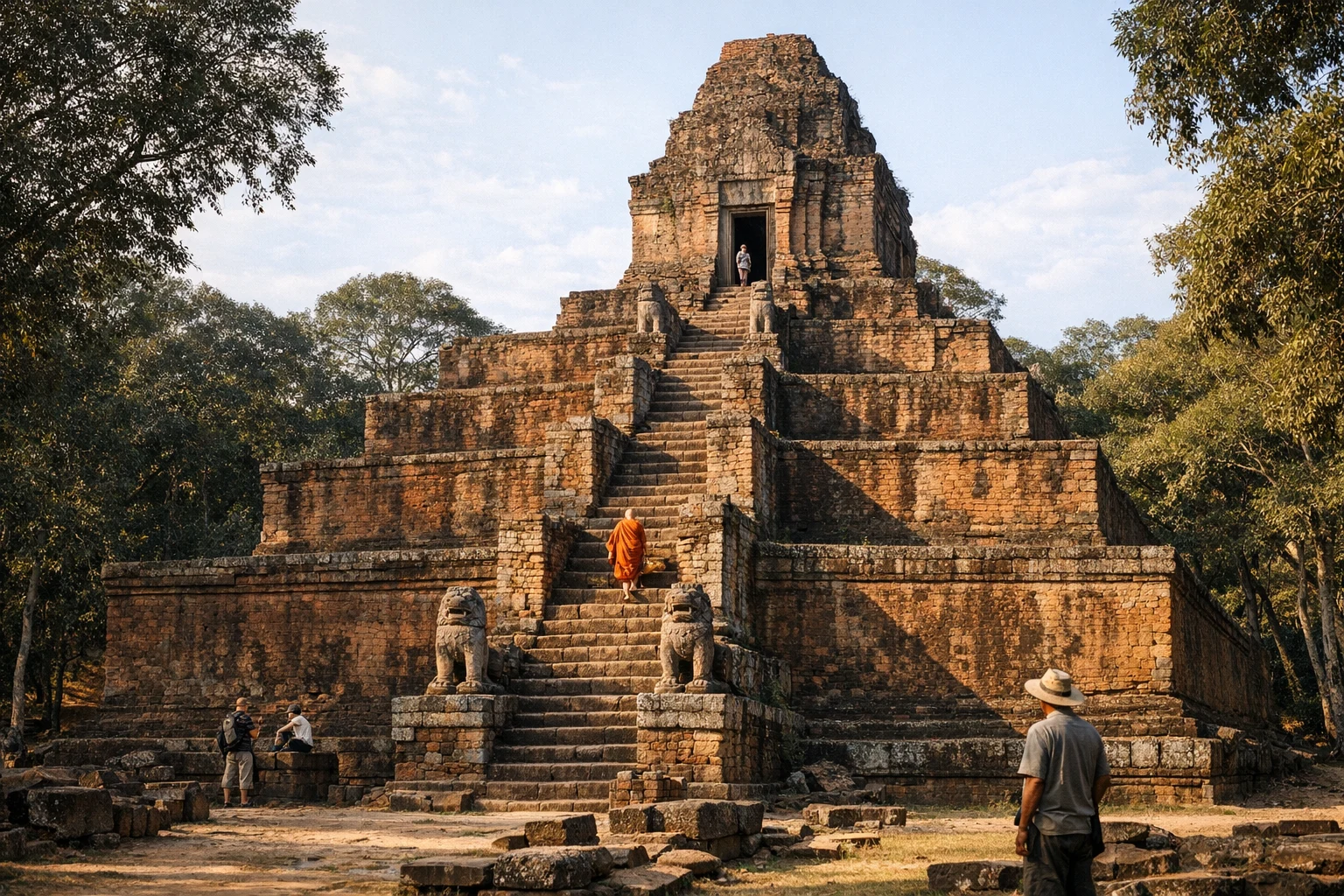
Nestled at the edge of the mighty Angkor complex in Siem Reap, Cambodia, the captivating temple of Baksei Chamkrong rises from the forest like a mysterious vestige of the Khmer Empire’s spiritual and artistic heights. Within the first light of dawn, the ancient bricks glow with a soft, golden hue, and the temple’s angular pyramid silhouette stands in perfect counterpoint to the vibrant green of the surrounding jungle. As you approach from the south gate of Angkor Thom—one of the principal arteries of this globally renowned UNESCO World Heritage Site—Baksei Chamkrong appears both intimate and monumental, an architectural gem often overlooked by the crowds flooding Angkor Wat just a few kilometers away.
Baksei Chamkrong’s name translates as “The Bird Who Shelters Under Its Wings,” evoking a legendary king protected by a mythical bird—a fitting metaphor for the enduring presence of this serene sanctuary across more than a thousand years of history. Built in the early 10th century as both a Shiva shrine and a tribute to royal ancestors, the temple is a testament to Angkor’s unique blend of spiritual devotion and grand vision. Smaller than its more illustrious neighbors but no less remarkable in its own right, Baksei Chamkrong invites visitors to discover the artistry and spirituality of the Khmer world on a more human scale. Shadows of ancient trees play across the four tiers of its sandstone pyramid, and visitors are transported back through the ages, connecting with a living past in a space where history still whispers through mossy carvings and weathered lintels. Whether you are an Angkor first-timer or a repeat explorer seeking the temple’s tranquil magic, Baksei Chamkrong offers a welcoming gateway into the soul of Cambodia’s cultural heart.
History
Origins in the 10th Century: Royal Devotion and Divine Tribute
The rise of Baksei Chamkrong is intimately tied to Cambodia’s tumultuous 10th-century political landscape and the enduring strength of the Khmer faith. Construction began during the reign of King Harshavarman I (c. 910–923 CE), a pivotal era that saw Angkor begin to assert itself as the unrivaled center of power and culture in Southeast Asia. In these formative decades, temple-building was a royal prerogative—a tangible means of asserting divinity, legitimacy, and gratitude to the gods. Baksei Chamkrong’s initial foundation likely emerged as part of a wider building campaign aimed at consolidating royal authority in the region.
Yet the temple as seen today owes much of its present form to King Rajendravarman II (c. 944–968 CE)—a visionary monarch credited with revitalizing the kingdom after decades of dynastic uncertainty. Rajendravarman was a devotee of Shaivism, the branch of Hinduism that revered Shiva as the paramount deity. The temple was completed with a precise hand and a clear theological purpose: to serve as a house of Shiva while venerating the king’s parents, who were memorialized in a Sanskrit inscription that still survives inside the sanctuary. The blending of royal ancestor worship and divine veneration at Baksei Chamkrong is emblematic of Angkorian religious thought, which saw the king as a bridge between the mortal and sacred realms.
Architectural Evolution and Religious Significance
Unlike earlier brick structures of Angkor, Baksei Chamkrong marks a turning point in Khmer temple design. This was one of the very first temples in the region to incorporate both sandstone and brick: sandstone framed doorways, lintels, and decorative sculpture, while dense reddish brick made up the main pyramid body. The temple follows a square plan with steep, symmetrical staircases on each of its four sides—a clear reference to Hindu cosmology and the mythical Mount Meru at the center of the universe.
The sanctum at the summit originally enshrined a Hindu linga—a polished stone phallus that symbolized Shiva’s cosmic energy—alongside statues of the king’s divinized parents. In later centuries, as Buddhism gradually became ascendant in Cambodia, the temple’s religious significance shifted. Some evidence of Buddhist adaptation is visible through the centuries, although Baksei Chamkrong remains most closely linked to its original Shaivite purpose. The temple’s enduring form pays homage to the syncretic spiritual landscape that marks Angkor as unique in global religious history.
Rediscovery and Modern Preservation
By the time French explorers and archaeologists arrived in Angkor in the late 19th century, Baksei Chamkrong was already partially smothered by jungle but still remarkably well preserved. The École française d’Extrême-Orient documented and stabilized the temple in the early 20th century, launching a period of restorative work that preserved many of the lintels and carved bricks that would otherwise have been lost to time.
In the era since Cambodia regained independence, Baksei Chamkrong’s place within the Angkor Archaeological Park has become more secure, thanks both to local community stewardship and international heritage efforts. The temple today is open to the world, its structural integrity supported by ongoing conservation projects, and draws a steady stream of visitors eager to learn about the Khmer Empire’s formative centuries. Its relatively low tourist profile offers a peaceful contrast to Angkor’s headline attractions—a benefit for travelers seeking to experience the sacred in serenity.
Key Features
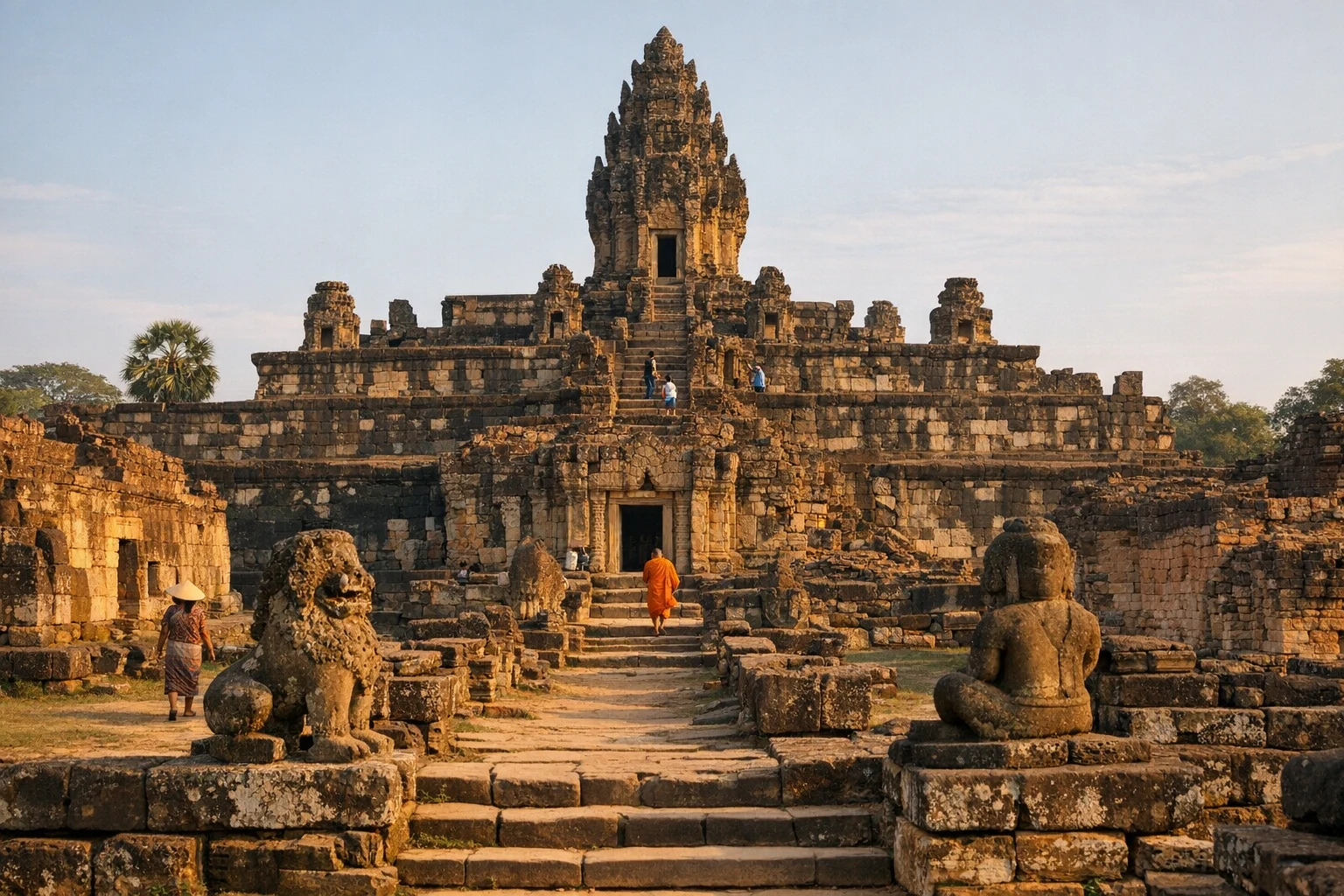
The singular beauty of Baksei Chamkrong lies in its elegant mathematical symmetry, intimate scale, and the enduring art of its carvings and inscriptions. As you approach from the main road between Angkor Thom’s South Gate and Angkor Wat, the first striking feature is its four-tiered pyramid, rising with measured grace toward the sky. Each of the pyramid’s faces boasts a steep, narrow staircase, drawing the visitor’s eyes upward while evoking the sacred slopes of Mount Meru—the center of the Hindu and Buddhist cosmos.
Baksei Chamkrong’s pyramid is constructed from laterite and brick, with sandstone used for key architectural and decorative elements. The temple’s base measures 27 meters per side, and rises to a compact summit crowned by a square brick sanctuary tower. Unlike larger Angkorian temples, Baksei Chamkrong’s intimacy allows for up-close examination of its detailed brickwork. The corners are sharply rendered, and the tiers are separated by narrow ledges, creating alternating bands of shadow and sun that seem to change over the course of the day.
The stairways themselves present both fascination and challenge: they are steep and narrow, requiring careful ascent for any visitor wishing to reach the uppermost platform. As you climb, look for sandstone guardian lions positioned at the lower levels—they stand as protectors of the sacred precinct. Reaching the summit, visitors are rewarded with tranquil views over the canopy and a serene sanctuary atop the small platform.
The sanctuary tower is modest but captivating. The south-facing entrance is framed by a sandstone lintel, intricately carved with images of Indra riding his elephant, Airavata, and detailed floral motifs swirling beside him. The carved decoration here is a testament to early Khmer sculptural skill—a preview of the grander styles that would emerge in later Angkorian masterpieces. Inscriptions in both Sanskrit and ancient Khmer script grace the sides of the doorways, recording details of the temple’s founding and dedication.
Stepping inside the sanctuary chamber, you find the heart of Baksei Chamkrong: a chamber designed to enshrine the temple’s original linga and icon of Shiva. This interior is simple compared to later temples, but a sense of sacred stillness lingers in the cool brickwork, recalling centuries of prayer and offerings. Outside, you may notice hints of stucco, the remains of original coverings that once would have added color and detail to the temple’s façade.
Perhaps most evocative is Baksei Chamkrong’s overall atmosphere. Shaded by tall, ancient trees but open to the sun above the treetops, the temple offers a contemplative retreat. Fewer tourists mean you are free to linger—examining weathered bas-reliefs, deciphering faded script, or imagining the temple in its prime, resplendent against the jungle. Of all Angkor’s seats of worship, few combine such artistic richness with peaceful isolation, making Baksei Chamkrong a rewarding stop for those able to explore its miracle of brick and stone.
Getting There
Visiting Baksei Chamkrong is straightforward thanks to its proximity to both Angkor Thom and Angkor Wat within the Angkor Archaeological Park. The temple lies just outside Angkor Thom’s iconic south gate, a short distance from the main tourist circuit but easily included in any standard itinerary.
If you are departing from central Siem Reap, the heart of tourism in the region, direct access to Baksei Chamkrong is possible via several comfortable and affordable options. The most popular choice is hiring a tuktuk—an open-sided, motorized rickshaw unique to Southeast Asia—for a half-day or full-day temple tour. Typical tuktuk fares for the Angkor “small circuit” (covering temples like Angkor Wat, Bayon, and Baksei Chamkrong) range from $18 to $25, depending on bargaining, season, and your negotiating skills. Private taxis are also available for those seeking more comfort or air conditioning, with rates starting at $30 for a half-day hire.
For the more adventurous traveler, bicycles can be rented in Siem Reap for as little as $3 to $5 per day. The ride to Angkor Archaeological Park is about 7 kilometers (4.3 miles) along paved, mostly flat roads—though summer heat and temple distances should be planned for. Rental motorbikes are technically not allowed for foreign tourists within the main park area; always check laws and local rental agreements before setting out.
Once inside the UNESCO park, you must present your Angkor Pass at multiple checkpoints (one-day passes cost $37, three-day passes $62, and week-long passes $72 as of 2024). Passes can be purchased at the official Angkor ticket center or online, and they cover entry to Baksei Chamkrong as well as all major temples. The site itself is unstaffed, and signage is modest, so many visitors choose to join a guided tour for richer context and navigation. However you arrive, the short distance from nearby icons like Angkor Wat and Bayon Temple means Baksei Chamkrong can be conveniently visited as a tranquil prelude or postscript to the grander monuments.
When to Visit
The experience of Baksei Chamkrong changes with the rhythm of Cambodia’s monsoon climate, so timing your visit can enhance your enjoyment dramatically. Siem Reap and the Angkor Archaeological Park have two main seasons: the dry season (November to April) and the wet season (May to October). Each brings its own advantages for temple explorers.
From November to February, the weather is coolest and driest, with daytime highs between 25°C and 30°C (77–86°F) and minimal rainfall. This period draws the most visitors to Angkor, but the relative obscurity of Baksei Chamkrong means you can still enjoy peaceful contemplation even in peak season. Mornings and late afternoons provide the softest light for photography, especially as sunrise bathes the pyramid in a gentle glow and the jungle mist begins to clear.
March and April mark the hot season, with temperatures often soaring above 35°C (95°F). Humidity intensifies, and even short temple walks can be draining. If you plan to visit during these months, aim for early morning or late afternoon, bring plenty of water, and wear sun protection. The reward is quieter temples and a distinct dramatic light, though the heat is not for everyone.
The rainy season from May to October transforms the landscape into a lush green paradise. Rains are typically concentrated in heavy afternoon showers, leaving mornings clear for exploration. This is when the temple’s ancient bricks and laterite seem to shimmer against vibrant plant life, and crowds are at their thinnest. Paths may become muddy, but the atmosphere is calm, refreshing, and ideal for those craving a tranquil experience with minimal interference.
Festivals and special events—such as Khmer New Year in April or Pchum Ben in late September and October—may affect visitation patterns, but generally do not close the site. Always check local calendars and plan accordingly for a truly immersive visit to Baksei Chamkrong.
Quick Facts
| Feature | Details |
|---|---|
| Location | South of Angkor Thom, Siem Reap Province, Cambodia |
| Coordinates | 13.4455° N, 103.8580° E |
| Built | Approximately 947 CE |
| Builder(s) | Harshavarman I; completed by Rajendravarman II |
| Civilization | Khmer Empire |
| Religion | Hinduism (Shiva); later Buddhist influences |
| Construction materials | Brick, sandstone, laterite |
| Entrance fee | Included with Angkor Pass ($37–$72, depending on duration) |
| Accessibility | Steep steps; stairways on all four sides |
| Nearby major sites | Angkor Thom, Angkor Wat, Bayon, Baphuon, Bakong |
| Style | Early Khmer pyramid temple |
| UNESCO World Heritage | Yes, as part of Angkor Archaeological Park |
| Best time to visit | November to February (dry and cool), dawn or late afternoon |
Frequently Asked Questions
When was Baksei Chamkrong built?
Baksei Chamkrong was begun in the early 10th century, around 947 CE, during the reign of Harshavarman I but primarily completed under Rajendravarman II.
What religion was Baksei Chamkrong built for?
Baksei Chamkrong is a Hindu temple, dedicated primarily to Shiva, and features a central lingam that symbolizes the deity.
Is Baksei Chamkrong inside the Angkor Archaeological Park?
Yes, Baksei Chamkrong is located just south of Angkor Thom’s south gate, within the Angkor Archaeological Park in Siem Reap.
How do I reach Baksei Chamkrong from Siem Reap?
It’s about a 20-minute tuktuk or taxi ride from central Siem Reap. The temple is easily accessible as part of temple circuit tours.
Is there an entrance fee for Baksei Chamkrong?
Entry to Baksei Chamkrong is covered by the Angkor Pass, which grants access to all major temples in the Angkor complex.
Is Baksei Chamkrong suitable for children or older visitors?
The main temple involves steep stairs that can be challenging. Parents and older visitors should exercise caution when climbing.
Can I visit Baksei Chamkrong at sunrise or sunset?
Yes, early mornings and late afternoons are pleasant times to visit, with soft light illuminating the temple’s sandstone carvings.
Nearby Ancient Sites
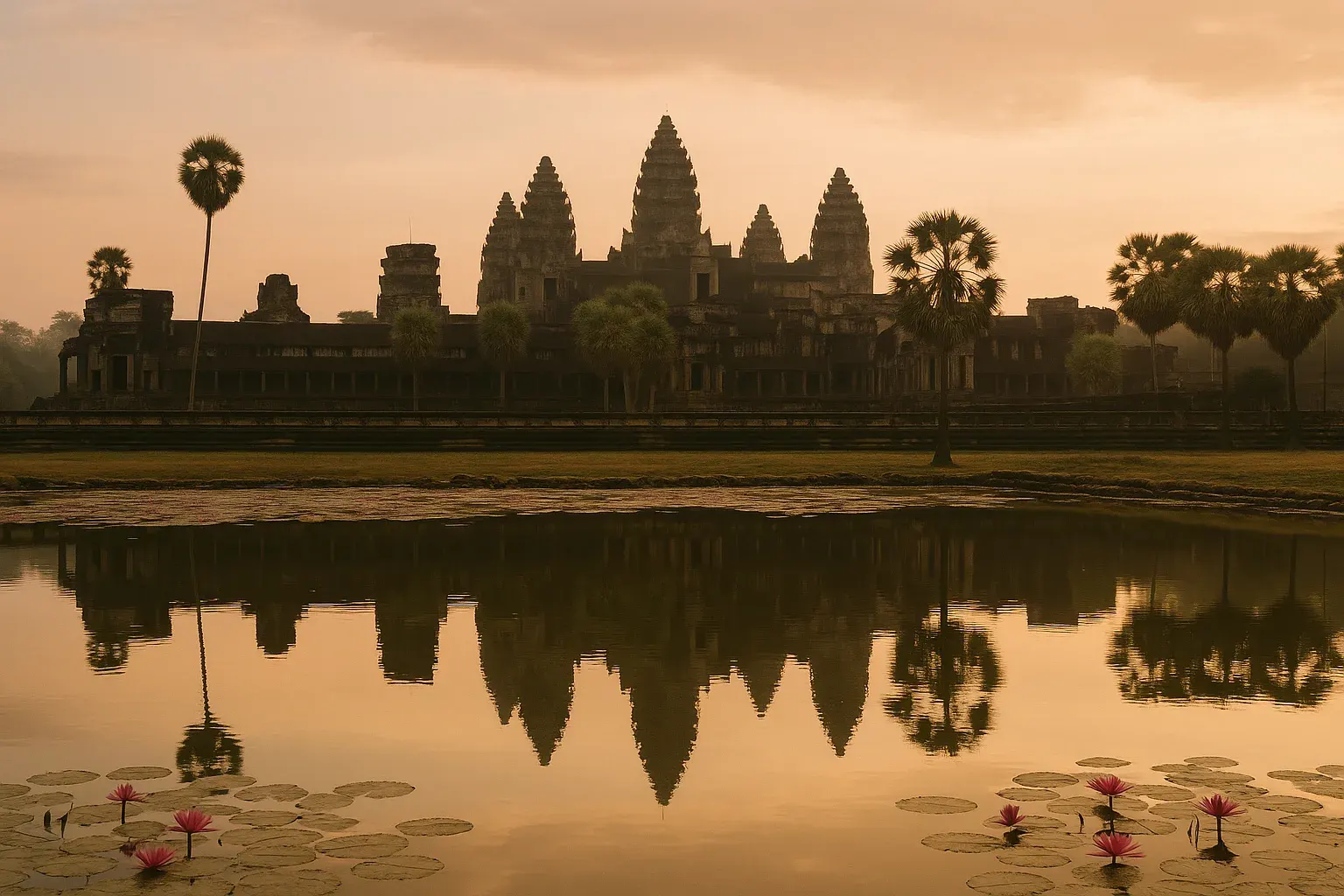
Angkor Wat Travel Guide 2026: Everything You Need to Know
KhmerAngkor Wat, the world's largest religious monument, spans over 400 acres in the heart of Cambodia. T...
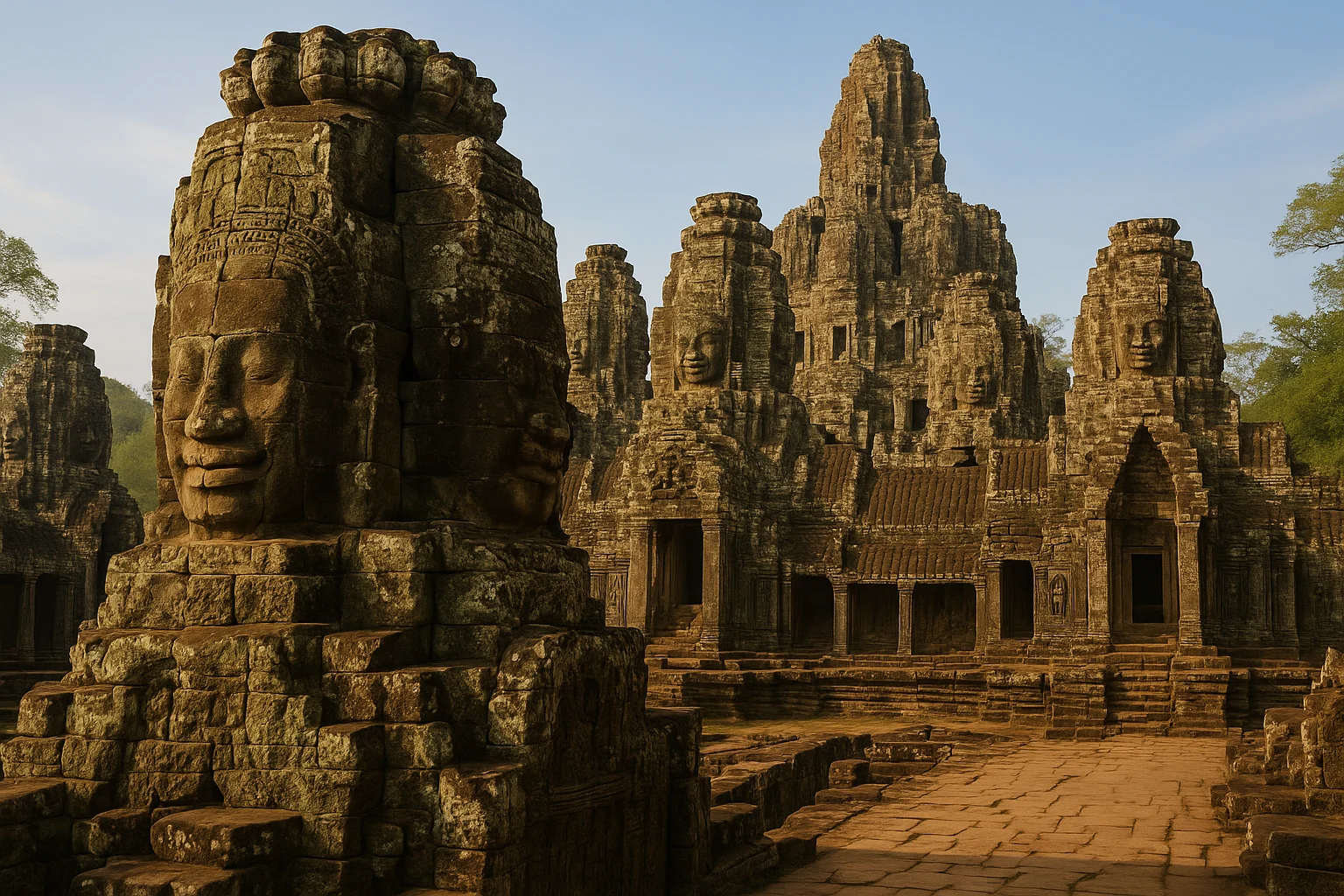
Bayon Temple Travel Guide 2026: Face Towers, Bas-Reliefs, and Best Visit Timing
KhmerBayon Temple sits at the center of Angkor Thom and is famous for its carved stone faces. This guide ...
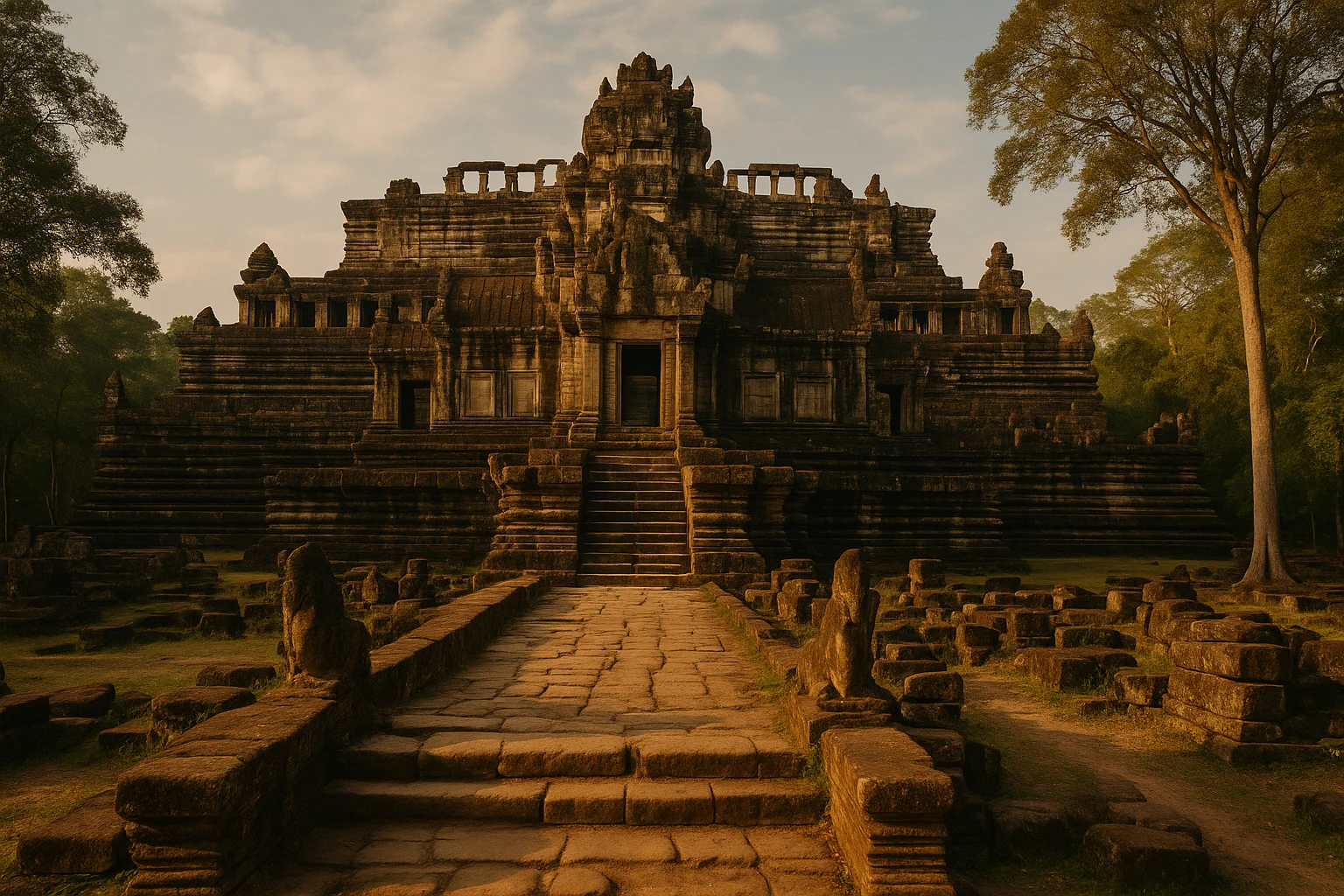
Baphuon
Khmer EmpireAn 11th-century sandstone temple mountain in Angkor Thom, Cambodia, renowned for its monumental recl...
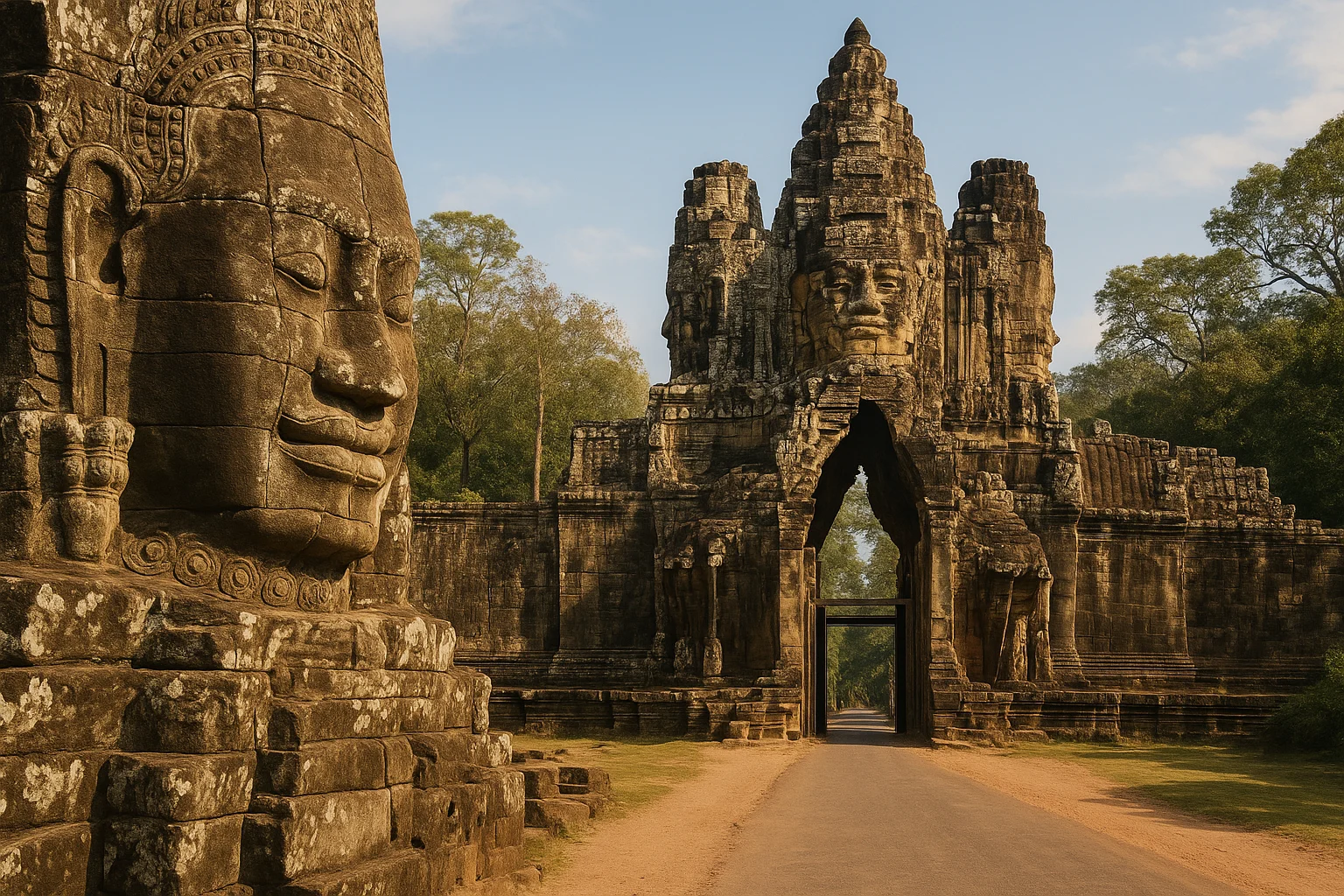
Angkor Thom Travel Guide 2026: Bayon Faces, Gates, and the Khmer Royal City
KhmerAngkor Thom was the last great capital of the Khmer Empire. This guide covers how to visit Bayon, th...
Bakong
Bakong is Cambodia's first major sandstone temple mountain, a stunning Khmer monument at the heart o...