Quick Info
Curated Experiences
Banteay Kdei and Angkor Small Circuit Guided Tour
Private Angkor Tour Including Banteay Kdei and Ta Prohm
Full Day Angkor Temples Tour with Banteay Kdei
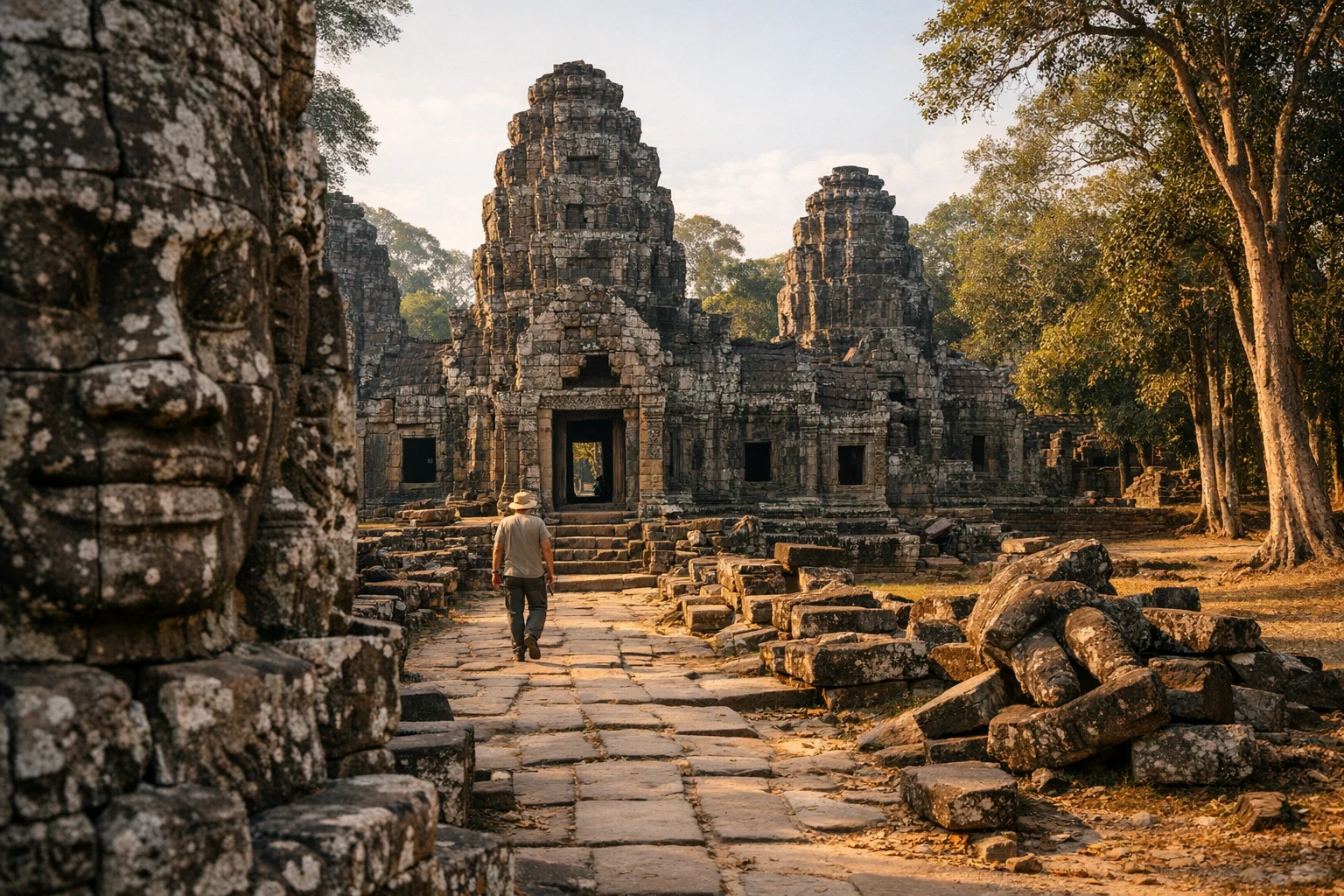
Banteay Kdei in Cambodia is one of the quieter great temples of Angkor, a place that rewards patience rather than spectacle. South of the main concentrations around Angkor Thom and not far from the broad waters of Srah Srang, the temple spreads through layered walls, worn courtyards, half-collapsed galleries, and doorways that seem to lead endlessly inward. It does not confront you with the singular visual shock of Angkor Wat or the face towers of Bayon. Instead, it works more slowly. The first impression is often of softness: weathered sandstone, filtered light, tree shade, and the sense of a sacred compound that has settled into the forest and into time. That calm can be misleading, because Banteay Kdei is architecturally rich and historically important, but it is exactly why many travelers end up remembering it more vividly than they expected.
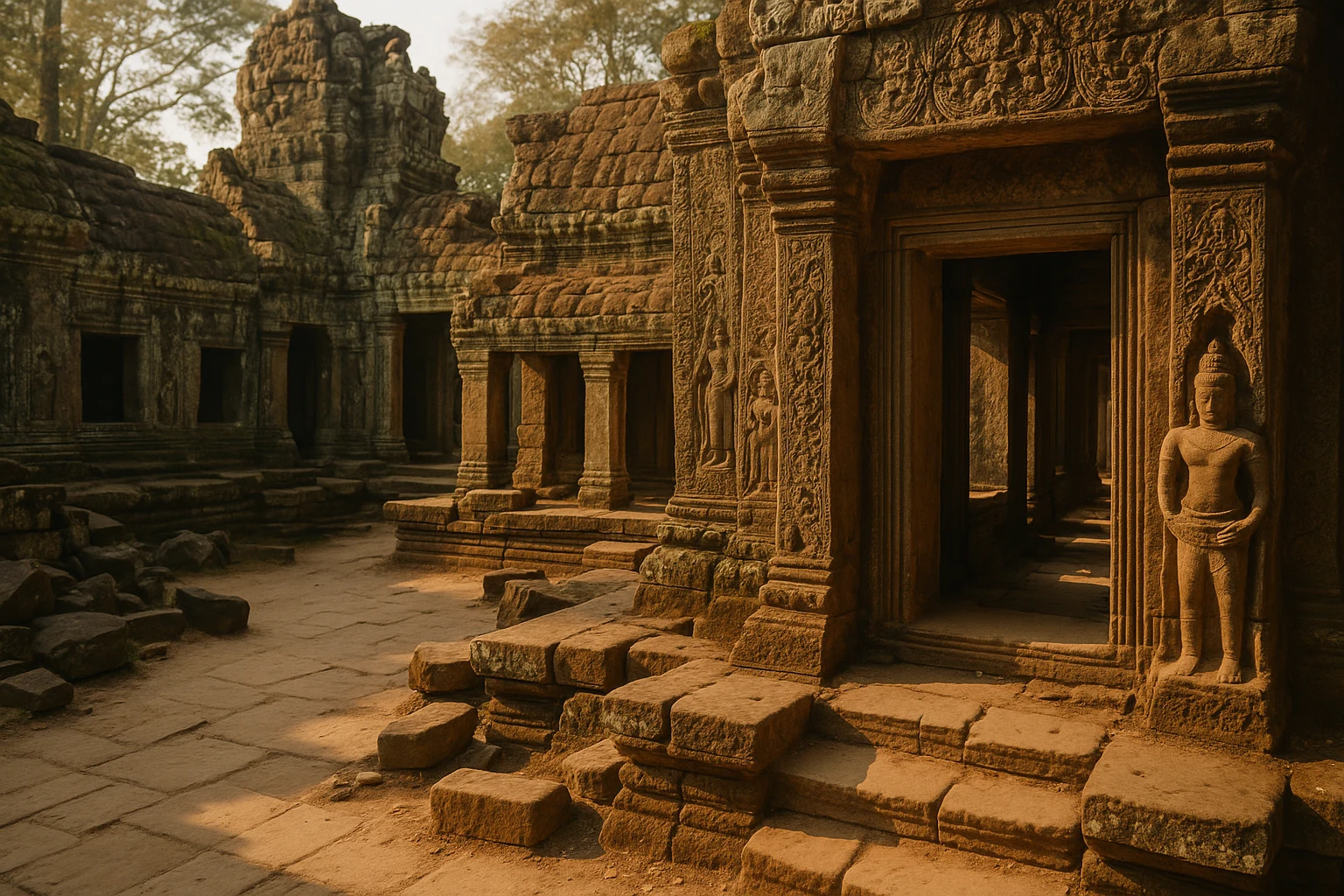
What makes Banteay Kdei special is its atmosphere of enclosure. The temple was built as a Buddhist monastic complex, and even now it feels more inward than theatrical. Corridors narrow, then open suddenly into courts. Devata carvings appear on worn walls. Small towers rise above rooflines broken by collapse and restoration. Lichen, root pressure, and centuries of neglect have softened the geometry without erasing it, leaving the monument somewhere between structure and ruin. That in-between quality is one of Angkor’s deepest pleasures, and Banteay Kdei offers it in abundance. For visitors trying to understand the spiritual and political landscape of Jayavarman VII’s Angkor, this temple is not a minor stop. It is one of the clearest places to feel how imperial Buddhism, monastic life, and architecture came together in stone.
History
Jayavarman VII and the Buddhist Transformation of Angkor
Banteay Kdei belongs to the great wave of construction associated with Jayavarman VII, the late 12th- to early 13th-century Khmer ruler who reshaped Angkor after a period of military crisis and political recovery. His reign is one of the most transformative in Cambodian history. It produced not only major monuments such as Bayon, Ta Prohm, and Preah Khan, but also roads, rest houses, hospitals, reservoirs, and monastic foundations across the empire. Under Jayavarman VII, architecture became a language of restoration, statecraft, and Buddhist kingship on a huge scale.
Banteay Kdei is usually understood as part of this wider program. Though smaller and less formally grand than some of the king’s best-known temples, it reflects the same broad artistic and ideological world. It was likely conceived as a monastic complex, perhaps occupying the site of an earlier temple or replacing earlier structures. Its plan, iconography, and relationship to nearby Srah Srang suggest a religious and possibly residential role more than a purely royal commemorative one. That makes it especially useful for understanding the variety within Jayavarman VII’s building vision. Not everything he sponsored was meant to function the same way.
Monastic Function and Architectural Character
The name Banteay Kdei is often interpreted as something like “Citadel of Chambers” or “Citadel of Monks’ Cells,” and although names and later usage can be historically complicated, the phrase captures a real truth about the site’s feel and probable function. Banteay Kdei has a strongly monastic character. Multiple enclosures, successive galleries, and a somewhat compartmentalized plan give it a more cloistered quality than many Khmer state temples. The monument appears designed not simply for dramatic royal display, but for a rhythm of movement and occupation more compatible with religious residence, ritual life, and controlled sacred space.
Architecturally, Banteay Kdei also belongs to a phase of Angkorian construction that sometimes shows technical strain. Some scholars note that monuments of Jayavarman VII’s era were built quickly and in great number, occasionally with materials or methods less durable than earlier masterpieces. At Banteay Kdei, this may help explain why sections became unstable or deteriorated badly over time. But this relative fragility is also part of the temple’s character today. It has survived not as a pristine monument of perfect balance, but as a deeply atmospheric structure whose ruin condition reveals the pressures of both ambition and time.
Religious Change and Post-Angkor Use
Like many temples of the Jayavarman VII period, Banteay Kdei reflects a Buddhist building phase within a broader Khmer world long shaped by both Hindu and Buddhist traditions. Over time, religious identities at Angkor shifted. Temples were reused, rededicated, altered, or partially stripped of earlier imagery. In some cases, Buddhist imagery replaced Hindu forms; in others, the reverse occurred later. Banteay Kdei’s surviving decoration and layout suggest its Buddhist affiliation clearly, but its long history almost certainly included moments of adaptation and reinterpretation.
As Angkor’s political center gradually declined and shifted after the 13th century, monuments like Banteay Kdei were affected differently depending on their function and location. Some remained in use longer than others; some fell into disrepair more quickly. Banteay Kdei’s monastic character may have helped sustain religious life for a time, but eventually the site entered the long phase of partial abandonment, vegetation growth, structural instability, and ruin that shaped so much of Angkor’s later history. By the time modern explorers, archaeologists, and conservators began documenting and clearing it, the temple had already acquired the weathered, inward-looking character that defines it today.
Restoration and Modern Appreciation
Modern conservation at Banteay Kdei has aimed less at total reconstruction than at stabilization and legibility. The temple’s complexity, combined with structural fragility, meant that careful work was needed to prevent further loss while preserving the evocative qualities that make it so compelling. Unlike Angkor Wat, where symmetry and state-level visibility dominate the visit, Banteay Kdei gained appreciation more gradually among travelers and scholars as a temple of mood, spatial richness, and monastic texture.
Today it forms an important part of the Angkor experience precisely because it broadens the emotional range of the site complex. Banteay Kdei shows that Khmer architecture was not only about central summits and cosmic mountains. It could also create quiet, enclosed, almost introspective sacred environments. In that sense, the temple’s modern appeal is not accidental. It arises directly from the historical role it once played.
Key Features
The strongest feature of Banteay Kdei is its spatial layering. From the outside, the temple may seem modest compared with Angkor’s more iconic monuments, but once inside, the experience becomes richly sequential. Enclosure gives way to enclosure. Galleries frame courtyards. Doorways open onto axial views, then break into side passages and subsidiary spaces. The result is a temple that feels almost labyrinthine without becoming confusing. It encourages slow walking and repeated shifts of perspective. This sense of movement through nested sacred zones is what gives Banteay Kdei its monastic and contemplative quality.
The outer gopuras and long galleries are particularly effective in establishing that rhythm. Their worn sandstone surfaces, partial collapses, and restored segments together produce exactly the kind of visual complexity many travelers hope to find at Angkor but sometimes miss in the more heavily trafficked major monuments. Here the ruin is legible without feeling over-managed. You can still read the intention of the architecture, but you are also constantly aware of time pressing on it through erosion, subsidence, and repair.
The carvings at Banteay Kdei are another major feature, though they tend to reward close attention rather than instant spectacle. Devatas, lintels, floral motifs, and decorative panels survive in varying states of preservation. Many are softened by weather, which paradoxically adds to the temple’s atmosphere. Instead of sharply insisting on themselves, they emerge gradually from the stone as your eyes adjust. This visual softness fits the overall mood of the monument. Banteay Kdei is less about display than about persistence.
Its relationship to nearby Srah Srang also matters. Just east of the temple lies the great royal reservoir often called the “Royal Bath,” and visiting the two together helps make architectural and ritual sense of the area. Banteay Kdei feels like an enclosed religious world beside a broad water landscape, and that contrast sharpens the meaning of both. Many visitors catch sunrise at Srah Srang and then cross to Banteay Kdei, which is an excellent sequence because it moves from open horizon to enclosed sacred interior.
Another of the temple’s strengths is its balance between accessibility and atmosphere. Unlike some of Angkor’s larger sites, Banteay Kdei is often calmer, giving visitors more time to feel how sound, shadow, and emptiness shape the experience. Birds, leaves, and footsteps can dominate here in a way that would be impossible in more crowded temples. It is one of the best places in Angkor to feel that a monument can be both archaeological and still spiritually suggestive. There may not be a single signature icon that defines it the way Bayon has its faces or Ta Prohm its trees, but that is also why Banteay Kdei works so well. It is a whole environment rather than a postcard view.
Getting There
Banteay Kdei is located within the Angkor Archaeological Park near Siem Reap, and it is easy to reach as part of the standard “small circuit” temple route. From central Siem Reap, the journey by tuk-tuk, car, or taxi usually takes around 20 to 35 minutes depending on your hotel location and traffic. Most travelers visit with a tuk-tuk driver hired for the day, often at rates roughly around USD 15 to 30 for a standard temple circuit, while air-conditioned cars cost more. Because Banteay Kdei lies close to Ta Prohm, Srah Srang, and other major stops, it fits naturally into a full day of Angkor sightseeing.
Guided tours often include Banteay Kdei, but some shorter itineraries skip it in favor of higher-profile monuments. If it matters to you, mention it explicitly when planning your route. Private guides are especially useful here because the temple’s quieter, monastic character is easier to appreciate when someone explains its layout and relationship to the Jayavarman VII era. Independent visitors can also enjoy it very well, especially with a map or basic context in hand.
You will need a valid Angkor pass, as with all major monuments in the park. Bring water, comfortable shoes, and sun protection, though Banteay Kdei often feels slightly cooler than fully exposed sites because of its enclosed passages and surrounding trees. It is logistically one of the easier Angkor temples to include, which makes its relative quiet all the more rewarding.
When to Visit
The best time to visit Banteay Kdei is during Cambodia’s cooler dry season, generally from November through February, when walking temple circuits is more comfortable and the light tends to be clearer. That said, Banteay Kdei works well in other seasons too because its atmosphere benefits from shadow, moisture, and softness. Even the rainy season can suit it, provided you are prepared for humidity and intermittent downpours. The temple’s worn stone and tree-framed galleries often look especially beautiful after rain.
Early morning is one of the best times to come, especially if you begin at nearby Srah Srang for sunrise and then walk or drive the short distance to the temple. At that hour, Banteay Kdei often feels calm and meditative, with fewer visitors and lower temperatures. Late afternoon is also excellent, when the lower light brings out surface texture and gives the interior spaces more depth. Midday can be hotter and visually flatter, though the galleries do provide some relief.
If your goal is atmosphere rather than simple checklist efficiency, avoid rushing through. Banteay Kdei is one of those places that improves when given a little time. Sit in a courtyard, walk the outer galleries twice, notice how views shift through doors and towers. In a monument defined by enclosure and quiet, timing is less about spectacle than about allowing yourself to tune in.
| Quick Facts | Details |
|---|---|
| Location | Angkor Archaeological Park, Siem Reap Province, Cambodia |
| Best Known For | Quiet monastic layout, layered galleries, and atmospheric ruin character |
| Cultural Tradition | Khmer Buddhist temple-monastery |
| Historical Period | Late 12th to early 13th century CE |
| Likely Builder | Jayavarman VII |
| Nearby Landmark | Srah Srang |
| Recommended Visit Length | 45 minutes to 1.5 hours |
| Best Time to Visit | Early morning or late afternoon in the dry season |
| Best Base | Siem Reap |
| Practical Tip | Pair it with Srah Srang and give it unhurried time, since its appeal is atmospheric rather than instantly obvious |
Frequently Asked Questions
What is Banteay Kdei best known for?
Banteay Kdei is best known for its calm, maze-like monastic layout, weathered sandstone carvings, and its atmospheric setting near Srah Srang in the Angkor complex.
Who built Banteay Kdei?
Banteay Kdei is generally attributed to the reign of Jayavarman VII in the late 12th or early 13th century, during the great Buddhist building era of Angkor.
How much time should you spend at Banteay Kdei?
Most visitors should allow 45 minutes to 1.5 hours, though history lovers may want longer to explore the multiple enclosures, galleries, and quieter corners.
Is Banteay Kdei worth visiting if you are already seeing Ta Prohm and Bayon?
Yes. It offers a more subdued and contemplative Angkor experience, with fewer crowds and a strong sense of monastic enclosure and ruin.
What does the name Banteay Kdei mean?
The name is often translated as 'Citadel of Chambers' or 'Citadel of Monks' Cells,' reflecting the temple’s many enclosed spaces and monastic associations.
When is the best time to visit Banteay Kdei?
Early morning and late afternoon are best, especially in the cooler dry season, when the light is softer and the temple’s quieter atmosphere is easiest to appreciate.
Nearby Ancient Sites
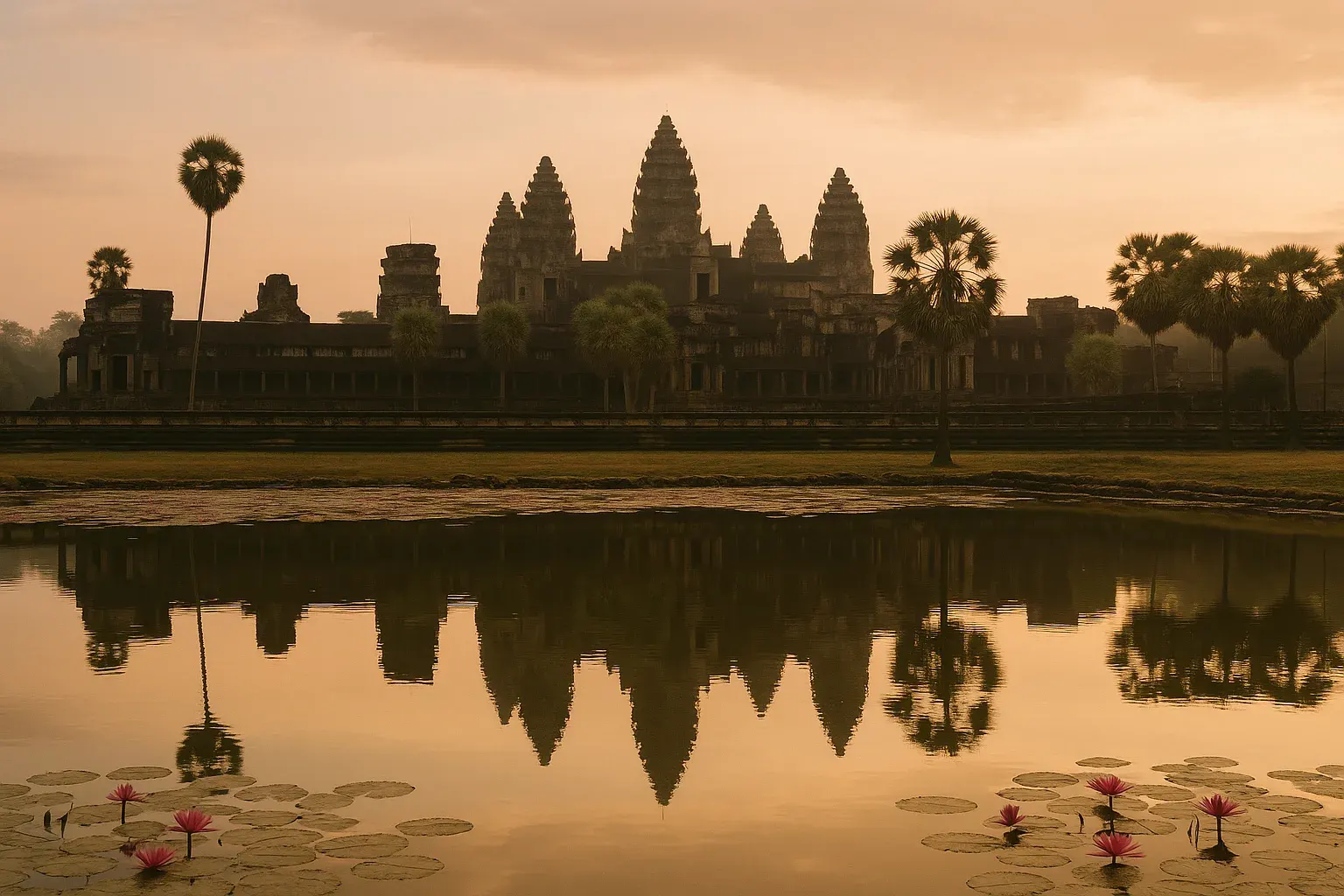
Angkor Wat Travel Guide 2026: Everything You Need to Know
KhmerAngkor Wat, the world's largest religious monument, spans over 400 acres in the heart of Cambodia. T...
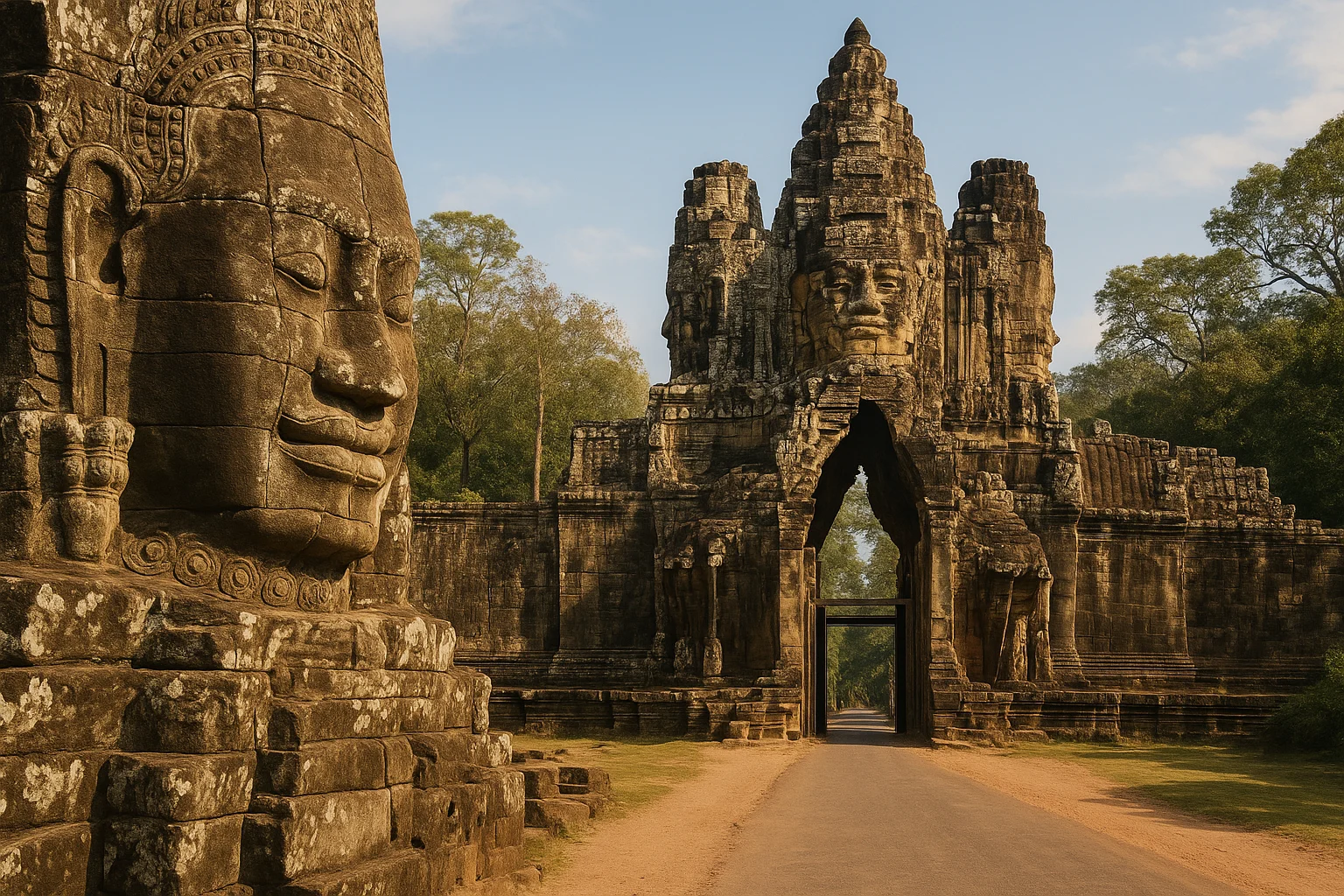
Angkor Thom Travel Guide 2026: Bayon Faces, Gates, and the Khmer Royal City
KhmerAngkor Thom was the last great capital of the Khmer Empire. This guide covers how to visit Bayon, th...
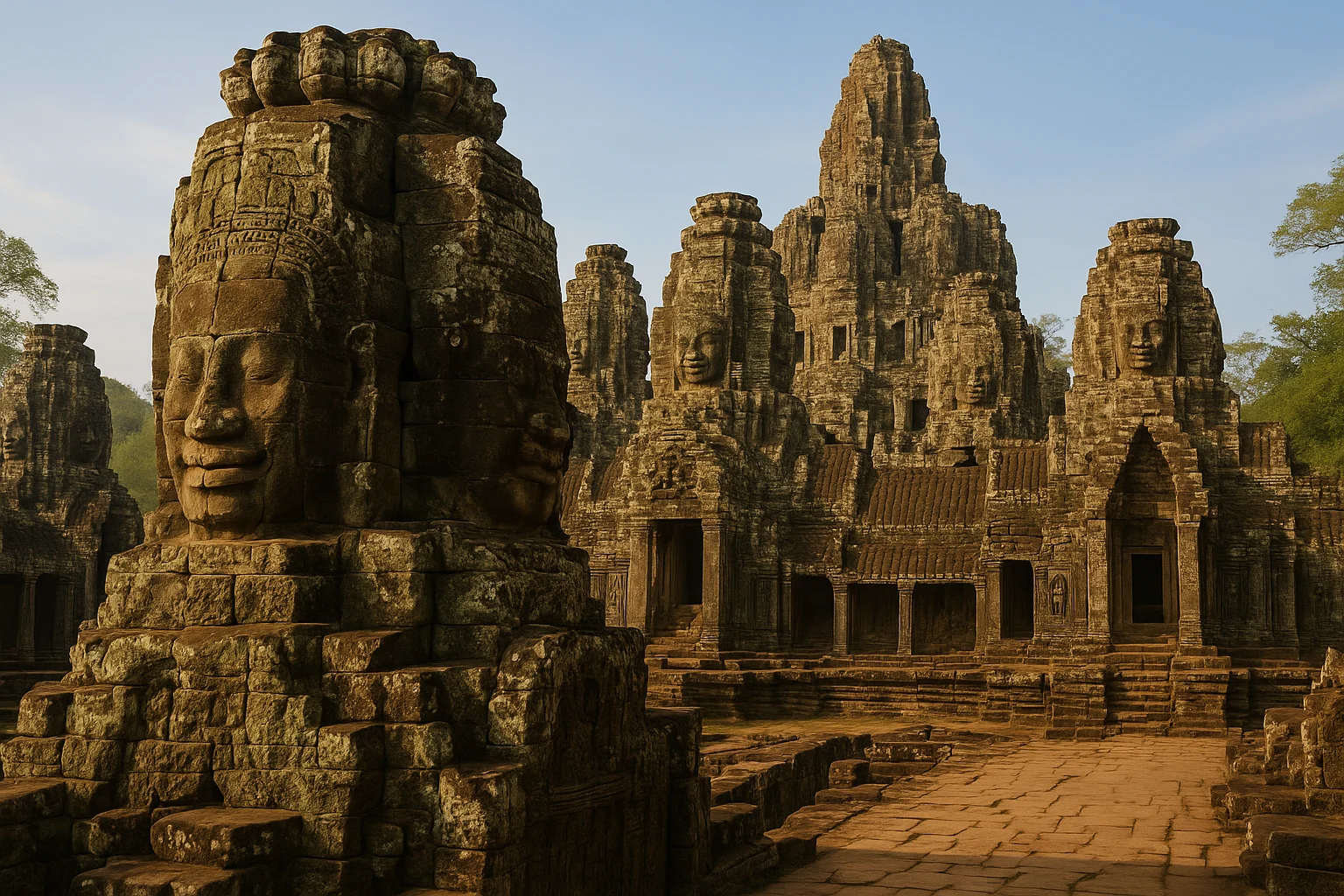
Bayon Temple Travel Guide 2026: Face Towers, Bas-Reliefs, and Best Visit Timing
KhmerBayon Temple sits at the center of Angkor Thom and is famous for its carved stone faces. This guide ...
Preah Khan (Angkor)
Khmer EmpireA vast 12th-century Buddhist city-temple at Angkor built by Jayavarman VII, famed for jungle-draped ...
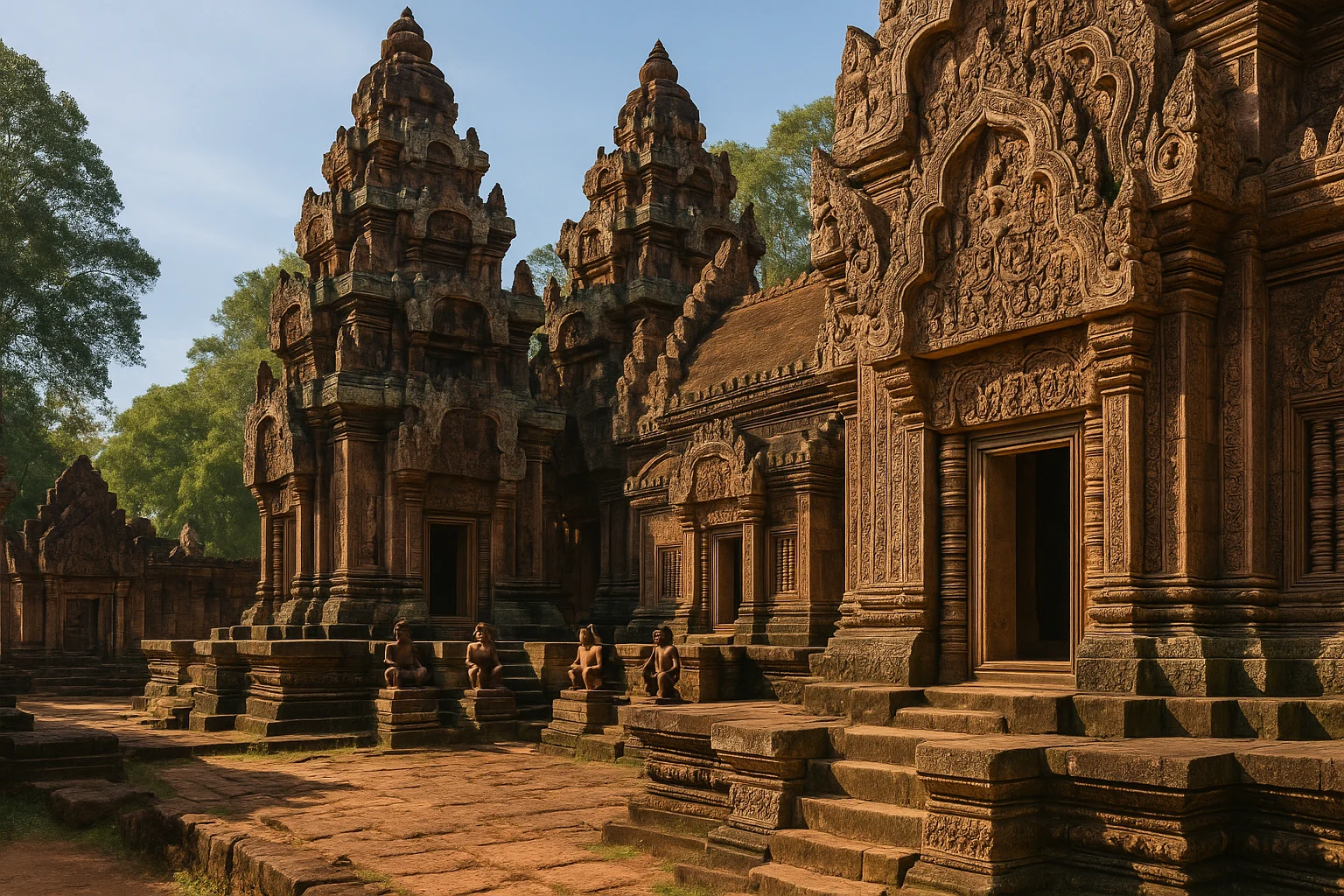
Banteay Srei Travel Guide 2026: Pink Sandstone Temple, Carvings, and Visit Tips
KhmerBanteay Srei is one of Cambodia’s most detailed Khmer temples, known for fine pink sandstone carving...