Quick Info
Curated Experiences
Angkor Thom & Baphuon Sunrise Small-Group Tour
Full-Day Angkor Complex Private Tour with Baphuon
Angkor Temples Tuk-Tuk Day Tour from Siem Reap
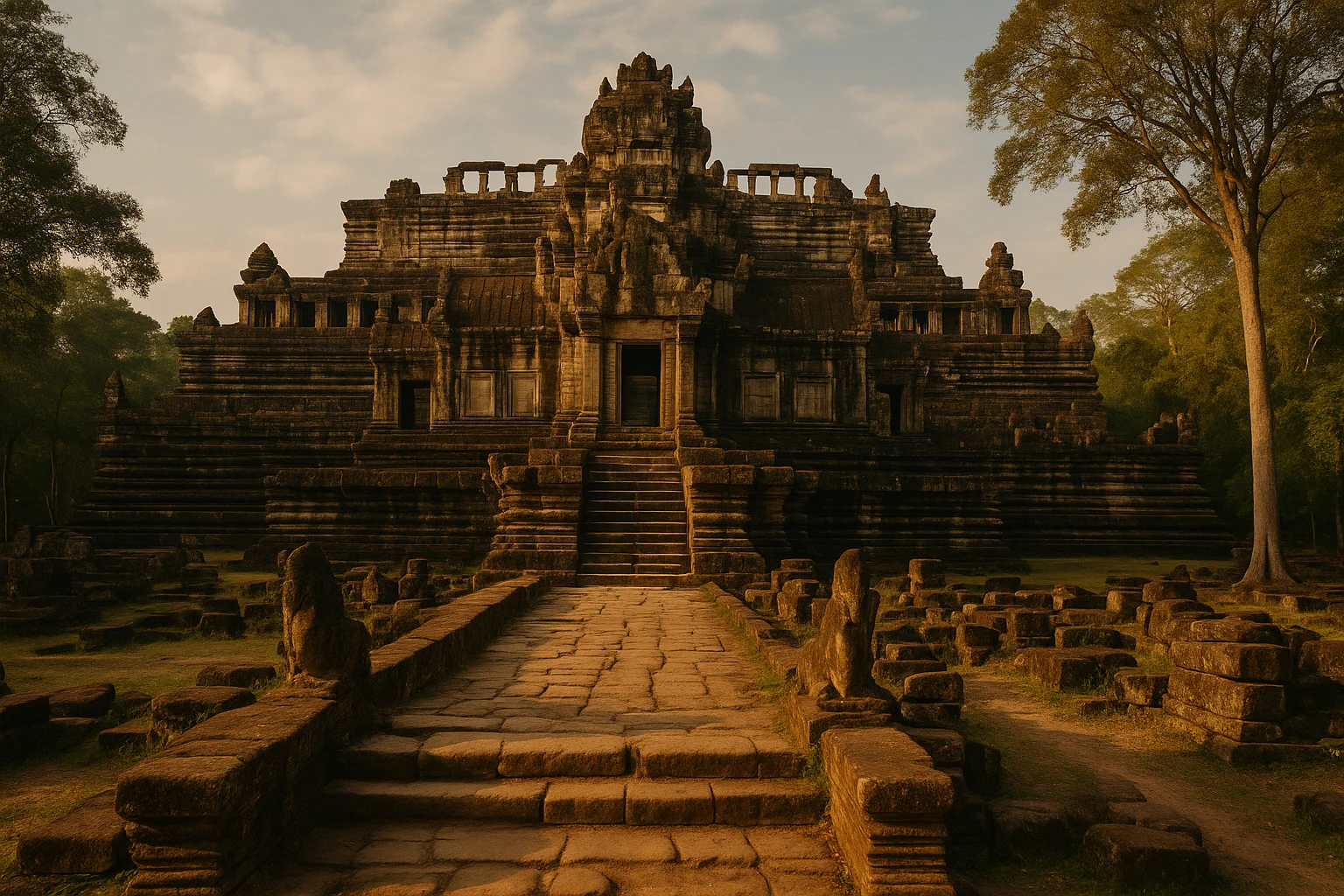
Deep inside the walled city of Angkor Thom, a broad sandstone causeway stretches nearly 200 metres through the jungle, elevated on short round columns as if floating above the earth. At its far end, the three-tiered pyramid of Baphuon rises from Cambodia’s flat alluvial plain like a miniature sacred mountain — its steep stairways, carved lintels, and coppery stone catching the equatorial light in ways that seem to shift by the hour. This is Baphuon, the state temple of King Udayadityavarman II, built around 1060 CE and dedicated to the Hindu god Shiva. For several decades of the twentieth century it was arguably the most structurally precarious major monument in Southeast Asia, dismantled block by block for a restoration project that war, genocide, and lost records would turn into one of archaeology’s most improbable puzzles. That it stands at all today — rebuilt, climbable, and arguably more beautiful than ever — is a testament to the stubborn patience of both Cambodian and international heritage workers. Standing at the base of Baphuon and looking up its steep central staircase toward the vanished sanctuary tower, it is easy to forget that every single stone you see was placed there by human hands twice over.
History
The Khmer Empire and Udayadityavarman II
By the mid-eleventh century, the Khmer Empire had already produced extraordinary monuments at Angkor. Yet Baphuon represented a new ambition. King Udayadityavarman II, who ruled from 1050 to 1066 CE, commissioned the temple as a physical representation of Mount Meru — the sacred cosmological mountain at the centre of the Hindu universe — and dedicated it to Shiva as the supreme deity of his reign. The Chinese diplomat Zhou Daguan, who visited Angkor in 1296–97 and left one of the only contemporary eyewitness accounts of the city, described Baphuon as a “tower of bronze” — a striking observation suggesting it was once sheathed or crowned in metal elements that have long since vanished.
Construction and Architectural Challenges
Baphuon was built on a massive artificial earthen fill, a construction technique that gave it impressive height but introduced serious long-term structural problems. Unlike the laterite and sandstone of many Angkor monuments, the infill beneath Baphuon was prone to subsidence over time, and by the twentieth century the pyramid was visibly failing — its galleries leaning, its stones displaced, its foundations undermined. The temple’s distinctive “Baphuon style” of architecture — recognisable by its relatively small, richly decorated pediments and the use of narrative bas-relief panels with multiple small figures — influenced Khmer construction for a generation and is named for the monument itself.
Conversion to a Buddhist Shrine
After the decline of Hinduism as the dominant court religion in Cambodia, Baphuon underwent a profound transformation. Sometime in the fifteenth or sixteenth century, Theravada Buddhist monks reorganised a large portion of the sandstone blocks on the western side of the second gallery to form a colossal reclining Buddha, approximately 70 metres long. The figure’s form — laid out flat, head resting on one hand, body extending west — is difficult to appreciate close up but resolves into clarity when viewed from the western approach. It remains one of the largest and most unusual reclining Buddha figures in the world, an extraordinary act of religious reinvention that repurposed the raw material of an older faith into a new devotional image.
The Modern Restoration Ordeal
In the 1960s, the École française d’Extrême-Orient (EFEO) undertook an ambitious anastylosis project at Baphuon — the methodical dismantling of the monument, block by numbered block, so that its crumbling foundations could be stabilised and the structure rebuilt in correct sequence. By 1975, roughly 300,000 stones had been tagged, catalogued, and set aside. Then the Khmer Rouge took Phnom Penh. The four years of the Pol Pot regime, followed by years of civil conflict and Vietnamese occupation, destroyed virtually all of the restoration documentation. When international archaeologists returned to Cambodia in the 1990s, they found the labelled stones scattered, their reference system gone. The subsequent effort to deduce the original placement of each block — working from photographs, architectural logic, and stone-by-stone inspection — consumed more than a decade of work. Baphuon reopened to visitors in 2011, a restored monument that is also a monument to what restoration can achieve under the worst possible circumstances.
Key Features
The Elevated Causeway
Baphuon announces itself before you arrive. The long sandstone causeway that connects the south gate to the temple entrance is one of the most theatrical approaches in the Angkor complex. Raised on short columns — leaving the ground visible beneath — the walkway creates a sense of processional transition between the mundane world and the sacred precinct ahead. The columns and their spacing once supported a wooden superstructure or covering that has vanished entirely, but even in its present form the causeway gives the approach a ceremonial gravity. Walking it in morning light, with dew still on the stones and birdsong filling the surrounding forest, is one of the quiet pleasures of the Angkor Archaeological Park.
The Temple Pyramid
The temple itself is a three-tiered pyramid built of grey-green sandstone and laterite. Each level is surrounded by a gallery, and the steep staircases that connect the tiers give Baphuon its characteristic profile: a structure that looks, from a distance, like a compressed mountain with sharp vertical lines. The galleries are decorated with carved sandstone panels — narrative scenes from Hindu epics including the Ramayana and the Mahabharata, as well as hunting scenes, celestial beings, and complex mythological tableaux. These panels are smaller in scale and more densely populated with figures than the grand bas-reliefs of Angkor Wat, giving them an almost tapestry-like quality when examined at close range.
The Upper Terrace and Missing Sanctuary
The climb to the third level is not for the faint of heart — the steps are steep, the stone well-worn, and there is only a single handrail-assisted staircase for the ascent. But the view from the top rewards the effort. The central sanctuary tower that once crowned Baphuon no longer exists; it collapsed long ago, and its stones were redistributed during the medieval reworking of the temple. What remains is a broad upper platform with low ruined walls, giving panoramic views across Angkor Thom’s jungle canopy and, on a clear day, glimpses of Bayon’s stone faces to the southeast.
The Reclining Buddha
The western face of the second gallery hides the monument’s most surprising feature. From the causeway on the west side, if you step back far enough to see the full face of the second level, a reclining figure emerges from what appears at first to be a random arrangement of stones. The reclining Buddha’s head, body outline, and feet become visible as the eye adjusts to the scale. Sections of the figure are incomplete — some stones have fallen or were never replaced — but enough survives to convey the colossal ambition of the medieval monks who created it. It is a strangely moving sight: an act of devotion encoded in a puzzle that took modern archaeologists years to even recognise fully.
Bas-Relief Narrative Panels
Throughout the lower two galleries, Baphuon’s sandstone walls are lined with narrative relief panels that reward slow, patient looking. Unlike Angkor Wat’s famous unbroken horizontal narrative friezes, Baphuon’s panels are arranged in smaller registers stacked vertically, each filled with dozens of figures — gods, demons, soldiers, animals, and celestial dancers. Scenes from the Churning of the Sea of Milk, battles between gods and asuras, and domestic episodes of Khmer life all appear within a few metres of one another. Many panels have been damaged or are partially missing, but the surviving carvings give a vivid impression of the decorative ambition that characterised the Baphuon style.
Getting There
Baphuon is located within the Angkor Thom walled city, approximately 8 kilometres north of central Siem Reap. The easiest and most popular way to reach the Angkor complex from town is by tuk-tuk: a driver hired for the full day typically charges between $15 and $25 USD depending on the circuit chosen, and can wait while you explore each monument. Agree on the route and price before departing. Bicycle rental is widely available in Siem Reap for around $3–5 per day, and the flat road through the park is well-suited to cycling — though midday heat between November and April can make the ride demanding.
Private car hire with driver is available through most Siem Reap hotels and guesthouses for around $40–60 USD per day, offering air-conditioned transport between sites. Organised half-day and full-day tours by minibus depart from town daily and typically include Baphuon on itineraries that cover the Angkor Thom complex — these can be booked through the hotels on Siem Reap’s Pub Street area or through international tour operators.
All visitors must purchase an Angkor Archaeological Park pass at the official ticket centre on the road north of town before entering the park. Passes cost $37 for one day, $62 for three days, and $72 for seven days. Tickets are checked at the entrance gates and again by rangers patrolling the monuments. Cash (USD) and credit cards are accepted at the ticket centre.
When to Visit
Cambodia has two well-defined seasons, and both affect a visit to Baphuon in different ways. The dry season runs from November through April, with cool mornings in November and December giving way to building heat from February onward. March and April are the hottest months, with afternoon temperatures regularly exceeding 35°C; arriving before 8 AM and retreating by midday is essential during this period. January and February offer the most comfortable combination of cool temperatures and clear skies, and these months see the highest visitor numbers — expect crowds at peak hours.
The wet season runs from May through October, bringing afternoon and evening monsoon rains that can be dramatic but rarely last all day. The surrounding jungle turns a vivid green, the light is often overcast and flattering for photography, and visitor numbers drop significantly outside school holiday periods. The causeways and stone staircases become slippery when wet, so appropriate footwear matters. Morning visits during the wet season can be strikingly atmospheric, with mist in the forest and bird life at its most active.
The Angkor complex is busiest between late December and late January, coinciding with both the dry season and the Christmas–New Year holiday period. For the quietest experience of Baphuon, aim for a weekday morning in September or October — the rains are intermittent, the heat is manageable, and the monument feels as close to private as it ever gets.
| Quick Facts | |
|---|---|
| Location | Angkor Thom, Siem Reap, Cambodia |
| Built | c. 1060 CE |
| Builder | King Udayadityavarman II |
| Dedicated to | Shiva (originally); reclining Buddha added c. 15th–16th century |
| Style | Baphuon |
| Height | Approx. 34 m (original sanctuary tower lost) |
| Material | Sandstone and laterite |
| Admission | Included in Angkor Archaeological Park pass (1-day $37 USD) |
| Opening Hours | 7:30 AM – 5:30 PM daily |
| Nearest City | Siem Reap (~8 km south) |
| UNESCO Status | Part of Angkor World Heritage Site (1992) |
| Restoration Completed | 2011 (EFEO, after 50+ years) |
Frequently Asked Questions
What is Baphuon and who built it?
Baphuon is an 11th-century Hindu temple mountain built by Khmer King Udayadityavarman II around 1060 CE. Dedicated to Shiva, it served as the state temple of his reign and stands today inside the Angkor Thom enclosure in Siem Reap, Cambodia.
Why is Baphuon famous for its restoration?
Between 1960 and 1975, French archaeologists dismantled much of Baphuon to reconstruct its failing foundations, labeling each of the 300,000 blocks. When the Khmer Rouge seized Cambodia, they destroyed nearly all of the documentation. Restorers spent decades reassembling the temple like a colossal three-dimensional jigsaw puzzle, completing the project in 2011.
Is there a reclining Buddha at Baphuon?
Yes. On the west pediment of the second level, Theravada Buddhist monks in the 15th or 16th century rearranged sandstone blocks to form a 70-metre reclining Buddha — one of the largest in the world. It is best viewed from the western approach to the temple.
How do I get to Baphuon from Siem Reap?
Baphuon is about 8 km north of central Siem Reap inside the Angkor Archaeological Park. Most visitors hire a tuk-tuk for the day (around $15–20 USD) or rent a bicycle. The temple sits a short walk north of Bayon inside Angkor Thom, so it is easily combined with nearby monuments.
What is the best time of day to visit Baphuon?
Early morning (7–9 AM) offers the softest light for photography and the smallest crowds. The elevated causeway and upper tiers face east, catching the morning sun beautifully. Visiting just after sunrise lets you walk the long approach causeway before tour groups arrive.
How long does it take to visit Baphuon?
Allow 1 to 1.5 hours for a thorough visit — time to walk the full causeway, climb to the upper terrace, and circle the base to view the reclining Buddha from the west. Combining Baphuon with Bayon and the Terrace of the Elephants makes for a natural half-day circuit within Angkor Thom.
Do I need a separate ticket for Baphuon?
No. Baphuon is covered by the standard Angkor Archaeological Park pass, available as a one-day ($37 USD), three-day ($62 USD), or seven-day ($72 USD) ticket. Passes must be purchased at the official ticket centre before entering the park.
Nearby Ancient Sites
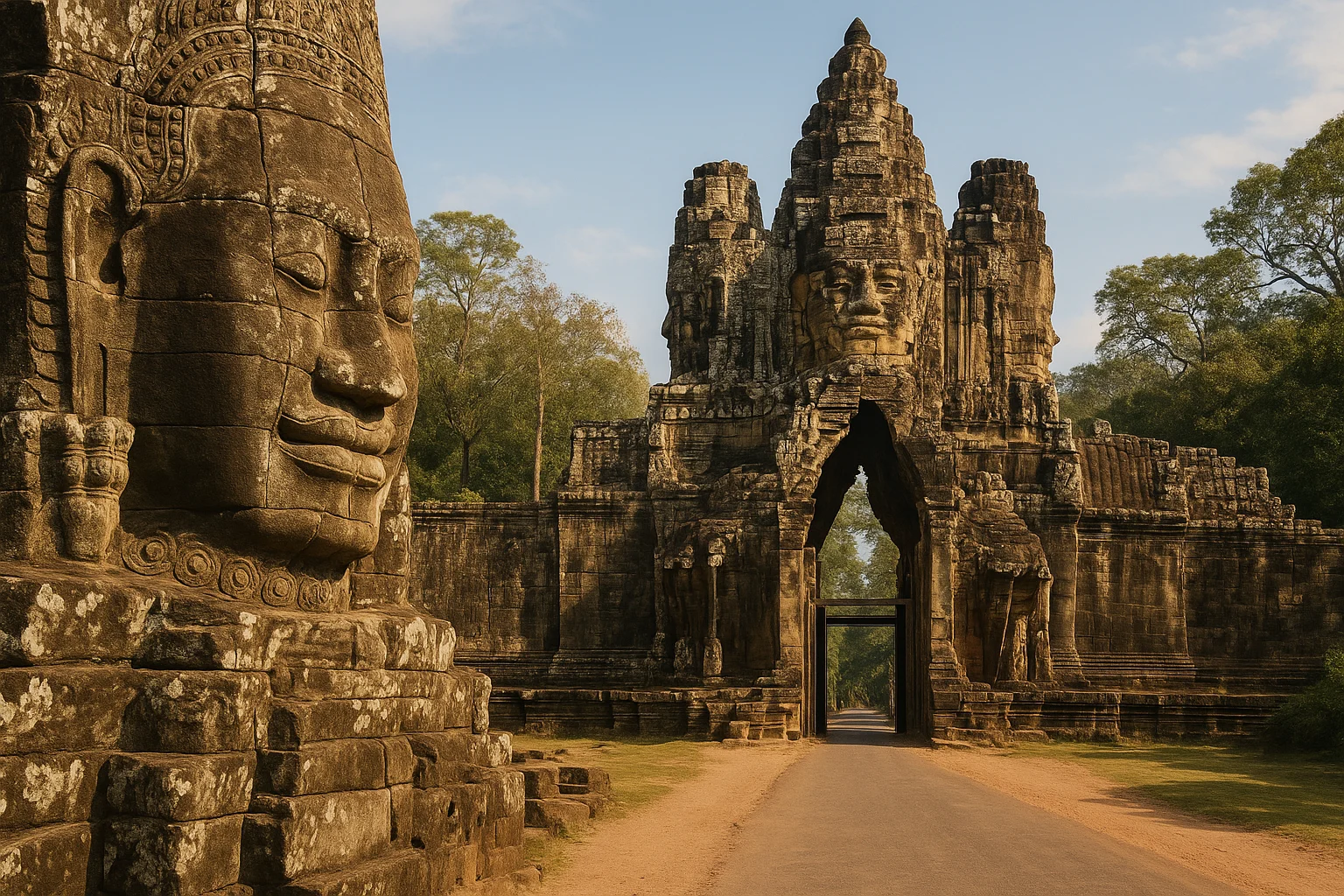
Angkor Thom Travel Guide 2026: Bayon Faces, Gates, and the Khmer Royal City
KhmerAngkor Thom was the last great capital of the Khmer Empire. This guide covers how to visit Bayon, th...
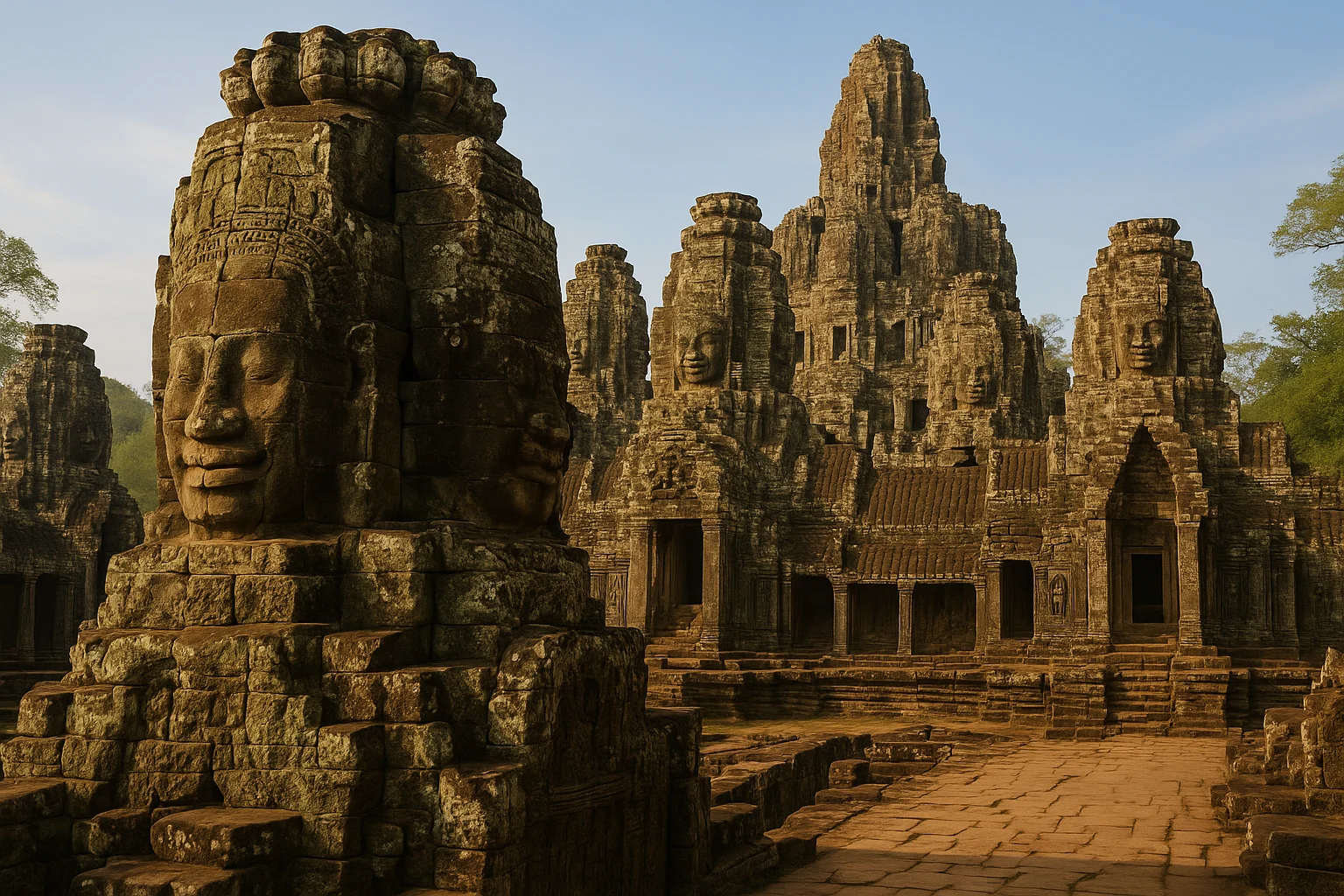
Bayon Temple Travel Guide 2026: Face Towers, Bas-Reliefs, and Best Visit Timing
KhmerBayon Temple sits at the center of Angkor Thom and is famous for its carved stone faces. This guide ...
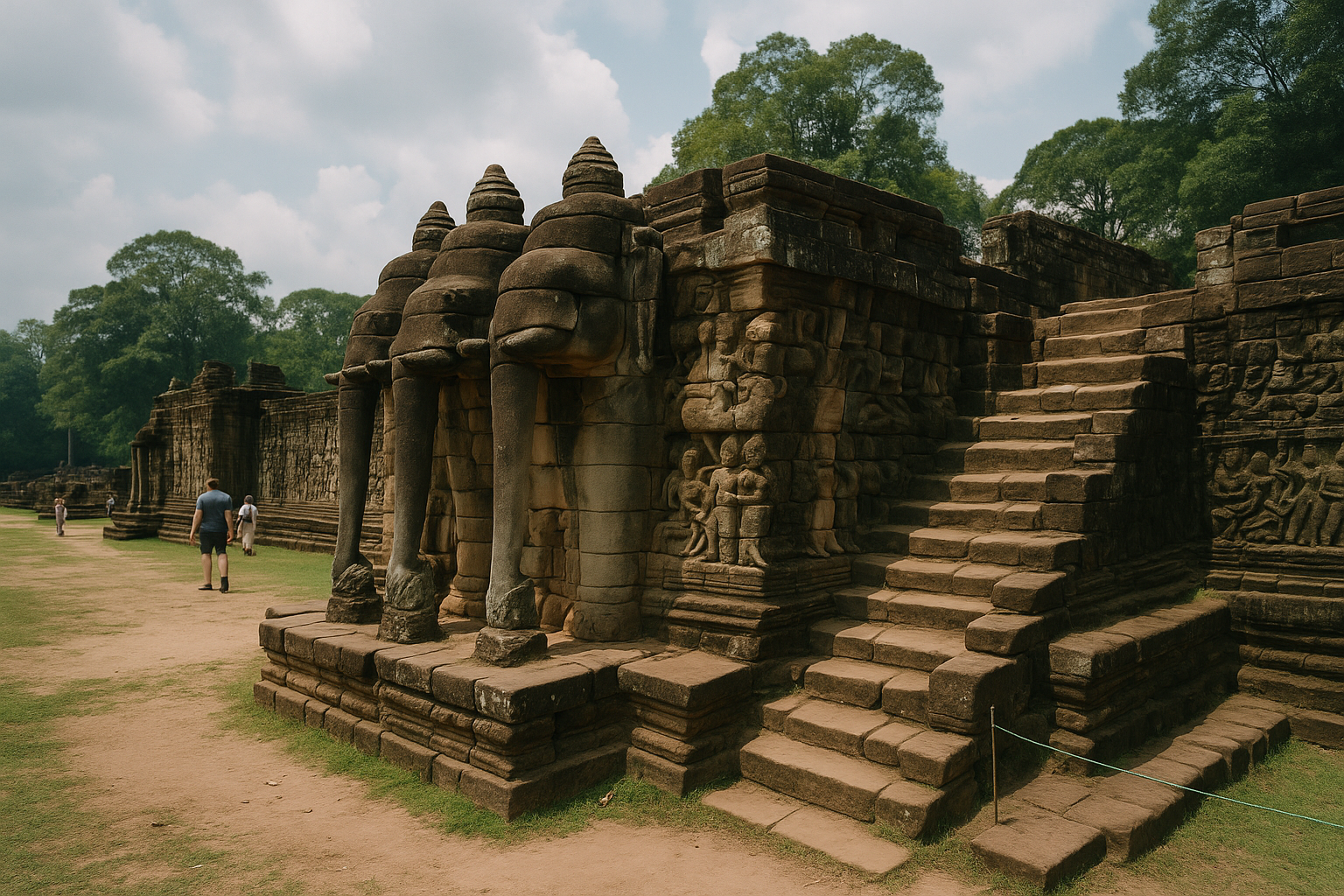
Terrace of the Elephants Travel Guide 2026: Angkor Thom’s Royal Viewing Platform
KhmerThe Terrace of the Elephants in Angkor Thom was a ceremonial platform used for royal events. This gu...
Angkor Wat Travel Guide 2026: Everything You Need to Know
KhmerAngkor Wat, the world's largest religious monument, spans over 400 acres in the heart of Cambodia. T...
Ta Prohm Travel Guide 2026: Temple of the Trees, Routes, and Photo Timing
KhmerTa Prohm is one of Angkor’s most atmospheric temples, where giant roots and sandstone galleries merg...