Quick Info
At a glance
In the quiet countryside of northern England, Chesters Roman Fort in the United Kingdom sits above the River North Tyne with a calm confidence that belies its military past. Today, sheep graze where mounted soldiers once drilled, and low stone outlines trace a frontier post that helped guard one of Rome’s most famous boundaries. For travelers exploring Hadrian’s Wall, Chesters offers something especially compelling: not just fragments of defensive architecture, but a site where the arrangement of daily life remains unusually readable.
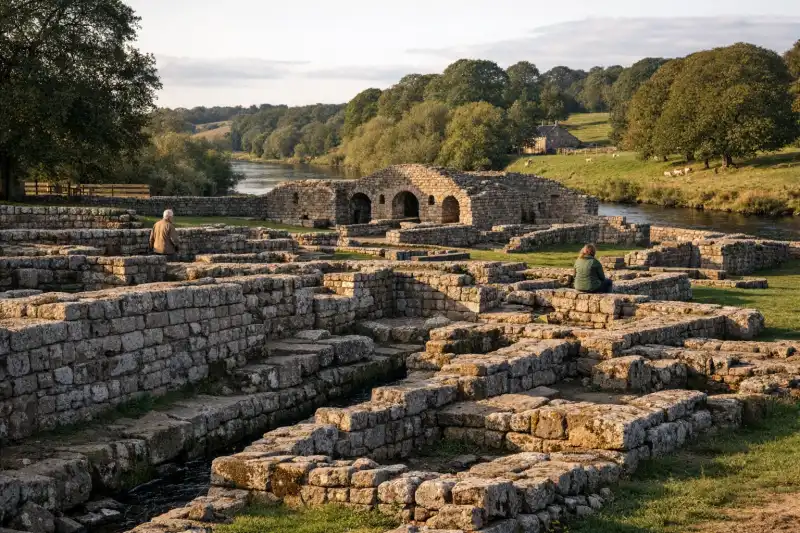
Known in antiquity as Cilurnum, the fort occupies a strategic point near a river crossing and the line of the wall itself. The setting is one of its greatest attractions. Open meadows, broad skies, and the curve of the river create a memorable contrast with the rigid logic of Roman planning. You are not standing in an isolated ruin but in a landscape where empire, engineering, and nature still speak to one another. The remains of the bathhouse are particularly atmospheric, while the museum preserves inscriptions, altars, tools, and sculptural fragments that give the site depth beyond what survives outdoors.
For visitors interested in Roman Britain, Chesters Roman Fort is one of the most rewarding stops in Northumberland. It combines archaeological importance with accessibility, and it fits easily into a wider journey along Hadrian’s Wall. Whether you come for military history, museum collections, or simply the pleasure of walking through a beautiful historic landscape, Chesters leaves a lasting impression.
History
Origins on Rome’s northern frontier
Chesters Roman Fort was established in the early 2nd century CE as part of the frontier system created after Emperor Hadrian ordered the construction of the wall that bears his name. This immense barrier, stretching across northern Britain, was not simply a defensive line. It was also a controlled border zone, designed to regulate movement, project imperial authority, and support military administration in a region that Rome considered sensitive.
The fort’s Roman name, Cilurnum, appears in ancient sources and inscriptions, and its position was carefully chosen. It stood near a crossing of the River North Tyne, making it strategically valuable for communication and local control. Like many forts along the wall, it was integrated into a larger network of milecastles, turrets, roads, and support installations. The Roman army did not rely on a single wall in isolation; it created a complex military landscape, and Chesters was one of its most significant components.
Archaeological evidence suggests that the original fort was designed to house a cavalry unit. This mattered. Mounted troops could patrol more widely than infantry, respond quickly to disturbance, and escort officials or messages along the frontier road system. Chesters was therefore not just a static base but an active operational center.
Cavalry garrison and daily military life
One of the defining features of Chesters Roman Fort is its close association with cavalry. The fort is generally linked with the ala II Asturum, a unit originally recruited in northwestern Hispania. Like many Roman auxiliary formations, it drew on regional identities even while serving the empire far from its homeland. The presence of such a unit reflects the cosmopolitan nature of Roman Britain, where soldiers, merchants, families, and administrators came from many corners of the Roman world.
Within the fort were the standard components of Roman military planning: headquarters buildings, barracks, granaries, workshops, and the commandant’s residence. These spaces were laid out according to a disciplined logic that made Roman forts efficient, legible, and replicable across vast distances. Yet life inside was not only martial. Soldiers worshipped a range of deities, managed supplies, maintained equipment, cared for horses, and interacted with local communities. A settlement outside the fort likely grew to serve and profit from the military presence.
The nearby bathhouse is one of the most evocative reminders that Roman forts were centers of routine as much as conflict. Bathing was a social, hygienic, and cultural institution of Roman life, and even on a distant frontier, troops expected this familiar amenity. Its survival at Chesters gives rare insight into how Roman identity was preserved through daily habits.
Later Roman changes and frontier adaptation
The northern frontier of Roman Britain was never entirely static. Over the 2nd, 3rd, and 4th centuries CE, military needs changed, units moved, and buildings were repaired or altered. Chesters Roman Fort went through several phases of development, reflecting the broader evolution of imperial strategy in Britain. There were periods when Roman attention shifted north to the Antonine Wall in Scotland, followed by returns to Hadrian’s Wall as the more sustainable frontier line.
Like other forts, Chesters would have required regular rebuilding. Timber gave way to stone in many places, defensive features were modified, and interior buildings adapted to changing troop strengths and responsibilities. Inscriptions and sculptural fragments found at the site hint at commanders, dedications, and official activity, preserving a trace of the human personalities who once occupied this outpost.
By the late Roman period, frontier management across Britain became more pressured by administrative strain, political upheaval, and shifting external threats. Chesters remained in use into the 4th century, but like the rest of Roman Britain, it eventually entered a phase of decline as imperial authority weakened and military structures ceased to function in their original way.
Rediscovery, excavation, and preservation
After the Roman withdrawal from Britain in the early 5th century, the fort gradually became part of the agricultural landscape. Stone was reused, walls collapsed, and the precise memory of the site faded, although the ruins never disappeared entirely. Antiquarians and early scholars took an interest in Hadrian’s Wall and its forts long before modern archaeology developed, but Chesters gained particular prominence in the 19th century.
A key figure in its rediscovery and preservation was John Clayton, the lawyer and antiquarian who did more than almost anyone to protect stretches of Hadrian’s Wall from destruction. At a time when quarrying and farming threatened many Roman remains, Clayton acquired land, carried out excavations, and assembled collections from the sites under his care. His work at Chesters helped save the fort and formed the basis of the museum that visitors see today.
Modern archaeological methods have deepened understanding of the site, but the value of Chesters lies not only in what has been uncovered. It also lies in what has been preserved as a coherent historic place: a fort, a bathhouse, a museum collection, and a landscape still closely tied to the line of Rome’s northern frontier.
Key Features
Chesters Roman Fort rewards slow exploration. Its remains are not towering or theatrical in the way of some ancient monuments, but they are unusually intelligible. You can walk the footprint of a Roman fort and understand how its spaces connected. The outlines of the headquarters building, granaries, barracks, and commanding officer’s house remain visible enough to reveal the disciplined planning at the heart of the Roman army. It is one of those sites where the geometry of empire can still be felt under your feet.
The bathhouse is perhaps the most memorable element. Located beside the River North Tyne, it survives as one of the best-preserved military bathhouses in Roman Britain. Its position near the water was practical, but the setting also adds dramatic charm. Here, among stone walls and vaulted remnants, visitors can imagine soldiers moving through changing rooms and heated chambers after a day of patrol or training. Even if you know little about Roman bathing culture, the structure makes its own case for the sophistication of life on the frontier. This was not a crude outpost at the edge of the known world; it was a place where Roman systems of comfort, ritual, and order were maintained with remarkable persistence.
The museum is another major highlight and should not be skipped. It holds one of the most important collections associated with Hadrian’s Wall, including altars, inscriptions, carved stones, tools, personal objects, and architectural fragments. Some pieces are powerful because of their craftsmanship, while others matter because they capture ordinary lives: names of officers, dedications to gods, evidence of trade, and traces of military bureaucracy. Together they remind visitors that Roman Britain was not abstract. It was populated by real individuals navigating service, belief, status, and identity far from the Mediterranean heartlands of empire.
Among the sculptural and inscribed stones, you can sense the multicultural character of the Roman army. Units posted here often originated elsewhere in the empire, bringing with them traditions, languages, and religious practices that mingled with local conditions in Britain. This gives Chesters a broader significance. It is not only a Northumberland site; it is evidence of how Rome connected distant provinces into a shared imperial system.
The landscape around the fort is also part of the experience. Unlike urban Roman sites, Chesters remains embedded in open countryside. The nearby river softens the military setting, while the wider valley and rolling fields help visitors understand why the Romans valued this location. Visibility, movement, water access, and road connections all mattered. Yet modern tranquility makes the site feel contemplative rather than severe. It is easy to spend time here imagining both the practical demands of frontier life and the long centuries during which the fort slowly passed into ruin.
Another feature that makes Chesters especially appealing is its relationship to the wider Hadrian’s Wall corridor. This is not an isolated ruin requiring specialist interest to appreciate. It forms part of a larger UNESCO-recognized frontier landscape, so a visit often gains richness from being paired with walks on the wall, nearby museums, or other Roman forts. Chesters often appeals most strongly to travelers who want a balanced experience: enough visible archaeology to stir the imagination, enough museum material to provide substance, and enough scenic beauty to make the visit enjoyable even for companions who are not devoted history enthusiasts.
What distinguishes Chesters in the end is coherence. Many Roman sites preserve one striking element, but here the fort plan, riverside bathhouse, and museum collection work together. The result is a place where military history becomes human scale. You see not only defenses and administration, but bathing, worship, movement, and memory. It is a rare chance to encounter the Roman frontier as a lived environment rather than a line on a map.
Getting There
Chesters Roman Fort is in Northumberland, close to Chollerford and within reach of Hexham, making it manageable as a day trip from Newcastle or as part of a longer Hadrian’s Wall itinerary. If you are driving, it is the easiest option. From Newcastle, the journey usually takes around 45 to 60 minutes depending on traffic, following the A69 west and then local roads toward Chollerford. Parking is typically available on site or nearby, and having a car makes it much easier to combine Chesters with other wall attractions in the same day.
By public transport, the most common route is to travel first to Hexham. Trains from Newcastle to Hexham usually take about 35 to 40 minutes, with standard fares often around £6 to £12 one way depending on timing and ticket type. From Hexham, local buses toward Hadrian’s Wall or Chollerford may connect seasonally or on limited schedules; fares are often in the £2 to £5 range. In some cases, a taxi from Hexham is the most practical final leg and may cost roughly £15 to £25.
Visitors exploring Hadrian’s Wall in summer should look for seasonal bus services such as the AD122 route, which links several major Roman sites along the wall corridor. Prices vary, but day tickets are generally reasonable and can be excellent value if you plan to stop at multiple attractions. If relying on public transport, check current timetables carefully, as rural service frequency can be limited outside peak visitor months.
When to Visit
The best time to visit Chesters Roman Fort is from late spring to early autumn, when Northumberland’s long daylight hours and milder weather make the open-air ruins especially enjoyable. May, June, and September are often ideal. These months usually offer a good balance of green landscapes, comfortable temperatures, and fewer crowds than the height of summer. The riverside bathhouse and fort outlines are particularly pleasant to explore when the ground is dry and the surrounding countryside is at its most vivid.
July and August bring the warmest conditions and the greatest chance of combining your trip with wider touring along Hadrian’s Wall. Seasonal transport services are more likely to be running, and museum visits pair well with walks in the area. The trade-off is that these are also the busiest months, especially during school holidays. Even then, Chesters rarely feels overwhelmingly crowded compared with major city attractions, but parking and local services can be busier.
Autumn can be beautiful, with softer light and a quieter atmosphere that suits the reflective mood of the site. Winter visits are certainly possible, and some travelers enjoy the stark frontier landscape at this time of year. However, weather in northern England can be cold, wet, and windy, and muddy ground may make the outdoor portions less comfortable. If visiting in winter, bring sturdy footwear and check opening times in advance, as facilities and access may vary seasonally. Whenever you come, a dry day transforms the experience.
| Quick Facts | Details |
|---|---|
| Location | Near Chollerford, Northumberland, England |
| Ancient name | Cilurnum |
| Country | United Kingdom |
| Frontier system | Hadrian’s Wall |
| Main function | Roman cavalry fort |
| Date established | 2nd century CE |
| Best-known feature | Well-preserved riverside bathhouse |
| Nearby base for visitors | Hexham |
| Recommended visit length | 1.5 to 3 hours |
| Best season | Late spring to early autumn |
Guided tours: worth it?
You can visit Chesters Roman Fort independently, but a guide can help connect the most important objects to the wider ancient landscape instead of turning the visit into a long label-reading session.
Best for
- Trips where tickets, circuits, or timed entry can shape the day
- Museum-plus-site days where the collection needs context
- Short visits where a planned route saves time
When to go self-guided
Go independently if you prefer setting your own pace, reading as you go, and checking official hours or ticket rules directly before you arrive.
What I’d avoid
Skip paid tours that bundle unrelated stops you do not actually want. The best option should either save meaningful planning time or add historical context you would miss on your own.
Hadrian's Wall Tours
Useful when: you want to compare guided formats before deciding
Northumberland Roman Sites Tours
Useful when: you want to compare guided formats before deciding
Newcastle to Hadrian's Wall Day Tours
Useful when: you want to compare guided formats before deciding
Some tour links are affiliate links, which may earn Ancient Travel a small commission at no extra cost to you. I try to surface options that make practical sense for the site—not just anything bookable.
Frequently Asked Questions
What is Chesters Roman Fort known for?
Chesters Roman Fort is best known as one of the best-preserved Roman cavalry forts on Hadrian’s Wall, with visible bathhouse remains, fort foundations, and an important collection of Roman artifacts.
Is Chesters Roman Fort part of Hadrian’s Wall?
Yes. Chesters Roman Fort was built along Hadrian’s Wall and formed part of the frontier system that marked the northern edge of Roman Britain.
How much time do you need at Chesters Roman Fort?
Most visitors spend 1.5 to 3 hours exploring the fort remains, riverside bathhouse, museum, and walking the surrounding landscape.
Can you visit Chesters Roman Fort without a car?
Yes, but it is easier with a car. Public transport options usually involve traveling to Hexham or Chollerford and then using a local bus, taxi, or walking route.
Is Chesters Roman Fort suitable for families?
Yes. Families often enjoy the open-air ruins, museum displays, and the chance to connect the site with a wider Hadrian’s Wall day trip.
When was Chesters Roman Fort built?
The fort was established in the 2nd century CE, soon after Hadrian’s Wall was built, and it remained in use through the Roman occupation of Britain.
Nearby Ancient Sites
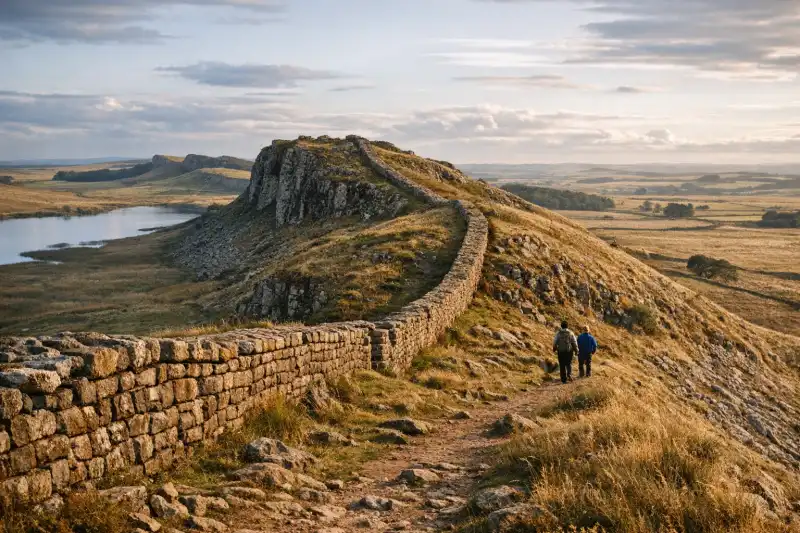
Hadrian's Wall
RomanExplore Hadrian’s Wall in the United Kingdom, Rome’s great northern frontier of forts, milecastles, ...

Castlerigg Stone Circle
Neolithic BritainAncient stone circle near Keswick in the United Kingdom, famed for dramatic mountain views and one o...
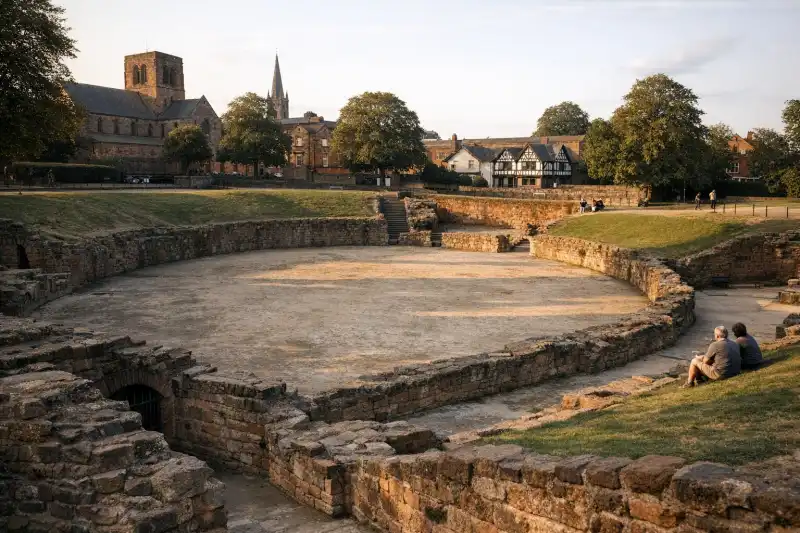
Chester Roman Amphitheater
Explore Chester Roman Amphitheater in the United Kingdom, the largest known Roman amphitheater in Br...