Quick Info
At a glance
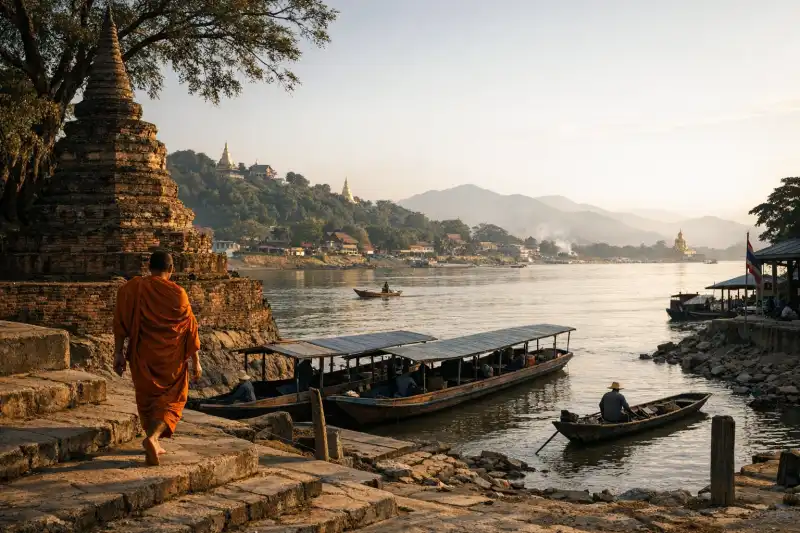
Chiang Saen in Thailand feels different from many of the country’s better-known heritage destinations. Instead of presenting itself through one monumental temple or a tightly managed archaeological park, it unfolds as an old frontier town where rivers, walls, ruined shrines, and living neighborhoods still share the same space. On the eastern edge of Chiang Rai Province, beside the Mekong River and not far from the meeting zone of Thailand, Laos, and Myanmar, the town carries an atmosphere shaped by both memory and geography. You are not simply visiting a single monument here. You are moving through the remains of a historical city that once mattered deeply to regional politics, religion, and trade.
What gives Chiang Saen its particular power is the way history remains embedded in the landscape. Earthen ramparts still trace old boundaries. Brick stupas rise unexpectedly from quiet compounds. Temple ruins sit beneath large trees, while the broad Mekong, still an artery of movement, flows past as it has for centuries. The setting helps explain why Chiang Saen became important and why competing kingdoms wanted to control it. For travelers interested in northern Thailand beyond the standard circuit, the town offers a more reflective experience: less spectacle, more texture. Its appeal lies in details—the surviving city plan, old Buddhist monuments, museum collections, and the feeling that this was once a strategic river city at the edge of several worlds.
History
Early settlement and regional roots
The area around Chiang Saen was inhabited long before the city emerged as a major political center. The Mekong River valley supported settlement, agriculture, and trade routes that linked upland zones with wider mainland Southeast Asia. Archaeological evidence from the broader region suggests long patterns of human occupation, and the riverine setting would naturally have encouraged exchange of goods, ideas, and religious traditions. Before Chiang Saen rose to prominence under Tai-speaking rulers, the region was already part of a cultural landscape influenced by Mon, Khmer, and local traditions.
Northern Thailand in the early medieval period was not a fixed political map but a shifting network of mueang, or city-states, connected by kinship, warfare, trade, and religion. Power depended heavily on control of fertile land, labor, and routes of communication. Chiang Saen’s location along the Mekong made it valuable in all three respects. Even before becoming one of the important centers of the Lanna world, it occupied a position that could support defense and commerce alike.
Rise under the Lanna Kingdom
Chiang Saen is most strongly associated with the Lanna Kingdom, which emerged in the 13th century in the north of what is now Thailand. Tradition links the city to the early history of Lanna and to the dynasty associated with King Mangrai, one of northern Thailand’s most important rulers. Whether considered as a dynastic homeland, a fortified urban center, or a strategic river city, Chiang Saen became part of the political architecture of Lanna at a formative time.
During this era, the city developed the features that still define its archaeological character: fortified walls, a moat, and numerous Buddhist temples. These were not merely religious foundations. Temples served as centers of scholarship, ritual legitimacy, and civic life. A prosperous city demonstrated power through monastery construction, image casting, and the patronage of monks. The remains of stupas and viharns across Chiang Saen reflect this period of growth and spiritual investment.
The Lanna period also linked Chiang Saen to artistic and religious currents that stretched across northern Thailand and into Laos and Myanmar. Sculptural styles, inscriptions, and monastery forms reveal a world that was connected rather than isolated. Chiang Saen art in particular became influential enough to be recognized as a distinct tradition within northern Thai Buddhist culture. The city flourished as both a religious center and a node in a borderland kingdom.
Conflict, Burmese control, and decline
From the 16th century onward, the history of Chiang Saen became more turbulent. The expansion of Burmese power into Lanna transformed northern cities into contested territories. Chiang Saen, because of its location and fortifications, became especially important in these struggles. Control of the town meant influence over the river corridor and a defensive anchor in the far north.
Under Burmese domination, some urban and religious life continued, but the city was increasingly shaped by military concerns. In many Southeast Asian frontier cities, political instability did not always mean complete abandonment; instead, populations shifted, rulers changed, and sacred structures were repaired, reused, or left to decay depending on the fortunes of war. Chiang Saen likely experienced these rhythms repeatedly.
The late 18th and early 19th centuries brought especially severe disruption. Siamese campaigns against Burmese-held territories turned Chiang Saen into a military target. After its capture in the early 1800s, the city was largely depopulated. As was common in premodern mainland Southeast Asia, populations could be forcibly relocated after conquest, leaving urban landscapes physically present but socially hollowed out. This process contributed significantly to the ruined character that visitors encounter today.
Reoccupation, memory, and modern preservation
In the later 19th and 20th centuries, Chiang Saen slowly re-emerged as an inhabited settlement while retaining visible traces of the older city. Rather than being rebuilt into a modern urban center that erased its past, it remained relatively small, allowing ancient embankments, temple ruins, and the broad plan of the historic city to survive. This continuity makes Chiang Saen unusual: it is both a living town and an archaeological environment.
Modern scholarship, museum work, and heritage conservation have helped clarify the city’s role in Lanna history. Excavations and restoration projects have preserved key temple remains, while local museums display Buddha images, inscriptions, ceramics, and architectural fragments that place the site within the wider northern Thai world. Chiang Saen today is not as famous internationally as Sukhothai or Ayutthaya, yet historians and culturally curious travelers increasingly recognize it as essential for understanding the political and artistic history of the upper Mekong region.
Its significance lies not only in individual monuments but in the survival of a whole urban memory: walls, sacred compounds, riverfront orientation, and the lingering sense of a once-important kingdom city at the northern edge of Thailand.
Key Features
Chiang Saen’s most distinctive feature is its ancient urban layout. The old city walls and moat still describe a clear historic boundary, giving visitors an unusually tangible sense of how the town once functioned as a fortified center. In many heritage destinations, urban defenses survive only in fragments or reconstructed sections. Here, earthen ramparts and surviving brickwork help you imagine the scale of the original settlement and its defensive logic. Walking or driving along these edges reveals how carefully the city was positioned between river and inland approaches. The setting makes strategic sense immediately.
Within and around the old city are numerous temple ruins, each contributing a different chapter to the site’s identity. Wat Chedi Luang is among the most notable, with its large brick stupa dominating the surrounding area and hinting at the ceremonial importance the city once possessed. The structure is impressive not simply because of its size, but because it retains the solemn gravity of a monument that outlasted the kingdom that built it. Nearby, smaller foundations, brick platforms, and weathered remains suggest the density of religious life that once animated Chiang Saen.
Wat Pa Sak is especially valued for its elegant architecture and historical inscriptions. Its chedi reflects refined Lanna craftsmanship, and the site demonstrates how northern Thai religious architecture could combine monumentality with delicate decorative sensibilities. Other ruins scattered through the town may appear quieter or more fragmentary, but together they create a layered archaeological landscape rather than a single focal point. This is part of Chiang Saen’s appeal: you explore by accumulation, noticing repeated forms and subtle differences between compounds.
The Mekong riverfront is another defining element. Unlike inland capitals, Chiang Saen has a direct environmental relationship with a major international waterway. The river broadens the visual horizon and reminds visitors that this was a city connected to movement, trade, diplomacy, and conflict beyond its walls. The riverbank today offers scenic viewpoints, but historically it also explains the town’s importance. Standing there, with Laos across the water and the Golden Triangle region nearby, the borderland nature of Chiang Saen becomes unmistakable.
Museum collections deepen the experience by providing context for what can otherwise seem like dispersed ruins. The local museum presents Buddha images in the Chiang Saen artistic style, stone inscriptions, ceramics, and architectural fragments recovered from the area. These objects are crucial because they reveal the sophistication of the city as a religious and artistic center. The famous Chiang Saen Buddha image style, noted for calm facial features and balanced form, reflects the region’s distinctive interpretation of Buddhist art. Seeing these works after visiting the ruins helps bridge the gap between architecture and lived devotional culture.
What also stands out is the mood of the place. Chiang Saen is not overwhelmed by large-scale tourism infrastructure, so the old sites often feel integrated into daily life rather than staged apart from it. Trees, local roads, temple compounds still in use, and quiet residential stretches all contribute to a softer archaeological experience. You are less likely to feel that you are moving through an isolated monument zone and more likely to feel that history remains embedded in a functioning town. For many travelers, that quality is more memorable than any single ruin.
Finally, Chiang Saen’s proximity to the Golden Triangle gives it an added interpretive dimension. Although the old city and the modern tourist concept of the Golden Triangle are not the same thing, they complement each other. One offers deep historical texture; the other helps explain the enduring strategic significance of the region. Together, they place Chiang Saen within a long story of borders, kingdoms, trade routes, and cultural exchange.
Getting There
Most visitors reach Chiang Saen from Chiang Rai, the nearest major city and the most practical transport base. By road, the journey is roughly 60 to 70 kilometers and usually takes around 1 to 1.5 hours depending on traffic and your exact starting point. Private taxis or ride-hire arrangements from Chiang Rai typically cost about 1,200 to 2,000 THB for a one-way trip, though full-day charters that include Chiang Saen, the Golden Triangle, and other northern stops can range from 2,500 to 4,500 THB.
Public transport is cheaper but less predictable. Local buses and songthaews serving the Chiang Rai–Chiang Saen route generally cost around 50 to 100 THB per person, though schedules can vary and may not be ideal for travelers wanting to maximize sightseeing time. If you are comfortable with flexible travel and some waiting, they are a budget-friendly option. Renting a car in Chiang Rai is often the most convenient independent choice; expect approximately 800 to 1,500 THB per day for a basic vehicle, plus fuel. Roads are generally straightforward, and having your own transport makes it easier to explore scattered ruins and nearby river viewpoints.
Chiang Rai itself is accessible by domestic flight from Bangkok, with airfares often ranging from about 1,000 to 3,000 THB if booked in advance. From Chiang Rai Airport, travelers can continue directly to Chiang Saen by taxi or arranged transfer. Organized day tours are also widely available and can be good value if you want transport, site commentary, and a combined Golden Triangle itinerary without logistical stress.
When to Visit
The best time to visit Chiang Saen is usually during Thailand’s cool season, from November to February. Temperatures are milder, humidity is lower, and walking around walls, temple ruins, and museum grounds is much more comfortable than in hotter months. Morning light over the Mekong is especially pleasant at this time of year, and clearer skies often improve both photography and long-distance views.
The hot season, roughly March to May, brings higher temperatures that can make midday exploration tiring, especially because many of Chiang Saen’s ruins are spread out and partially exposed. If you visit then, it is best to start early, take a long lunch break, and continue again later in the afternoon. Northern Thailand can also experience seasonal haze during parts of the late dry season, which may soften views and affect air quality.
The rainy season, from about June to October, transforms the landscape into a greener and more atmospheric setting. The moats, trees, and river scenery can be particularly attractive, and visitor numbers are often lower. However, sudden downpours can interrupt plans, and some outdoor walking areas may become muddy or less comfortable. For travelers who do not mind occasional rain, this can still be a rewarding period, especially if the goal is a quieter, more contemplative visit.
If possible, aim for a weekday morning in the cool season. The town feels calm, the light is soft, and you can explore at an unhurried pace that suits the character of the site.
| Quick Facts | Details |
|---|---|
| Location | Chiang Rai Province, northern Thailand |
| Historical identity | Ancient fortified city of the Lanna Kingdom |
| Setting | On the Mekong River near the Golden Triangle |
| Best known for | Old city walls, temple ruins, and Chiang Saen Buddha art |
| Main monuments | Wat Chedi Luang, Wat Pa Sak, old ramparts and moat |
| Best base | Chiang Rai |
| Suggested visit length | Half day to full day |
| Best season | November to February |
| Atmosphere | Quiet, historical, and less crowded than major Thai heritage parks |
| Ideal for | Travelers interested in Lanna history, archaeology, and river landscapes |
Chiang Saen rewards a slower style of travel. It is not a destination of dramatic crowds or one-icon recognition, but of context, continuity, and place. Its walls recall vanished power, its temples reveal centuries of devotion, and its riverfront explains why this corner of northern Thailand mattered so much for so long. For anyone trying to understand the deeper history of the Thai north—not only as a region of beautiful temples, but as a shifting frontier of kingdoms and exchange—Chiang Saen is one of the most evocative places to visit.
Guided tours: worth it?
Self-guided works here, but a guide can add real value if you want the ruins explained as a living place rather than just a sequence of monuments.
Best for
- First-time visitors who want context, not just photos
- Short visits where a planned route saves time
When to go self-guided
Go independently if you prefer setting your own pace, reading as you go, and checking official hours or ticket rules directly before you arrive.
What I’d avoid
Skip paid tours that bundle unrelated stops you do not actually want. The best option should either save meaningful planning time or add historical context you would miss on your own.
Chiang Saen Thailand Tours
Useful when: you want to compare guided formats before deciding
Golden Triangle and Chiang Saen Day Trips
Useful when: transport or pickup logistics matter
Chiang Rai to Chiang Saen Excursions
Useful when: you want to compare guided formats before deciding
Some tour links are affiliate links, which may earn Ancient Travel a small commission at no extra cost to you. I try to surface options that make practical sense for the site—not just anything bookable.
Frequently Asked Questions
What is Chiang Saen known for?
Chiang Saen is known for its ancient city walls, ruined temples, Lanna heritage, and its setting on the Mekong River near Thailand's Golden Triangle.
Is Chiang Saen worth visiting from Chiang Rai?
Yes. It makes an excellent day trip or overnight stop from Chiang Rai for travelers interested in history, archaeology, and quieter alternatives to more crowded northern destinations.
How much time do I need in Chiang Saen?
Most visitors can see the main archaeological remains and museums in half a day, but a full day allows time for riverside viewpoints, temple visits, and a slower exploration of the old town.
Can you see the Golden Triangle from Chiang Saen?
Chiang Saen is very close to the Golden Triangle area, and many itineraries combine the old city with viewpoints and river excursions nearby.
What are the main historic attractions in Chiang Saen?
Highlights include the old city ramparts and moat, Wat Chedi Luang, Wat Pa Sak, riverside temple ruins, and museum collections that explain the city's Lanna and regional history.
When is the best time to visit Chiang Saen?
The cool season from November to February is generally the most comfortable, with clearer skies and milder temperatures for walking around the archaeological sites.
Nearby Ancient Sites
Sukhothai
Sukhothai, in northern Thailand's Sukhothai Province, is famed as the cradle of Thai civilization an...
Sukhothai Historical Park Travel Guide 2026: Thailand’s First Capital Without the Crowds
Sukhothai KingdomPlan a smarter Sukhothai Historical Park visit with route tips, key ruins, and practical timing for ...
Si Satchanalai
Sukhothai KingdomExplore Si Satchanalai, a serene UNESCO-listed ancient city in Thailand known for elegant temples, k...