Quick Info
At a glance
Chiapa de Corzo in Mexico sits on the warm plains of Chiapas near the Grijalva River, where deep antiquity and everyday local life still meet in a surprisingly intimate landscape. Unlike some better-known Mesoamerican ruins that rise in massive stone silhouettes from the forest, Chiapa de Corzo reveals its importance more gradually. Its significance lies not only in what remains visible above ground, but in what archaeologists have uncovered about its role as one of the earliest major centers in southern Mesoamerica. Here, broad platforms, sculpted monuments, elite tombs, and traces of early urban planning speak of a community that flourished long before the Classic Maya reached their height.
For travelers, that makes the site especially compelling. A visit to Chiapa de Corzo is not about chasing the tallest pyramid or the most elaborate decorative facade. It is about standing in one of the oldest civic-ceremonial landscapes in the region and understanding how early political power, trade, ritual, and social organization developed in what is now Chiapas. The archaeological zone also benefits from its setting near the colonial town of the same name and the boat departures for Sumidero Canyon, making it easy to include in a broader day of exploration. If you are interested in the deeper roots of Mesoamerican civilization rather than only its later monumental expressions, Chiapa de Corzo offers one of Mexico’s most rewarding and often overlooked ancient destinations.
History
Early settlement and formative beginnings
Chiapa de Corzo was occupied very early, with settlement beginning around 1200 BCE during the Early Preclassic period. This makes it one of the oldest known major centers in the region. Its position near the Grijalva River was crucial. Access to fertile land, transport routes, and exchange networks helped the settlement grow into a place of regional importance. Archaeological evidence suggests that the community participated in broad Mesoamerican interaction systems from an early date, including contacts with Gulf Coast Olmec traditions.
These early centuries were formative in every sense. The people living here were not simply inhabiting a village that happened to endure. They were part of a developing ceremonial and political center, one where public architecture and ritual space already mattered. Excavations have shown that residents constructed platforms and organized communal areas in ways that point to coordinated labor and leadership. This was a place where social hierarchy was beginning to take visible form.
Rise as a regional center
By the Middle and Late Preclassic periods, roughly between 900 and 300 BCE, Chiapa de Corzo had become a major center in the Central Depression of Chiapas. During this era the site expanded in scale and complexity. Monumental earthen and masonry constructions appeared, plazas became more defined, and ceremonial life likely grew more elaborate. Some of the most important discoveries from the site date to this broad span, including elite burials and monuments that indicate both local authority and wide-ranging cultural connections.
One of the site’s most celebrated finds is Tomb 1, discovered inside Mound 11. This rich burial included jade, iron-ore mirrors, and other prestige goods, demonstrating the presence of a powerful ruling class. Such material confirms that Chiapa de Corzo was not a peripheral settlement but a place with developed elites, long-distance exchange, and ceremonial prestige. The tomb is often discussed as one of the earliest known complex elite burials in Mesoamerica.
The site is also famous in discussions of writing and chronology. Archaeological finds from Chiapa de Corzo have been linked to some of the earliest Long Count calendar evidence in Mesoamerica, a topic of major importance for understanding how early dating systems emerged and spread. Even where scholarly debate continues, the site clearly occupies an important place in the story of early political and intellectual development in southern Mexico.
Transition, continuity, and change
After its Preclassic peak, Chiapa de Corzo began to lose some of its regional dominance. This did not mean sudden abandonment. Rather, like many ancient cities, it passed through periods of adaptation and reduced prominence. Changing trade routes, political competition, environmental pressures, and evolving regional power structures may all have influenced its trajectory. As neighboring centers rose and interaction spheres shifted, Chiapa de Corzo’s role changed with them.
Occupation continued into later periods, though often at lower intensity. The site’s long chronology is one of the reasons it matters so much to archaeologists. It allows scholars to trace continuity and transformation across many centuries of Mesoamerican history. Ceramics, burials, construction phases, and imported goods together reveal a community that remained connected to wider cultural currents even as its own political fortunes altered.
Rediscovery and archaeology
Modern archaeological interest in Chiapa de Corzo has built gradually over decades of fieldwork. Researchers recognized early that the site held unusual significance because of both its antiquity and its strategic location. Excavations have uncovered mounds, plazas, burials, and artifacts that transformed scholarly understanding of early complex societies in Chiapas.
What makes archaeology here especially valuable is the way it fills a geographic and historical gap. Too often, broad public narratives of ancient Mexico jump from the Olmec heartland to the Maya world, overlooking the dynamic societies of Chiapas in between. Chiapa de Corzo shows that this region was neither isolated nor secondary. It was a crossroads where local traditions, wider exchange, and early state formation intersected. Today, even though the site remains less famous than headline destinations on the Yucatán Peninsula, it is recognized by specialists as one of the key places for understanding early Mesoamerican civilization.
Key Features
Chiapa de Corzo is best appreciated as a ceremonial and civic landscape rather than a single monument. The site includes a series of mounds, plazas, and platforms that once framed political authority and ritual activity. Although many structures survive as grassy rises rather than towering rebuilt pyramids, this should not be mistaken for a lack of importance. In fact, the more understated appearance encourages visitors to think archaeologically: to imagine the site as layers of occupation, rebuilding, and ceremonial use accumulated over centuries.
Among the most notable features are the large mounds that define the core of the archaeological zone. These elevated constructions formed the backbone of the ceremonial center and likely supported temples, elite residences, or other public buildings made partly from perishable materials now lost. Their scale still conveys the coordinated labor required to shape the city. Walking among them, you can sense the planning behind the arrangement of open space and elevated platforms, a reminder that this was a structured urban environment rather than a random settlement.
Mound 11 is especially significant because of the elite tomb discovered within it. Even though visitors do not experience the burial in the same way archaeologists did during excavation, knowing what was found there changes the way the entire site is read. The rich funerary offerings connected Chiapa de Corzo to broader systems of prestige, belief, and trade. Jade ornaments, mirrors, and finely made objects point to a society in which rulership and ceremony were closely linked. The mound is therefore not just an architectural feature but a key to understanding power at the site.
Another important element is the site’s role in discussions of early writing and calendrical notation. Chiapa de Corzo is associated with monuments and finds that have made it central to debates about the origins of the Long Count calendar tradition. For visitors, this may sound abstract at first, but it gives the site an intellectual significance that extends beyond architecture. Places like this were not only political centers; they were also settings where systems of memory, record-keeping, and sacred time were being shaped.
The setting itself is part of the experience. Chiapa de Corzo lies in a lowland riverine environment that would have supported agriculture while also connecting the community to regional routes. The proximity to the Grijalva River helps explain why the settlement became influential so early. Ancient cities did not thrive by accident, and here the landscape reveals the practical foundations of ceremonial power. Access to water, fertile soils, and transportation corridors made sustained occupation possible.
Visitors should also pay attention to the broader context beyond the excavated remains. The modern town of Chiapa de Corzo preserves a distinct identity and acts as a cultural bridge between the ancient site and the living region. Combining the ruins with the town’s historic center, artisan traditions, and riverfront atmosphere gives the destination unusual depth. It becomes easier to see how this location has long attracted settlement, exchange, and ritual significance.
The relative quiet of the archaeological zone is another feature in its favor. Because it is less crowded than Mexico’s marquee ruins, there is often space to walk slowly, study the terrain, and reflect. This calmer atmosphere suits the site’s character. Chiapa de Corzo rewards patience and imagination. It may not overwhelm with vertical scale, but it offers something equally valuable: the chance to engage with one of Mesoamerica’s earliest urban experiments in a setting that still feels connected to the land that made it possible.
Getting There
Chiapa de Corzo is one of the easiest ancient sites to reach in Chiapas. The nearest major gateway is Tuxtla Gutiérrez, which has Ángel Albino Corzo International Airport. From the airport to Chiapa de Corzo, a taxi or private transfer usually takes around 35 to 50 minutes depending on traffic and typically costs about MXN 350 to 700. If you are already in central Tuxtla Gutiérrez, the journey is shorter, often 20 to 30 minutes, with taxi fares commonly around MXN 120 to 250.
Budget travelers can use local transport. Colectivos and local buses run between Tuxtla Gutiérrez and Chiapa de Corzo, generally costing about MXN 15 to 35 per person. These are economical and frequent, though they may not stop directly at the archaeological entrance, so expect a short walk or a brief taxi ride from town. If you prefer flexibility, renting a car is straightforward and useful if you plan to combine the site with Sumidero Canyon or other parts of Chiapas. Parking conditions can vary, but road access is generally simple.
Many visitors see Chiapa de Corzo as part of an organized day tour. Shared excursions from Tuxtla often include transport plus a boat trip through Sumidero Canyon, with prices commonly ranging from about MXN 700 to 1,600 per person depending on inclusions and group size. Private guides cost more but can make the archaeology much easier to understand. If your main goal is the ancient site itself, going independently is usually easy and affordable.
When to Visit
The best time to visit Chiapa de Corzo is during the dry season, roughly from November to April. During these months, skies are often clearer, paths are easier to navigate, and the heat, while still present, is usually more manageable than in the wetter part of the year. Morning visits are especially pleasant. Arriving early helps you avoid the strongest midday sun and gives the site a quieter, more reflective atmosphere.
From May to October, the rainy season brings greener surroundings but also heavier humidity and the chance of sudden downpours. The site can still be visited during these months, but lightweight rain gear, water-resistant shoes, and extra caution on slippery ground are wise. The advantage of the wet season is that the landscape feels lush, and visitor numbers may be lower. If you do not mind brief storms, it can still be a rewarding period to come.
Temperature matters more here than cold or seasonal extremes. Chiapas lowlands can feel hot for much of the year, so carrying water, sunscreen, and a hat is important in every season. If you are planning to pair the ruins with Sumidero Canyon, consider weather and timing together. A morning archaeological visit followed by an afternoon boat trip often works well in dry months, while in wetter months it may be better to prioritize the part of the day with the most stable forecast.
Cultural timing can also shape your experience. The town of Chiapa de Corzo is famous for traditional festivities, especially in January, when local celebrations can add color and energy to a visit. If you want a quieter archaeological experience, choose weekdays outside festival peaks. If you enjoy combining ancient history with living heritage, those celebratory periods can be especially memorable.
| Quick Facts | Details |
|---|---|
| Location | Chiapa de Corzo, Chiapas, Mexico |
| Nearest city | Tuxtla Gutiérrez |
| Cultural significance | One of the earliest major urban and ceremonial centers in southern Mesoamerica |
| Main periods | Preclassic to Postclassic |
| Earliest occupation | Around 1200 BCE |
| Best for | Early Mesoamerican history, archaeology, day trips from Tuxtla |
| Typical visit length | 1–2 hours for the archaeological zone |
| Good combined excursion | Sumidero Canyon and the town of Chiapa de Corzo |
| Best season | November to April |
| Access style | Easy independent visit by taxi, colectivo, car, or guided tour |
Chiapa de Corzo is a destination for travelers who value depth over spectacle. Its importance is embedded in chronology, exchange, and the early shaping of complex society in Mesoamerica. The architecture that survives may seem modest beside Mexico’s most iconic ruins, yet the site’s historical weight is immense. Here, in the plains of Chiapas, you encounter evidence of political authority, ritual life, elite burial, and calendrical thought at a remarkably early date. Add the convenience of access from Tuxtla Gutiérrez and the possibility of combining the ruins with river landscapes and local culture, and Chiapa de Corzo becomes one of the most rewarding ancient destinations in southern Mexico. For anyone seeking a fuller understanding of how Mesoamerican civilization took shape, it is a place well worth making time for.
Guided tours: worth it?
Most travelers can visit Chiapa de Corzo independently. Compare a tour only if you want a tighter history-focused visit, easier logistics, or a guide who can answer questions on the spot.
Best for
- Short visits where a planned route saves time
When to go self-guided
Go independently if you prefer setting your own pace, reading as you go, and checking official hours or ticket rules directly before you arrive.
What I’d avoid
Skip paid tours that bundle unrelated stops you do not actually want. The best option should either save meaningful planning time or add historical context you would miss on your own.
Chiapa de Corzo tours
Useful when: you want to compare guided formats before deciding
Sumidero Canyon and Chiapa de Corzo tours
Useful when: you want to compare guided formats before deciding
Tuxtla Gutierrez to Chiapa de Corzo tours
Useful when: you want to compare guided formats before deciding
Some tour links are affiliate links, which may earn Ancient Travel a small commission at no extra cost to you. I try to surface options that make practical sense for the site—not just anything bookable.
Frequently Asked Questions
What is Chiapa de Corzo known for?
Chiapa de Corzo is known as one of the oldest important urban centers in Mesoamerica, with occupation stretching back to the first millennium BCE and finds that show ties to early Olmec and later regional traditions.
Where is Chiapa de Corzo located?
The archaeological site is in the state of Chiapas, Mexico, near the modern town of Chiapa de Corzo and close to Tuxtla Gutiérrez, on the Grijalva River.
How much time do I need to visit Chiapa de Corzo?
Most travelers can see the archaeological zone in 1 to 2 hours, though pairing it with the town center and a Sumidero Canyon boat trip can easily fill half a day or more.
Can I visit Chiapa de Corzo on a day trip from Tuxtla Gutiérrez?
Yes. Chiapa de Corzo is a very easy day trip from Tuxtla Gutiérrez, usually reached in around 20 to 30 minutes by taxi, rideshare, or local transport depending on traffic.
What is the best time of year to visit Chiapa de Corzo?
The dry season from roughly November to April is generally the most comfortable for visiting, with sunnier weather and easier walking conditions.
Is Chiapa de Corzo suitable to combine with Sumidero Canyon?
Yes. Many visitors combine the archaeological site and colonial town with a boat trip through Sumidero Canyon because the departure piers are nearby.
Nearby Ancient Sites
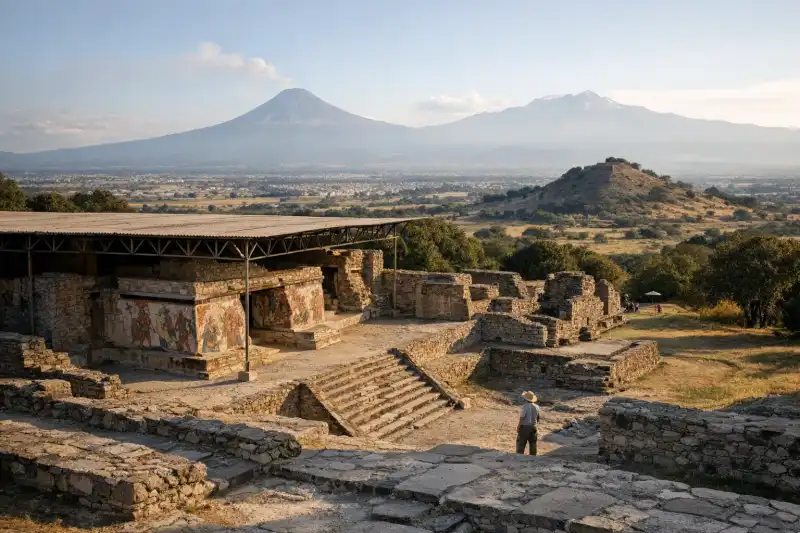
Cacaxtla
Olmeca-Xicalanca and broader Epiclassic Mesoamerican traditionsExplore Cacaxtla in Mexico, a hilltop archaeological site famed for vivid murals and Epiclassic hist...
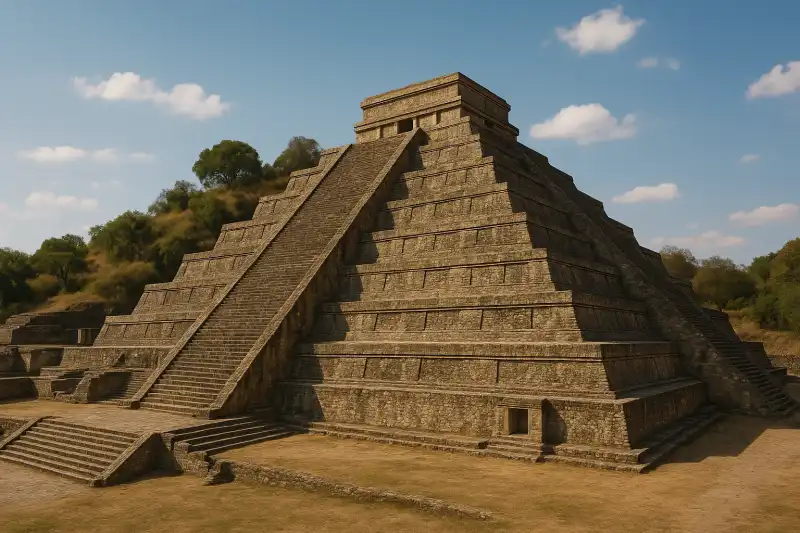
Great Pyramid of Cholula Travel Guide 2026: Tlachihualtepetl Essentials
Preclassic and Postclassic MesoamericanPlan a smart visit to the Great Pyramid of Cholula with key context, timing advice, and practical fi...
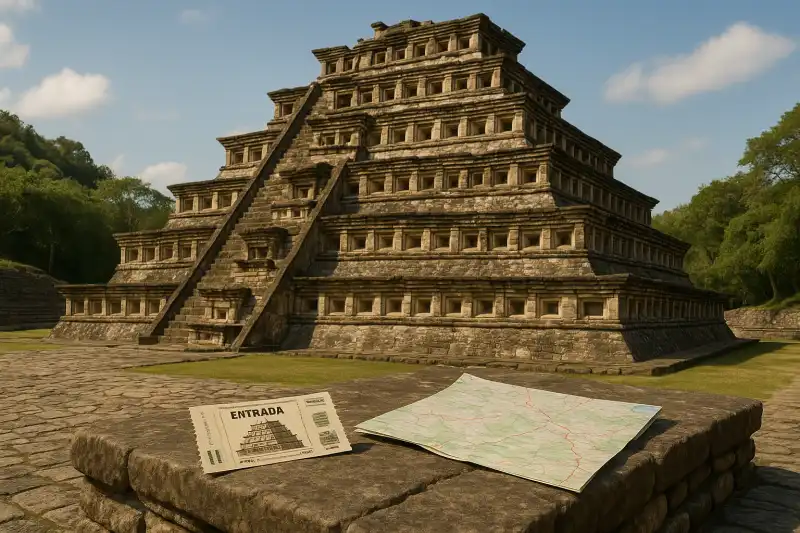
El Tajin Travel Guide 2026: Pyramid of the Niches, Tickets, and Route Planning
Classic VeracruzPlan a smoother El Tajin visit with practical transport timing, key structures to prioritize, and re...