Quick Info
At a glance
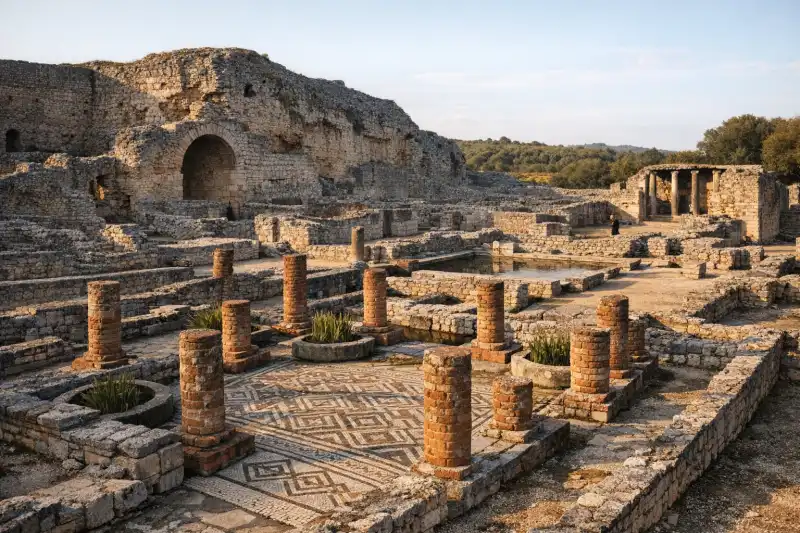
Conimbriga, in Portugal, is one of those rare archaeological places where ancient urban life feels close enough to imagine in detail. Set amid the softly rolling landscape south of Coimbra, the site does not overwhelm through gigantic scale alone; instead, it captivates through texture, intimacy, and preservation. Stone streets still suggest the rhythm of movement through a Roman town. House plans reveal social rank and private routines. Mosaics, some astonishingly vivid, preserve not only decorative taste but a sense of comfort, wealth, and aspiration. Here, the Roman world is not abstract. It appears as courtyards, fountains, baths, workshops, defenses, and domestic thresholds worn by countless footsteps.
What makes Conimbriga especially rewarding is the way it combines archaeological significance with accessibility. This was once a prosperous town in western Iberia, shaped by pre-Roman roots, transformed under Roman rule, and later pressured by instability during late antiquity. Today, visitors can walk through a landscape of ruins that still speaks clearly: a forum where civic life gathered, thermal complexes where residents bathed and socialized, and elegant villas whose mosaic floors remain among the finest in Portugal. The adjacent museum deepens the experience, connecting scattered stones to objects of everyday life. For travelers interested in the Roman Empire beyond Italy’s best-known sites, Conimbriga offers something memorable: a sophisticated provincial city preserved in a distinctly Portuguese setting.
History
Pre-Roman origins
Long before Conimbriga became a Roman city, the site was already occupied. Its location in central Portugal offered practical advantages: defensible terrain, access to agricultural land, and proximity to inland communication routes. Like many settlements in the Iberian Peninsula, it likely began as an indigenous community shaped by Iron Age traditions. These early inhabitants lived in a world of regional exchange, local identities, and changing political pressures as Mediterranean powers expanded westward.
Archaeology suggests that the pre-Roman settlement formed the base upon which later urban development would grow. This layered beginning matters because Conimbriga was not simply created from nothing by Rome. It was absorbed, reorganized, and expanded. The Roman conquest of the Iberian Peninsula often followed this pattern, integrating local communities into imperial systems while reshaping their institutions, architecture, and economy.
Roman incorporation and urban growth
Conimbriga entered the Roman orbit during the later phases of Rome’s expansion into Hispania, probably in the 2nd century BCE. Over time, military control gave way to civic development. Roads, trade, and administration tied the town into the wider provincial network of Roman Lusitania. As the empire stabilized the region, Conimbriga benefited from increasing prosperity and urbanization.
By the 1st century CE, the city was taking on a recognizably Roman character. Public monuments, planned streets, baths, and domestic architecture reflected imperial models adapted to local circumstances. The forum became the symbolic and administrative heart of the settlement. Residential districts expanded, and elite families invested in homes that emphasized status through layout, decoration, and water features. Romanization here was not just political allegiance. It was visible in building methods, public amenities, language, and patterns of daily life.
The city’s growth continued through the high imperial period. Conimbriga became one of the most important urban centers in what is now Portugal, though it was not the provincial capital. Its significance came from its prosperity, its urban sophistication, and the quality of its built environment. Archaeological remains show a community confident enough to renovate and embellish itself repeatedly. New baths were constructed, older buildings were modified, and luxurious houses acquired increasingly intricate mosaics.
Late Roman fortification and adaptation
By the 3rd and 4th centuries CE, the Roman world was changing. Political instability, economic fluctuations, and external threats altered life across the empire. Conimbriga responded in a way seen at many late Roman sites: it contracted and fortified. New defensive walls enclosed a smaller area than the earlier city, suggesting that inhabitants prioritized protecting a more compact urban core rather than maintaining the full extent of earlier expansion.
This late wall is one of the site’s most striking historical indicators. It shows adaptation rather than immediate collapse. The city still functioned, but under different conditions. Public life may have become more constrained, and investment shifted toward security. Some monumental areas lost their former centrality, while domestic and defensive concerns gained importance. Such changes reveal how provincial Roman communities navigated uncertainty.
Conimbriga remained inhabited into late antiquity, but it gradually declined as regional power structures shifted. The rise of nearby Aeminium, modern Coimbra, likely contributed to its diminishing importance. Strategic, economic, and administrative functions that once sustained Conimbriga increasingly favored other centers. By the early medieval period, the old city had largely been abandoned.
Rediscovery and archaeology
Though the ruins were never wholly forgotten locally, systematic attention to Conimbriga developed much later. Antiquarian interest eventually gave way to organized archaeological investigation in the 19th and especially 20th centuries. Excavations revealed the extraordinary preservation of houses, streets, hydraulic systems, and mosaics, establishing Conimbriga as one of Portugal’s premier Roman sites.
Modern archaeology transformed Conimbriga from a scattered ruin field into a place legible to both scholars and visitors. Excavators uncovered major domestic complexes such as the House of the Fountains, identified public structures, and documented the city’s phases of construction and contraction. Conservation efforts have been essential, especially for the mosaics that give the site much of its fame. Today, Conimbriga stands not only as an ancient city but also as a testament to archaeological interpretation, preservation, and public history in Portugal.
Key Features
Conimbriga’s greatest strength lies in how completely it evokes urban life. Rather than presenting a single temple or isolated monument, the site unfolds as a network of spaces that once worked together. You do not just see ruins here; you sense a city’s organization. Streets connect neighborhoods. Domestic architecture interacts with civic buildings. Water management, decoration, and defense all appear as parts of one functioning whole.
Among the highlights, the residential quarters are especially memorable. The House of the Fountains is often considered the jewel of Conimbriga, and for good reason. It preserves an elegant arrangement of courtyards, gardens, basins, and mosaic floors that suggest the lifestyle of a prosperous household. The mosaics are not merely fragments but richly patterned surfaces with geometric and figurative motifs that still command attention. Water, always a status marker in Roman domestic design, played a central role in the house’s visual effect. Even in ruin, the arrangement feels refined and deliberate.
Other houses across the site help broaden the picture. They reveal that Roman domestic life ranged from practical and work-oriented to luxurious and display-driven. Some spaces were designed for reception and prestige, while others served storage, cooking, or daily labor. This variation makes Conimbriga particularly useful for understanding the social structure of a Roman town. Wealth existed alongside ordinary routines, and architecture encoded both.
The bath complexes are another major attraction. Roman baths were far more than places to wash; they were centers of sociability, routine, and urban identity. At Conimbriga, the remains of thermal buildings allow visitors to trace changing rooms, heated rooms, and bathing sequences. Seeing these spaces in relation to furnaces, water systems, and circulation paths helps explain how technically sophisticated Roman public infrastructure could be, even in provincial towns. The baths give physical form to a familiar but often abstract fact: Rome spread habits as much as institutions.
The forum area, though less visually complete than some domestic spaces, remains historically important. This was the civic core of Roman Conimbriga, where administration, commerce, ritual, and public identity intersected. Even when only foundations and structural traces survive, the forum anchors the city’s plan. It reminds visitors that Conimbriga was not just a collection of private homes but a community organized around collective institutions.
The late Roman walls are among the clearest signs of the city’s long life and adaptation. Walking near them, visitors can read the story of a settlement under pressure yet still functioning. The walls are substantial, and their reduced circuit tells a powerful historical story about contraction, defense, and changing priorities. They connect Conimbriga to broader transformations across the late Roman Empire.
Finally, the museum is not an afterthought but an integral part of the visit. Artifacts recovered from the site—coins, ceramics, glass, inscriptions, sculpture, domestic tools—restore human scale to the ruins outside. The museum helps explain chronology and function, but it also adds intimacy. A mosaic floor may impress visually in the open air; a small household object in a display case can make the people who lived there feel unexpectedly real.
Getting There
Conimbriga is easiest to reach from Coimbra, the nearest major city, located roughly 16 kilometers to the north. By car, the journey usually takes about 20 to 25 minutes, depending on traffic and route. This is the simplest option for most independent travelers, especially those combining Conimbriga with other stops in central Portugal. Rental cars are widely available in Coimbra, and fuel plus parking costs are generally modest. Expect to spend around €10 to €20 in total transport costs for a round trip by private car, excluding rental fees.
Taxis and ride-hailing can also work well for visitors based in Coimbra. A one-way taxi fare is often in the range of €20 to €30, though prices vary by time of day and exact pickup point. For couples or small groups, this can be a practical choice, particularly if you want flexibility without driving yourself. Some taxi drivers will agree to wait or return for a scheduled pickup, but it is best to arrange this in advance.
Public transport is possible but less straightforward than driving. Regional bus options may connect Coimbra with nearby villages, but schedules can be limited and may not align well with museum opening hours. If relying on buses, check current timetables locally before your visit. Fares are usually inexpensive, often around €3 to €6 each way, but journey times and walking distances can be less convenient.
Guided day tours from Coimbra sometimes include Conimbriga along with the city’s historic center or nearby attractions. These can be excellent value if you want transport, historical context, and simplified logistics in one package. Prices commonly begin around €50 to €100 per person depending on inclusions and group size.
When to Visit
Spring and autumn are the most comfortable times to visit Conimbriga. From March to May and from September to early November, temperatures are usually mild, the countryside is attractive, and walking the exposed ruins is pleasant for extended periods. These seasons also offer good light for photography, especially in the morning and late afternoon, when the textures of stonework and mosaic surfaces are at their most expressive.
Summer brings longer days and reliably dry weather, which can make planning easy, but it also comes with strong sun and heat. Because much of Conimbriga is open and only lightly shaded, midday visits in July and August can feel tiring. If you visit in summer, aim to arrive early, bring water, wear a hat, and allow time in the museum during the hottest part of the day. Morning is by far the best time to explore the archaeological zone in comfort.
Winter can be rewarding for travelers who prefer quieter conditions. Central Portugal is generally milder than much of northern Europe, and many winter days are perfectly suitable for visiting outdoor sites. However, rain is more likely, and overcast weather can make stone surfaces slippery in places. The advantage is atmosphere: a cool, quiet day can lend the ruins a reflective quality, and visitor numbers are usually lower.
Whenever you go, allow enough time for both the site and museum. Conimbriga rewards unhurried exploration. If possible, visit on a weekday or outside major holiday periods for a calmer experience. Morning or late afternoon light is ideal not only for comfort but for appreciating relief, masonry, and the subtle color contrasts in the surviving mosaics.
| Quick Facts | Details |
|---|---|
| Location | Near Condeixa-a-Nova, Coimbra District, Portugal |
| Nearest city | Coimbra |
| Main significance | One of the most important Roman archaeological sites in Portugal |
| Best known for | Mosaics, villas, baths, forum remains, and late Roman walls |
| Historical periods | Iron Age, Roman Imperial, Late Antiquity |
| Time needed | 2 to 4 hours |
| Best season | Spring and autumn |
| Access | Easiest by car or guided tour from Coimbra |
| Family friendly | Yes, though some terrain is uneven |
| On-site museum | Yes |
Conimbriga is one of the clearest places in Portugal to understand how Rome shaped everyday life far from the imperial capital. Its appeal lies not in a single iconic monument but in the coherence of the whole: homes, water systems, baths, fortifications, streets, and civic spaces surviving in one landscape. For travelers drawn to archaeology, it offers scholarly depth without sacrificing immediacy. For general visitors, it offers beauty, atmosphere, and the pleasure of discovery. A walk through Conimbriga is a walk through an ancient city that still speaks with unusual clarity.
Guided tours: worth it?
Self-guided works here, but a guide can add real value if you want the ruins explained as a living place rather than just a sequence of monuments.
Best for
- First-time visitors who want context, not just photos
- Short visits where a planned route saves time
When to go self-guided
Go independently if you prefer setting your own pace, reading as you go, and checking official hours or ticket rules directly before you arrive.
What I’d avoid
Skip paid tours that bundle unrelated stops you do not actually want. The best option should either save meaningful planning time or add historical context you would miss on your own.
Conimbriga Portugal tours
Useful when: you want to compare guided formats before deciding
Coimbra and Conimbriga day tours
Useful when: you want to compare guided formats before deciding
Roman ruins in Portugal tours
Useful when: you want to compare guided formats before deciding
Some tour links are affiliate links, which may earn Ancient Travel a small commission at no extra cost to you. I try to surface options that make practical sense for the site—not just anything bookable.
Frequently Asked Questions
What is Conimbriga best known for?
Conimbriga is best known for being one of the most important Roman archaeological sites in Portugal, especially for its exceptionally preserved mosaics, villas, baths, and urban remains.
How far is Conimbriga from Coimbra?
Conimbriga is about 16 kilometers south of Coimbra, making it an easy half-day or full-day excursion by car, taxi, or guided tour.
Is the Conimbriga museum worth visiting?
Yes. The museum adds valuable context to the ruins with artifacts, inscriptions, household objects, and explanations that help visitors understand daily life in the Roman city.
How much time should I spend at Conimbriga?
Most visitors spend between 2 and 4 hours at Conimbriga, depending on their interest in Roman archaeology and whether they also explore the museum in detail.
Can you see Roman mosaics at Conimbriga?
Yes. Conimbriga is famous for its intricate Roman mosaics, many of which remain in situ and are among the site's most memorable highlights.
Is Conimbriga suitable for families?
Yes. Families often enjoy the open-air ruins, the sense of exploration, and the museum displays, though some surfaces are uneven and sturdy footwear is recommended.
Nearby Ancient Sites
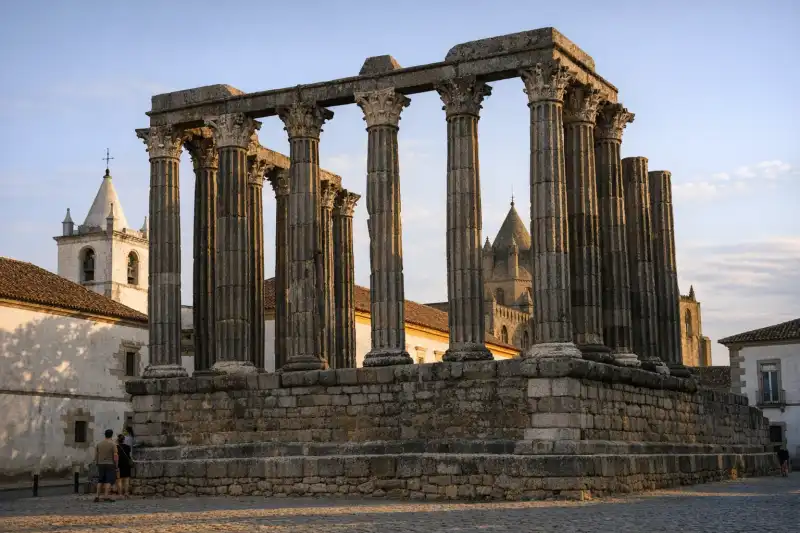
Évora Roman Temple
RomanThe Évora Roman Temple in Portugal is a remarkably preserved 1st-century AD monument and a stunning ...
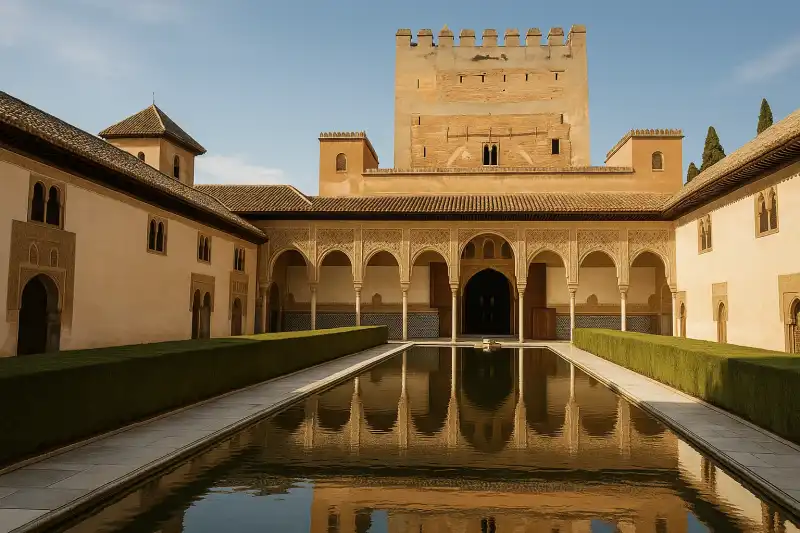
Alhambra Travel Guide 2026: Nasrid Palaces, Tickets, and Visit Strategy
Nasrid Dynasty (Moorish)Plan a well-timed visit to Granada's Alhambra with practical ticket advice, must-see highlights, and...
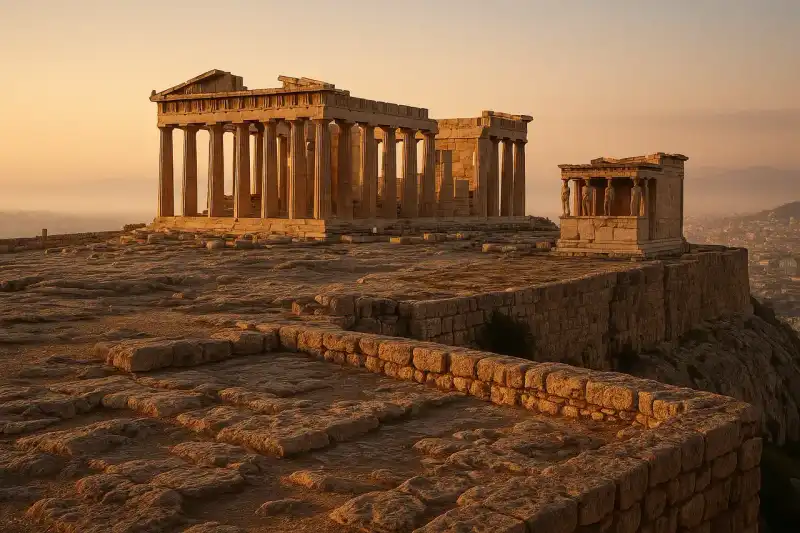
Acropolis Travel Guide 2026: Parthenon, Tickets, and Best Time
Ancient GreecePlan an efficient Acropolis visit with practical ticket timing, key monuments, and museum pairing ti...