Quick Info
Curated Experiences
Delos Half-Day Guided Tour from Mykonos
Delos & Mykonos Combined Day Tour
Private Guided Archaeological Tour of Delos
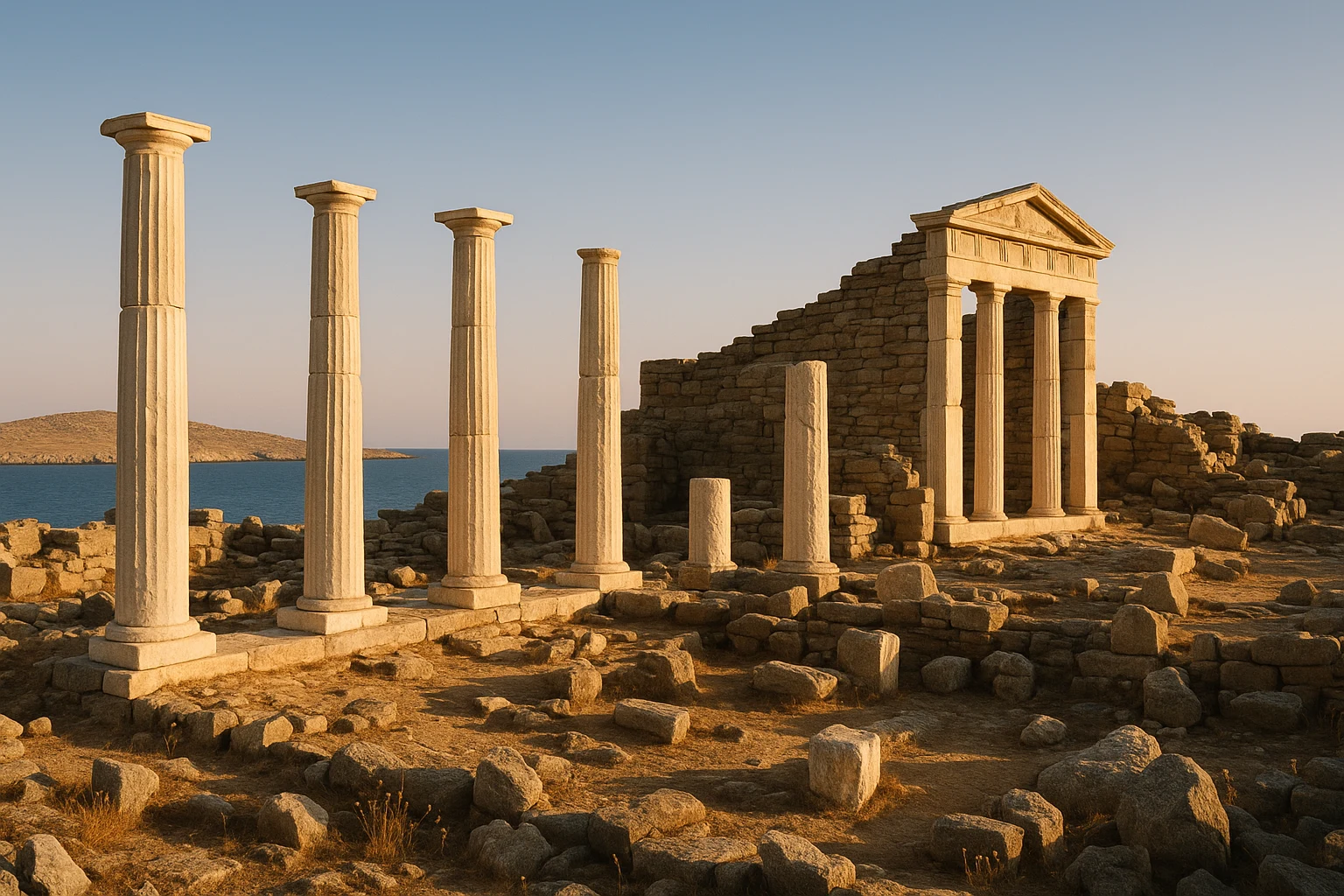
Few places in Greece carry the mythological weight of Delos. This tiny, treeless island at the geographic center of the Cyclades was revered across the ancient Mediterranean as the birthplace of the twin gods Apollo and Artemis—and its ruins reflect a millennia-long accumulation of temples, treasuries, markets, and private houses built by every power that controlled the Aegean. Today Delos is uninhabited, protected by UNESCO, and visited only by day-trippers who ferry over from Mykonos. Walking its silent streets, where lions still face a dried-up sacred lake and mosaic floors glow beneath open skies, is among the most arresting archaeological experiences Greece has to offer.
Why Delos Matters
Most Greek sacred sites serve as pilgrimage destinations for a single city or region. Delos was different: it belonged to the whole Greek world. Because the island was birthplace of Apollo, god of light, music, and prophecy, every maritime power—Athens, Sparta, Rhodes, Egypt, Rome—sent delegations, offerings, and building projects here. The sanctuary at the island’s heart became one of the wealthiest and most cosmopolitan places in antiquity. By the second and first centuries BCE, Delos had evolved into the busiest slave-trading hub in the Mediterranean, capable of processing ten thousand enslaved people in a single day according to ancient sources. That grim fact, layered beneath the piety and the marble, gives the site its full human complexity.
No other small island in Greece contains such density of layered history, intact urban fabric, and unanswered questions. Visiting Delos is not a scenic excursion—it is a confrontation with the ancient world at full scale.
Historical Context
The island’s sacred status was already established by at least the tenth century BCE, when the Ionians made it the center of their pan-Hellenic league and held athletic and musical festivals in Apollo’s honor. The Archaic period brought the first great temples and the famous Terrace of the Lions, constructed by the Naxians around 600 BCE as a monumental approach to the sanctuary.
Athens took control in the sixth century BCE under the tyrant Peisistratos, who ordered a ceremonial purification: all graves within sight of the sanctuary were exhumed and relocated. The Athenians repeated this purification on a larger scale in 426 BCE, during the Peloponnesian War, removing all burials from the island entirely and banning both births and deaths on Delian soil—measures designed to guarantee the island’s permanent sanctity.
After Alexander the Great’s conquests opened the eastern Mediterranean to Greek commerce, Delos transformed into a free port under Athenian administration. The island’s position at the center of Cycladic trade routes made it irresistible to merchants from Italy, Syria, Egypt, and beyond. Between 166 and 88 BCE Delos was the wealthiest commercial entrepôt in the Aegean. That era ended violently: in 88 BCE the forces of Pontic king Mithridates VI massacred an estimated twenty thousand of the island’s inhabitants and enslaved the survivors. A second attack in 69 BCE finished what remained. Delos never recovered, and by the time of the Roman travel writer Pausanias the island was a ruin maintained only by a small custodial community. French archaeologists from the École française d’Athènes have been excavating here continuously since 1873.
What to See
The Terrace of the Lions is the defining image of Delos and one of the most reproduced monuments of antiquity. The Naxians placed a row of lean, roaring marble lions along the processional way to the Sacred Lake sometime around 600 BCE. Originally nine or more, five restored originals remain on the terrace—the ones you see today are casts; the weathered originals are inside the museum. Their elongated, archaic posture is unlike any later Greek sculpture, and their repetition creates an almost hypnotic effect.
The Sacred Lake, now a dry depression marked by a solitary palm tree, was once the mythological pool beside which Leto gave birth to Apollo and Artemis. The ancient Greeks would not have drained it; the lake was filled deliberately in the nineteenth century to control malaria. The palm is a replacement for the one that Homer described in the Odyssey as sacred to Apollo.
The Sanctuary of Apollo at the island’s center contains the foundations of three successive temples to the god, built across several centuries by different patrons including the Athenians and the Delians themselves. The scale of the precinct, with its treasuries, stoas, and administrative buildings, conveys how seriously the ancient world took this place. The colossal fragments of a seventh-century BCE kouros—once nine meters tall—still lie where they fell.
The Theatre Quarter is where Delos surprises visitors expecting only temples. This densely packed residential and commercial neighborhood preserves private houses with intact mosaic floors, underground cisterns, and colonnaded courts. The House of the Dolphins and the House of the Masks contain some of the finest Hellenistic mosaics in existence—vivid mythological scenes in polychrome tesserae that have survived two thousand years of Mediterranean weather beneath open skies.
The Theatre itself seated five thousand spectators and retains much of its original cavea. The view from the upper seats over the ruined city toward the sea is one of those moments that makes Greek archaeology worth the journey.
The Archaeological Museum beside the sanctuary is essential viewing before or after walking the site. The original lions, the fragments of colossal sculpture, and the collection of votive objects and everyday items excavated from the houses provide indispensable context.
Practical Tips
Delos is a half-day minimum and a full-day ideal. Ferries depart from Mykonos Old Port (Chora) several times in the morning, with the crossing taking about 30 minutes. Book your return ferry time carefully—boats do not run after mid-afternoon, and the site itself closes. There are no ferries on Mondays, which is also the site’s weekly closure day.
There is no shade on Delos. The island is a treeless, wind-scoured rock, and in summer the combination of direct sun, radiant heat from ancient stone, and limited water supply makes preparation essential. Carry at least a liter of water per person, wear sun protection, and bring a hat. The small café near the museum sells drinks and basic food at high prices; do not rely on it as your primary supply.
Entrance to the archaeological site and museum is covered by a combined ticket. Guided tours departing from Mykonos include the ferry fare and a licensed archaeologist guide, and they are highly recommended: the site is enormous, the signage minimal, and an experienced guide turns a confusing field of foundations into a legible ancient city.
Wear closed-toe shoes with grip. The ancient paving is uneven, worn smooth in places, and slick if there has been any rain.
Combining Delos with Nearby Sites
Delos is invariably visited as a day trip from Mykonos, which serves as the practical base for any Cycladic itinerary. Mykonos itself has the Archaeological Museum of Mykonos in Chora, housing finds from the island and the Cyclades including a remarkable seventh-century BCE storage pithos depicting the Trojan War.
From a Mykonos base, Naxos is easily reached by ferry. The largest Cycladic island, Naxos preserves an unfinished colossal kouros at Apollonas—still lying in the ancient quarry where it was abandoned—as well as the Portara, the monumental doorway to an unfinished temple of Apollo overlooking the harbor, and a Venetian kastro in the old town. Naxian marble, prized in antiquity, supplied the Delos lions themselves.
Paros, a short ferry ride from either Mykonos or Naxos, offers the early Christian Ekatontapyliani church and access to Antiparos, with its famous stalactite cave where Alexander the Great’s successors left graffiti.
Why Delos Still Matters
Delos is not a convenient site. Getting there requires planning, the visit demands physical effort, and the ruins do not explain themselves easily. But that friction is part of what makes it valuable: Delos has never been prettified or made tourist-friendly in ways that soften the reality of what it was. The silence is genuine—no shops, no hotels, no vendors—only the wind, the marble, and the cumulative evidence of twenty-five hundred years of human belief, commerce, and violence. Standing at the center of the Sacred Precinct with the Aegean visible in every direction, you are as close as modern travel permits to the living pulse of ancient Greek civilization.
Quick Facts
| Detail | Info |
|---|---|
| Location | Delos, Cyclades, Greece |
| Nearest hub | Mykonos (30 min by ferry) |
| Site hours | Tue–Sun; closed Mondays |
| Best months | April–October |
| Time needed | 3–5 hours |
| Entrance | Combined site + museum ticket |
| Civilization | Ancient Greek, Hellenistic, Roman |
| UNESCO status | World Heritage Site (1990) |
Frequently Asked Questions
How do I get to Delos from Mykonos?
Ferries depart from Mykonos Old Port (Chora) several times daily, typically between 9 AM and 1 PM. The crossing takes about 30 minutes. Return boats run until late afternoon. No ferries operate on Mondays, and the site is closed.
How long do you need on Delos?
Plan at least 3 to 4 hours to cover the main highlights at a reasonable pace. Archaeology enthusiasts may want a full day. The site closes at 3 PM in low season and around 8 PM in summer.
Is Delos open year-round?
The site is open Tuesday through Sunday, closed Mondays. Ferry services are seasonal and limited in winter. April through October is the best time to visit, with the site fully accessible and ferries running frequently.
Can you stay overnight on Delos?
No. Delos is uninhabited and overnight stays are strictly prohibited. All visitors must leave on the last ferry back to Mykonos or other Cycladic islands.
Is there a museum on Delos?
Yes, the Delos Archaeological Museum on the island houses an outstanding collection of sculptures, mosaics, and objects excavated from the site, including the original marble lions from the Terrace of the Lions.
Do I need a guide to visit Delos?
A guide is strongly recommended. The site is vast, poorly labeled, and much of the significance of what you are seeing requires context. Guided tours from Mykonos are the most convenient option and ensure you get the most from the visit.
What should I bring to Delos?
Sun protection is essential—there is no shade on the island. Bring plenty of water, sturdy shoes for uneven ancient paving, and a hat. There is a small café near the museum but supplies are limited and expensive.