Quick Info
At a glance
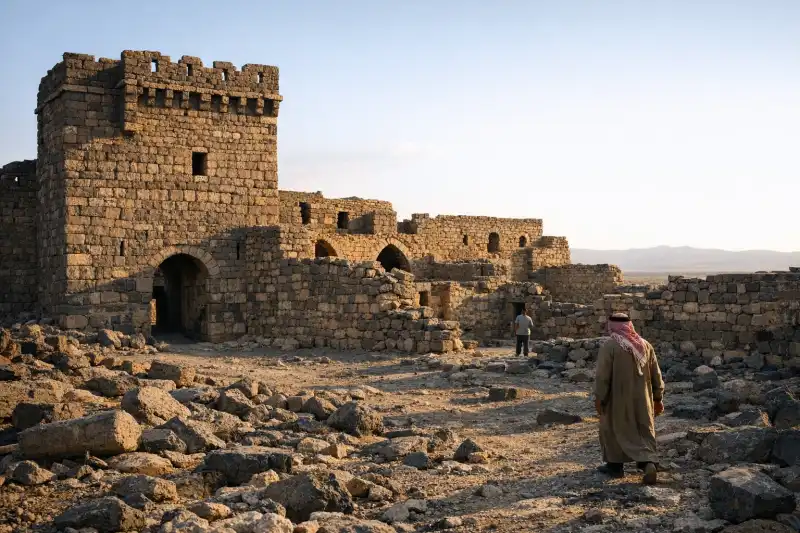
In eastern Jordan, Desert Castles (Qasr al-Azraq) rises from the edge of a desert oasis in a form unlike almost any other fortress in the region. Instead of honey-colored limestone glowing in the sun, this stronghold is built in dark basalt, its black walls and heavy gates giving it a severe, memorable presence against the pale open plain. The contrast is immediate and dramatic: water and settlement in one of the driest landscapes in the Levant, and a castle that feels at once Roman, Islamic, and modern in the stories attached to it.
For many travelers, Qasr al-Azraq is one stop on the classic eastern desert castles route from Amman, often paired with Qasr Kharana and Qusayr Amra. Yet it rewards more than a brief photo stop. This was no isolated monument built merely for display. Its position at the Azraq oasis made it strategically valuable for centuries, controlling water, caravan movement, military passage, and communication lines across eastern Jordan. Successive powers adapted it to their own needs, from Roman frontier administration to Umayyad governance and later Ottoman-era use. Its fame expanded again in the 20th century because T.E. Lawrence used it as a base during the Arab Revolt. Today, visitors can walk through massive stone doorways, stand in its broad courtyard, and feel how geography, empire, and survival shaped one of Jordan’s most distinctive ancient sites.
History
Roman origins at the oasis
The story of Qasr al-Azraq begins with geography. Azraq was never important by accident. In a harsh basalt desert zone where water is scarce, its oasis made it indispensable to anyone seeking to move people, goods, or armies across the region. Long before the present structure took shape, the area served as a settlement and stopping point for trade and travel. Under Roman influence, this strategic value was formalized within the broader frontier system that linked roads, forts, and administrative stations across the eastern reaches of the empire.
The Romans understood that water meant power. A fortress at Azraq could monitor routes connecting Arabia, Syria, and the steppe. Although parts of the visible structure belong to later phases, the site preserves the legacy of Roman military planning and occupation. Stone from earlier constructions was likely reused in subsequent rebuilding, a common pattern at long-lived frontier posts. Rather than representing a single moment, Qasr al-Azraq embodies a layered military landscape in which each ruling power inherited the logic of the oasis and adapted the fortification to contemporary needs.
Byzantine and early Islamic transitions
As Roman control evolved into Byzantine rule, the importance of eastern Jordan did not disappear. The network of settlements, religious communities, and military points remained active, though changing political pressures altered how sites were maintained and defended. At Azraq, continuity mattered more than rupture. A secure oasis station stayed valuable regardless of whether authority came from Constantinople, local elites, or emerging Arab powers.
Following the early Islamic conquests in the 7th century, the site entered a new political world centered increasingly on Damascus and the ruling Umayyad dynasty. The so-called “desert castles” of Jordan belong to this broad era, but the label can be misleading. Some functioned partly as estates, hunting lodges, administrative centers, or symbols of authority rather than purely defensive castles. Qasr al-Azraq, however, retained an unusually practical strategic role because of its location. It was associated with water management, travel, and security, making it more than just an ornamental desert retreat.
Umayyad rebuilding and architectural identity
A major rebuilding phase is generally attributed to the Umayyad period, especially the early 8th century. This phase likely gave the fortress much of the recognizable form visitors see today: a roughly square enclosure, stout corner towers, and a compact, self-contained military-plan layout around a large courtyard. The dark basalt construction is one of its most striking characteristics. In contrast to many Jordanian monuments built in lighter stone, Qasr al-Azraq appears almost volcanic in character, as if the fortress were cut from the surrounding lava fields rather than assembled by hand.
Within the enclosure, structures were arranged to support both occupation and administration. There was space for accommodation, storage, movement of men and animals, and likely communal or religious use. An early mosque inside the complex is one reminder that the fortress was integrated into Islamic political and daily life. The Umayyads did not build in a vacuum; they repurposed a strategic place with older roots and made it serve a new imperial order.
Medieval and Ottoman use
After the Umayyads, the site continued to be occupied or reused at different moments by later Islamic regimes. As with many desert strongholds, periods of intense activity were followed by quieter centuries, but the fortress was never meaningless. Its value lay not only in grandeur but in utility. Any authority interested in controlling desert movement or protecting access to water would find Azraq worth holding.
Under the Ottomans, who ruled the region for centuries, the fort again gained practical relevance. The broader imperial landscape of caravan security, tribal negotiation, and regional movement gave sites like Azraq renewed purpose. Repairs and modifications likely occurred as needed rather than as part of monumental rebuilding campaigns. Such pragmatic reuse is central to understanding Qasr al-Azraq: this is a working place before it is a romantic ruin.
T.E. Lawrence and the Arab Revolt
Qasr al-Azraq entered global popular memory through its role in the Arab Revolt during World War I. T.E. Lawrence, later known as Lawrence of Arabia, used the fortress as a headquarters in 1917–1918 while coordinating operations with Arab forces against Ottoman positions. His descriptions helped transform the fort into a site of literary and political legend, especially for English-speaking audiences.
This association can sometimes overshadow the much older history of the place, but it also underscores the same enduring truth that had guided Roman and Umayyad interest centuries earlier: Azraq mattered because it controlled movement through a difficult landscape. Lawrence did not choose it for atmosphere alone. He chose it because the old fortress at the oasis was still strategically sound. That continuity, from antiquity to modern conflict, is one of the most compelling aspects of the site today.
Key Features
What makes Qasr al-Azraq so memorable is the immediate impact of its material. The fortress is built largely from black basalt, a hard volcanic stone widely available in this part of eastern Jordan. The color transforms the visitor’s experience. Instead of sunlit ruins that seem delicate or eroded, the structure feels dense, heavy, and almost austere. The walls absorb light rather than reflect it, and the visual effect changes with the time of day. In the morning, the stone can appear bluish or charcoal-gray; by late afternoon, it often takes on a warmer tone while retaining its severe silhouette.
The main entrance is one of the site’s most celebrated features. Its basalt doors, massive and carefully pivoted, are themselves an architectural statement. They demonstrate not only technical skill but a concern for security and permanence. Visitors often pause here because the entrance condenses the fort’s identity into one element: practical, elegant, and intimidating. The doors suggest that this was a place built to endure both climate and conflict.
Inside, the broad central courtyard creates a strong sense of enclosure. It is not overcrowded with reconstruction or modern additions, which allows the geometry of the fortress to read clearly. Walking through the open space, you can understand how circulation was organized and how defenders, residents, animals, and supplies might once have been accommodated. The courtyard also heightens the sensation of isolation. Surrounded by dark walls and towers, the outside desert seems both near and far, visible through openings yet held at bay.
Around the courtyard are rooms and chambers that reveal the site’s layered function. Some spaces feel distinctly military, others more administrative or domestic. This ambiguity is part of what makes desert castles in Jordan so interesting. They often resist modern categories. Qasr al-Azraq was defensive, certainly, but it was also a managed station at an oasis, a place for governance, resupply, and organized presence in the landscape. Looking closely at the interior spaces helps visitors see the fortress less as a single-purpose stronghold and more as a compact working complex.
One of the most significant internal elements is the small mosque, usually dated to the early Islamic period. Its presence confirms that the fortress was woven into everyday religious life as well as political authority. In practical terms, this also shows that the resident community was not temporary in the narrow sense. Prayer spaces imply rhythm, routine, and continuity. Even in a desert station, ordinary life had to be structured.
The corner towers give the building its fortified profile and would have offered observation points over the surrounding flat terrain. From these elevated areas, the strategic logic of Azraq becomes easier to grasp. There are no dramatic mountain slopes or river bends here; instead, advantage comes from distance and visibility. In a land of long horizons, seeing movement early was essential. The towers therefore belong not just to architecture but to surveillance, communication, and control.
Another major feature is the relationship between the fortress and the oasis itself. Even if today’s environmental conditions differ from what ancient and medieval occupants knew, the site still makes most sense when understood as part of a water landscape. Qasr al-Azraq was not simply dropped into empty desert. It was positioned beside one of the region’s key life sources. That made it useful to caravans, pilgrims, traders, armies, and states. If the dark basalt walls are the visual signature of the castle, water is its hidden foundation.
Modern visitors also encounter traces of the Lawrence story, which adds another interpretive layer. Rooms associated with his wartime stay attract understandable interest, and on-site displays often explain the Arab Revolt connection. Yet even here the site’s deeper strength becomes clear: Lawrence is one chapter, not the entire narrative. The same spaces that served a 20th-century rebellion had already served empires for many centuries. Qasr al-Azraq remains compelling because it can hold all those stories at once.
Getting There
Qasr al-Azraq is most easily reached from Amman, and for most travelers this is the practical starting point. The drive is generally around 100 to 120 kilometers east, depending on where you begin in the capital, and usually takes 1.5 to 2 hours via the Azraq highway. Renting a car is the simplest option if you want flexibility to combine Qasr al-Azraq with other eastern desert castles such as Qasr Kharana and Qusayr Amra. A one-day rental from Amman often starts around 25 to 45 JOD before fuel, while fuel costs for the round trip are usually moderate.
Private taxis can also be arranged in Amman. For a dedicated half-day or full-day trip covering multiple desert castles, expect roughly 60 to 100 JOD depending on negotiation, waiting time, and hotel pickup. This is a good option for travelers who do not want to drive on Jordanian highways but still prefer a flexible schedule.
Organized tours are common and often represent the best value for short-stay visitors. Group day tours from Amman typically range from about 40 to 90 JOD per person, depending on group size, guide services, and whether entrance fees are included. Private tours cost more but can be efficient if shared between several travelers.
Public transport to Azraq town exists but is less convenient for most visitors, with minibuses and local buses departing from Amman transport hubs at variable times. Fares are inexpensive, often around 3 to 5 JOD each way, but schedules can be irregular, and you may still need a short taxi ride from town to the site. If you are traveling independently without a car, confirm return options before setting out.
When to Visit
The best time to visit Qasr al-Azraq is during spring and autumn, when eastern Jordan is warm but usually manageable. From March to May, temperatures are often comfortable for walking around the courtyard and climbing short stairways, and the desert light is especially beautiful for photography. Autumn, especially from late September to November, offers similarly pleasant conditions with clearer skies and milder afternoons.
Summer visits are entirely possible, but the heat can be intense. The dark basalt of the fortress absorbs warmth, and midday can feel far hotter inside the walls than the thermometer suggests. If you visit between June and August, aim to arrive early in the morning or later in the afternoon. Carry plenty of water, wear a hat, and do not expect much shade during your exploration.
Winter in Azraq can surprise travelers who associate Jordan only with heat. Days may be cool and bright, but wind can make the fortress feel much colder, especially in open areas and on elevated sections. A jacket or layered clothing is useful from December through February. The advantage of winter is softer light, fewer visitors, and a more atmospheric sense of the desert’s harshness.
If you are combining several desert castles in one day, consider starting with Qasr al-Azraq either early or late, when the low-angle sun enhances the texture of the basalt walls. Midday light tends to flatten details. Weekdays are generally quieter than weekends or local holidays. Because this is a year-round destination, timing is mostly about comfort and photography rather than access, but choosing the right season can greatly improve the experience.
| Quick Facts | Details |
|---|---|
| Site name | Qasr al-Azraq |
| Location | Azraq, Zarqa Governorate, Jordan |
| Type | Desert fortress / oasis stronghold |
| Main periods | Roman, Byzantine, Umayyad, Ottoman |
| Building material | Black basalt |
| Best known for | Strategic oasis setting and T.E. Lawrence connection |
| Distance from Amman | About 100–120 km east |
| Typical visit length | 45 minutes to 1.5 hours |
| Best seasons | Spring and autumn |
| Often combined with | Qasr Kharana and other eastern desert castles |
Qasr al-Azraq stands apart even within Jordan’s rich landscape of ancient sites. It does not rely on monumental scale like Jerash or dramatic topography like Petra. Its power is more concentrated. Here, history is compressed within dark stone walls at a desert water source that mattered across empires. Roman frontier logic, Umayyad rebuilding, Ottoman utility, and the drama of the Arab Revolt all meet in one fortress whose purpose never fully disappeared.
For travelers interested in more than postcard ruins, this is one of the country’s most rewarding visits. The castle’s basalt mass, its oasis setting, and its long strategic life make it feel grounded in the realities of movement, survival, and control. You leave not only with images of black gates and stark courtyards, but with a clearer understanding of how Jordan’s deserts were never empty margins. They were connected spaces, shaped by roads, water, empire, and memory—and Qasr al-Azraq was one of the places that made those connections possible.
Guided tours: worth it?
A guide can be genuinely useful at Desert Castles (Qasr al-Azraq), especially if you want help with transport, timing, tickets, or understanding a large site without losing half the day to logistics.
Best for
- First-time visitors who want context, not just photos
- Travelers who want transport, timing, or entry logistics handled
- Short visits where a planned route saves time
When to go self-guided
Go independently if you already have transport and tickets sorted, enjoy moving at your own pace, and are comfortable checking the latest official rules before you arrive.
What I’d avoid
Skip paid tours that bundle unrelated stops you do not actually want. The best option should either save meaningful planning time or add historical context you would miss on your own.
Jordan Desert Castles Tour
Useful when: you want to compare guided formats before deciding
Qasr al-Azraq Day Trip
Useful when: transport or pickup logistics matter
Amman to Desert Castles
Useful when: you want to compare guided formats before deciding
Some tour links are affiliate links, which may earn Ancient Travel a small commission at no extra cost to you. I try to surface options that make practical sense for the site—not just anything bookable.
Frequently Asked Questions
What is Qasr al-Azraq?
Qasr al-Azraq is a historic desert fortress in eastern Jordan, built largely of black basalt and used in Roman, Byzantine, early Islamic, and later Ottoman periods.
Why is Qasr al-Azraq important?
It is one of Jordan’s best-known desert castles, notable for its strategic oasis location, unusual basalt construction, Umayyad-period rebuilding, and association with T.E. Lawrence during the Arab Revolt.
How far is Qasr al-Azraq from Amman?
Qasr al-Azraq is roughly 100 to 120 kilometers east of Amman, depending on your starting point, and the drive usually takes around 1.5 to 2 hours.
Can you visit Qasr al-Azraq independently?
Yes. Many travelers visit by rental car or private taxi from Amman, and it is also commonly included in organized desert castles day tours.
How much time do you need at Qasr al-Azraq?
Most visitors spend 45 minutes to 1.5 hours exploring the courtyard, towers, mosque area, and interpretive exhibits, though history enthusiasts may stay longer.
What should you wear when visiting Qasr al-Azraq?
Wear breathable clothing, walking shoes, sun protection, and carry water. In winter, bring an extra layer because the desert can feel cold and windy.
Nearby Ancient Sites
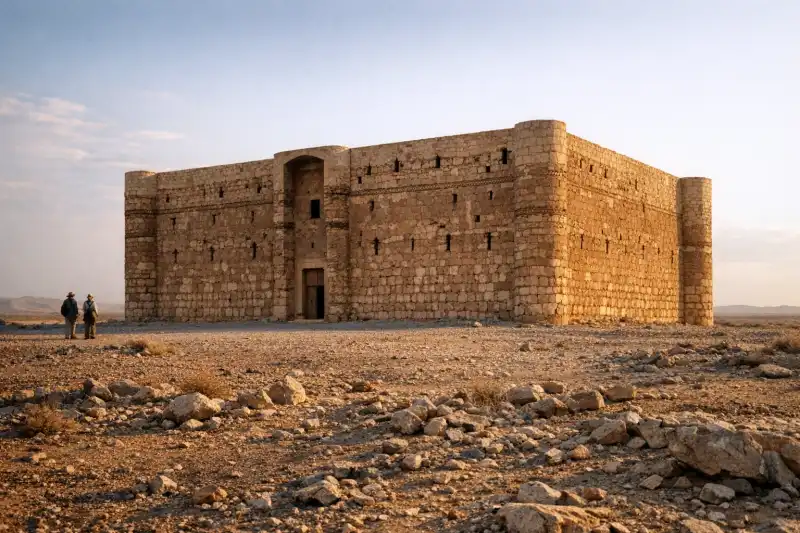
Desert Castles (Qasr Kharana)
UmayyadA remarkably preserved early Islamic desert castle in Jordan, Qasr Kharana reveals Umayyad architect...
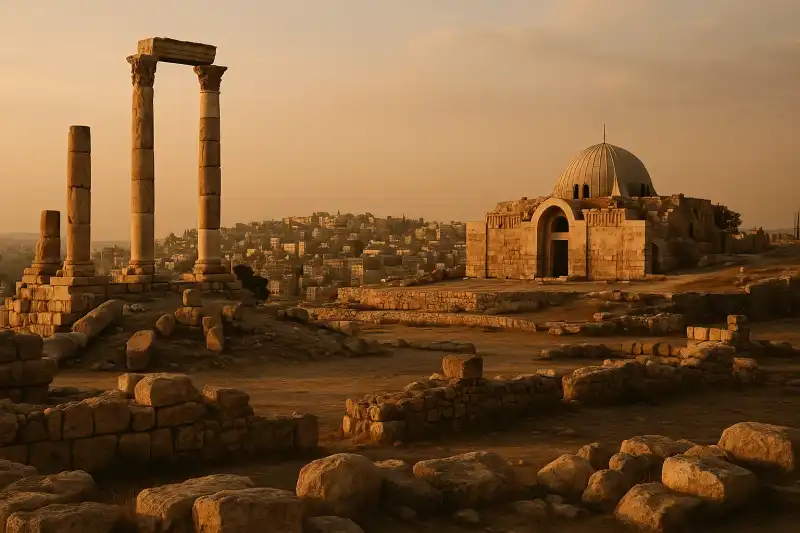
Amman Citadel Jordan Guide 2026: Temple of Hercules & Ancient Rabbah
Ammonite-Roman-UmayyadExplore Jordan's ancient citadel overlooking modern Amman. Discover the Temple of Hercules, Umayyad ...
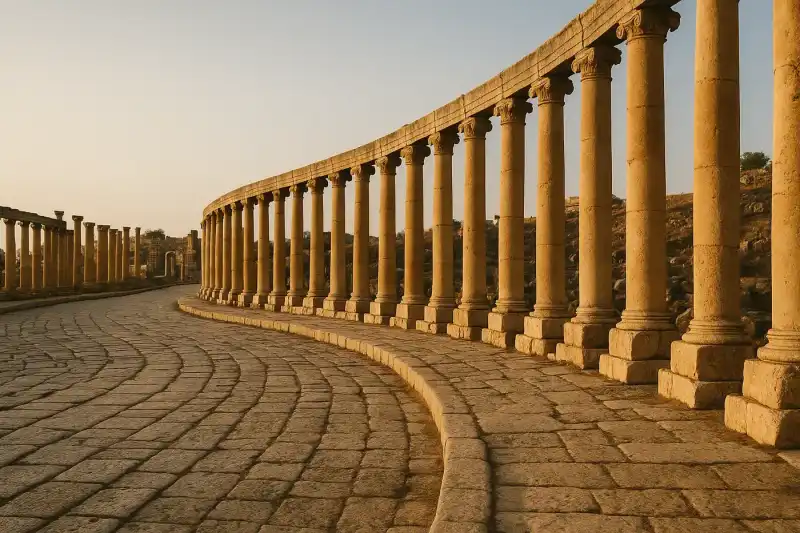
Jerash: The Pompeii of the East and Jordan's Best-Preserved
Roman / NabataeanDiscover Jerash, Jordan's remarkable Roman ruins. Walk the colonnaded streets of ancient Gerasa, exp...
Bethany Beyond the Jordan
Bethany Beyond the Jordan in Jordan is an archaeological and religiously significant site believed t...