Quick Info
At a glance
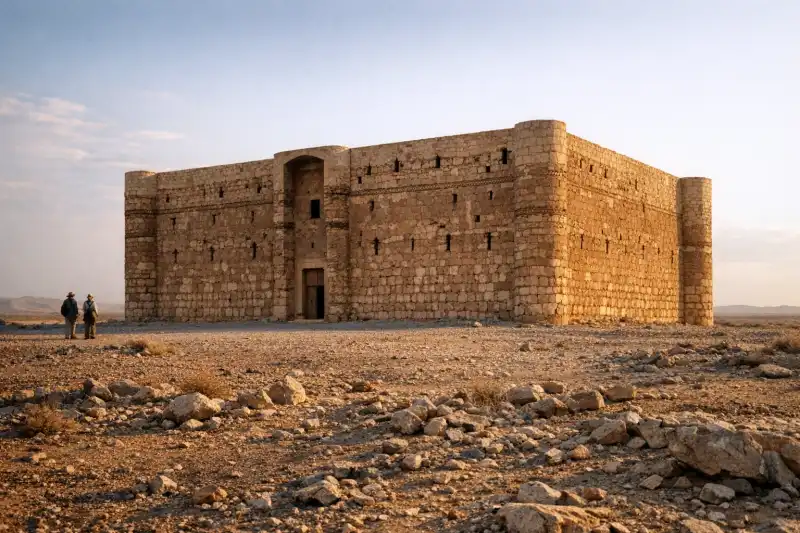
Desert Castles (Qasr Kharana) in Jordan rises out of the eastern steppe with a kind of quiet authority, its compact, square mass appearing at first like a fortress and then, on closer approach, something far more enigmatic. Set beside the highway east of Amman, it is one of those monuments that can surprise travelers twice: first because it survives so completely in such an open landscape, and second because its purpose remains debated even after generations of study. Seen from a distance, the building’s pale stone walls and rounded corner towers seem to belong naturally to the desert horizon, as if the structure had condensed from the land itself.
For visitors, that first impression is powerful. The emptiness around Qasr Kharana sharpens every architectural line, from the narrow slits of the upper windows to the disciplined geometry of its façade. Unlike a sprawling ruin that requires imagination to reconstruct, this site retains enough of its shape and spaces to feel legible. You can step through the entrance, cross the central courtyard, climb to upper rooms, and begin to understand how movement, privacy, light, and climate were managed in an early Islamic building far from any modern city. Yet the monument also keeps its secrets. Whether it functioned as a caravan station, meeting place, lodge, or elite retreat, Qasr Kharana stands today as one of Jordan’s most evocative windows into the Umayyad world.
History
Umayyad Jordan and the eastern desert
Qasr Kharana is generally dated to the late 7th or early 8th century CE, placing it within the Umayyad era, when the first great Islamic dynasty ruled a vast territory from Damascus. Jordan occupied an important position within this landscape. It sat between the settled agricultural zones of Syria and Palestine, the Hijaz routes to the south, and the steppe and desert spaces used by pastoral communities, traders, and state officials. The Umayyads invested in roads, waystations, agricultural estates, and a series of desert complexes now collectively known as Jordan’s desert castles.
Although the term “castle” is convenient, it can mislead. These sites often blended practical, political, and ceremonial functions. Some had bathhouses; some were linked to agricultural estates; others may have served as seasonal residences or gathering points. Qasr Kharana’s design suggests that it was never intended purely as a military stronghold. Its walls look defensive, but many architectural details do not support a full fortress interpretation. Instead, scholars have proposed that it may have been a meeting place for elites, perhaps involving negotiations with tribal leaders or a controlled setting for administration and hospitality in the steppe zone.
Construction and architectural purpose
The building’s masonry and decorative features point to an early Islamic date, while also revealing the layered influence of Byzantine and Sasanian architectural traditions circulating across the wider region. This mixture was typical of the early Islamic world, when builders and patrons adapted existing forms to new political and cultural contexts. Qasr Kharana’s façade, interior organization, and ornamental details all suggest a structure designed with care rather than an improvised frontier outpost.
Its plan centers on a rectangular courtyard surrounded by two stories of rooms. This arrangement made it possible to separate public and private areas, accommodate guests, and provide sheltered circulation. The upper rooms, in particular, include decorative niches, engaged columns, and plaster or stone detailing that indicate the building had a status beyond basic utility. Small apertures in the walls and subtle ventilation features show attention to comfort and climate control, an important concern in the harsh environment of Jordan’s eastern desert.
The exact purpose remains uncertain because the site offers no definitive inscription explaining its role. That ambiguity is part of what makes Qasr Kharana so compelling. It belongs to a broader Umayyad strategy of occupying and organizing marginal landscapes, but it does so in a way that resists easy categorization. It may have hosted travelers and caravans on occasion, but it seems too refined and too selectively arranged to have been merely a roadside inn.
Decline, abandonment, and rediscovery
Like many early Islamic desert sites, Qasr Kharana’s active use probably did not last many centuries in its original form. Political centers shifted, economic patterns changed, and the balance between settled agriculture and desert routes evolved over time. As the Umayyad dynasty gave way to the Abbasids in the mid-8th century, many structures associated with Umayyad regional power lost their original function or patronage.
Over the centuries, the building stood largely isolated in the steppe. That isolation, paradoxically, may have helped preserve it. While urban monuments were often dismantled for building materials or heavily rebuilt, Qasr Kharana remained in a relatively remote area. Wind, weathering, and neglect took their toll, but the monument was never completely erased. Travelers and scholars in the modern period began to document Jordan’s desert castles more systematically, recognizing them as key monuments in the study of early Islamic architecture.
Conservation and modern significance
In the 20th century, conservation work helped stabilize Qasr Kharana and make it accessible to visitors. Today it is one of the easiest desert castles to visit from Amman and often forms part of a circuit that includes other eastern desert landmarks. Its significance now extends beyond architecture alone. It is a rare monument that captures the confidence of the early Islamic state, the dialogue between inherited regional traditions and new artistic forms, and the strategic importance of Jordan’s landscapes during the Umayyad period.
For historians, Qasr Kharana is an essential case study in how early Islamic elites used architecture to project order, authority, and hospitality. For travelers, it is a place where those scholarly debates remain visible in stone. The building is complete enough to walk through as a coherent whole, yet mysterious enough to keep interpretation alive.
Key Features
The most striking feature of Qasr Kharana is its exterior silhouette. The structure appears almost cubic, with heavy walls articulated by projecting half-round towers and a rhythm of small openings that create a severe, nearly monumental face toward the desert. This outer shell gives an impression of defense, but the visual drama is as important as any practical function. The building announces itself as a place of consequence. Its proportions are measured and self-assured, and the contrast between its strong perimeter and the empty plain around it amplifies that effect.
Stepping inside changes the experience completely. The central courtyard opens the building to the sky, transforming the monument from a closed block into a carefully organized interior world. This courtyard would have served as a space of light, circulation, and social interaction, with rooms arranged around its edges on two levels. The change from harsh exterior brightness to shadowed corridors and chambers is one of the pleasures of visiting. You begin to notice how architecture managed the desert environment not by resisting it directly, but by moderating exposure through layered spaces.
The rooms themselves are among the site’s most rewarding features. Some are plain and functional, but others contain decorative elements that hint at prestige and ceremony. Arched niches, carved details, and the remains of ornamental treatment suggest that important conversations or receptions may once have taken place here. In several chambers, the transitions between rooms are choreographed in a way that implies hierarchy: some spaces feel more public, while others appear secluded or intended for select guests. This complexity is one reason scholars hesitate to call the building simply a fort or a caravanserai.
Upper-level spaces offer another dimension. Climbing to the second story reveals how the building used height, airflow, and outlook. Windows and vents are modest, but intelligently placed. Their narrowness reduces heat and glare, while still allowing light and ventilation. These features also shape the aesthetic of the building. Instead of large openings framing panoramic views, Qasr Kharana provides carefully edited glimpses of the surrounding desert. The outside world is present, but controlled.
One especially interesting architectural detail is the use of decorative blind arches and interior moldings that connect the monument to artistic traditions from neighboring regions. This blending of influences reflects the cultural environment of the Umayyad state, which drew on Byzantine, Roman provincial, and Sasanian precedents while developing its own early Islamic vocabulary. Qasr Kharana may appear austere from afar, but up close it reveals a refined understanding of texture, relief, and spatial sequence.
The materials also contribute to its character. The stone blocks are practical and regionally appropriate, yet their arrangement gives the structure elegance. Sunlight changes the building throughout the day, softening the stone to warm beige in the morning and evening, then flattening it to pale intensity under the midday sun. Because the surrounding landscape is so open, shadows cast by parapets, arches, and recesses become central visual elements. Photographers often find that the monument is never static; it is constantly redrawn by light.
Finally, Qasr Kharana’s setting is a feature in itself. Unlike sites embedded in modern cities, this monument still feels connected to the landscape that shaped it. The emptiness around it helps visitors understand why controlled architecture mattered here. Shelter, enclosure, orientation, and social order all become easier to read when the desert presses so close on every side. The building is not just placed in the environment; it is an intelligent response to it.
Getting There
Qasr Kharana is one of the easiest archaeological excursions from Amman. The site lies about 60 kilometers east of the capital on Highway 40, and the drive usually takes between 50 and 70 minutes. The most convenient option is a rental car or private driver, especially if you want to combine Qasr Kharana with other eastern desert sites on the same day. A basic private taxi or driver from Amman for a half-day desert castles trip often costs around 40 to 80 Jordanian dinars, depending on negotiation, waiting time, and how many stops are included.
Organized tours are also common and remove the hassle of route planning. Small-group or private excursions from Amman often bundle Qasr Kharana with Quseir Amra and other desert landmarks. Prices vary widely, but many day tours start around 50 to 120 Jordanian dinars per person depending on transport quality, guide services, and whether entry fees are included.
Public transport is the least straightforward option. There is no simple, dedicated tourist bus to the monument, and ordinary buses serving the eastern highway do not always stop conveniently for independent visitors. If you are determined to travel cheaply, you may be able to reach the general area by regional transport and then hire a local taxi for the final stretch, but this usually takes more time than it saves in money. For most travelers, a car, driver, or tour is by far the most practical choice.
Road access is generally good, and signage on the desert castles route is usually sufficient. Carry water, sun protection, and cash for tickets or small expenses, as services near the site can be limited.
When to Visit
The best times to visit Qasr Kharana are spring and autumn, when Jordan’s desert temperatures are more forgiving and the light is especially pleasant. From March to May, days are often mild to warm, with clearer skies and a softer atmosphere than the extremes of summer. This season is ideal if you want to spend time both inside the monument and outside walking around for photographs. September through November offers similar advantages, with warm days, cooler mornings, and generally comfortable touring conditions.
Summer visits are possible, but the heat can be intense, especially from late morning through mid-afternoon. The open setting means there is little natural shade outside the building, and even though interior rooms offer some relief, the journey and surrounding grounds can feel exhausting in peak sun. If you visit between June and August, aim to arrive as early as possible, bring plenty of water, and keep your visit relatively short.
Winter has its own appeal. The desert air can be crisp, the low-angle sunlight is beautiful for photography, and the monument often feels especially dramatic under changing skies. However, mornings and evenings may be surprisingly cold, and windy days can make the site feel exposed. A light jacket is usually wise from December through February.
Time of day matters almost as much as season. Early morning and late afternoon provide the best experience for most visitors. The exterior walls glow in warmer tones, shadows sharpen the building’s architectural relief, and temperatures are easier to manage. Midday light is harsher and tends to flatten some of the site’s visual subtleties. If your schedule allows, plan your visit for the first or last part of the day.
| Quick Facts | Details |
|---|---|
| Site Name | Desert Castles (Qasr Kharana) |
| Country | Jordan |
| Region | Zarqa Governorate |
| Nearest Major City | Amman |
| Historical Period | Early Islamic period |
| Associated Civilization | Umayyad |
| Estimated Date | Late 7th to early 8th century CE |
| Setting | Eastern desert steppe |
| Typical Visit Duration | 30–60 minutes |
| Best For | Early Islamic architecture, history trips, photography |
| Access | By car, private driver, or organized tour from Amman |
| Best Visiting Seasons | Spring and autumn |
Guided tours: worth it?
A guide can be genuinely useful at Desert Castles (Qasr Kharana), especially if you want help with transport, timing, tickets, or understanding a large site without losing half the day to logistics.
Best for
- Travelers who want transport, timing, or entry logistics handled
- Short visits where a planned route saves time
When to go self-guided
Go independently if you already have transport and tickets sorted, enjoy moving at your own pace, and are comfortable checking the latest official rules before you arrive.
What I’d avoid
Skip paid tours that bundle unrelated stops you do not actually want. The best option should either save meaningful planning time or add historical context you would miss on your own.
Qasr Kharana Jordan Desert Castles
Useful when: you want to compare guided formats before deciding
Amman to Desert Castles Day Tour
Useful when: you want to compare guided formats before deciding
Jordan Eastern Desert Castles Tour
Useful when: you want to compare guided formats before deciding
Some tour links are affiliate links, which may earn Ancient Travel a small commission at no extra cost to you. I try to surface options that make practical sense for the site—not just anything bookable.
Frequently Asked Questions
What is Qasr Kharana?
Qasr Kharana is one of Jordan’s best-known desert castles, an early Islamic structure usually dated to the Umayyad period in the late 7th or early 8th century.
How far is Qasr Kharana from Amman?
Qasr Kharana lies roughly 60 kilometers east of Amman along Highway 40, and the drive usually takes about 50 to 70 minutes depending on traffic.
Do I need a guide to visit Qasr Kharana?
A guide is not essential because the monument is compact and easy to walk through, but a knowledgeable guide adds useful context about Umayyad architecture and the wider desert castles network.
How much time should I spend at Qasr Kharana?
Most visitors spend 30 to 60 minutes exploring the courtyard, upper rooms, and exterior viewpoints, though history enthusiasts often combine it with other eastern desert sites for a half-day or full-day trip.
Is Qasr Kharana included in the Jordan Pass?
Admission policies can change, so check the latest Jordan Pass and Ministry of Tourism information before visiting, especially if you plan to combine several archaeological sites.
When is the best time of day to visit Qasr Kharana?
Early morning and late afternoon are best for softer light, cooler temperatures, and more dramatic desert views, particularly for photography.
Nearby Ancient Sites
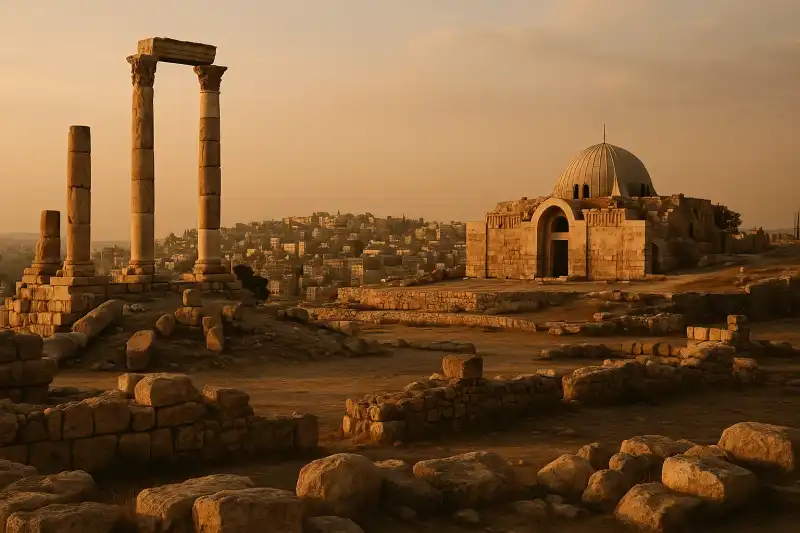
Amman Citadel Jordan Guide 2026: Temple of Hercules & Ancient Rabbah
Ammonite-Roman-UmayyadExplore Jordan's ancient citadel overlooking modern Amman. Discover the Temple of Hercules, Umayyad ...
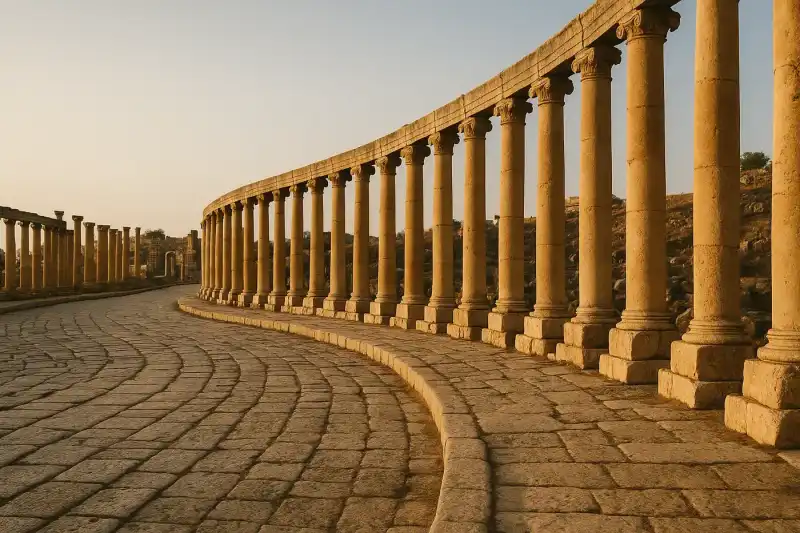
Jerash: The Pompeii of the East and Jordan's Best-Preserved
Roman / NabataeanDiscover Jerash, Jordan's remarkable Roman ruins. Walk the colonnaded streets of ancient Gerasa, exp...
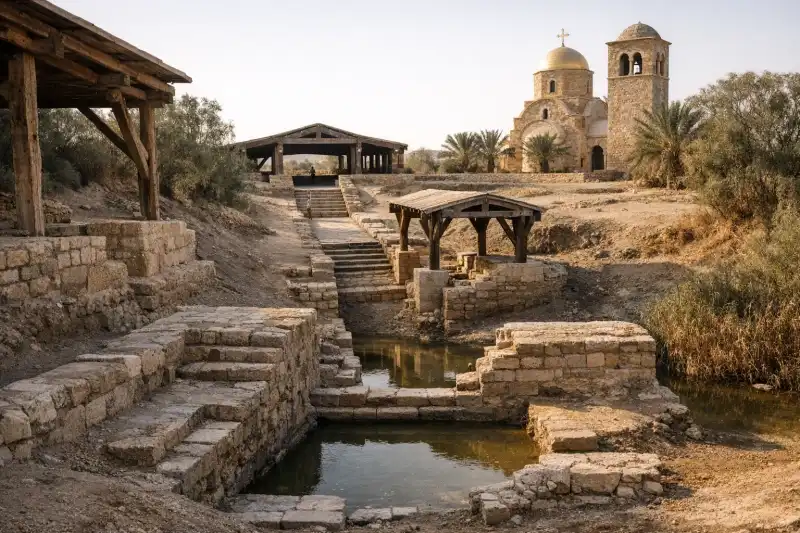
Bethany Beyond the Jordan
Bethany Beyond the Jordan in Jordan is an archaeological and religiously significant site believed t...
Ajloun Castle
Ajloun Castle in Jordan is a 12th-century Muslim fortress renowned for its strategic hilltop locatio...