Quick Info
At a glance
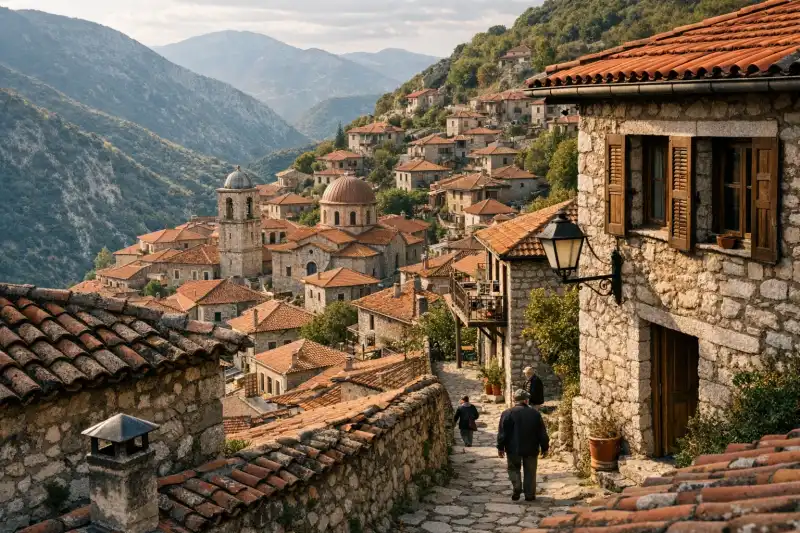
Dimitsana, Greece, sits high in the mountains of Arcadia, where stone mansions, slate roofs, and narrow lanes cling to a ridge above the dramatic Lousios Gorge. It is a place that feels both fortified and contemplative: a settlement shaped by altitude, faith, trade, and the long memory of resistance. Unlike a sprawling archaeological park filled with fallen columns, Dimitsana offers a different kind of encounter with the past. Here, history is woven into the built fabric of the town itself, into churches and libraries, into old gunpowder mills, and into the monasteries hidden in the ravines below.
Arriving in Dimitsana, many travelers notice first the mountain light. It changes constantly across the valley, catching the pale stone of the houses and the deep folds of the Peloponnesian landscape. The town’s elevated position gives it a natural drama, but also explains much of its historical endurance. This was never merely a scenic village. It became an important local center in Ottoman times, a place of learning, religion, and regional influence, and later a crucial support base during the Greek War of Independence. For visitors today, Dimitsana combines several experiences at once: a preserved historic town, a gateway to monasteries and hiking routes, and one of the most atmospheric mountain destinations in Greece. Its appeal lies not in a single monument, but in the continuity of place.
History
Early roots in Arcadia
The broader region around Dimitsana belongs to Arcadia, one of the most storied areas of the Peloponnese. Arcadia appears repeatedly in ancient Greek tradition as a mountainous interior associated with pastoral life, sanctuaries, and fiercely local identities. While Dimitsana itself is primarily known through its later medieval and early modern development, the landscape it occupies has been inhabited and traversed for centuries. The ridges, springs, and ravines of this part of Arcadia shaped settlement patterns long before the modern town emerged.
The Lousios Gorge below Dimitsana was especially important in antiquity and the medieval period because it offered water, arable pockets, defensive advantages, and routes between upland communities. Religious life also settled naturally into these protected spaces. In Greece, many later monasteries were founded in places where older patterns of refuge, devotion, and movement already existed. Dimitsana’s significance, then, is partly geographical: it stands within a landscape that had strategic and spiritual value long before the town reached prominence.
Byzantine and post-Byzantine development
Dimitsana’s clearer historical profile begins in the Byzantine and especially post-Byzantine eras. The town likely developed as a defensible highland settlement in a period when many communities in the Peloponnese relied on elevated positions for security. Stone construction, compact street patterns, and a close relationship with monasteries are all hallmarks of settlements shaped by these centuries.
After the fall of Constantinople and the Ottoman consolidation of power in Greece, many mountain towns like Dimitsana gained importance as relatively sheltered communities. Their remoteness could be difficult, but it also offered a degree of autonomy. In Dimitsana, education and ecclesiastical institutions became central to local identity. The town cultivated a reputation for learning unusual for its size, and clerics and scholars connected it to wider intellectual currents in the Greek-speaking world.
This reputation was strengthened by religious foundations in the surrounding area, including the monasteries of Philosophou and Prodromou in the Lousios Gorge. These monastic communities preserved manuscripts, fostered literacy, and tied the spiritual landscape of the gorge to the social life of the town above. Dimitsana was never isolated in a cultural sense; it was part of a network of mountain communities, monasteries, and Ottoman-era Greek institutions that helped sustain Orthodox education and identity.
Ottoman-era prosperity and learning
By the 17th and 18th centuries, Dimitsana had become one of the notable settlements of mountainous Arcadia. Local trade, clerical influence, and the town’s educational traditions contributed to a level of prosperity reflected in its architecture. Many of the mansions and substantial stone buildings that still define the townscape today have roots in this era or in later rebuilding inspired by it.
Dimitsana also became known for its library and schools. These institutions were not simply decorative symbols of status; they were central to the town’s prestige. In many parts of Ottoman Greece, local schools played a crucial role in preserving Greek language education and ecclesiastical learning. Dimitsana contributed clergy, teachers, and public figures to wider Greek society, and this gave the town a significance beyond its modest population.
The mountain environment also encouraged practical adaptation. Water power was essential in the surrounding landscape, and the streams of the region supported mills and workshops. This local technological tradition would become decisive during the revolutionary period.
The Greek War of Independence
Dimitsana is most famous in national history for its role in the Greek War of Independence, which began in 1821. The town became a vital center of support for the revolutionary cause, especially through the production of gunpowder. Nearby water-powered mills were adapted to grind and process materials needed for munitions, earning Dimitsana an enduring place in Greek historical memory. A well-known tradition holds that “if Dimitsana had not supplied powder, the revolution would not have lasted,” a phrase that captures the town’s symbolic status even if it simplifies the broader logistics of the conflict.
Several prominent churchmen and political figures associated with the revolution were connected to Dimitsana. The town’s educational and religious background had already prepared it to produce influential leaders, and the upheavals of the early 19th century brought many of them into national prominence. In this period, Dimitsana was not a passive mountain refuge but an active participant in the transformation of Greece.
The war also left scars. Like many settlements in the Peloponnese, Dimitsana faced insecurity, pressure, and disruption. Yet its contribution to the struggle became central to how the town was remembered after independence.
Modern preservation and identity
In modern Greece, Dimitsana developed into a heritage destination without losing its lived character. It remained a real town first and a visitor destination second, which helps explain why it still feels coherent rather than theatrical. Restoration of stone houses, churches, and public buildings has reinforced its historic atmosphere, while cultural institutions such as the Open-Air Water Power Museum interpret the technologies that once powered local life and wartime industry.
Today, Dimitsana occupies a distinct place in the Peloponnese: not a classical ruin in the conventional sense, but a historic Greek mountain settlement where architecture, religion, environment, and revolutionary memory remain closely joined.
Key Features
What makes Dimitsana memorable is the way its features work together as a whole. The town is built amphitheatrically along a ridge, and its dense fabric of stone houses creates a powerful sense of continuity. Walking its lanes, you encounter high walls, arched gateways, balconies, and paved passages that open unexpectedly onto views of mountains and gorge. The architecture is one of the town’s greatest attractions. Unlike modern resort development, the historic core preserves the visual logic of a mountain settlement: compact, defensive, and adapted to steep terrain.
The churches of Dimitsana add another layer to the experience. They are not monumental in the classical sense, but they express the town’s religious history and social life. Their interiors often contain iconography, carved woodwork, and the intimate scale typical of Orthodox worship spaces in mountain communities. These buildings make clear that Dimitsana was a center of faith as well as residence and trade.
One of the most important attractions near the town is the Open-Air Water Power Museum. This site helps visitors understand how deeply water shaped the economy of the region. Reconstructed and interpreted facilities show the use of hydraulic power in flour milling, tanning, and gunpowder production. It is especially valuable because it connects everyday technology with national history. Rather than treating the Greek War of Independence only through battles and leaders, the museum reveals the infrastructure behind resistance: mills, materials, labor, and local ingenuity. For many travelers, this becomes the key to understanding why Dimitsana mattered.
The surrounding Lousios Gorge is another defining feature. It transforms the visit from a simple heritage stop into a landscape experience. The gorge is steep, wooded, and deeply atmospheric, with trails linking Dimitsana to monasteries and neighboring settlements. In spring and autumn especially, hiking here is one of the great pleasures of the region. The path down into the gorge shifts the perspective on the town. From above, Dimitsana seems poised and commanding; from within the ravine, it appears as part of a wider sacred and ecological world.
The monasteries associated with the gorge are among the most striking sights in the area. The Monastery of Philosophou, with its older structure tucked dramatically into the rock face, and the Monastery of Prodromou, seemingly suspended above the valley, are both unforgettable. Though technically outside the town proper, they belong to the same cultural landscape and are essential to any understanding of Dimitsana. They reveal how monasticism in Greece often sought inaccessible places not merely for seclusion, but for protection, symbolism, and access to water and fertile land.
Dimitsana also rewards slower, less formal exploration. Small squares, viewpoints, local cafés, and old public buildings contribute to its charm. The town’s library and links to education remain part of its identity even if many visitors engage with them only indirectly. More than anything, Dimitsana’s key feature is atmosphere: a lived-in historical environment where one can still sense how geography molded society. It is not a destination of isolated highlights so much as one of sustained immersion.
Getting There
Dimitsana is most easily reached by road. From Athens, the drive usually takes about 3 to 3.5 hours depending on traffic and route, generally via Corinth, Tripoli, and the mountain roads of Arcadia. A rental car is the most practical option because it allows you to combine Dimitsana with Stemnitsa, the Lousios Gorge trailheads, and nearby monasteries. Fuel costs for a round trip from Athens commonly fall in the range of €35 to €60 depending on vehicle type and current prices, while tolls on the main highway add roughly €15 to €20 each way.
Public transport is possible but less convenient. Travelers can usually take an intercity KTEL bus from Athens to Tripoli, with fares often around €15 to €20 one way, and then continue by regional bus or taxi toward Dimitsana. Taxi transfers from Tripoli to Dimitsana can cost approximately €60 to €90 depending on time of day and vehicle size. Because schedules may be limited, it is wise to check current timetables in advance rather than assume easy same-day connections.
Organized tours from Athens exist, especially private day trips or multi-stop Peloponnese itineraries. These are more expensive, but they remove the difficulty of navigating rural roads and can be worthwhile if your time is limited. Private excursions often begin around €250 and rise significantly depending on group size and inclusions.
Once in Dimitsana, the town center is best explored on foot. Streets are narrow and sometimes steep, and parking is usually easier at the edge of the historic area than in the middle of it.
When to Visit
Spring is one of the best times to visit Dimitsana. From April to early June, the mountains of Arcadia are green, the gorge is lively with water, and daytime temperatures are generally comfortable for walking and hiking. This is the season when the relationship between town and landscape is especially vivid. Wildflowers, fresh air, and clearer trail conditions make excursions to the monasteries particularly rewarding.
Autumn is equally attractive. September through early November usually brings crisp light, pleasant temperatures, and fewer crowds than peak holiday periods. The stone architecture seems to suit the season perfectly, and the cooler weather makes uphill lanes and longer walks more enjoyable. For many travelers, this is the ideal balance between accessibility and atmosphere.
Summer is viable because Dimitsana’s elevation keeps temperatures milder than on the coast or in lowland cities. Even so, midday can still be hot, especially for strenuous hiking in exposed stretches. The advantage of summer is long daylight and reliable road conditions, but it can be busier on weekends when domestic travelers head to the mountains.
Winter gives Dimitsana a very different personality. It becomes a cozy cold-weather destination, popular for fireplaces, traditional guesthouses, and dramatic mountain scenery. Snow is possible, which can make the town especially beautiful, though road conditions may occasionally require extra caution. If your main interest is hiking, winter is less predictable; if you want atmosphere, local food, and a more introspective experience, it can be excellent.
Overall, the most versatile months are May, June, September, and October. These offer the best combination of scenery, comfort, and access.
| Quick Facts | Details |
|---|---|
| Location | Arcadia, Peloponnese, Greece |
| Setting | Mountain town above the Lousios Gorge |
| Best For | History, architecture, hiking, monasteries |
| Nearest Major Hub | Tripoli |
| Typical Visit Length | 1 day for the town, 2–3 days for the wider area |
| Best Seasons | Spring and autumn |
| Famous For | Stone architecture, revolutionary gunpowder mills, monastic landscape |
| Transport | Best reached by car; limited public transport via Tripoli |
| Terrain | Steep lanes, mountain roads, gorge trails |
| Travel Style | Heritage, nature, slow travel, cultural touring |
Dimitsana rewards travelers who look beyond the standard checklist of ancient temples and major museum cities. Its importance lies in continuity: a mountain settlement that preserved learning, supported monastic life, adapted water power to local needs, and played a memorable role in the making of modern Greece. Its streets are beautiful, but they are more than picturesque. They tell the story of a community shaped by isolation and connection at once, rooted in Arcadia yet deeply linked to wider Greek history.
For visitors exploring the Peloponnese, Dimitsana offers a richer and more layered experience than many expect. You come for the stone houses and mountain views, but you leave remembering the sound of water in the gorge, the improbably perched monasteries, and the sense that history here is still embedded in daily life. That combination of beauty and substance is what makes Dimitsana endure.
Guided tours: worth it?
A guide can be genuinely useful at Dimitsana, especially if you want help with transport, timing, tickets, or understanding a large site without losing half the day to logistics.
Best for
- Travelers who want transport, timing, or entry logistics handled
- Short visits where a planned route saves time
When to go self-guided
Go independently if you already have transport and tickets sorted, enjoy moving at your own pace, and are comfortable checking the latest official rules before you arrive.
What I’d avoid
Skip paid tours that bundle unrelated stops you do not actually want. The best option should either save meaningful planning time or add historical context you would miss on your own.
Peloponnese and Arcadia Day Tours from Athens
Useful when: transport or pickup logistics matter
Ancient Greece and Peloponnese Private Tours
Useful when: you want flexible timing or a private guide
Athens to Arcadia and Mountain Villages Tours
Useful when: you want to compare guided formats before deciding
Some tour links are affiliate links, which may earn Ancient Travel a small commission at no extra cost to you. I try to surface options that make practical sense for the site—not just anything bookable.
Frequently Asked Questions
Where is Dimitsana located?
Dimitsana is a historic mountain town in Arcadia in the central Peloponnese of Greece, perched above the Lousios Gorge.
Is Dimitsana an ancient archaeological site?
Dimitsana is better known as a historic settlement with strong Byzantine, Ottoman, and Greek War of Independence significance rather than as a large classical ruin site.
How do you get to Dimitsana from Athens?
Most visitors travel by car from Athens in roughly 3 to 3.5 hours via Tripoli and Stemnitsa, though organized tours and some intercity bus combinations are also possible.
What is Dimitsana famous for?
Dimitsana is famous for its stone architecture, monasteries near the Lousios Gorge, gunpowder production during the Greek War of Independence, and scenic Arcadian mountain setting.
How much time should you spend in Dimitsana?
A full day is enough for the town itself, but 2 to 3 days lets you explore nearby monasteries, hiking trails, Stemnitsa, and the Open-Air Water Power Museum.
When is the best time to visit Dimitsana?
Spring and autumn are ideal for mild weather, green landscapes, and hiking, while winter is popular for cozy mountain stays and summer offers clear days with cooler temperatures than the coast.
Nearby Ancient Sites
Acropolis Travel Guide 2026: Parthenon, Tickets, and Best Time
Ancient GreecePlan an efficient Acropolis visit with practical ticket timing, key monuments, and museum pairing ti...
The Complete Acropolis Athens Travel Guide: Temples
Ancient GreecePlan the perfect visit to the Acropolis of Athens with our 2026 guide. Discover the Parthenon, best ...
Ancient Agora of Athens Travel Guide 2026: Route, Tickets, and Context
Classical GreekPlan a better Ancient Agora visit with practical timing, monument priorities, and clear historical c...