Quick Info
Curated Experiences
Diocletian's Palace Underground Halls Guided Tour
Split Old Town and Diocletian's Palace Walking Tour
Split Half-Day Tour from Dubrovnik
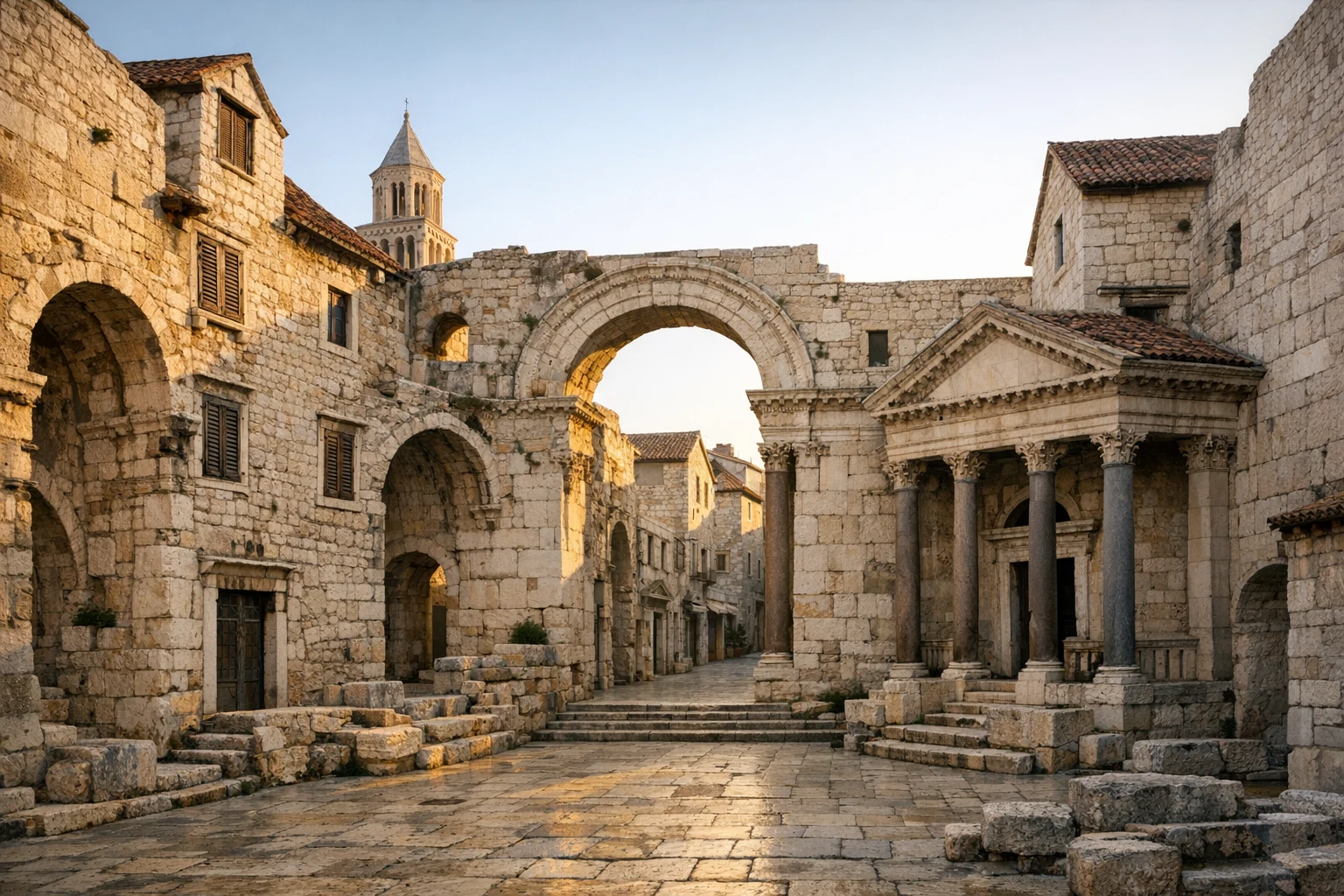
At the edge of the Adriatic Sea, pressed against the warm stone promenade of the Croatian city of Split, stands one of the most astonishing survivals of the ancient world. Diocletian’s Palace is not a ruin waiting to be explored — it is a living city layered over a Roman emperor’s retirement home, its ancient streets still bustling with cafés, apartments, street musicians, and market stalls. Walking through the Golden Gate into its interior for the first time is disorienting in the best possible way: the scale is unmistakably Roman, the colonnades and towers still upright, the underground vaults cavernous and cool, and yet laundry hangs from medieval additions to imperial walls, and espresso is served in a bar occupying what was once a ceremonial vestibule. Croatia holds many extraordinary places, but Diocletian’s Palace in Split is something rarer still — an ancient monument that never stopped being used, a Roman fortress that evolved into a town and then into a city district, carrying seventeen centuries of continuous human habitation within its walls.
History
The Emperor Who Chose Retirement
Gaius Aurelius Valerius Diocletianus, known to history as Diocletian, was among the most consequential rulers of the late Roman Empire. Coming to power in 284 AD after decades of military and political chaos, he reorganized the empire, reformed its tax system, and created the Tetrarchy — a power-sharing arrangement between four co-emperors designed to prevent the instability that had plagued Rome for a generation. He also unleashed one of the most severe persecutions of Christians in Roman history. In 305 AD, having achieved a degree of stability, Diocletian did something almost unheard of in imperial Rome: he voluntarily abdicated. He had been building his retirement home since approximately 295 AD, constructing it on a peninsula of the Dalmatian coast near his birthplace of Salona, the prosperous Roman capital of the province of Dalmatia.
Architecture of Power and Privacy
The palace was designed as a hybrid of military fortress and imperial villa, and the tension between those two functions gives the complex its distinctive character. Its outer walls measured roughly 215 meters from north to south and 180 meters from east to west, enclosing an area of approximately 31,000 square meters. Four gates — named Gold, Silver, Iron, and Bronze — pierced the walls at cardinal points. The northern half of the complex functioned essentially as a fortified garrison, housing soldiers, staff quarters, and service buildings. The southern half, overlooking the sea, belonged to the emperor himself: his mausoleum, a Temple of Jupiter, ceremonial reception halls, and private apartments arranged around a grand colonnaded courtyard known today as the Peristyle.
From Imperial Residence to Medieval City
Diocletian died around 316 AD, and his palace passed through imperial hands before the Tetrarchy itself dissolved. By the fifth century, as the Western Roman Empire fragmented under pressure from migrating peoples, Salona — the nearby provincial capital — became increasingly dangerous. Around 614 AD, following a catastrophic Avar and Slavic assault that destroyed Salona, its surviving population took refuge inside the massive walls of the old palace. What followed was one of the most remarkable processes of urban transformation in European history. Refugees subdivided imperial rooms into family dwellings, built churches into pagan temples, filled the underground substructure with storage and workshops, and gradually created a medieval city within the Roman shell. Diocletian’s mausoleum was converted into a Christian cathedral — a profound act of symbolic reversal, as Diocletian had been among the most vicious persecutors of Christians. The Temple of Jupiter became a baptistery.
Ottoman Pressure and Venetian Rule
Through the medieval period, Split flourished as a regional trading port, passing under Byzantine suzerainty, Croatian kings, and eventually Venetian control from 1420 onward. The Venetians reinforced and adapted the old Roman walls, adding Gothic and Renaissance elements that layered new architectural languages over the ancient substrate. The Ottoman expansion into the Balkans brought periods of siege and conflict, and the palace walls — never intended for sustained medieval warfare — were supplemented with additional Venetian fortifications. The city survived, and after the fall of Venice in 1797 passed to the Habsburg Empire, then through the upheavals of the twentieth century into the modern Croatian state.
Modern Rediscovery
The Scottish architect Robert Adam visited in 1757 and produced detailed measured drawings of the palace, publishing them in 1764 in a landmark volume that directly influenced the Neoclassical architecture then sweeping Britain and America. His documentation introduced educated European audiences to a monument they had largely forgotten was Roman at all, buried as it was beneath centuries of medieval accretion. Archaeological work in the twentieth century gradually uncovered the underground substructures, and the site’s inscription on the UNESCO World Heritage List in 1979 brought international attention to its significance. Today it is the best-preserved example of late-Roman palatial architecture anywhere in the world.
Key Features
The Peristyle
The heart of the imperial southern precinct is the Peristyle, a rectangular ceremonial courtyard flanked by colonnaded loggias of pink limestone. In Diocletian’s day this was the formal approach to the imperial apartments, the space where the emperor would appear elevated above his subjects in the ritual of adoratio — the prostration before a god-emperor that Diocletian formalized as court protocol. Today it remains the social and spatial heart of Split’s Old Town. The columns stand intact, their capitals a blend of Corinthian and composite orders. An Egyptian black granite sphinx — one of several that Diocletian transported from Egypt — crouches on a pedestal at the courtyard’s southern end, a deliberate evocation of ancient imperial power. Café tables spread across the ancient paving stones, and in summer the Peristyle hosts outdoor opera performances, the colonnade providing extraordinary acoustic resonance for a performance space nearly two thousand years old.
The Cathedral of Saint Domnius
Rising above the roofscape of Split on a base of ancient Roman stonework, the Cathedral of Saint Domnius occupies Diocletian’s own mausoleum — an octagonal domed structure of extraordinary quality, its interior still retaining the original Roman coffered dome and carved frieze depicting imperial hunting scenes and portrait medallions of Diocletian and his wife. The cathedral was established in the seventh century when the incoming Christian refugees dedicated the mausoleum to Saint Domnius, a bishop of Salona martyred under Diocletian’s persecutions. The irony is explicit and presumably intentional: the emperor’s own tomb became a church honoring one of his victims. A Romanesque campanile, begun in the thirteenth century and completed only in the twentieth, rises 57 meters beside the mausoleum and offers panoramic views across the rooftops of the palace and the Adriatic beyond.
The Underground Halls
Beneath the imperial apartments, an extensive substructure of vaulted cellars and corridors mirrors the layout of the rooms above — effectively a basement at imperial scale, used originally for storage and service functions. Entered from the Peristyle through an arched vestibule, the underground halls extend across much of the southern half of the palace. In the medieval period they were used as rubbish dumps and gradually filled to their ceilings; systematic excavation and clearance beginning in the 1950s revealed the spaces as they appear today: long barrel-vaulted corridors, damp and atmospheric, their stonework still bearing tool marks from Roman masons. Because the rooms above were demolished or transformed beyond recognition over centuries, the underground plan provides the clearest picture available of how Diocletian’s private apartments were arranged. The substructure is entered via the Bronze Gate on the sea-facing southern wall and functions today as exhibition space for seasonal installations.
The Golden Gate and Northern Walls
The northern face of the palace, intended for arrivals from Salona, presents its most monumental exterior. The Golden Gate — Porta Aurea — was the formal ceremonial entrance, flanked by octagonal towers and decorated with blind arcading and niched figures that would once have held statues. It remains the best-preserved of the four gates and gives the clearest sense of the original grandeur of the palace exterior. Just outside the Golden Gate stands an enormous bronze statue of Bishop Gregory of Nin by the Croatian sculptor Ivan Meštrović, cast in 1929. Touching the bishop’s left big toe is said to bring good luck, and the toe gleams golden with the accumulated contact of generations of visitors.
The Temple of Jupiter
Set within the northern service half of the complex, the small but exquisitely preserved Temple of Jupiter served as the primary pagan sanctuary of the palace precinct. Like the mausoleum, it was converted to Christian use in the early medieval period, becoming a baptistery — its coffered barrel vault, carved in stone with acanthus scrolls and rosettes, still intact above the space. The original Roman relief carvings on the entrance vestibule survive, and a headless sphinx guards the entrance. The juxtaposition of Roman and early Christian iconography within a single unaltered Roman structure makes this one of the most thought-provoking small spaces in the entire complex.
Getting There
Split is well connected to the rest of Europe by air, sea, and road, making Diocletian’s Palace one of the most accessible major ancient sites in the Mediterranean region.
By Air: Split Airport (airport code SPU) receives direct flights from major European hubs including London, Frankfurt, Amsterdam, and Rome, particularly during the summer season. Budget carriers including Ryanair and easyJet serve the airport extensively from April through October. From the airport, the Croatia Airlines bus runs approximately every 30 minutes to Split’s central bus station, directly adjacent to the palace walls, for around €8–€10. The journey takes 30–45 minutes.
By Bus or Train: Split’s bus terminal and ferry port are both located within a few minutes’ walk of the palace’s eastern wall. Long-distance buses connect Split with Zagreb (approximately 5–6 hours, from €15), Dubrovnik (around 4 hours, from €12), and Sarajevo (around 4 hours, from €15). Train service to Split from Zagreb takes around 5–6 hours and offers scenic mountain scenery.
By Ferry: The Jadrolinija ferry service connects Split with numerous Dalmatian islands as well as an overnight route to Ancona in Italy, making it an excellent base for wider regional exploration. The ferry terminal is steps from the palace’s sea-facing southern wall.
On Foot within Split: The palace itself is entirely pedestrianized. All four gates open onto the historic street network. Most Split hotels are within easy walking distance, and the Old Town is compact enough that no internal transport is required.
When to Visit
Dalmatia has a classic Mediterranean climate — hot, dry summers and mild, wet winters — and the timing of a visit to Diocletian’s Palace significantly shapes the experience.
Summer (June–August) is peak season and peak heat, with temperatures regularly exceeding 32°C and the narrow lanes of the palace becoming extremely crowded, especially on days when cruise ships dock. Accommodation prices peak and must be booked months in advance. That said, summer brings the outdoor opera season in the Peristyle, extended opening hours, and a festive atmosphere that is genuinely special. Early morning visits — arriving at the Golden Gate by 8 AM — allow exploration of the streets in relative quiet before the day’s crowds arrive.
Shoulder season (April–May and September–October) offers the best combination of good weather and manageable crowds. Temperatures in the low-to-mid 20s°C make walking comfortable, the Adriatic is warm enough to swim in September, and accommodation prices drop significantly from the summer peaks. This is the optimal window for a measured, unhurried visit.
Winter (November–March) transforms Split into a city that feels genuinely lived-in rather than tourist-directed. The palace lanes are the domain of locals, cafés are quiet, and the quality of light on the limestone is extraordinary in winter sunlight. Some smaller museums and attractions keep reduced hours, and ferry services to the islands run less frequently, but the major monuments remain accessible and the experience of walking the Roman streets without summer’s crowds is uniquely atmospheric.
| Quick Facts | |
|---|---|
| Location | Split, Split-Dalmatia County, Croatia |
| Coordinates | 43.5081° N, 16.4402° E |
| Built | c. 295–305 AD |
| Commissioned by | Emperor Diocletian |
| Civilization | Roman Empire (Late Period) |
| UNESCO Status | World Heritage Site (inscribed 1979) |
| Area | ~31,000 m² (inner precinct) |
| Still Inhabited | Yes — approximately 3,000 residents live within the walls |
| Nearest Airport | Split Airport (SPU), ~25 km |
| Entry | Outer streets free; cathedral, underground halls, and temple charge separately (€5–€10 each) |
| Best Season | April–May or September–October |
Frequently Asked Questions
Is Diocletian's Palace free to enter?
The streets and squares of the palace complex are open to the public at no charge, as people live and work inside its walls. However, specific attractions within the complex — such as the Cathedral of Saint Domnius, the Jupiter Temple crypt, and the underground Vestibule halls — charge separate entry fees typically ranging from €5 to €10 each.
How long should I spend at Diocletian's Palace?
A thorough self-guided visit of the major monuments, underground halls, and the atmospheric lanes of the Old Town takes between three and four hours. If you add a guided tour, time for a meal inside the walls, or visits to the City Museum, budget a full half-day. Most visitors find themselves lingering far longer than planned.
Is Diocletian's Palace a UNESCO World Heritage Site?
Yes. The Historic City of Trogir and the Historic Complex of Split with Diocletian's Palace were jointly inscribed on the UNESCO World Heritage List in 1979 in recognition of their outstanding Roman and medieval urban fabric.
When was Diocletian's Palace built and by whom?
Construction began around 295 AD under the order of the Roman Emperor Diocletian and was completed by approximately 305 AD. Diocletian retired there after his abdication, making it one of the very few purpose-built imperial retirement residences in the ancient world.
Can I stay overnight inside Diocletian's Palace?
Yes — a unique feature of this site is that people live, sleep, and run businesses within the ancient walls. Numerous hotels, apartments, and guesthouses operate inside the palace footprint, allowing visitors to sleep within rooms that were once part of a Roman emperor's residence.
What is the best way to get to Diocletian's Palace from the airport?
Split Airport (SPU) is located about 25 km northwest of the city. A dedicated airport bus runs directly to the central bus station adjacent to the palace for approximately €8–€10. Taxis and ride-shares cost roughly €35–€50, and transfers take between 30 and 45 minutes depending on traffic.
Are guided tours worth it at Diocletian's Palace?
Guided tours add considerable depth, particularly for the underground substructure and the Cathedral of Saint Domnius, where centuries of adaptive reuse can be difficult to interpret without context. Two-hour guided tours are widely available from the Peristyle and typically cost €15–€25 per person.
Nearby Ancient Sites
Aosta Roman Ruins Guide 2026: Alpine Rome on Foot
RomanPlan a practical visit to Aosta's Roman remains, including the Arch of Augustus, theater, city walls...
Appian Way Rome Guide 2026
RomanPlan a smart visit to the Appian Way with route choices, catacomb logistics, bike-vs-walk strategy, ...
Akrotiri
Minoan / CycladicExplore Akrotiri, the Bronze Age Minoan city buried under volcanic ash on Santorini around 1613 BCE ...
The Complete Acropolis Athens Travel Guide: Temples
Ancient GreecePlan the perfect visit to the Acropolis of Athens with our 2026 guide. Discover the Parthenon, best ...
Alhambra Travel Guide 2026: Nasrid Palaces, Tickets, and Visit Strategy
Nasrid Dynasty (Moorish)Plan a well-timed visit to Granada's Alhambra with practical ticket advice, must-see highlights, and...