Quick Info
At a glance
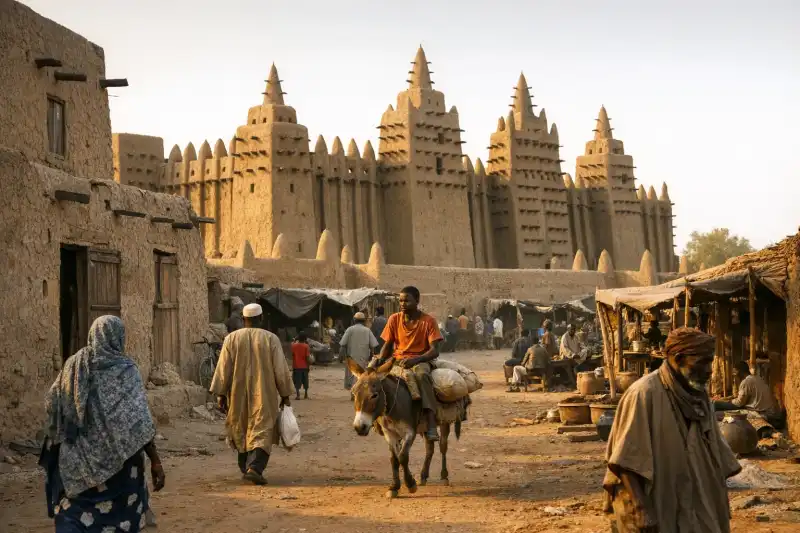
Djenne in Mali rises from the floodplain like a mirage of earth and light, its skyline shaped not by stone towers or marble colonnades but by sculpted mud walls, tapering buttresses, and wooden beams projecting from sun-baked facades. Few cities in Africa are so instantly recognizable, and fewer still have preserved such a strong sense of continuity between past and present. Here, architecture is not a relic sealed off from daily life; it is renewed, repaired, and inhabited in rhythm with the seasons. Traders still gather, families still live behind thick earthen walls, and the city’s most famous monument, the Great Mosque, still anchors both the physical and spiritual landscape.
Set in Mali’s inland Niger delta, Djenne has long been a meeting place between riverine agriculture, regional exchange, and trans-Saharan commerce. Its location helped it become one of the great historic cities of the western Sahel, connected to caravan routes, Islamic scholarship, and artisanal traditions that continue to define its identity. Visiting today is less about ticking off a single monument and more about entering a distinctive urban world: narrow lanes of banco houses, bustling market activity, changing river landscapes, and a deep architectural heritage shaped from mud, timber, water, and communal labor. Djenne is at once monumental and intimate, legendary and lived-in.
History
Early settlement and Djenné-Djeno
The story of Djenne begins before the present city took shape. Archaeological research at nearby Djenné-Djeno, just outside modern Djenne, has shown that this part of Mali supported one of sub-Saharan Africa’s earliest complex urban settlements. Occupied from roughly the 3rd century BCE, Djenné-Djeno developed in the fertile inland delta, where seasonal flooding supported fishing, farming, and regional exchange. This was not an isolated village but a substantial urban center linked to a network of satellite settlements.
Finds from the site reveal local craftsmanship and wide trading connections. Ironworking, pottery production, and exchange in commodities such as rice, fish, and perhaps gold helped sustain the settlement. Long before the rise of the better-known medieval empires of West Africa, communities here had already created a sophisticated urban economy adapted to the Sahelian environment. That alone makes the Djenne area historically remarkable: it demonstrates that urbanism in inland West Africa emerged through local ecological and commercial dynamics, not merely through later external influence.
Over time, Djenné-Djeno declined, probably because of shifting trade patterns, environmental change, and the growing importance of Islamically oriented urban centers nearby. But its legacy formed part of the foundation on which medieval Djenne rose.
Medieval growth and the Islamic city
By the early second millennium CE, Djenne had become a major regional center. Its position was ideal. It stood near waterways that linked the inland delta and near overland routes that connected the western Sudan to Saharan trade networks. Goods moving through the region included salt from the desert, agricultural products from the floodplain, craft goods, and eventually gold and manuscripts circulating within broader West African and Islamic trading worlds.
As Islam spread through commerce, scholarship, and political networks, Djenne became an Islamic town of growing importance. Merchants and scholars helped shape its institutions, and mosques became central to the city’s identity. Like Timbuktu farther north, Djenne developed a reputation not only as a market town but as a place of learning. The city’s urban culture blended local building traditions with the social prestige and intellectual frameworks of the wider Muslim world.
The ruler traditionally credited with embracing Islam in Djenne appears in oral and written traditions, though exact chronology can be difficult to pin down. What is clear is that by the medieval era the city had become deeply integrated into the Islamic and commercial systems of the western Sahel. Its prosperity rested on mediation: between river and desert, farmers and caravans, local life and long-distance trade.
Empires, trade, and changing power
Djenne’s fortunes rose and fell alongside the great Sahelian empires. It interacted with the Empire of Mali and later the Songhai Empire, both of which depended on networks of trade, taxation, and urban administration across broad territories. During these centuries, Djenne’s marketplace and scholarly circles flourished, and the city became one of the region’s most admired urban centers.
No Sahelian city existed in perfect stability, however. Political transitions, competition over trade, and military campaigns repeatedly reshaped the balance of power. Moroccan intervention in the Songhai world in the late 16th century disrupted long-established systems, and over the following centuries regional authority became more fragmented. Yet Djenne endured because it was rooted not in a single dynasty alone but in geography, commerce, and community organization.
European travelers later described Djenne as a thriving town with impressive architecture and lively markets. Their accounts often emphasized its unusual earthen skyline and strategic commercial role, though they rarely captured the full internal logic of the city’s social and religious life. For residents, Djenne was not exotic; it was a durable urban tradition adapted to climate, materials, and faith.
Colonial era to UNESCO recognition
French colonial expansion in the late 19th century brought Djenne into a new political system. Colonial rule altered trade patterns, administration, and infrastructure, often weakening older regional networks in favor of routes and priorities established by imperial authorities. Still, the city remained important as a local center and as a symbol of West African architectural heritage.
The Great Mosque visible today dates largely from 1907, when the present structure was built on the site of earlier mosques. Though often described as “ancient,” it is better understood as a continuation of a much older religious and architectural tradition. Its form preserves and magnifies the style that made Djenne famous: monumental earthen construction with rhythmic buttressing and timber toron beams projecting from the walls.
In 1988, the Old Towns of Djenne were inscribed on the UNESCO World Heritage List, recognizing both the archaeological significance of the area and the extraordinary living tradition of earthen urban architecture. Modern Djenne faces challenges from environmental pressures, economic shifts, conservation needs, and regional instability, yet its significance remains immense. It is one of the clearest surviving expressions of how an African city could be built from earth and maintained through communal knowledge across centuries.
Key Features
The defining feature of Djenne is, without question, the Great Mosque. It is one of the world’s most iconic buildings, not because it is ancient in the sense of untouched antiquity, but because it embodies continuity. The mosque’s massive mud-plastered walls rise in sculpted planes, punctuated by engaged pillars and crowned with ostrich-egg finials. Long wooden beams project from the exterior, creating a dramatic texture while also serving practical purposes during annual replastering. The building appears at once monumental and organic, as if shaped from the very floodplain on which it stands. In changing light, its surface shifts from soft gold to deep brown, reminding visitors that this architecture is inseparable from the land.
Equally important is the mosque’s urban setting. Djenne is not a solitary monument in an empty field; it is a whole earthen city. The old town’s houses line narrow streets in forms that echo the mosque’s language—thick banco walls, internal courtyards, carved wooden doors, and upper facades modeled with restraint and rhythm. Some homes belong to old merchant families, and many reveal the city’s social history through details of layout and ornament. The consistency of material gives Djenne unusual visual coherence. Even ordinary residential lanes can feel architecturally significant.
The market square in front of the mosque is another central feature. On market days, the space fills with sellers, buyers, carts, livestock, textiles, pottery, produce, and conversation. This is where Djenne’s historic commercial identity becomes tangible. The square is not merely picturesque; it remains one of the clearest living expressions of the city’s role as an exchange center linking agricultural hinterlands, river communities, and regional trade. For visitors, the contrast between the vast stillness of the mosque facade and the movement of market activity offers one of Djenne’s most memorable scenes.
Beyond the visible town lies the archaeological importance of Djenné-Djeno and related mound sites. These remains do not deliver the same immediate visual drama as the Great Mosque, but for anyone interested in early African urbanism they are essential. They push Djenne’s story far deeper into antiquity and challenge outdated ideas about the development of cities south of the Sahara. The significance of the site lies as much in what archaeology has revealed—dense occupation, production, trade, and long-term settlement—as in what stands above ground today.
Another striking feature of Djenne is the annual maintenance tradition associated with its earthen buildings, especially the mosque. Mud architecture survives not by resisting time but by engaging with it. Rain, heat, and erosion make regular replastering necessary, turning conservation into a communal act. The famous annual restoration of the mosque, in which residents gather to renew the outer plaster, is both practical and ceremonial. It is a vivid reminder that heritage here is participatory rather than purely curatorial.
Finally, the surrounding landscape matters. Djenne’s place in the inland delta gives it a seasonal character that shapes movement, food, economy, and atmosphere. Waterways, floodplains, and dry-season routes have all influenced the city’s architecture and historical importance. To appreciate Djenne fully, visitors should look beyond individual walls to the environmental logic of the whole place: a city of earth built in a watery landscape, poised between permanence and renewal.
Getting There
Most travelers reach Djenne via Mopti, the nearest major transport hub, about 130 kilometers away by road. In practical terms, journeys usually begin in Bamako, Mali’s capital, from where travelers continue eastward by domestic transport or private arrangement. Road conditions can vary greatly by season, and security conditions in central Mali can change, so it is essential to check current government travel advisories and local guidance before setting out.
From Bamako to Mopti, private car hire is often the most straightforward option for international visitors. Depending on vehicle type, fuel prices, and whether a driver is included, the trip can cost roughly $180 to $350 one way for the vehicle. Shared buses or bush taxis may be significantly cheaper, often in the range of $15 to $35 per person, but schedules are less predictable and comfort is limited. From Mopti to Djenne, local shared taxis or minibuses may cost around $5 to $15 per person, while a private car transfer can run from $40 to $100 depending on road conditions and negotiation.
Historically, access also involved crossing by ferry or causeway depending on seasonal water levels and infrastructure status, so travel times can be longer than the map suggests. In the dry season, the road journey from Mopti may take three to four hours; during or after rains it can be slower. Organized cultural tours, when available, simplify logistics by bundling transport, local guides, and timing around market days. Because services shift over time, visitors should confirm routes, departure points, and expected fares locally before departure.
When to Visit
The best time to visit Djenne is generally the cooler dry season, from November to February. During these months, daytime temperatures are still warm but usually more manageable than the intense heat that builds later in the year. The light is often excellent for photography, roads are typically easier to navigate, and walking through the old town is far more comfortable. This is the season most travelers prefer for combining Djenne with Mopti and other Sahelian destinations.
March to May is usually the hottest period. Temperatures can become oppressive, especially in the afternoon, and sightseeing is best limited to early morning and late day. The advantage of this season is thinner visitor traffic, but the heat can reduce the pleasure of exploring earthen streets with little shade. Anyone traveling then should plan carefully for water, sun protection, and a slower pace.
The rainy season, broadly from June to September, transforms the surrounding delta landscape. This can be a beautiful time in environmental terms, with greener scenery and fuller waterways, but heavy rains can complicate road access and make transport less reliable. Earthen architecture also looks different in this season, more vulnerable and more obviously tied to ongoing maintenance. For some travelers, that is part of the appeal; for others, the logistical uncertainty outweighs it.
If possible, time your visit around Djenne’s famous Monday market, when the town is at its liveliest. Visitors interested in architecture should also ask locally about the timing of annual mosque replastering traditions, though exact dates can vary. In all seasons, current security information should be the first factor in deciding whether and when to travel.
| Quick Facts | Details |
|---|---|
| Location | Djenne, Mopti Region, Mali |
| Famous for | The Great Mosque of Djenne and historic earthen urban architecture |
| UNESCO status | Part of the Old Towns of Djenne World Heritage listing since 1988 |
| Earliest nearby settlement | Djenné-Djeno, occupied from around the 3rd century BCE |
| Historic role | Regional trade hub and center of Islamic learning in the western Sahel |
| Main building material | Banco, a sun-dried mud construction technique |
| Best season to visit | November to February |
| Nearest major hub | Mopti |
| Typical visit length | Half day to 1 full day, longer for deeper cultural exploration |
| Travel note | Always check current security and road conditions before planning a trip |
Guided tours: worth it?
Most travelers can visit Djenne independently. Compare a tour only if you want a tighter history-focused visit, easier logistics, or a guide who can answer questions on the spot.
Best for
- Short visits where a planned route saves time
When to go self-guided
Go independently if you prefer setting your own pace, reading as you go, and checking official hours or ticket rules directly before you arrive.
What I’d avoid
Skip paid tours that bundle unrelated stops you do not actually want. The best option should either save meaningful planning time or add historical context you would miss on your own.
Djenne Mali cultural tours
Useful when: you want to compare guided formats before deciding
Mopti and Djenne day trips
Useful when: transport or pickup logistics matter
Mali architecture and heritage tours
Useful when: you want to compare guided formats before deciding
Some tour links are affiliate links, which may earn Ancient Travel a small commission at no extra cost to you. I try to surface options that make practical sense for the site—not just anything bookable.
Frequently Asked Questions
What is Djenne best known for?
Djenne is best known for the Great Mosque of Djenne, one of the world's most celebrated earthen buildings, and for its historic role in Saharan trade and Islamic scholarship.
Where is Djenne located?
Djenne is located in central Mali in the Mopti Region, on the inland delta of the Niger River system.
Can visitors enter the Great Mosque of Djenne?
Access rules can vary, and non-Muslim entry is often restricted, so visitors should confirm local regulations before planning an interior visit.
When is the best time to visit Djenne?
The cooler dry season, generally from November to February, is the most comfortable time for sightseeing, photography, and road travel.
How do you get to Djenne?
Most travelers reach Djenne overland from Mopti, often by private car or shared transport, with road conditions and security advisories checked in advance.
Why is Djenne historically important?
Djenne was a major commercial and religious center in the western Sahel, linking regional agriculture, trans-Saharan trade, and Islamic learning for centuries.
Nearby Ancient Sites
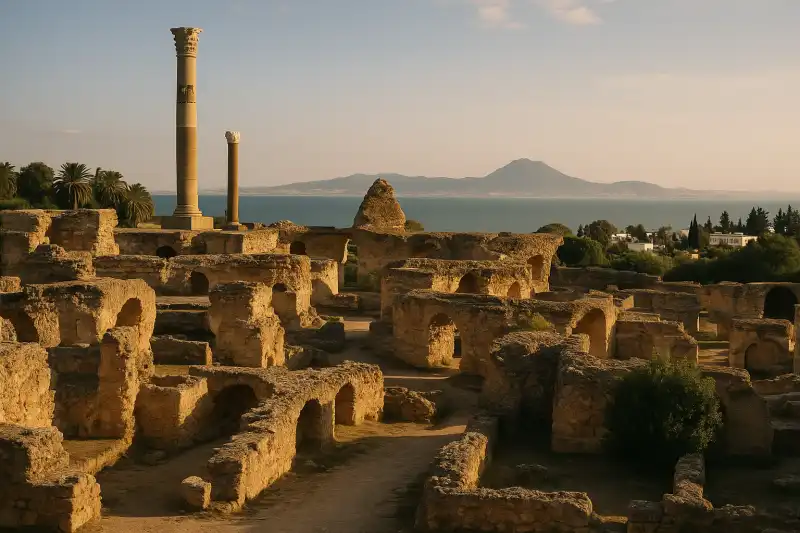
Carthage
Phoenician / Carthaginian / RomanCarthage in Tunisia preserves the ruins of a once-mighty Phoenician empire and Roman provincial capi...
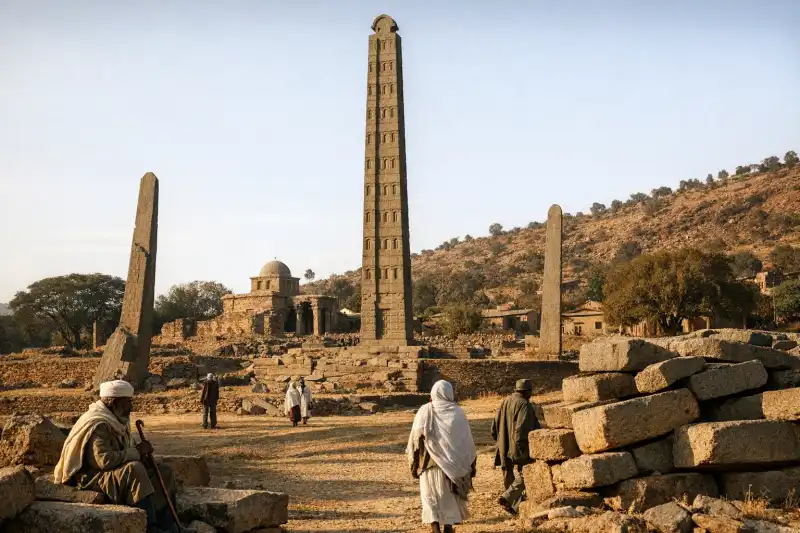
Aksum
Aksumite KingdomExplore Aksum, Ethiopia’s ancient royal city of towering stelae, early Christianity, and one of Afri...
Abydos Temple Egypt Guide 2026: Temple of Seti I & King List
New Kingdom-PtolemaicAbydos Temple near Luxor: magnificent Temple of Seti I with war reliefs, ancient king list, and vibr...