Quick Info
At a glance
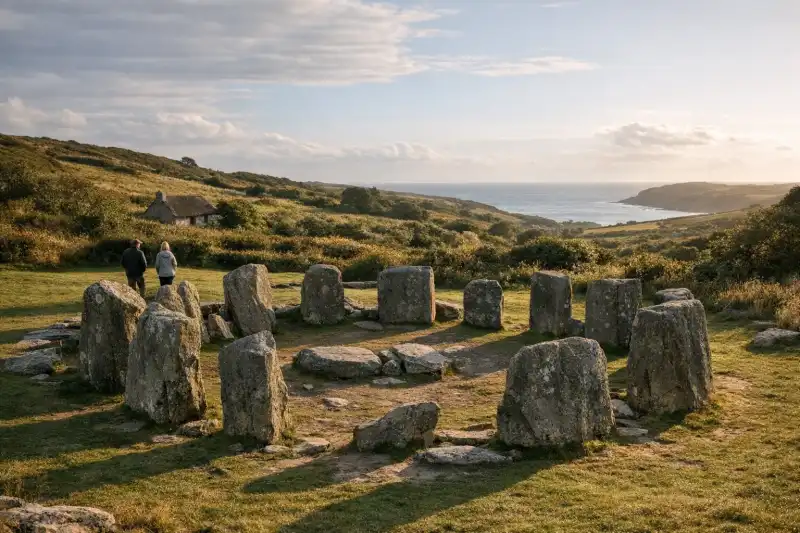
Drombeg Stone Circle in Ireland sits in a quiet fold of the West Cork countryside, where green fields, winding lanes, and Atlantic weather create an atmosphere that feels at once intimate and ancient. Unlike some archaeological sites that announce themselves from miles away, Drombeg reveals its power gradually. You arrive through farmland, step out into open air, and suddenly the stones are there: low, weathered, and arranged with a precision that still carries meaning after more than three thousand years. The monument is not grand in scale, but that is part of its appeal. It feels human, local, and deeply rooted in the landscape around it.
For many travelers, Drombeg is one of Ireland’s most memorable prehistoric sites because it combines mystery with accessibility. It is close enough to popular West Cork routes to fit into a scenic day trip, yet secluded enough to preserve a strong sense of stillness. The stone circle is often called the “Druid’s Altar,” though that name reflects later folklore rather than its true Bronze Age origins. What survives today is a ring of standing stones, carefully positioned and aligned, with associated archaeological remains nearby that suggest ritual, domestic activity, and communal gathering. Visiting Drombeg is less about ticking off a famous monument and more about standing inside a place where ancient people organized time, ceremony, and community around stone, sky, and land.
History
Bronze Age origins
Drombeg Stone Circle was built during the Late Bronze Age, probably sometime between about 1100 and 800 BCE. This was a period when communities across Ireland were creating monuments in stone, refining metalworking skills, and shaping landscapes through farming, ritual activity, and settlement. Stone circles in Cork and Kerry form a distinctive regional tradition, and Drombeg is one of the finest surviving examples. Archaeologists classify it as an axial stone circle, a type characteristic of southwest Ireland. In such circles, the arrangement of stones appears to have been designed with a marked axis, often connected to celestial observations or symbolic orientations.
The monument originally consisted of 17 stones, of which most survive today. The recumbent stone at the southwest side is especially important. It lies horizontally and forms a visual anchor in the circle’s design. Opposite it are two taller portal stones that frame the space and emphasize the axis. This was not a casual arrangement of local boulders. The builders selected, positioned, and balanced the stones carefully, creating a place that likely had ceremonial or calendrical meaning.
Excavations in the 20th century produced evidence that deepened understanding of the site. Charred remains found in the center suggested a funerary association, with one burial involving a young individual. This supports the idea that Drombeg may have served several purposes over time: ritual gathering place, ceremonial center, and perhaps a location connected to remembrance of the dead.
Ritual use and community life
Drombeg was not isolated in function. Nearby remains include two circular hut sites and a substantial stone-lined trough often interpreted as a fulacht fiadh, or ancient cooking place. At such sites, water was heated by dropping in stones that had been warmed in a fire. This process could have been used for cooking, bathing, textile work, or other communal tasks. At Drombeg, the presence of both ceremonial and practical structures suggests a more complex landscape than the stone circle alone might imply.
That complexity matters. Bronze Age monuments were not necessarily separate from everyday life in the way modern visitors often imagine. Ritual and domestic activity could overlap. Gatherings at Drombeg may have involved feasting, seasonal observance, social exchange, and perhaps acts of remembrance or initiation. The circle itself may have served as the focus for important moments in the annual cycle, while the surrounding features supported larger communal events.
One of the most discussed aspects of Drombeg is its possible astronomical alignment. Researchers have noted that the axis of the circle appears linked to the setting sun around the winter solstice, visible over a distant notch in the hills. While interpretations vary and certainty is difficult, the alignment reinforces the idea that the site was part of a worldview in which celestial patterns mattered deeply. For a farming society, observing the turning of the year would have had practical as well as symbolic importance.
Decline, folklore, and rediscovery
At some point, Drombeg ceased to function in its original role. The reasons are unknown. Like many prehistoric monuments, it likely passed through long phases of neglect, partial collapse, and reinterpretation. Stones may have shifted, some may have fallen, and local people over the centuries would have created new stories to explain an already ancient place. The later nickname “Druid’s Altar” belongs to this tradition of folklore, attaching the monument to imagined priestly practices from a much later era than its true construction.
Such names are common across Ireland, where prehistoric sites often became woven into local belief. Stone circles, ringforts, and standing stones were associated with fairies, saints, giants, or mysterious ancestral powers. These stories helped protect some sites by making them places of caution and respect, even if the original Bronze Age meanings had long been forgotten.
Modern archaeological interest brought Drombeg back into scholarly focus. Excavations carried out in the 1950s helped clarify the monument’s structure and associated features. The site was carefully studied and conserved, making it one of the most informative stone circles in Ireland for both specialists and general visitors. Today, Drombeg stands as a protected national monument and an important piece of Ireland’s prehistoric heritage, valued not only for its stones but for the wider archaeological landscape that surrounds them.
Key Features
The first thing many visitors notice at Drombeg Stone Circle is its sense of proportion. It is not a vast ceremonial complex on the scale of Newgrange or a dramatic hilltop fort like Dun Aonghasa. Instead, it is a compact circle, roughly 9 meters across, where every stone seems to contribute to a carefully choreographed whole. This scale allows you to take in the site in a single glance, yet the longer you look, the more deliberate it appears. The 17-stone layout creates an enclosure that feels both open and defined, with the space inside the ring still holding a subtle psychological weight.
The most distinctive stone is the recumbent slab on the southwest side. It is long, low, and horizontal, contrasting with the upright stones around it. Carved cup marks are visible on its surface, adding another layer of mystery. These shallow depressions appear on many prehistoric stones in Atlantic Europe, but their exact meaning remains debated. At Drombeg, they reinforce the ceremonial character of the monument and the care with which selected stones were used. Opposite the recumbent stone, the taller portal stones draw the eye and establish the monument’s axial orientation. Even without expert knowledge, you can sense that the placement was intentional.
The setting is just as important as the stones themselves. Drombeg is surrounded by rolling pasture, hedgerows, and distant views shaped by the mild, wet climate of southwest Ireland. The monument does not dominate the landscape; it belongs to it. This intimacy is part of its charm. Instead of confronting a monumental skyline, visitors encounter a site embedded in ordinary rural scenery, which may not be so different in spirit from the agricultural world of its builders. The changing light can transform the experience. On a bright day the stones stand sharp against green grass and blue sky. Under cloud or mist they seem older, softer, and more enigmatic.
A short walk from the circle brings you to the associated hut sites and the stone trough. These features are easy to overlook if you come only for a quick photograph, but they are essential to understanding Drombeg. The huts suggest shelter or activity areas, while the trough points toward communal labor, food preparation, or possibly ritualized heating of water. One reconstructed interpretation imagines a roofing cover over the trough and a lively scene of fire, steam, and people at work. Whether these activities were strictly domestic or partly ceremonial is impossible to know, but they remind us that prehistoric monuments were often part of lived landscapes rather than isolated shrines.
Another important feature of Drombeg is its accessibility. Some ancient sites require strenuous hiking, ferry crossings, or complex logistics. Drombeg does not. A small parking area and short path make it relatively easy to reach, which means visitors can experience a nationally significant prehistoric monument without needing a full expedition. Yet the approach is still modest enough to preserve a sense of discovery. There are no urban intrusions or large visitor facilities to distract from the setting.
Finally, Drombeg’s enduring appeal lies in its ambiguity. It is clearly purposeful, clearly ancient, and clearly significant, but it does not yield a single simple explanation. Was it primarily a ceremonial calendar? A burial place? A gathering point for seasonal rituals? A site where feasting and astronomy met? The answer may be all of these in different periods. That uncertainty is not a weakness. It is what gives Drombeg its emotional depth. Visitors are left with just enough evidence to imagine the lives behind the stones, but not enough to fully solve the puzzle.
Getting There
Drombeg Stone Circle is located in County Cork in southwest Ireland, about 6 kilometers from Glandore and roughly 15 to 20 minutes by car from Rosscarbery. The easiest way to visit is by rental car, especially if you are exploring West Cork’s coastal routes. From Cork City, the drive usually takes around 1 hour 30 minutes to 1 hour 45 minutes depending on traffic and the exact route. Expect to pay roughly €40 to €70 per day for a compact rental car in the region, with fuel extra. Roads in West Cork can be narrow and winding, so allow more time than the map may suggest.
Public transport is possible but less convenient. Bus services connect Cork City with towns such as Clonakilty, Skibbereen, and Rosscarbery, with one-way fares often in the €10 to €20 range depending on route and operator. From Rosscarbery or Skibbereen, a taxi is usually required for the final leg to the site. A local taxi fare can range from about €20 to €35 each way, so this option works best if shared between several travelers.
Organized day tours focused specifically on Drombeg are limited, but broader West Cork heritage or scenic tours sometimes include prehistoric or historical stops. These can be a good option if you prefer not to drive. If you do self-drive, combine Drombeg with Glandore, Union Hall, Rosscarbery, or the nearby coastline for a fuller day. Parking at the site is generally free, and the walk from the car park to the monument is short, though sturdy shoes are useful in wet weather.
When to Visit
Drombeg Stone Circle can be visited year-round, but the experience changes significantly with the seasons. Late spring through early autumn, especially May to September, offers the most reliable conditions. Days are longer, the surrounding fields are lush, and roads are easier to navigate in good light. Summer also brings the best chance of combining Drombeg with a broader West Cork itinerary that includes coastal villages and beaches. The trade-off is that this is the busiest period, though the site rarely feels crowded in the way major urban attractions do.
Autumn can be especially atmospheric. September and October often bring soft light, fewer visitors, and a countryside still green from Atlantic rains. Photographers may find this one of the most rewarding times to come, as low sun and moving cloud can dramatically shape the look of the stones. Winter visits are possible and can be memorable, particularly given the site’s often-discussed relationship to the winter solstice sunset. However, weather is less predictable, with rain, wind, and muddy ground all common. If visiting in winter, bring waterproof layers and be prepared for quickly changing conditions.
Morning and late afternoon are usually the best times of day. Early visits offer more solitude, while evening light can enhance the site’s subtle alignments and textures. Midday is perfectly fine, but the monument is often most evocative when shadows lengthen and the landscape feels quieter. Whenever you go, check the forecast, wear practical footwear, and leave a little flexibility in your schedule. At Drombeg, atmosphere is part of the attraction, and the weather often shapes that atmosphere as much as the archaeology itself.
| Quick Facts | Details |
|---|---|
| Location | Near Glandore and Rosscarbery, County Cork, Ireland |
| Type | Bronze Age axial stone circle |
| Date | c. 1100-800 BCE |
| Original stones | 17 |
| Best known feature | Recumbent stone with cup marks |
| Associated remains | Hut sites and stone-lined cooking trough |
| Access | Free entry via short walk from small parking area |
| Best visit duration | 30-60 minutes |
| Closest town | Rosscarbery |
| Best season | Late spring to early autumn |
Drombeg Stone Circle rewards travelers who appreciate places that do not need grand scale to leave a lasting impression. It offers a direct encounter with prehistoric Ireland in a setting that still feels deeply rural and connected to the rhythms of land and season. The monument’s stones, alignments, and nearby features suggest a community that measured time carefully, gathered with purpose, and invested meaning in the relationship between people and place. That connection remains visible today.
For visitors to West Cork, Drombeg fits naturally into a wider journey through one of Ireland’s most beautiful regions. Yet it is more than a scenic stop. It is a place where archaeology, folklore, and landscape overlap, inviting you to slow down and look closely. Whether you come for Bronze Age history, solstice mystery, or simply the calm of standing among ancient stones in open country, Drombeg offers something rare: a small site with a remarkably large presence.
Guided tours: worth it?
Most travelers can visit Drombeg Stone Circle independently. Compare a tour only if you want a tighter history-focused visit, easier logistics, or a guide who can answer questions on the spot.
Best for
- Short visits where a planned route saves time
When to go self-guided
Go independently if you prefer setting your own pace, reading as you go, and checking official hours or ticket rules directly before you arrive.
What I’d avoid
Skip paid tours that bundle unrelated stops you do not actually want. The best option should either save meaningful planning time or add historical context you would miss on your own.
West Cork archaeology and coastal sites tours
Useful when: you want to compare guided formats before deciding
County Cork historical day tours
Useful when: you want to compare guided formats before deciding
Ireland ancient sites tours
Useful when: you want to compare guided formats before deciding
Some tour links are affiliate links, which may earn Ancient Travel a small commission at no extra cost to you. I try to surface options that make practical sense for the site—not just anything bookable.
Frequently Asked Questions
Where is Drombeg Stone Circle located?
Drombeg Stone Circle is in County Cork in southwest Ireland, near Glandore and Rosscarbery in the West Cork countryside.
Do you need a ticket to visit Drombeg Stone Circle?
No, Drombeg Stone Circle is generally free to visit, with access provided through a small parking area and short path to the monument.
How much time should you allow for a visit?
Most visitors spend 30 to 60 minutes at Drombeg Stone Circle, though history enthusiasts may stay longer to explore the surrounding hut remains and landscape.
What is Drombeg Stone Circle famous for?
It is famous for its well-preserved Bronze Age stone circle, its striking axial alignment, and nearby archaeological remains including ancient cooking and settlement features.
Is Drombeg Stone Circle suitable for families?
Yes, the site is suitable for families, though the ground can be uneven and muddy in wet weather, so sturdy footwear is recommended.
Can you visit Drombeg Stone Circle in bad weather?
Yes, but conditions can be windy and wet, especially outside summer, so waterproof clothing and care on slippery paths are advisable.
Nearby Ancient Sites
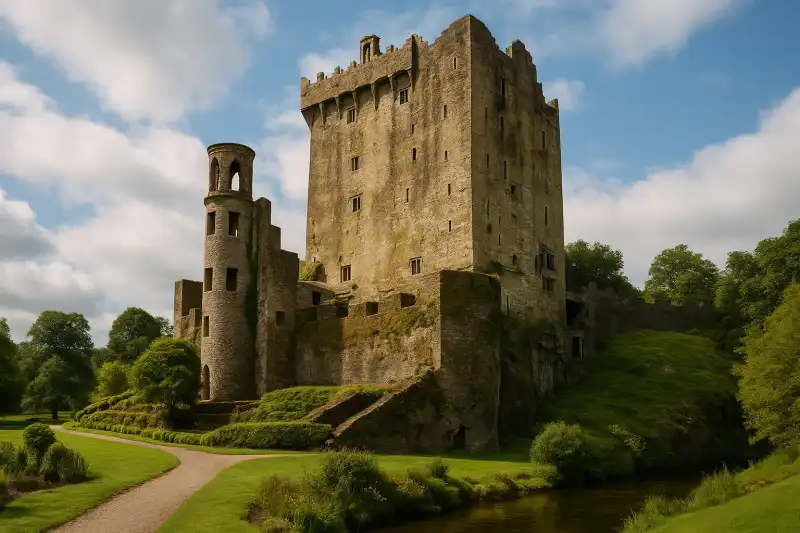
Blarney Castle Travel Guide 2026: Cork Day-Trip Timing, Gardens, and Stone Access
Medieval IrelandPlan a practical first visit to Blarney Castle with timing for the Stone queue, garden route priorit...
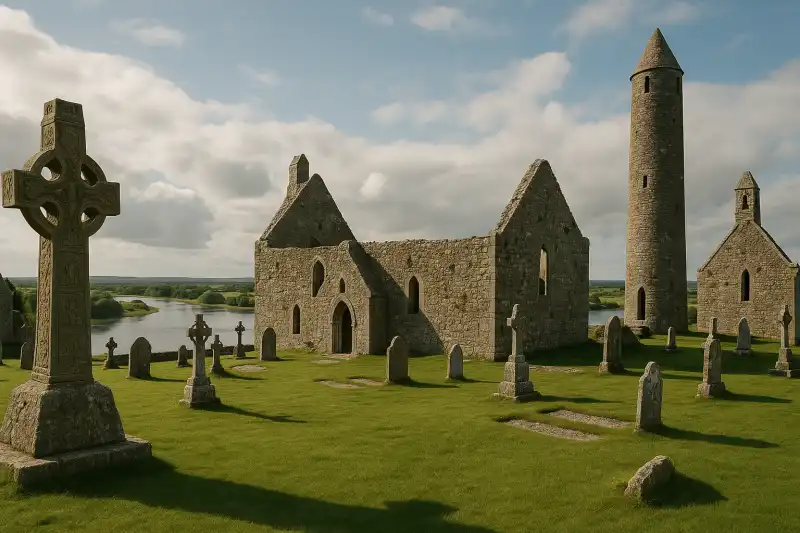
Clonmacnoise Travel Guide 2026: Monastic Ruins, High Crosses, and River Shannon Context
Early Medieval IrelandPlan a first visit to Clonmacnoise with practical timing, monastic-site context, and clear route adv...
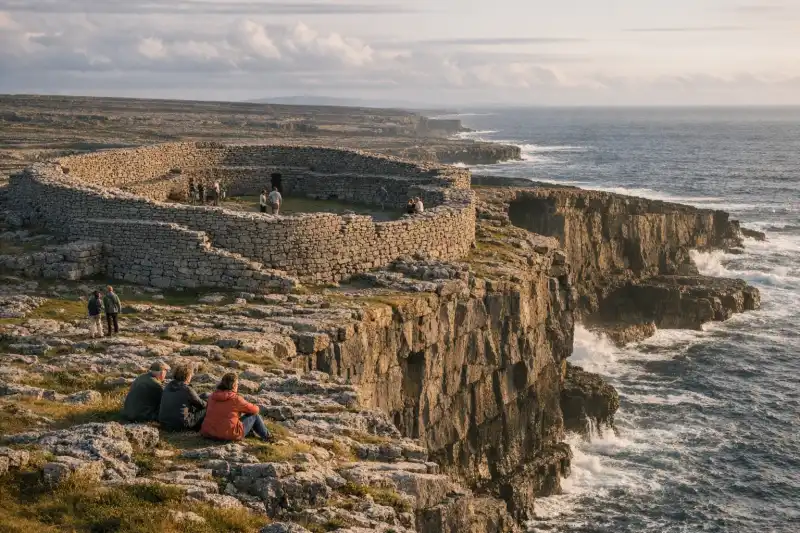
Aran Islands Stone Forts
Prehistoric and early medieval IrishExplore the dramatic prehistoric stone forts of Ireland’s Aran Islands, where Atlantic cliffs and an...