Quick Info
Curated Experiences
Euromos Temple of Zeus Tour from Milas
Caria Ancient Sites Regional Tour
Southwest Turkey Hellenistic Temples Tour
Quick Facts
- Location: Rural farmland near Milas, southwestern Caria
- Best for: Temple architecture enthusiasts, quiet archaeology
- When to visit: April-June, September-October
- Entry fee: Around 50 Turkish Lira
- Crowds: Virtually none - you may see no other visitors
- What to see: Temple of Zeus, sanctuary precinct, agriculture integrated with ruins
A Temple Lost in Time
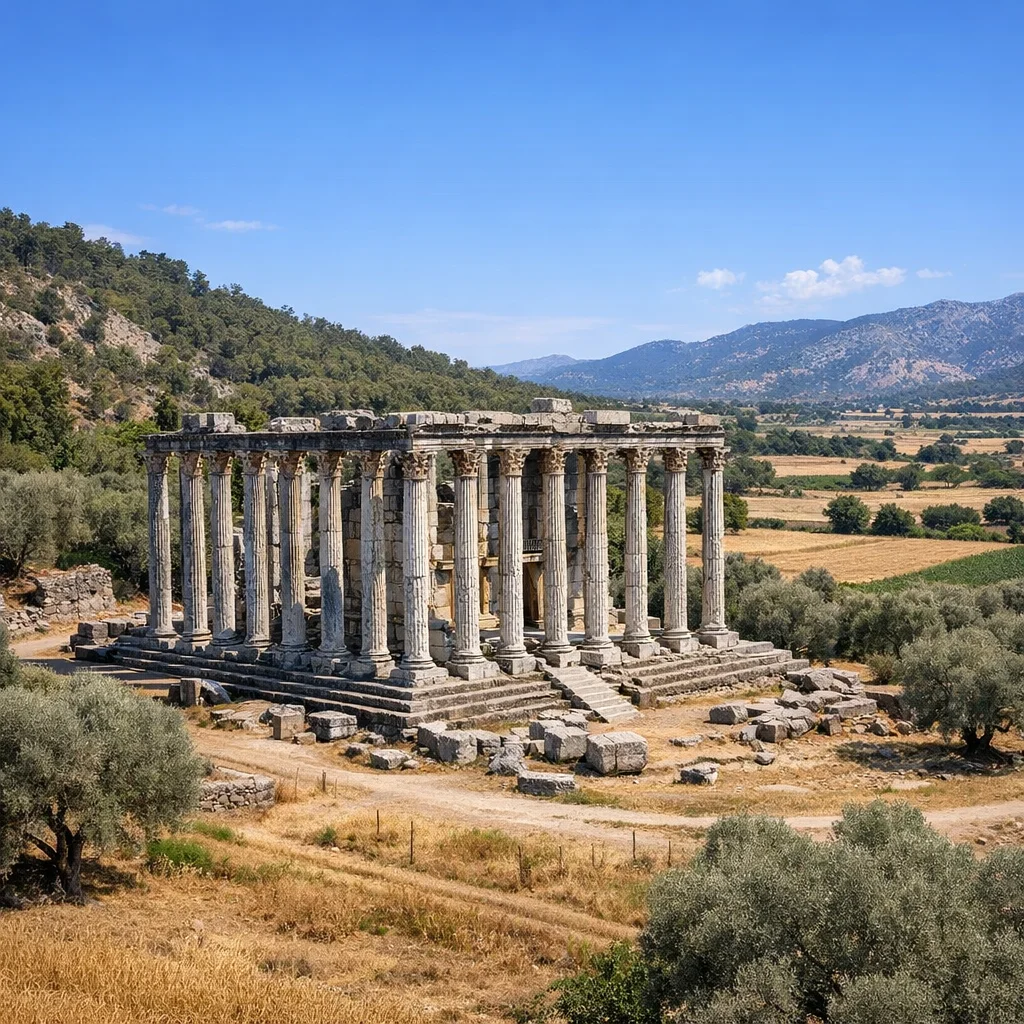
You drive through olive groves and cornfields near Milas, following increasingly vague directions toward what seems to be nowhere. Then, abruptly, a marble temple rises from the landscape: sixteen Corinthian columns supporting an entablature carved with such precision that you instinctively understand that ancients possessed mastery you hadn’t fully appreciated before.
This is Euromos, a Carian city that commands attention not for its size or fame, but for the singular beauty and preservation of its temple. Dedicated to Zeus, built in the Hellenistic period with later Roman additions, the temple at Euromos stands as one of the finest examples of Hellenistic temple architecture anywhere. That it survives at all, isolated in farmland, is something of a miracle—but also a sign that Euromos was never wealthy or important enough to be pillaged for building materials by later civilizations.
The Temple of Zeus
The temple is what you came to see, and it does not disappoint. Six columns on the short sides, eleven on the long sides, arranged with the perfect proportions that characterize Hellenistic architecture at its best. The capitals are Corinthian—elaborately carved acanthus leaves suggesting wealth and urban sophistication. The entablature features sculpted metopes (relief panels) that are partially preserved.
The cella (inner chamber) is open to view. Where was the statue of Zeus that once dominated this space? Probably removed in antiquity, when Christianity spread and pagan temples were systematically stripped of valuable bronze and marble sculptures. But you can stand where it stood, imagine the candlelit ceremonies, the offerings, the prayers of a Carian population who believed that this image held divine presence.
The temple dates to around the 2nd century BCE, the high point of Hellenistic culture and architecture. It was later re-dedicated to Zeus during the Roman period, when the Carians lost political independence but maintained religious autonomy over local sanctuaries. The temple shows this dual heritage: Hellenistic in basic design and proportions, Roman in some decorative elements and inscriptions.
The Sanctuary Precinct
The temple sat at the center of a larger sanctuary precinct—a sacred zone surrounded by walls and gates. You can trace these boundaries, identify gate foundations, and understand the organization of ritual space. Unlike urban temples that competed for space in crowded cities, Euromos’s sanctuary had room to expand, to develop multiple buildings, to create a landscape designed specifically for religious ceremony and pilgrimage.
The precinct included altars, votive monuments, treasuries for storing offerings, and probably structures for priestly administration. The presence of these elements suggests that Euromos was not merely a local village shrine, but a sanctuary that drew pilgrims from surrounding regions. People traveled to this location believing that Zeus was present in a particular way here—and the investment in marble and architecture was meant to honor that presence.
Caria and Its Significance
Euromos represents the broader culture of Caria, a region that maintained distinct identity even under Persian and Greek rule. The Carians developed their own alphabet (which influenced Greek letters), worshipped distinctive deities, and maintained cultural practices that outsiders often found unusual or barbaric.
Under the Hellenistic dynasties, and later under Rome, Caria became integrated into broader Mediterranean culture. Cities like Magnesia, Halicarnassus, and Stratonikeia grew wealthy and powerful. But Euromos remained relatively provincial—sufficient for a marble temple, but not for the grand urban development that transformed other Carian cities.
This provincial status is actually Euromos’s gift to us. Because it never grew into a major city, its landscape was never rebuilt and rebuilt again. The temple survives not hidden under medieval layers, but preserved in the agricultural landscape it’s always occupied.
The Farmer’s Sanctuary
What’s remarkable about Euromos today is not only what survives, but how it survives—integrated into the modern landscape much as it was in antiquity. Farmers work the fields around the temple. Olive trees grow within feet of the columns. The sanctuary is a working part of the countryside, not cordoned off as a museum exhibit.
This produces an experience unlike most archaeological sites. You’re not visiting a preserved zone; you’re seeing archaeology in situ, in the landscape that produced it. The temple served ancient farmers and merchants moving between Carian cities. It serves modern farmers as a landmark, a fixed point in a changing landscape.
Access and Practicalities
Euromos is reached from Milas, a town on the coastal highway. It’s about 20 kilometers inland—a 20-30 minute drive into agricultural country. The site is poorly signposted; detailed directions are advisable. A car is essentially required, though taxi drivers from Milas know the location.
The site itself is open air with minimal facilities. There is a small museum or guard post (staffing is irregular), but most visitors will find only the temple and surrounding fields.
Best time: April-June or September-October. Summers are hot; winters see occasional rain.
Duration: 1-2 hours to explore the temple and precinct thoroughly.
What to bring: Water, sun protection, comfortable walking shoes.
Photography: The temple photographs beautifully from multiple angles. The sky backdrop is usually clear, and the marble columns have good contrast. Late afternoon light is particularly flattering.
Connecting to Other Carian Sites
Euromos is best experienced as part of a broader exploration of Caria. Visit Stratonikeia for a larger Carian city with theater and more complex remains. Magnesia offers another temple of comparable importance. Together, these sites show the range of Carian civilization from village sanctuary to urban center.
The Solitude of Marble
Standing before the temple of Euromos, you experience something most tourists never access: the possibility of genuine encounter with ancient architecture without mediation. There is no guide narration, no reconstruction, no interpretation—only marble, craftsmanship, and your own effort to understand.
Euromos teaches that significant human achievement often occurs far from centers of power. A small agricultural community mobilized resources to create something of lasting beauty. They succeeded. And nearly two thousand years later, their temple stands, waiting for visitors attentive enough to find it.
Carian Religious Practice
The temple at Euromos reveals aspects of Carian religious practice and priorities. The investment in marble construction, the hiring of skilled architects, the scale of the project—all suggest that Zeus worship was central to the Carian identity. Zeus, king of the gods, was the supreme deity, and his temple commanded respect and resources.
Carian religious practice maintained distinctive characteristics even as the region came under external influence. The Carians developed their own alphabet, their own cults, their own religious practices. When Hellenistic culture spread after Alexander’s conquests, the Carians incorporated Greek religious forms while maintaining their own distinctiveness. The temple at Euromos, built in Hellenistic style, served Carian religious purposes, demonstrating how local cultures adapted to broader Mediterranean influences.
Religious festivals at the temple would have drawn pilgrims from surrounding regions. Annual ceremonies would have marked the seasonal calendar. The temple served as a focal point for community identity and religious devotion. For Carian farmers and merchants, the temple symbolized their connection to the divine and to each other.
The Persistence of Sacred Sites
What makes Euromos archaeologically significant is precisely what made it vulnerable—its rural, agricultural location. The temple was never surrounded by dense urban development. It remained embedded in the landscape where farming continued. Medieval and later inhabitants passed by or around the temple rather than building on it or pillaging it for building materials. The temple’s isolation preserved it.
This pattern—sacred sites surviving in rural locations while urban sites are rebuilt repeatedly—helps explain why Euromos preserves such complete remains. Unlike urban temples that were destroyed, rebuilt, or incorporated into later structures, Euromos stood essentially untouched, weathering but surviving, waiting for archaeologists to document and understand it.
The temple’s survival also reflects Carian identity and Islam’s treatment of pre-Islamic religious sites. The temple was abandoned as Christianity spread, but the site was not deliberately destroyed. The structure was left standing, a monument to earlier religious practices but not a direct challenge to Christian belief. This pattern of tolerance or indifference toward abandoned pagan temples helped preserve them.
Nearby Ancient Sites
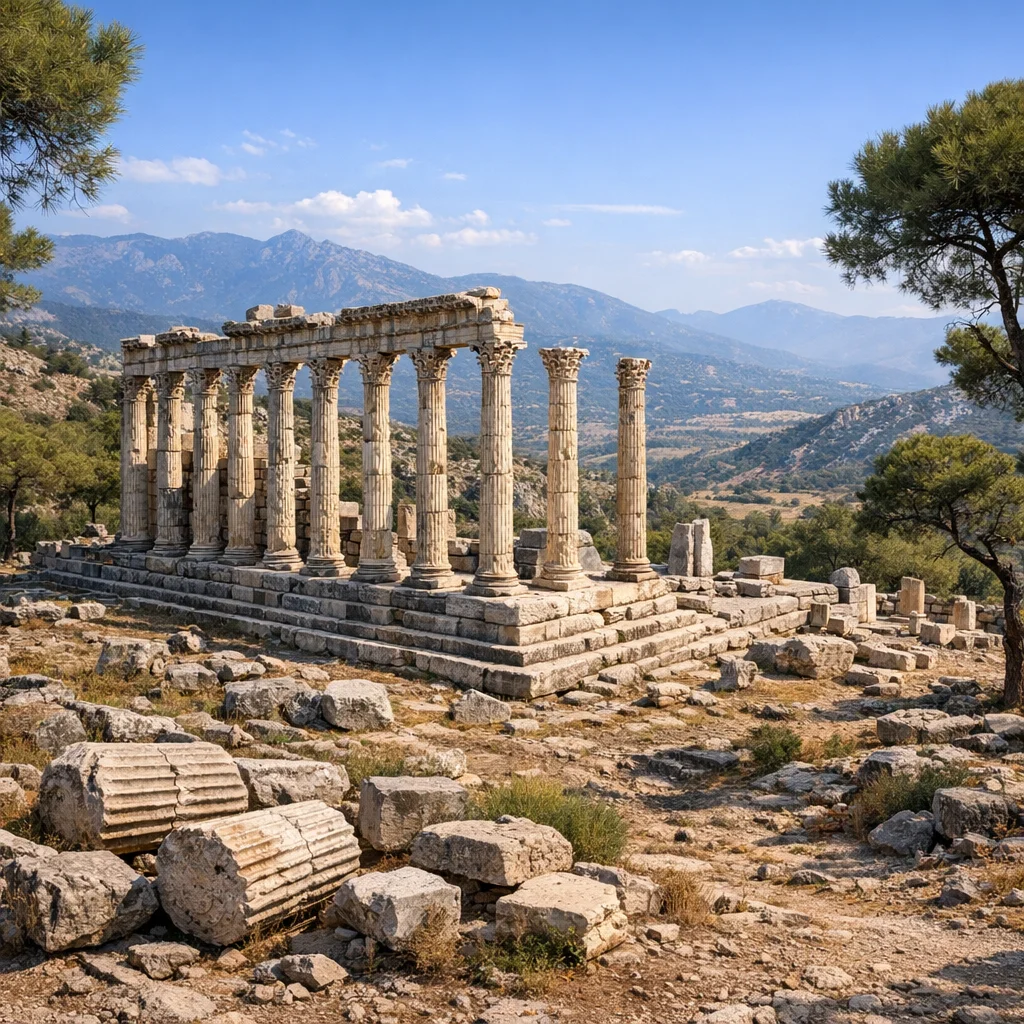
Magnesia Turkey Travel Guide: Mountain Sanctuary & Hellenistic Temple
Greek, Carian, HellenisticExplore Magnesia (Magnesia ad Maeandrum), a remote Carian city with a stunning Hellenistic temple to...
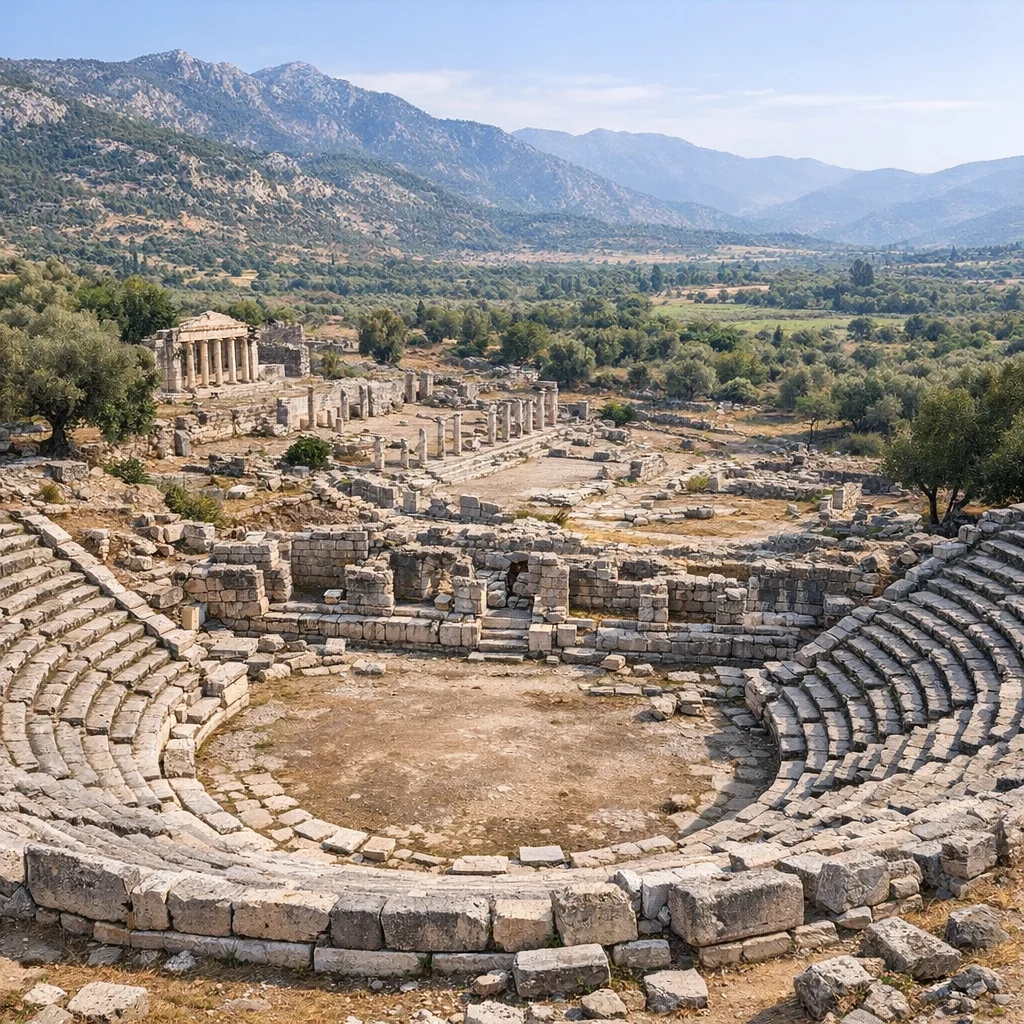
Stratonikeia Turkey Travel Guide: Carian City & Theater Ruins
Carian, Hellenistic, RomanExplore Stratonikeia, a prosperous Carian city with well-preserved theater, civic monuments, and a t...
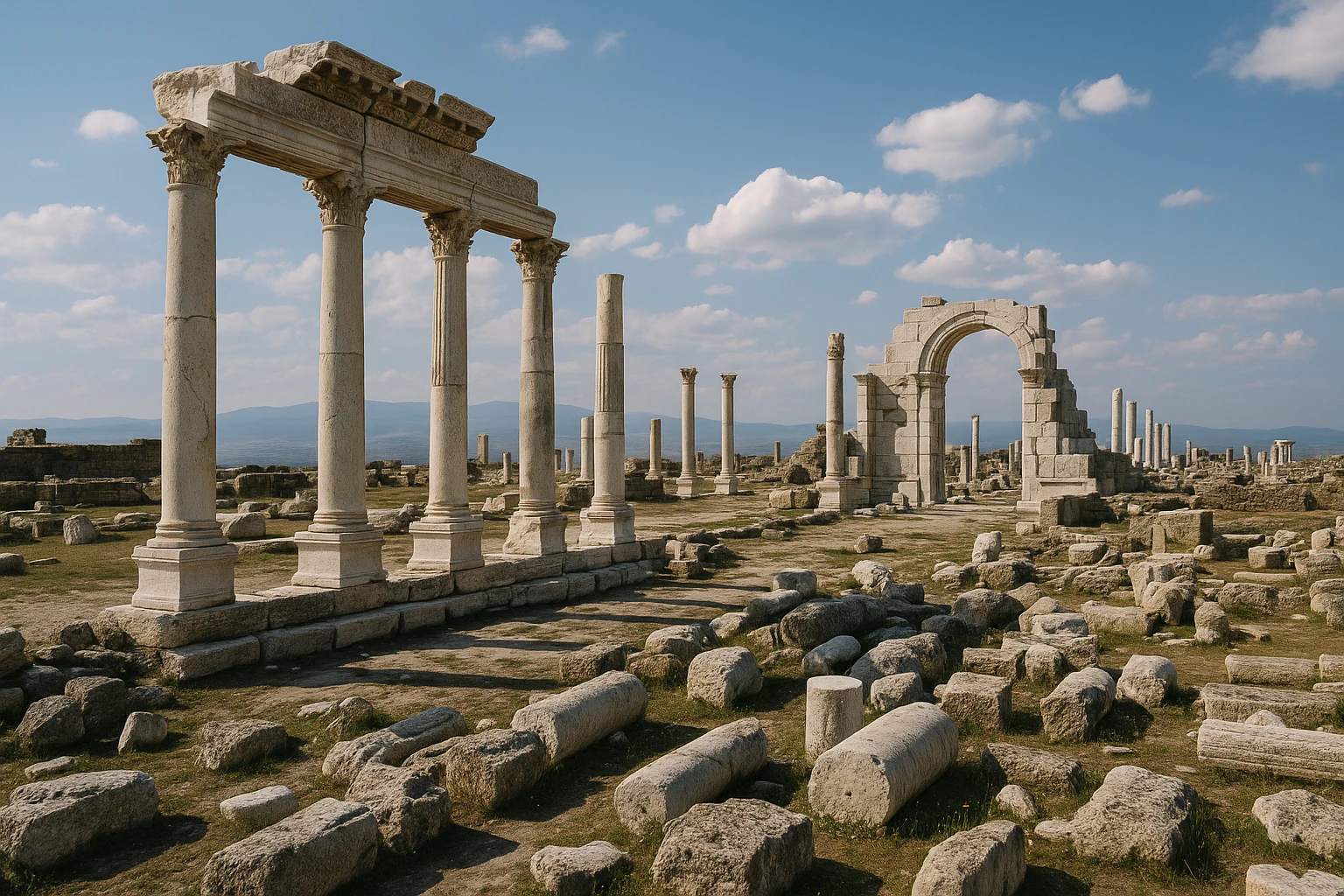
Laodikeia Turkey Guide 2026: Syrian Street & Ancient Churches
Hellenistic-Roman-Byzantine-Seljuk-OttomanPlan Laodikeia in Turkey: Roman avenues, churches, tickets, hours, and transport from Denizli or Pam...