Quick Info
Curated Experiences
Fenghuang Ancient Town Full-Day Walking Tour
Fenghuang Night Cruise on the Tuojiang River
Zhangjiajie and Fenghuang Multi-Day Tour from Changsha
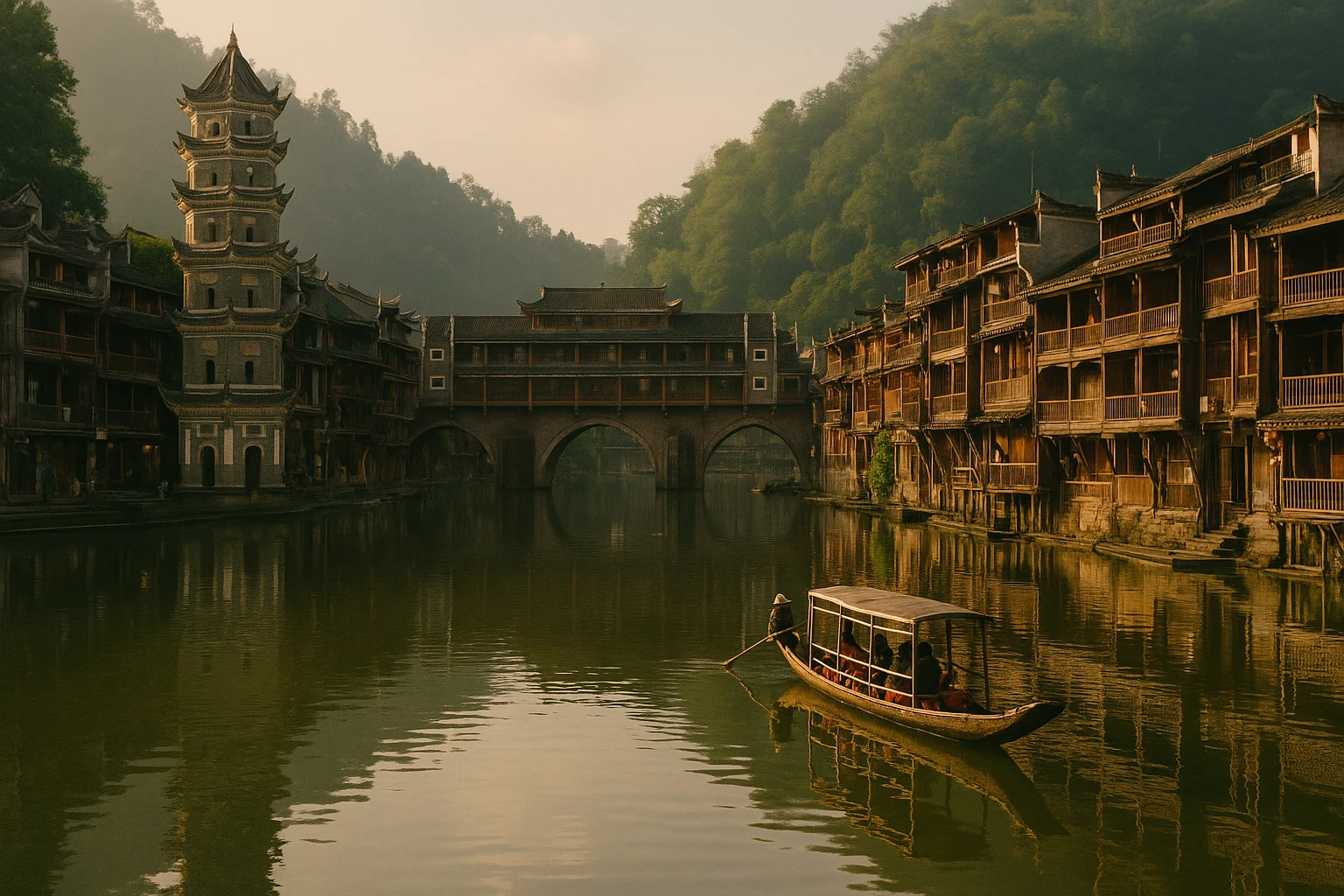
There is a photograph that exists in almost every travel article about Hunan Province: a row of dark timber houses balanced on stilts over jade-green water, lanterns glowing orange in the evening, their reflections stretching in broken lines across the Tuojiang River. That photograph is Fenghuang Ancient Town, and the real thing — standing on the Hong Bridge at dusk while the mist begins to roll off the surrounding Wuling Mountains — is more affecting than any image of it. Fenghuang, whose name translates to “Phoenix,” sits in the western reaches of Hunan Province in south-central China, cradled by karst hills and inhabited by a blend of Han Chinese, Miao, and Tujia communities whose combined cultural inheritance gives the town a texture unlike anywhere else on the continent. The old quarter’s streets are paved in dark cobblestone, the lanes barely wide enough for two people to pass, and the smell of oil-paper umbrellas, drying river fish, and charcoal braziers drifts through doorways that have been opening onto the same views for three centuries. Unlike many Chinese heritage towns that preserve facades while gutting interiors for commercial purposes, Fenghuang retains an authentic residential core: people still live in the stilted houses, cook over wood fires, and practice crafts their grandparents taught them. To walk through Fenghuang is to encounter a version of Chinese history that is intimate rather than monumental — a history of ordinary lives conducted with extraordinary care for their physical surroundings.
History
Ancient Borders and Fortified Beginnings
The site that would become Fenghuang has been inhabited since prehistoric times, but its identity as a defended border settlement took shape during the early imperial era. The region lay on the southwestern margins of Chinese imperial control, bordering the territories of Miao and other non-Han peoples who maintained their own political and cultural systems for centuries. Chinese states repeatedly attempted to incorporate or pacify these frontier zones, and Fenghuang’s geography — a river valley flanked by high ridges — made it a natural chokepoint for both trade and military movement.
The formal establishment of a garrisoned town dates to the early Qing dynasty. In 1704, the Qing court constructed a stone city wall enclosing the settlement, and Fenghuang became an administrative and military hub for the management of the borderlands. The wall, built from locally quarried blueish-grey sandstone, ran for over 700 meters along the northern edge of the town and incorporated four gates oriented to the cardinal directions. Soldiers, merchants, and officials from across the empire passed through those gates, and their various architectural sensibilities gradually fused with indigenous Miao building techniques to produce the distinctive hybrid vernacular that defines Fenghuang today.
Ming Foundations and Qing Flourishing
Much of what visitors see in Fenghuang’s historic core was constructed or substantially rebuilt during the Ming and Qing dynasties, spanning roughly 1368 to 1912. The diaojiaolou — the cantilevered timber stilt houses that have become the town’s visual signature — evolved from earlier Miao building techniques adapted to the constraints of the riverbank, where flat ground was scarce and seasonal floods were a recurring threat. By projecting rooms over the water on wooden piles, builders maximized living space while placing the structure above ordinary flood levels. The technique required sophisticated joinery, and the best examples in Fenghuang display compound cantilevers, bracketed eaves, and interlocked timber frames assembled without iron nails.
During the Qing period, the town prospered as a hub for trade in medicinal herbs, dyes, raw silk, and silver ornaments produced by Miao craftspeople. Merchant families built grander courtyard compounds in the interior lanes, and civic institutions — academies, temples, guild halls — added public architecture to the residential fabric. The Tianhou Temple, dedicated to the sea goddess Mazu and constructed by Fujian merchants who had settled in the town, stands as evidence of how far the commercial networks radiating out of Fenghuang extended.
Shen Congwen and Modern Recognition
Fenghuang’s international reputation owes much to one of its native sons. Shen Congwen (1902–1988) was born in the town, grew up swimming in the Tuojiang and listening to Miao folk songs, and went on to become one of the most celebrated prose writers in modern Chinese literature. His novel Border Town (1934) drew on the landscapes, people, and rhythms of Fenghuang and the surrounding region, creating a lyrical portrait of a way of life that modernity was already beginning to dissolve. Shen’s former residence is now one of the town’s most visited heritage buildings, and he is buried on a hillside outside the old walls, his grave marked by a rough stone bearing a line from his own writing. The town was recognized as a National Historical and Cultural Town by the Chinese government in 2001, which brought both protective status and the infrastructure of heritage tourism that has shaped its present character.
Key Features
The Diaojiaolou Riverside Row
The most iconic element of Fenghuang’s built environment is the unbroken chain of diaojiaolou that lines the south bank of the Tuojiang River through the heart of the old town. These stilt houses — some rising three or four stories, all clad in weathered timber darkened by decades of coal smoke and river damp — lean slightly toward the water as though drawn by gravity toward their own reflections. The ground floor of each structure rests on stone foundations set back from the bank, while the upper floors project outward on a forest of wooden posts driven into the riverbed or the stone embankment. Balconies wrap the upper stories, hung with drying herbs, chili strings, and laundry that functions as a kind of accidental seasonal decoration. Walking the riverbank at any hour, you find yourself looking up into lit interiors where families eat dinner, at wooden shutters thrown open to catch the evening air, at old women watching the water from chairs that have occupied the same balcony corner for forty years. The buildings are not a museum display but a functioning neighborhood, and that aliveness is what distinguishes them from the reconstructed heritage streetscapes common elsewhere in China.
The Ancient City Wall and Gates
The Qing-era city wall that once enclosed Fenghuang’s northern perimeter survives in substantial sections and constitutes one of the most tactile heritage experiences the town offers. The wall is constructed from large, precisely fitted blocks of local sandstone that have taken on a greenish patina from moss and weathering. Walking its top, you look south over the old town’s roofscape — a landscape of grey tile, chimney smoke, and the occasional burst of persimmon tree orange — and north toward the river and the mountains beyond. The North Gate tower, a two-story timber pavilion set atop the stone base, is among the most photographed structures in Fenghuang after the riverside row, particularly in early morning when mist fills the river valley and the gate’s reflection shimmers in the Tuojiang below. The East Gate and portions of the connecting wall are also accessible and give a strong sense of the town’s original defensive logic.
Shen Congwen’s Former Residence and the Literary Quarter
The house where Shen Congwen was born and raised occupies a quiet lane a short walk from the river. It is a two-courtyard compound built in the local Han-Miao vernacular style, with carved wooden screens, stone paving worn smooth by a century of foot traffic, and rooms furnished to suggest the period of Shen’s childhood in the early twentieth century. The rooms display early editions of his works, photographs, letters, and manuscripts, and the courtyard gardens are planted with the flowering trees he described repeatedly in his fiction. Adjacent lanes contain the former residences of other Fenghuang-born figures, including the Republican-era general Xiong Xiling, and the broader literary and official heritage of the town is well interpreted through a series of small museum spaces that can be toured in a single afternoon.
Miao Cultural Crafts and Silver Work
Fenghuang’s Miao heritage is visible not just in architecture but in a living tradition of craft production. The town has long been a center for Miao silver jewelry — elaborate headdresses, pectoral ornaments, bracelets, and earrings fashioned from silver by techniques passed down through artisan lineages. Workshops in the old town are open to visitors, and watching a silversmith chase patterns into sheet metal with a small hammer is one of the more genuinely artisanal experiences available in China’s heritage tourism landscape. Miao embroidery, produced on traditional looms with geometric patterns that encode cosmological and narrative meaning, is sold alongside the silver in the market lanes, and the quality varies enormously: the best pieces are made by elderly women using traditional techniques; the worst are factory replicas. Taking time to find the genuine article is worthwhile.
The Hong Bridge and River Life
The Hong Bridge — a covered timber bridge that spans the Tuojiang just upstream from the main riverside row — is the town’s great social gathering space. Its interior arcade is lined with small vendors selling tea, local snacks, and trinkets, and residents use it as a shaded walkway throughout the day. In the evening it becomes a vantage point for watching the river boats and the illuminated facades of the stilt houses, which are lit from below with warm artificial light that turns the entire riverbank into something resembling a stage set. Cormorant fishermen sometimes work the river in the early morning, poling flat wooden boats with trained birds perched on the gunwales — a practice that is partly tradition and partly performance for early-rising tourists, but no less visually striking for that.
Getting There
Fenghuang sits in a mountainous region without its own rail station, so reaching it requires a connection through a larger hub. The most popular approach is via Zhangjiajie, which is served by direct flights from Beijing, Shanghai, Guangzhou, and Chengdu. From Zhangjiajie’s Hehua Airport or rail station, long-distance buses run to Fenghuang in approximately three to four hours, with fares around ¥60–¥80. The road winds through genuinely dramatic scenery and is itself part of the experience.
Alternatively, take a high-speed train to Jishou on the Hunan–Chongqing line, which is connected to both Changsha and Chongqing. From Jishou’s bus station, minibuses and taxis to Fenghuang depart frequently and cover the 50-kilometer distance in around 50 minutes; the fare is approximately ¥20–¥30 by bus or ¥80–¥100 by taxi. Overnight sleeper trains from Changsha to Jishou are a comfortable budget option for those traveling from Hunan’s capital.
From Changsha, direct long-distance buses to Fenghuang operate from the South Bus Terminal (南站), covering roughly 430 kilometers in about five to six hours depending on traffic, with fares around ¥100–¥130. Once in Fenghuang, the old town’s core is entirely walkable — no vehicles are permitted in the historic lanes.
When to Visit
Spring (April through early June) is widely regarded as the best season for Fenghuang. Temperatures are mild (15–25°C), the surrounding hills are green, azaleas bloom on the hillsides, and the river runs clear and relatively high. Crowds are present but manageable, and the light during this period — soft, slightly diffused, with frequent morning mist — is ideal for photography of the riverside architecture.
Autumn (September through November) offers the second-best conditions: comfortable temperatures, lower humidity than summer, and the added visual interest of turning foliage on the slopes above town. October’s Golden Week national holiday (October 1–7) brings very heavy domestic tourist traffic and should be avoided if solitude is a priority.
Summer (July and August) is hot and humid, with temperatures regularly exceeding 35°C and significant rainfall that can temporarily raise the Tuojiang to levels that close the riverbank walkways. It is also the peak domestic tourism season, and the town’s narrow lanes can become genuinely congested. Those who enjoy atmospheric conditions may find the monsoon-season mist and dramatic cloud formations compensate for the heat.
Winter (December through February) is quiet, cold (occasionally below freezing), and occasionally foggy in ways that make the river landscape feel melancholy and ancient. Many riverside businesses reduce hours or close entirely, but accommodation prices drop significantly and the town’s residential authenticity is most legible when tourists are few.
| Quick Facts | |
|---|---|
| Location | Fenghuang County, western Hunan Province, China |
| Coordinates | 27.95°N, 109.60°E |
| Established | Circa 1704 (Qing dynasty fortified settlement) |
| Primary Dynasties | Ming (1368–1644), Qing (1644–1912) |
| Ethnic Heritage | Han Chinese, Miao, Tujia |
| Key River | Tuojiang (Tuo River) |
| Nearest Major Hub | Zhangjiajie (~3.5 hrs) or Jishou (~50 min) |
| Entrance Fee | No combined ticket; individual sites ¥10–¥50 |
| Best Visited | April–June, September–November |
| Notable Native | Shen Congwen, novelist (1902–1988) |
| Heritage Status | National Historical and Cultural Town (2001) |
| UNESCO Status | Nominated; not yet inscribed |
Frequently Asked Questions
Is Fenghuang Ancient Town worth visiting?
Absolutely. Fenghuang is one of China's best-preserved ancient towns, offering a rare glimpse of Ming and Qing dynasty vernacular architecture in a living community setting. The stilted riverside houses, old city walls, and stone-paved lanes make it visually distinctive from any other heritage site in China.
How do I get to Fenghuang Ancient Town?
The most common route is to fly or take a high-speed train to Zhangjiajie, then transfer by bus (roughly 3.5 hours). Alternatively, take a high-speed train to Jishou, from which Fenghuang is about 50 minutes by bus. Direct overnight trains from Changsha to Jishou are also popular.
Is there an entrance fee for Fenghuang Ancient Town?
As of recent years, Fenghuang no longer charges a combined entrance ticket for the entire town. Most individual heritage buildings and museums inside the old town charge their own small fees (typically ¥10–¥50 per site). The riverside area itself is free to walk and photograph.
What is Fenghuang Ancient Town famous for?
Fenghuang is famous for its rows of diaojiaolou — wooden stilt houses cantilevered over the Tuojiang River — as well as its intact Ming-era city walls, traditional Miao and Tujia minority culture, and its connection to celebrated Chinese author Shen Congwen, who was born here in 1902.
How many days should I spend in Fenghuang?
Two full days is the ideal minimum: one day to explore the core historic district, visit the key museums and temples, and take an evening boat ride; a second day to walk the outer neighborhoods, climb the old walls, and venture to nearby Miao villages. One day is doable but rushed.
What is the best time of year to visit Fenghuang Ancient Town?
April through June and September through November offer the most comfortable weather and the most dramatic light on the river. Summer (July–August) brings heavy crowds and humid heat. Winter is quiet and sometimes misty, which suits photographers but means some riverside businesses close.
What ethnic minority culture is present in Fenghuang?
Fenghuang sits in a traditionally Miao and Tujia region. Many local residents still wear elements of traditional dress, and the town's architecture, festival calendar, silver jewelry craft, and embroidery traditions all bear strong Miao cultural influence alongside Han Chinese elements.
Nearby Ancient Sites
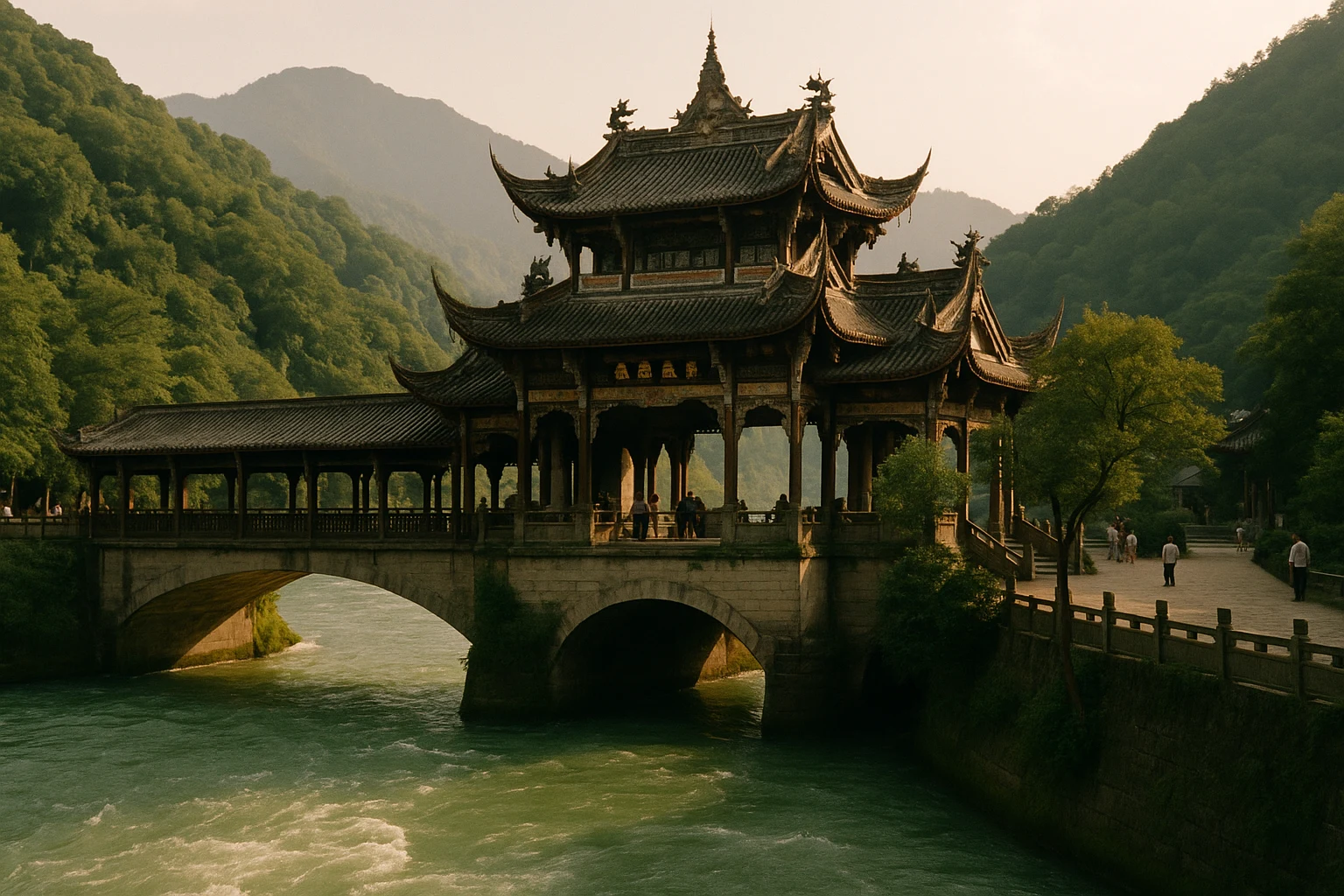
Dujiangyan Irrigation System
Explore Dujiangyan, the world's oldest functioning irrigation system, built in 256 BCE by engineer L...
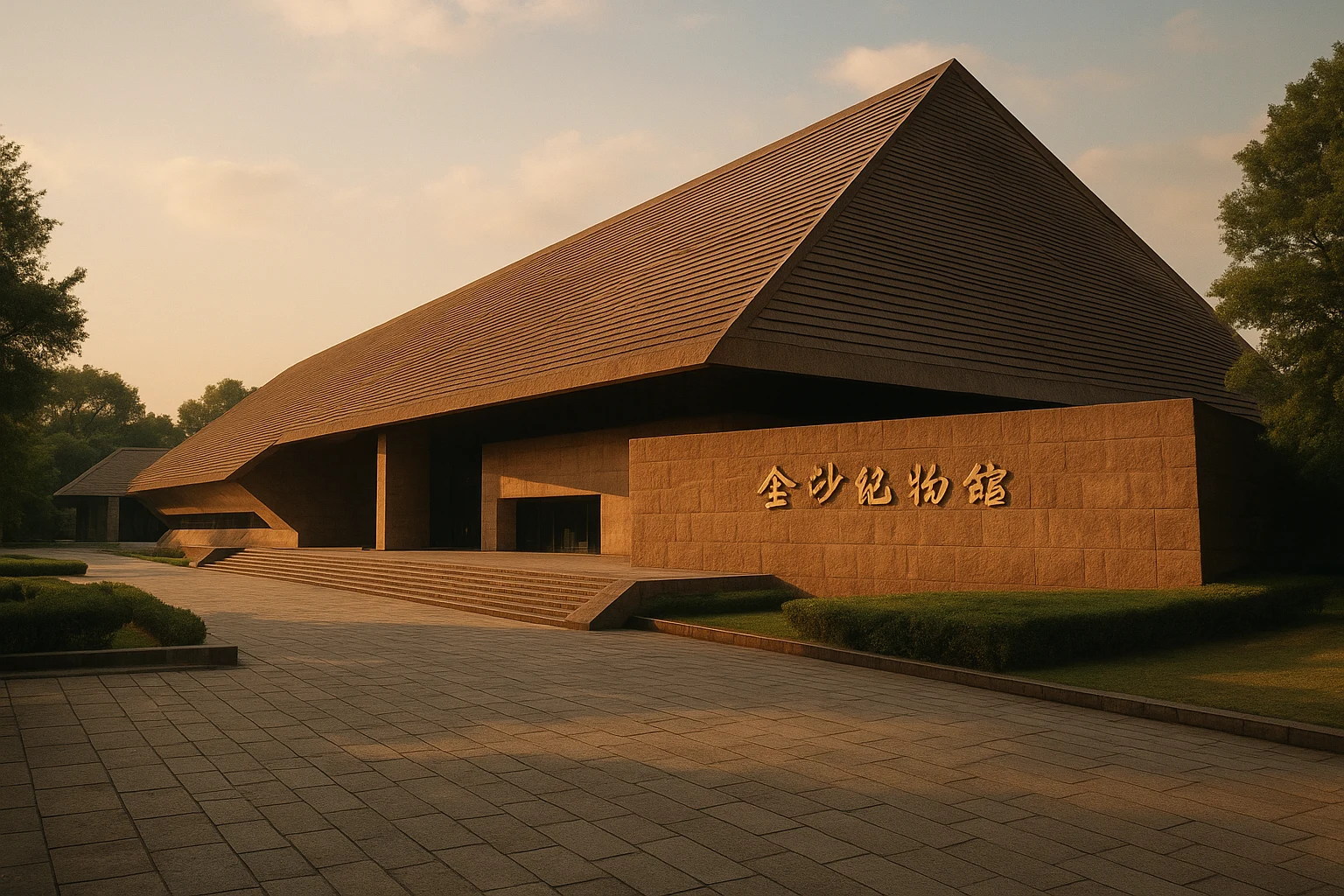
Jinsha Site Museum
Discover the Jinsha Site Museum in Chengdu, home to Bronze Age Shu Kingdom artifacts including the i...
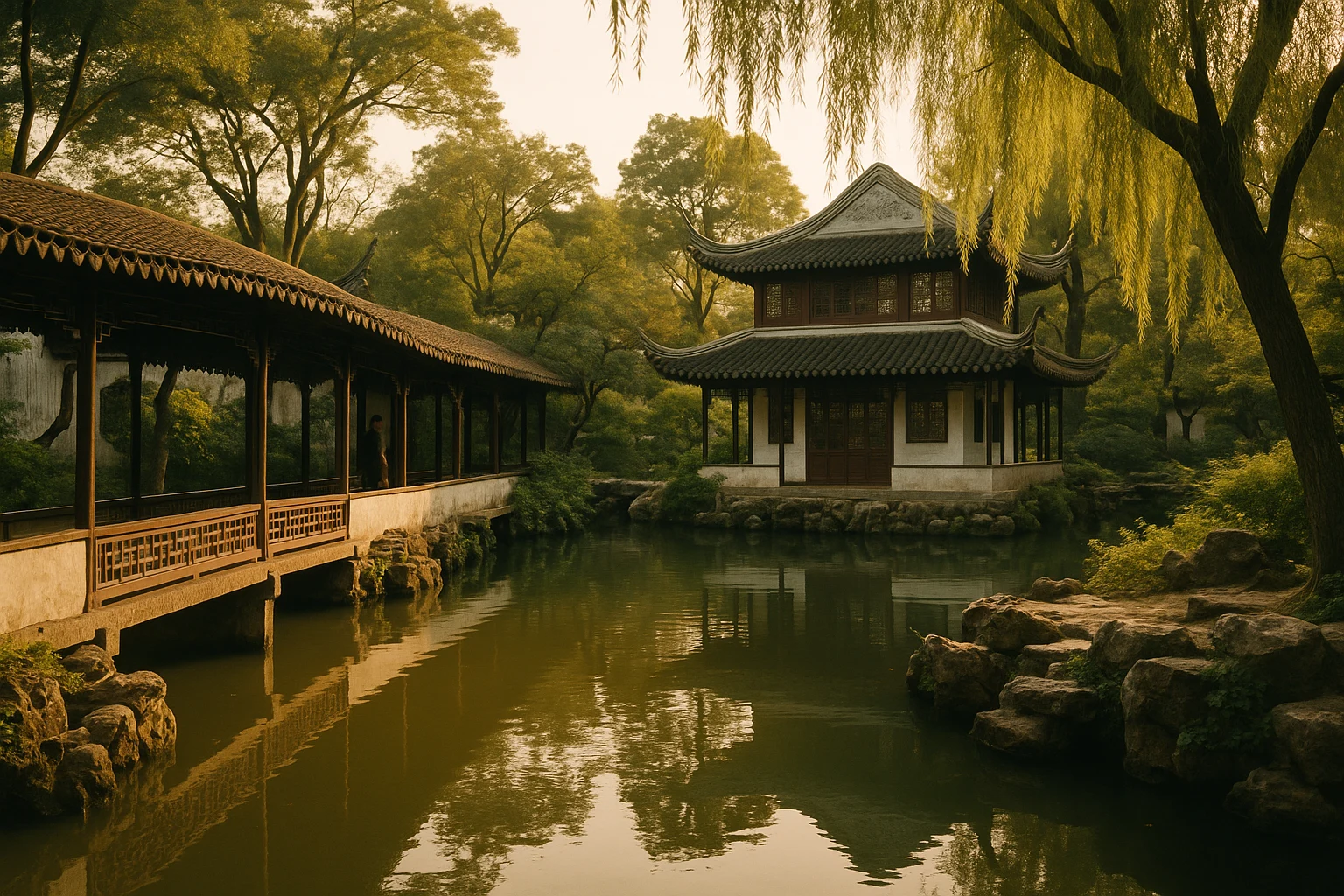
Humble Administrator's Garden
Chinese ImperialSuzhou's largest classical garden, a UNESCO World Heritage masterpiece of water, stone, and pavilion...
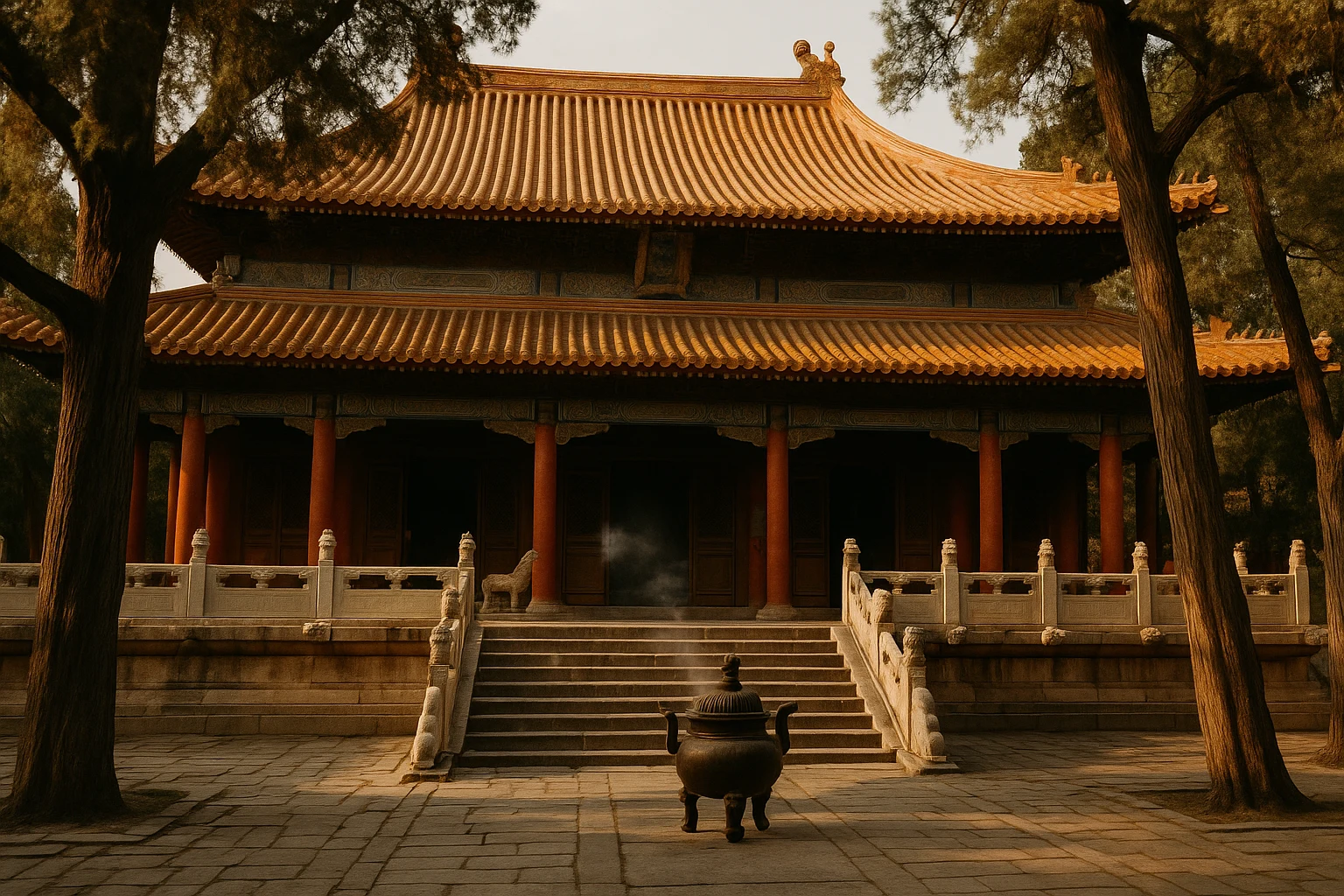
Confucius Temple (Qufu)
The ancient Temple of Confucius in Qufu, Shandong, is China's largest Confucian temple complex, a UN...