Quick Info
At a glance
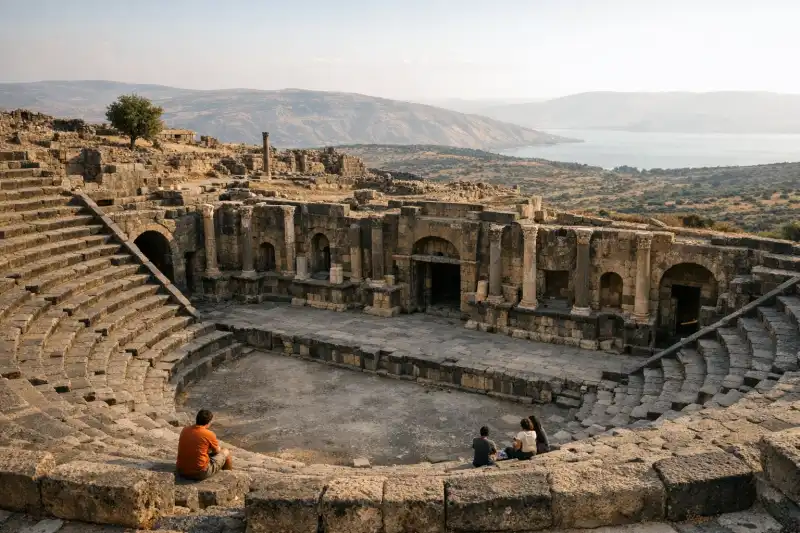
Gadara Theater (Umm Qais) in Jordan sits on one of the most dramatic archaeological ridges in the Levant, where ancient stone meets open sky and the land drops away toward a broad sweep of lakes, valleys, and distant hills. Part of the larger ruins of ancient Gadara, the theater is not an isolated monument but a stage set within a whole classical city—one that once belonged to the Decapolis, the league of prosperous Greco-Roman urban centers spread across the eastern Mediterranean frontier. What makes this theater instantly memorable is not just its age or its elegant semicircle, but the material from which it rises: dark volcanic basalt, giving the building a heavier, more austere beauty than the pale limestone theaters many travelers expect elsewhere in the Roman world.
A visit here feels different from touring more crowded ancient sites. The ruins at Umm Qais have an expansive, wind-brushed character, and the theater participates in that atmosphere. It is easy to imagine performances once unfolding before a local audience of merchants, officials, farmers, and visitors, all gathered at the edge of an empire that linked Arabia, Syria, and the Mediterranean. Today, the setting adds another layer of drama. From the site, travelers can look across the Jordan Valley toward the Sea of Galilee and the Golan heights, making Gadara Theater not only an archaeological landmark but also one of northern Jordan’s finest scenic viewpoints. For visitors interested in Roman urbanism, regional history, and a quieter alternative to Jordan’s most famous sites, Umm Qais offers a rewarding and deeply atmospheric experience.
History
Hellenistic foundations of Gadara
The history of Gadara begins long before the surviving theater took its present form. The city emerged in the Hellenistic period, probably in the 3rd century BCE, when the political and cultural influence of the successors of Alexander the Great reshaped cities across the Near East. Gadara’s hilltop position made it strategically useful and commercially attractive. It controlled routes connecting inland Syria and northern Jordan with the Jordan Valley, and it grew into a place where Greek urban ideas mingled with long-established local traditions.
In this period, Gadara became known as a cultivated city. Ancient authors associated it with intellectual life, philosophy, and literature, suggesting that it was more than a provincial settlement. Although the visible theater largely reflects later Roman development, the urban framework that made such a building possible was laid in these earlier centuries, when Gadara developed civic institutions, public spaces, and a strong local identity.
Roman conquest and Decapolis prosperity
In 63 BCE, the Roman general Pompey brought much of the region under Roman influence, and Gadara became one of the cities of the Decapolis. This was a turning point. Under Roman rule, many cities in the region expanded and monumentalized their public spaces. Streets were colonnaded, temples and baths were built or enlarged, water systems improved, and theaters became essential markers of civic prestige.
The theater at Gadara likely reached its mature form during this era of Roman prosperity, probably in the 1st or 2nd century CE. As in other Roman cities, the theater was not merely a venue for entertainment. It was a public institution that reflected the city’s wealth, values, and political status. Performances, public ceremonies, and civic gatherings all reinforced the idea of Gadara as a fully urbanized center integrated into the wider Roman world.
The use of black basalt is especially significant. Northern Jordan and adjacent areas are rich in volcanic stone, and builders here employed local materials in ways that gave the city a distinctive appearance. While the theater follows familiar Roman design principles, its dark stone gives it a regional identity that ties it strongly to the landscape around it.
Byzantine continuity and changing urban life
By the Byzantine period, beginning in the 4th century CE, Gadara continued as an important city, though urban life evolved as Christianity spread and civic priorities changed. Churches were built, and some earlier Roman buildings were adapted, repurposed, or gradually neglected. The theater may have continued to be used in some capacity, though like many theaters across the eastern Mediterranean, its role likely shifted over time as tastes and administrative structures changed.
The city itself remained inhabited and connected to regional networks. This continuity is important, because Umm Qais was not a place that vanished suddenly at the end of the Roman age. Instead, it transformed gradually. Layers of architecture and occupation show how public monuments could coexist with changing religious, political, and social landscapes.
Earthquakes, decline, and rediscovery
Like many ancient cities in the Levant, Gadara suffered from earthquakes, especially the major seismic events that struck the region in late antiquity and the early medieval era. Such shocks damaged monumental structures and contributed to urban contraction. Over time, parts of the city fell into ruin, while later settlement reused stones from older buildings.
The modern name Umm Qais belongs to the later village that occupied the site. In the Ottoman period and afterward, houses built of reused basalt blocks stood among the ancient remains. This created a layered cultural landscape in which the ancient and the relatively recent existed side by side. Archaeological work in the 19th and 20th centuries brought renewed scholarly attention to Gadara, identifying its theater, streets, terraces, tombs, and other public buildings.
Today, conservation and archaeological research continue to clarify the city’s development. The theater is one of the most visible and evocative survivals, helping modern visitors understand how a frontier city of the Roman East expressed civic identity through architecture, performance, and public gathering.
Key Features
Gadara Theater’s most striking feature is its construction in dark basalt. This immediately sets it apart from many classical theaters in Jordan and the wider Roman world, where lighter stone often dominates. The basalt gives the seating tiers and structural elements a dense, sculptural quality, especially in the early morning or late afternoon when sunlight catches the edges of the worn steps. The surface of the stone, shaped by centuries of weathering, has a texture that feels at once severe and refined. Rather than gleaming, it absorbs light, giving the theater a sober grandeur.
The cavea, or seating area, is arranged in the expected semicircular form, designed to focus attention on the stage below. Even in partial ruin, the geometry remains legible. Visitors can climb sections of the seating and appreciate the way Roman architects shaped public space to create shared lines of sight and sound. The surviving form allows you to imagine the social choreography of an ancient performance day: citizens taking their places according to rank, voices carrying forward, and the city itself gathering in one architectural embrace.
The stage area and architectural fragments around it suggest a once more elaborate scaenae frons, the decorative backdrop that framed performances. Though much of the superstructure has vanished, enough remains to show that the theater was embedded in a sophisticated urban ensemble. It was not simply an entertainment venue dropped into open countryside. It belonged to a complete cityscape of paved streets, monumental gateways, shops, baths, and religious buildings. As you move between the theater and nearby ruins, the interconnection of these spaces becomes clear.
Another defining feature is the setting. Umm Qais occupies a ridge with commanding views over one of the most storied landscapes in the region. From around the theater and other terraces nearby, visitors can look toward the Jordan Valley and the Sea of Galilee. On clear days, the panorama extends across multiple modern borders, reminding travelers that ancient Gadara stood at a crossroads of worlds. This elevated position likely enhanced the city’s prestige in antiquity, and it certainly heightens the emotional impact of a visit now.
The broader archaeological site adds context that enriches the theater itself. Roman streets paved in stone, remains of columns, Byzantine structures, and the site museum together help visitors understand Gadara as a living city rather than a single isolated ruin. The museum, housed in part within a historic Ottoman-era residence, also underscores the layered nature of Umm Qais. Here, archaeology is not only about classical antiquity but about long continuity of habitation and reuse.
One of the pleasures of visiting Gadara Theater is the relative calm of the site compared with Jordan’s busiest destinations. This allows time to notice details: the curve of seating worn smooth by countless feet, the joinery of heavy basalt blocks, the contrast between formal architecture and open horizon. For photographers, the site offers rich visual material. The theater’s dark stone contrasts beautifully with dry grass, blue sky, and shifting seasonal light. For history-minded travelers, it demonstrates how Roman architectural models could be adapted to local materials and local topography without losing their essential ceremonial power.
In practical terms, the monument is also approachable. The site is large enough to feel significant but compact enough that the theater can be appreciated without an exhausting trek. Combined with surrounding ruins, it offers a strong half-day visit for those interested in Roman Jordan outside the more frequently visited Jerash. What lingers afterward is less a sense of having checked off a monument than of having encountered a city edge—an ancient place where architecture, landscape, and empire met.
Getting There
Gadara Theater is located within the archaeological site of Umm Qais in northern Jordan, roughly 25 km northwest of Irbid and about 110 to 120 km from Amman depending on your route. The easiest way to visit is by private car or taxi. From Amman, the drive usually takes around 2 to 2.5 hours via major highways through Irbid. A private taxi hired for the day from Amman may cost roughly 70 to 110 JOD depending on negotiation, waiting time, and whether you combine Umm Qais with Jerash or Ajloun Castle.
If you are based in Irbid, travel is simpler and cheaper. A taxi from Irbid to Umm Qais commonly costs around 15 to 25 JOD one way, though prices vary by season and time of day. Some travelers use local buses or service taxis from Irbid toward the Bani Kinanah area, then continue by taxi. This is the lowest-cost option, but schedules can be irregular and may add significant travel time. Expect public transport costs to be only a few dinars, plus the final taxi leg.
Rental cars are a strong option in Jordan, especially for independent travelers. Roads to Umm Qais are generally manageable, and parking is available near the site. Guided tours from Amman are also popular and save logistical effort, especially if you want historical interpretation included. Whichever method you choose, carry cash for transport and entry-related expenses, and allow extra time if relying on public transit, as return options can be limited later in the afternoon.
When to Visit
The best times to visit Gadara Theater are spring and autumn, when northern Jordan is at its most comfortable. From March to May, temperatures are usually mild, the surrounding hills can be green, and visibility across the valley is often excellent after winter rains. This is one of the most photogenic periods, with softer light and a landscape that feels more alive than in the peak of summer. September through November is similarly pleasant, with warm days, cooler mornings, and fewer weather extremes.
Summer, especially June through August, is still possible, but midday heat can make exposed walking tiring. The theater and surrounding ruins offer limited shade, so early morning or late afternoon visits are far better than arriving at noon. Bring water, a hat, sunscreen, and sturdy shoes, since the basalt surfaces can absorb heat and ancient pathways are uneven.
Winter has its own appeal. The site can feel especially atmospheric under shifting clouds and cooler air, and crowds are often lighter. However, temperatures in this part of Jordan can be surprisingly chilly, particularly because of the elevation and wind exposure. Rain can make surfaces slick, and fog occasionally reduces the sweeping views that are one of Umm Qais’s greatest pleasures.
If possible, plan to arrive either soon after opening or in the final hours before sunset. Morning offers quieter exploration and crisp visibility, while late afternoon brings beautiful low-angle light that deepens the color of the basalt and makes the theater particularly dramatic. For many travelers, that golden-hour combination of ruins and horizon becomes the highlight of the visit.
| Quick Facts | Details |
|---|---|
| Site Name | Gadara Theater (Umm Qais) |
| Location | Umm Qais, Irbid Governorate, Jordan |
| Ancient City | Gadara |
| Cultural Context | Hellenistic, Roman, Byzantine, Early Islamic |
| Best Known For | Black-basalt Roman theater and panoramic valley views |
| Approximate Main Period | 1st–2nd century CE for major Roman development |
| Material | Local basalt stone |
| Nearest Major City | Irbid |
| Typical Visit Length | 2–4 hours |
| Best Seasons | Spring and autumn |
| Access Style | Best by car, taxi, or guided day tour |
| Combine With | Jerash, Ajloun Castle, northern Jordan scenic routes |
Gadara Theater rewards travelers who appreciate sites where history is inseparable from place. It is architecturally impressive, but its power lies equally in context: a Roman theater in dark volcanic stone, set inside an ancient Decapolis city, looking out over a landscape that has linked empires, religions, and trade routes for millennia. At Umm Qais, the monument does not stand alone. It speaks with the streets, terraces, and ruins around it, and with the ridge that carries them all. For visitors exploring Jordan beyond the usual postcard stops, this is one of the country’s most memorable ancient destinations.
Guided tours: worth it?
A guide can be genuinely useful at Gadara Theater (Umm Qais), especially if you want help with transport, timing, tickets, or understanding a large site without losing half the day to logistics.
Best for
- Travelers who want transport, timing, or entry logistics handled
- Short visits where a planned route saves time
When to go self-guided
Go independently if you already have transport and tickets sorted, enjoy moving at your own pace, and are comfortable checking the latest official rules before you arrive.
What I’d avoid
Skip paid tours that bundle unrelated stops you do not actually want. The best option should either save meaningful planning time or add historical context you would miss on your own.
Umm Qais Day Tours
Useful when: you want to compare guided formats before deciding
Northern Jordan Archaeology Tours
Useful when: you want to compare guided formats before deciding
Jerash and Umm Qais Tours
Useful when: you want to compare guided formats before deciding
Some tour links are affiliate links, which may earn Ancient Travel a small commission at no extra cost to you. I try to surface options that make practical sense for the site—not just anything bookable.
Frequently Asked Questions
Where is Gadara Theater (Umm Qais) located?
Gadara Theater is located within the archaeological site of Umm Qais in northern Jordan, in Irbid Governorate near the borders with Israel and Syria.
Why is Gadara Theater famous?
It is known for its dark basalt construction, its setting within the ancient Decapolis city of Gadara, and its panoramic views over the Jordan Valley and the Sea of Galilee.
How much time should I spend at Umm Qais?
Most visitors spend 2 to 4 hours exploring the theater, colonnaded streets, basilica terrace, museum area, and viewpoints.
Can you visit Gadara Theater on a day trip from Amman?
Yes. Umm Qais can be visited on a long day trip from Amman, often combined with Jerash or Ajloun Castle.
Is Gadara Theater suitable for families?
Yes, but parents should watch children on uneven ancient stone surfaces, stepped seating, and exposed viewpoints.
What should I wear to visit Gadara Theater?
Wear comfortable walking shoes with good grip, sun protection, and season-appropriate layers, especially if visiting in cooler or windy months.
Nearby Ancient Sites
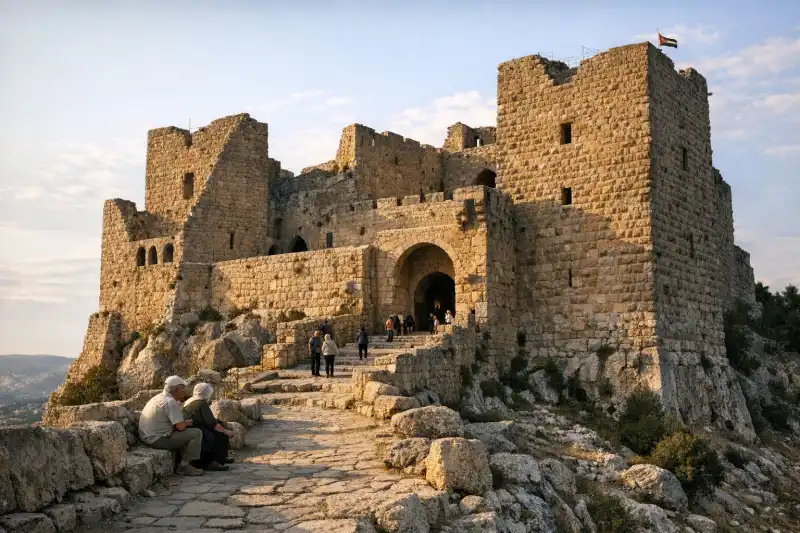
Ajloun Castle
Ajloun Castle in Jordan is a 12th-century Muslim fortress renowned for its strategic hilltop locatio...
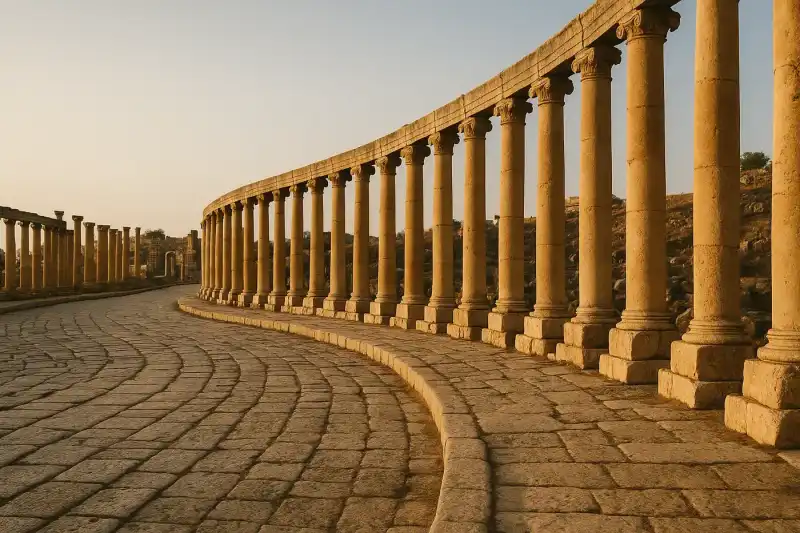
Jerash: The Pompeii of the East and Jordan's Best-Preserved
Roman / NabataeanDiscover Jerash, Jordan's remarkable Roman ruins. Walk the colonnaded streets of ancient Gerasa, exp...
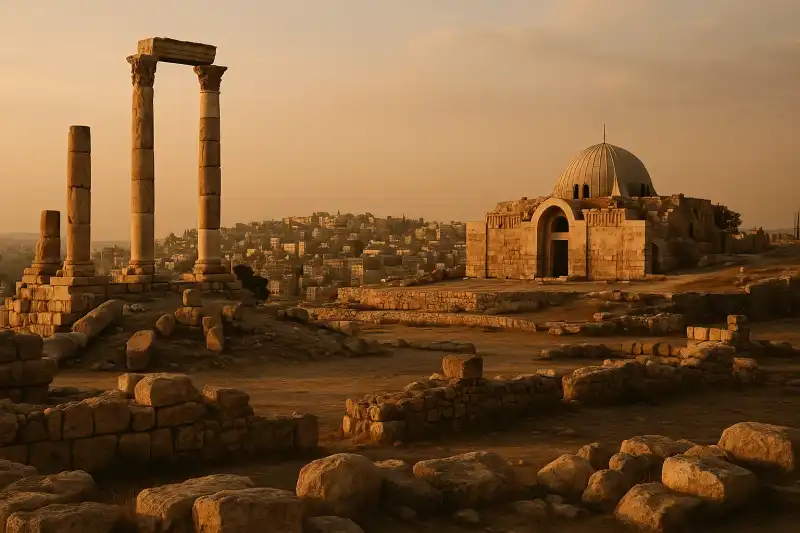
Amman Citadel Jordan Guide 2026: Temple of Hercules & Ancient Rabbah
Ammonite-Roman-UmayyadExplore Jordan's ancient citadel overlooking modern Amman. Discover the Temple of Hercules, Umayyad ...