Quick Info
At a glance
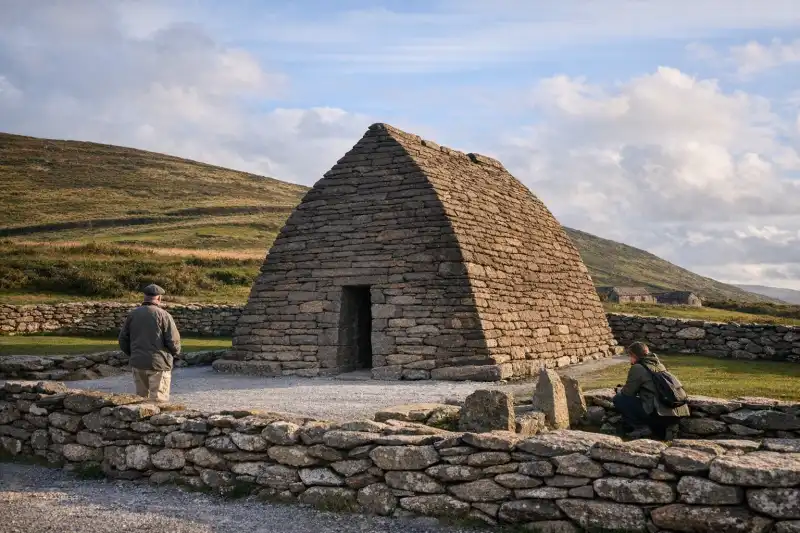
Gallarus Oratory, in Ireland, sits against the windswept landscape of the Dingle Peninsula like a carefully folded stone vessel left ashore by another age. Small in size but striking in presence, it is one of those monuments that rewards stillness more than spectacle. You do not approach it through the drama of towering ruins or a sprawling archaeological park. Instead, you find a modest building, low and compact, rising from the green fields of County Kerry with a calm certainty that feels almost modern in its precision. Then you look closer and realize that every stone belongs to a building that has stood for well over a millennium.
The setting matters as much as the structure. The western edge of Ireland has long been shaped by weather, sea routes, pilgrimage, and isolation, and Gallarus Oratory seems to gather all of these themes into a single form. Its dry-stone walls are fitted so tightly that generations have admired not only its beauty but its practicality. Rain, so common in this Atlantic landscape, sheds off its steep sides with remarkable efficiency. The result is a building that has endured in a region known for exposing weakness.
For travelers, Gallarus Oratory offers a different kind of ancient site experience. It is intimate rather than overwhelming, mysterious rather than fully explained. Whether you come for architecture, early Christian history, or simply the atmosphere of the Dingle Peninsula, this little chapel has a way of lingering in memory long after larger monuments fade. It feels less like a ruin and more like a message from early medieval Ireland, still legible in stone.
History
Origins in Early Christian Ireland
Gallarus Oratory emerged during a formative period in Irish history, when Christianity had become deeply rooted across the island but local religious life still retained distinctive regional traditions. Most scholars place its construction somewhere between the 7th and 9th centuries CE, though debate continues. This uncertainty is not unusual for small early medieval structures in Ireland, especially those built without inscriptions or extensive documentary records. What is clear is that the building belongs to the world of monastic communities, pilgrimage routes, and remote devotional landscapes that characterized early Christian western Ireland.
The Dingle Peninsula was not a marginal place in this era. Though physically remote, it was spiritually and culturally connected to wider networks of learning and worship. Monasteries, hermitages, and small churches developed along the Atlantic edge, often in dramatic or isolated settings. These communities were not only religious centers but also places of literacy, local influence, and artistic production. Gallarus Oratory likely served such a world, whether as a chapel for prayer, a commemorative shrine, or part of a broader ecclesiastical settlement nearby.
Its very form suggests a deliberate effort to build something lasting. Unlike timber churches that would have disappeared long ago, this stone structure was designed to withstand a demanding climate. The decision to construct in finely fitted masonry reflects both technical skill and an investment in permanence.
Medieval Use and Local Tradition
As the centuries passed, Gallarus Oratory became woven into local memory. One long-standing interpretation is that it functioned as a pilgrimage church, perhaps linked to nearby ecclesiastical remains and burial grounds. Another view is that it formed part of a small monastic enclosure, serving a resident religious community rather than large numbers of pilgrims. Because evidence is limited, no single explanation has fully prevailed, and this ambiguity has become part of the site’s fascination.
In medieval Ireland, small oratories and churches often served multiple purposes over time. A building might begin as a private devotional space and later become associated with burial, saintly cults, or seasonal gatherings. Gallarus Oratory may have followed a similar path. The surrounding landscape includes other early Christian sites, reinforcing the sense that this was a sacred zone rather than an isolated structure.
Local tradition also played a role in preserving its identity. While many ancient buildings lose their names or are absorbed into folklore in ways that obscure their origins, Gallarus Oratory retained a strong sense of distinctiveness. Its unusual shape encouraged comparisons to an upturned boat, an image still commonly used today. In a coastal region where maritime life shaped everyday experience, that comparison would have come naturally and helped people remember the building across generations.
Antiquarian Interest and Modern Scholarship
By the 18th and 19th centuries, Gallarus Oratory had attracted the attention of antiquarians, travelers, and early scholars interested in Ireland’s past. These observers were struck by its extraordinary condition. Many ancient religious sites survive as partial ruins, with missing roofs or heavily altered walls. Gallarus, by contrast, remained almost intact, making it especially important for the study of early Christian architecture.
Scholars began debating its date and function in earnest. Some argued for an early medieval origin, while others proposed a somewhat later date. The building’s clean geometry and sophisticated masonry inspired admiration, but also confusion: it seemed too refined to fit simplistic ideas of “primitive” early church construction. Over time, more nuanced scholarship placed the oratory within the broader tradition of stone-built ecclesiastical architecture in western Ireland.
Modern conservation and interpretation have focused on preserving both the structure and its setting. Because the monument is relatively small, even modest visitor pressure can affect the immediate environment. Management efforts therefore aim to balance public access with long-term protection. Today Gallarus Oratory stands not only as a monument of early medieval faith, but also as a benchmark for how ancient buildings can survive when craftsmanship, climate adaptation, and continued care align over many centuries.
Key Features
What makes Gallarus Oratory so compelling is not grandeur but control. Every element of the building appears measured, purposeful, and elegantly solved. The most famous feature is its dry-stone construction. Rather than relying on mortar in the modern sense, the stones are carefully laid and angled so that the building remains tightly sealed. This method required expert knowledge of weight distribution and weather resistance. In a place where Atlantic rain can arrive suddenly and repeatedly, the structure’s survival is the strongest proof of its engineering.
The oratory’s silhouette is unforgettable. Its side walls curve upward and inward, narrowing toward the roof in a technique often described as corbelling. Each successive layer of stone projects slightly inward until the walls nearly meet, creating a steep, boat-like profile. This shape is both visually distinctive and highly practical. Water runs off easily, reducing the risk of penetration and erosion. The comparison to an overturned boat is not merely poetic; it also helps explain why the design works so well in a maritime climate.
The entrance is another important detail. It is narrow and plain, but not crude. The doorway reflects a sense of proportion and restraint often found in early Christian architecture, where spiritual focus was expressed through simplicity rather than ornament. Stepping near it, visitors often notice how thick the walls are and how protected the interior would have felt. The building may be small, but it was made to create enclosure, concentration, and separation from the outside world.
Inside, the space is austere. There is no lavish decoration, no surviving painted program, and none of the monumental scale associated with later medieval churches. Yet this simplicity is part of the site’s power. The interior invites you to imagine the rhythms of prayer, the sound of wind outside, and the limited but meaningful gatherings that may have taken place within. Light enters sparingly, and that controlled illumination would have heightened the sense of sacred focus.
A small east window adds another layer of interest. In Christian architecture, orientation mattered deeply, and eastern alignment often carried symbolic meaning connected to resurrection, dawn, and liturgical direction. At Gallarus, the window is functional but also suggestive of these broader traditions. It reminds visitors that even this remote stone building participated in ideas shared across Christian Europe, while still expressing them in a uniquely Irish way.
The wider landscape is also one of the site’s key features. Gallarus Oratory does not stand in urban density or among crowded monumental remains. It is part of a peninsula where fields, low walls, distant hills, and the Atlantic atmosphere all contribute to interpretation. The journey to the site helps explain it. By the time visitors arrive, they have usually passed through scenery that makes isolation, devotion, and endurance easier to understand. The monument does not dominate the landscape; it belongs to it.
Nearby remains, including other early Christian features in the area, enrich the experience further. Even if those remains are fragmentary, they suggest that Gallarus was not built in a vacuum. It formed part of a living sacred geography. For travelers interested in ancient architecture, this context is essential. The oratory is a masterpiece in miniature, but it gains meaning when seen as one surviving voice within a wider medieval landscape.
Getting There
Gallarus Oratory is located on the Dingle Peninsula in County Kerry, western Ireland, and the easiest base for most visitors is the town of Dingle. From Dingle, the site is roughly 8 kilometers west, and the drive usually takes about 15 to 20 minutes depending on road conditions and seasonal traffic. Renting a car is the most convenient option, especially if you plan to explore additional peninsula sites on the same day. In peak season, small rental cars from Kerry Airport or Killarney often start around €35 to €70 per day, though prices can rise significantly in summer.
If you are coming from Killarney, expect a drive of around 1 hour 15 minutes to 1 hour 45 minutes. From Tralee, the trip is usually about an hour. Public transport to the Dingle Peninsula exists, but reaching Gallarus Oratory directly without a car requires more planning. Buses connect larger towns to Dingle, with one-way fares commonly in the €10 to €20 range depending on route and operator. From Dingle, a taxi to the oratory may cost approximately €15 to €25 each way, though local rates and availability vary.
Seasonal guided tours of the Dingle Peninsula can be a practical alternative for travelers who do not want to drive narrow rural roads. Day tours from Killarney or nearby areas often include scenic peninsula stops, and prices commonly begin around €35 to €80 per person. Cyclists also visit the site, especially in good weather, but roads can be exposed and occasionally busy, so this option suits confident riders more than casual travelers.
When to Visit
The best time to visit Gallarus Oratory is from late spring through early autumn, when daylight is long and the Dingle Peninsula is at its most accessible. May, June, and September are especially rewarding months. During these shoulder-season periods, the landscape is vividly green, temperatures are generally comfortable, and visitor numbers are usually lighter than in high summer. You may still encounter rain and wind, but that is part of western Ireland in any season.
July and August bring the warmest weather and the broadest range of local services, including tours, cafés, and extended opening hours in the wider region. However, these are also the busiest months. Roads around the peninsula can become congested, parking may be tighter, and popular scenic routes can feel less tranquil. If summer is your only option, visiting early in the day or later in the afternoon helps preserve some sense of quiet around the site.
Autumn can be beautiful, particularly in September and early October, when softer light suits both photography and the contemplative nature of the monument. Winter visits are possible, but conditions are less predictable. Rain, wind, and reduced daylight can make the journey harder, especially if you are combining Gallarus with a broader peninsula itinerary. Some local visitor services may also operate on reduced schedules.
Whatever the season, bring a waterproof jacket and sturdy shoes. Even short walks in County Kerry can involve wet ground and strong gusts. The weather changes quickly, but that changeability is also part of the experience. Gallarus Oratory is a building made for Atlantic conditions, and seeing it under shifting skies often reveals more about its design than a perfectly clear day ever could.
| Quick Facts | Details |
|---|---|
| Location | Dingle Peninsula, County Kerry, Ireland |
| Nearest town | Dingle |
| Site type | Early Christian stone oratory |
| Date | c. 7th-9th century CE |
| Cultural context | Early Medieval Irish Christianity |
| Known for | Exceptional dry-stone preservation and boat-shaped profile |
| Typical visit length | 30-60 minutes |
| Best season | Late spring to early autumn |
| Access style | Best reached by car, taxi, bike, or regional tour |
| Atmosphere | Quiet, remote, architectural, contemplative |
Gallarus Oratory proves that historical importance does not depend on scale. It is one of Ireland’s smallest major monuments, yet few places express so much with so little. In its carefully angled stones, visitors can read practical intelligence, devotional intent, and a deep understanding of place. The building’s survival is not accidental. It reflects the choices of people who knew how to shape architecture for weather, worship, and endurance.
For modern travelers, that makes Gallarus unusually satisfying. It offers a direct encounter with early medieval Ireland without the distractions of later rebuilding or heavy interpretation. You arrive, look, and almost immediately begin asking the same questions that scholars and pilgrims have asked for generations: who built this, exactly when, and for what purpose? The fact that not every answer is certain only sharpens the experience.
Just as important, the oratory rewards the wider journey. The roads of the Dingle Peninsula, the shifting Atlantic light, and the old sacred landscape around it all help frame the monument properly. Gallarus is not simply a stop on an itinerary; it is a reminder that some of the most enduring achievements in ancient travel are quiet ones. It stands low to the ground, weatherproof and self-contained, still doing what it was built to do: hold its shape against time.
Guided tours: worth it?
Most travelers can visit Gallarus Oratory independently. Compare a tour only if you want a tighter history-focused visit, easier logistics, or a guide who can answer questions on the spot.
Best for
- Short visits where a planned route saves time
When to go self-guided
Go independently if you prefer setting your own pace, reading as you go, and checking official hours or ticket rules directly before you arrive.
What I’d avoid
Skip paid tours that bundle unrelated stops you do not actually want. The best option should either save meaningful planning time or add historical context you would miss on your own.
Dingle Peninsula Tours
Useful when: you want to compare guided formats before deciding
County Kerry Historical Tours
Useful when: you want to compare guided formats before deciding
Ring of Kerry and Dingle Day Trips
Useful when: transport or pickup logistics matter
Some tour links are affiliate links, which may earn Ancient Travel a small commission at no extra cost to you. I try to surface options that make practical sense for the site—not just anything bookable.
Frequently Asked Questions
What is Gallarus Oratory?
Gallarus Oratory is a small stone-built early Christian church or prayer house on the Dingle Peninsula in County Kerry, Ireland, famous for its exceptionally preserved dry-stone construction.
How old is Gallarus Oratory?
Most scholars date Gallarus Oratory to the early medieval period, likely between the 7th and 9th centuries CE, though some debate about its exact date continues.
Do you need a ticket to visit Gallarus Oratory?
Access arrangements can vary, but visitors typically encounter a small admission fee associated with the visitor center and site maintenance; it is wise to check current local information before traveling.
How long should you spend at Gallarus Oratory?
Most visitors spend 30 to 60 minutes at Gallarus Oratory, though those exploring the wider Dingle Peninsula often stay longer to visit nearby churches, scenic viewpoints, and archaeological remains.
Why is Gallarus Oratory important?
It is important because it is one of Ireland’s best-preserved early Christian stone buildings and offers rare insight into medieval craftsmanship, worship, and monastic life.
Can you go inside Gallarus Oratory?
Depending on current conservation rules and site management, visitors may be able to enter or view the interior closely, but access can be restricted to help preserve the structure.
Nearby Ancient Sites
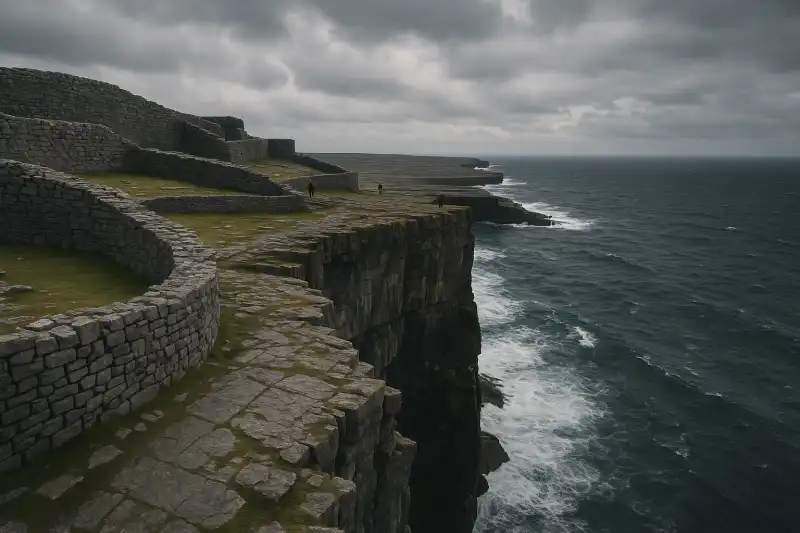
Dún Aonghasa Travel Guide 2026: Aran Islands Cliff Fort History, Highlights, and Visit Planning
Iron Age Atlantic communitiesPlan a first visit to Dún Aonghasa on Inis Mór with practical ferry timing, cliff-fort context, and ...
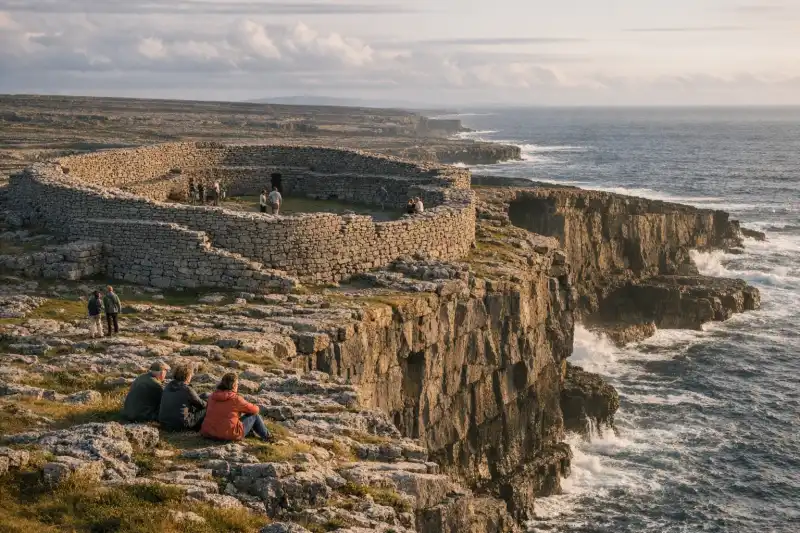
Aran Islands Stone Forts
Prehistoric and early medieval IrishExplore the dramatic prehistoric stone forts of Ireland’s Aran Islands, where Atlantic cliffs and an...
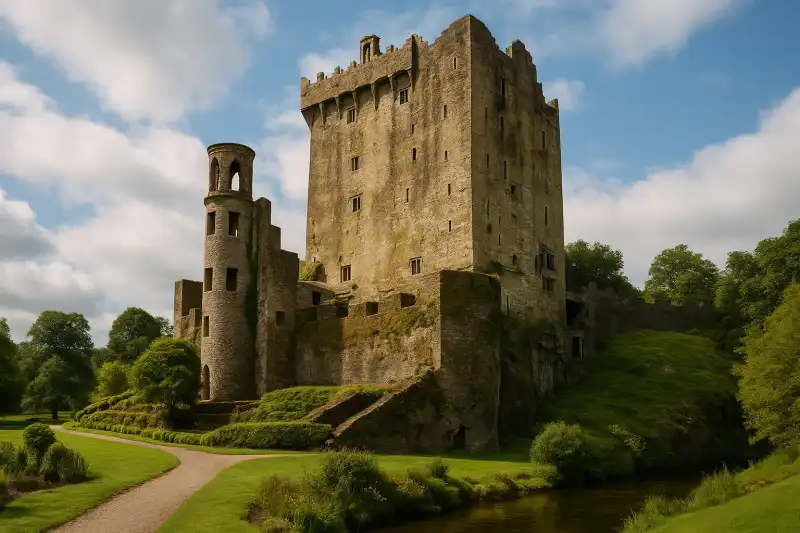
Blarney Castle Travel Guide 2026: Cork Day-Trip Timing, Gardens, and Stone Access
Medieval IrelandPlan a practical first visit to Blarney Castle with timing for the Stone queue, garden route priorit...
Clonmacnoise Travel Guide 2026: Monastic Ruins, High Crosses, and River Shannon Context
Early Medieval IrelandPlan a first visit to Clonmacnoise with practical timing, monastic-site context, and clear route adv...