Quick Info
Curated Experiences
Gortyn, Phaistos & Matala Day Trip from Heraklion
South Crete Archaeological Sites Tour
Crete History and Archaeology Private Tour
Why Gortyn Deserves a Place on Every Cretan Itinerary
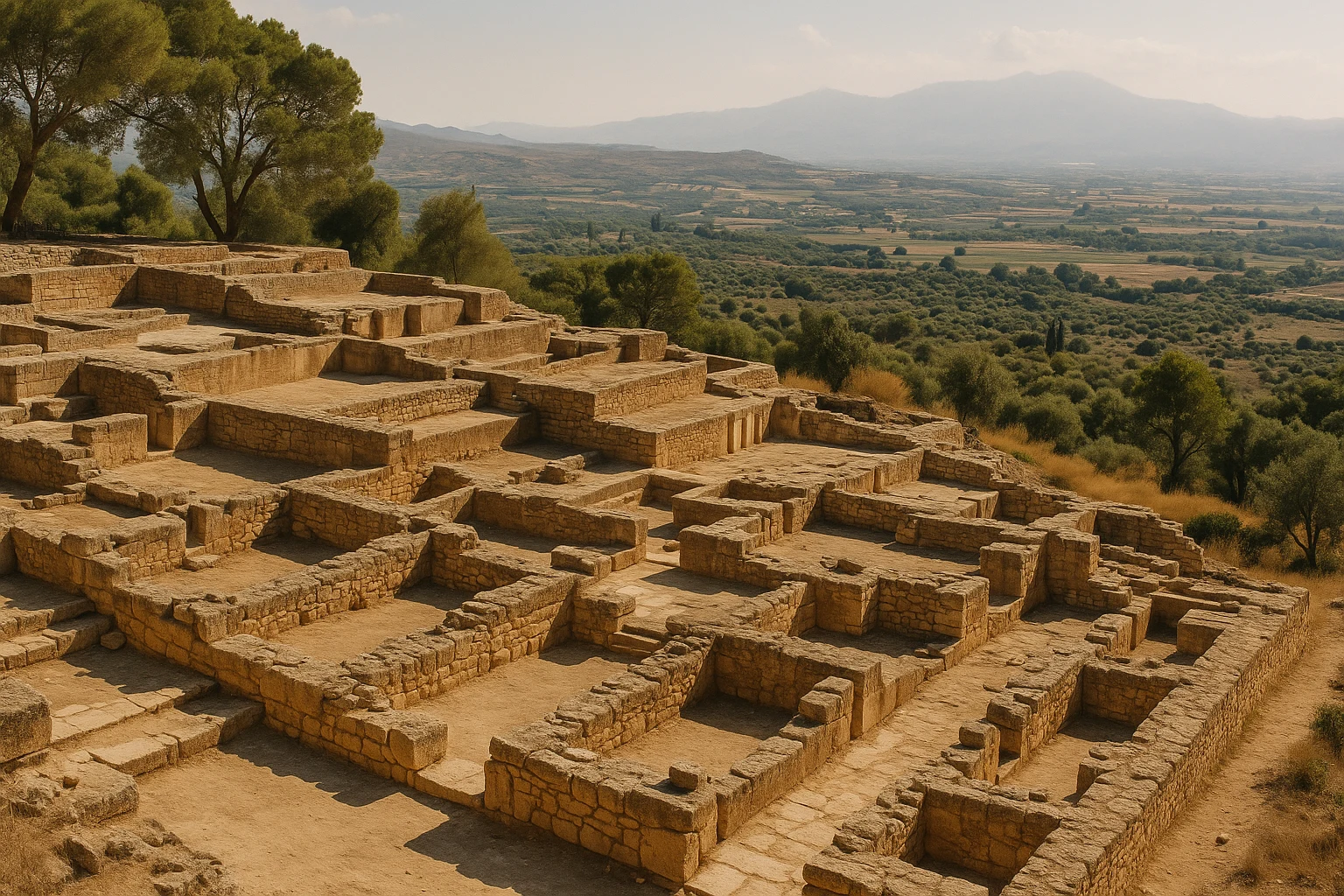
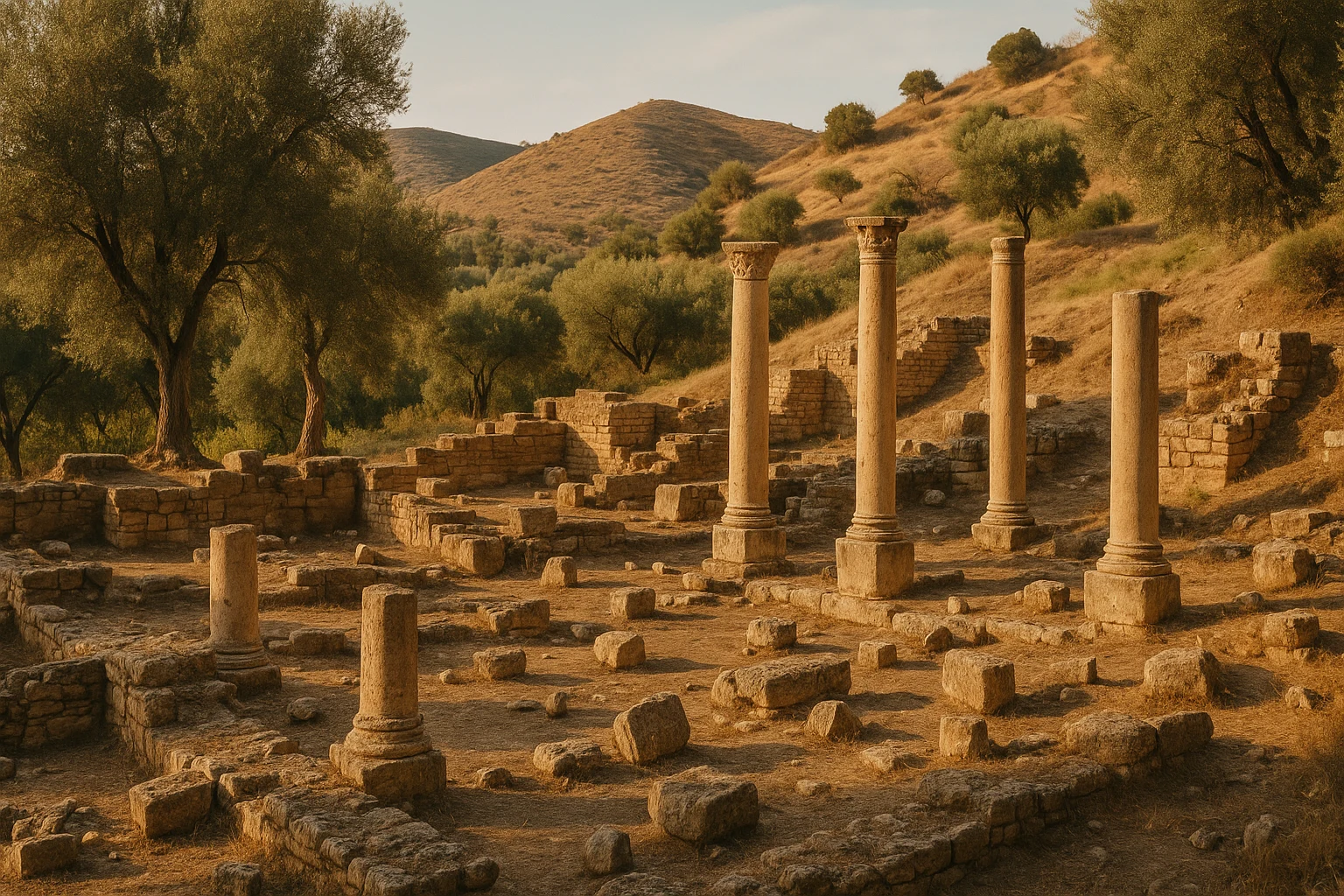
Most visitors to Crete focus on the Minoan palaces at Knossos and Phaistos, but Gortyn offers something those sites cannot: a continuous human story running from the Bronze Age through Minoan, Dorian Greek, Hellenistic, Roman, and Byzantine times, all layered in a single accessible landscape in the heart of the Messara Plain. The olive groves and eucalyptus trees here shelter column drums, temple foundations, and Byzantine apses in a setting that feels genuinely off the tourist trail, even though Gortyn was once the most powerful city on Crete.
The site’s anchor is world-class: the Gortyn Law Code, inscribed around 450 BCE on massive stone blocks, is the oldest surviving complete legal text from the Greek world. Standing before those deeply carved letters, written in a script that alternates direction like an ox plowing a field, is one of the most quietly thrilling experiences available at any ancient site in Greece.
Historical Context
Gortyn’s origins reach back to the third millennium BCE, when a Bronze Age settlement occupied the acropolis hill above the Letheos River. During the Minoan period the site was a secondary centre, subordinate to the great palaces at Knossos and Phaistos whose ruins lie within easy reach. The site grew in stature after the collapse of Minoan palace culture around 1200 BCE, and Dorian Greeks settled here in force during the Iron Age, establishing one of Crete’s most powerful city-states.
By the archaic and classical periods, Gortyn was a major power on the island, frequently in conflict with Knossos. Its wealth and civic ambition are nowhere more clearly expressed than in the Law Code: a monumental civic achievement that regulated virtually every aspect of civil life, from the division of estates to the rights of free women to divorce their husbands. The code was not a penal law but a civil one, and its sophistication puts to rest any notion that archaic Greece was legally primitive.
When Rome pacified Crete in 67 BCE following Quintus Caecilius Metellus’s campaign, Gortyn’s existing prominence and southern location made it the obvious capital. The city expanded dramatically under Roman rule. A grid of streets replaced earlier urban patterns; a vast praetorium housed the provincial governor; temples to Egyptian gods reflected the cosmopolitan reach of Roman trade; a nymphaeum supplied public water; and baths and an amphitheatre provided the familiar amenities of Roman civic life. Gortyn’s population is estimated to have reached 100,000 at its peak—an almost unimaginable figure for Crete at any period.
Early Christianity arrived here in the first century CE. According to tradition, the Apostle Paul sent his companion Titus to Crete as its first bishop, and Gortyn became the island’s first episcopal see. The magnificent basilica of Agios Titos, largely intact as a roofless shell, commemorates that missionary legacy. The city survived into the seventh century CE before Arab raids devastated it around 824 CE, shifting power permanently northward to what would eventually become Heraklion.
What to See
The Odeon and the Law Code — The fenced archaeological enclosure at the site entrance contains the Roman Odeon, a small semicircular theatre probably used for musical performances and public meetings. Built in the first century CE, the Odeon incorporated into its curved back wall the great inscribed blocks of the Law Code. Twelve columns of Dorian Greek text, each column roughly a metre tall, run around the apse. The boustrophedon script—reading left to right on one line, then right to left on the next, like a plowed field—is immediately recognisable even if you cannot read ancient Greek. Signage explains the content clearly.
The Basilica of Agios Titos — Just across the road from the Odeon, the sixth-century Byzantine basilica built over an earlier church is one of the best-preserved early Christian monuments in Greece. Three naves defined by columns, a substantial apse, and well-preserved masonry give a vivid impression of the building in use. It remained an active church until the Arab conquest.
The Praetorium — Following the dirt track south through the olive groves leads to the sprawling remains of the governor’s palace, rebuilt in the second century CE under Trajan and Hadrian. Column stumps, wall fragments, and an elaborate nymphaeum with water channels convey the scale of Roman civic ambition. This is the most atmospheric part of the site, shaded by eucalyptus and largely unvisited.
The Temple of Pythian Apollo — On the acropolis hill above the main site stand the ruins of a temple dedicated to Apollo, Gortyn’s principal civic deity. The cult here was one of the oldest on the island, predating the Dorian settlement. The climb rewards visitors with views across the Messara Plain to the White Mountains.
The Amphitheatre and Outlying Monuments — Further field exploration reveals an amphitheatre, several temples, early Christian remains, and stretches of Roman road. Much of this is accessible via informal paths through working agricultural land. Comfortable footwear and a sun hat are essential.
Practical Tips
Gortyn sits in the Messara Plain, Crete’s most fertile region and also one of its hottest. Summer midday temperatures frequently exceed 35°C. Visit early in the morning or in the late afternoon, bring plenty of water, and wear a hat. There is no café or shop at the site entrance; the nearest services are in the village of Agioi Deka (the Saints Ten), less than 1 km east, named for ten early Christians martyred here under Decius in 250 CE.
The main enclosure has formal hours and is staffed during peak season, though admission is currently free. The outlying ruins across the fields are accessible at any time. Dogs from local farms occasionally wander the site; they are generally friendly but exercise normal caution.
Public bus service from Heraklion to Mires stops near the site, but the timetable is limited and makes a combined Gortyn–Phaistos day trip by bus logistically tight. Renting a car or joining an organised tour is strongly recommended for visitors without their own transport.
Photography is unrestricted. The Law Code inscriptions photograph beautifully in low-angle morning or evening light, when the carved letters cast the deepest shadows.
Pairing Gortyn with Nearby Sites
Gortyn sits at the centre of the richest archaeological landscape outside Heraklion. Phaistos, the second great Minoan palace, is 10 km to the west and should be treated as a paired visit; together they cover Crete’s pre-Greek and Greek heritage comprehensively. Three kilometres beyond Phaistos, the Agia Triada Minoan villa complex is smaller and less visited but yields extraordinary finds including a famous painted sarcophagus (the original is in Heraklion’s Archaeological Museum). The coastal village of Matala, 20 km further, offers swimming, lunch, and a famous set of Roman-era tombs carved into seaside cliffs—an unconventional but memorable way to end the day.
For those staying in the Messara region rather than commuting from Heraklion, the village of Agioi Deka adjacent to the site offers simple accommodation, and the drive south over the Asterousia Mountains to the remote beaches of the Libyan coast takes under an hour.
Why Gortyn Still Matters
Gortyn’s Law Code is not merely an antiquarian curiosity. It is evidence that a Greek community in the mid-fifth century BCE had developed a sophisticated, written, publicly accessible system for regulating the rights and obligations of its citizens—including the rights of women to own property, initiate divorce, and retain a share of marital assets. The code predates the flowering of Athenian democracy and challenges the assumption that Athens was the sole source of Greek civic innovation.
Standing in front of those inscribed blocks, in a eucalyptus-shaded enclosure that most coach tours bypass on their way to Phaistos, you are reading one of the founding documents of Western legal thought. That experience, free of charge and almost free of crowds, is precisely why Gortyn rewards the visitor who looks past the obvious.
Frequently Asked Questions
What is the Gortyn Law Code?
The Gortyn Law Code is the oldest surviving complete legal text in the Greek world, inscribed around 450 BCE on the curved wall of the Roman Odeon. Written in the Dorian dialect using boustrophedon script (alternating left-to-right and right-to-left), its 12 columns cover property rights, inheritance, marriage, divorce, and the status of enslaved people. It is one of the most important documents in the history of Western jurisprudence.
How do you get to Gortyn from Heraklion?
Gortyn is about 45 km south of Heraklion, roughly a 45-minute drive via the E75 motorway toward Mires. KTEL buses run from Heraklion's bus station to Mires, stopping near the site entrance. Renting a car is the most flexible option and allows you to combine Gortyn with Phaistos and Matala in a single day.
How long does a visit to Gortyn take?
The main archaeological park, which includes the Odeon and the Law Code, can be explored in 30–45 minutes. The broader site, including the basilica of Agios Titos, the praetorium, the nymphaeum, and scattered field ruins, rewards a full 2–3 hours for curious visitors.
Is Gortyn free to enter?
Yes, Gortyn is currently free to enter. The main enclosure with the Odeon and Law Code is fenced and staffed, while many of the outlying ruins are accessible across open farmland.
What was Gortyn's role in the Roman Empire?
After Rome conquered Crete in 67 BCE, Gortyn was chosen as the capital of the combined province of Creta et Cyrenaica. It became the island's largest and most prosperous city, home to a governor's palace (praetorium), temples, baths, an amphitheatre, and substantial public infrastructure. It remained the island's administrative centre through the early Byzantine period.
Can you visit Gortyn and Phaistos on the same day?
Yes, and this is highly recommended. Phaistos is just 10 km west of Gortyn. Most visitors combine both sites with a stop at the scenic coastal village of Matala, making for a full and rewarding day trip from Heraklion or from accommodation in the Messara Plain.