Quick Info
At a glance
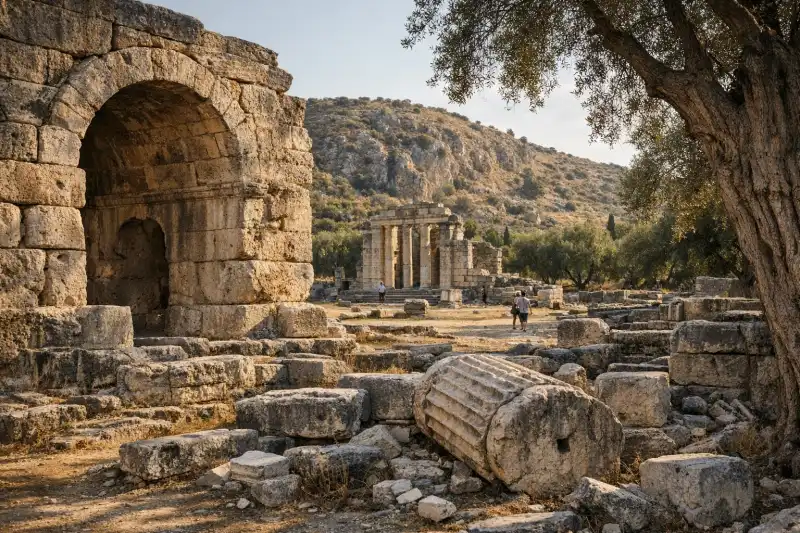
Gortyna, in Greece, lies quietly among olive groves and the wide agricultural landscape of Crete’s Mesara plain, but its historical weight is immense. What appears at first to be a calm archaeological park in southern Crete was once one of the island’s most important cities: a place of myth, law, Roman administration, and early Christianity. Visitors often arrive expecting a single monument and leave with the feeling of having walked through several civilizations layered on the same ground. Broken colonnades, basilica walls, monumental stone blocks, inscriptions, and fig trees all share the same warm light, and that contrast gives Gortyna much of its power.
Unlike hilltop citadels or compact temple sanctuaries, Gortyna is expansive. It unfolds across a landscape rather than presenting itself in a single dramatic silhouette. That means the experience here is less about one postcard view and more about understanding how an ancient city lived and evolved over centuries. There is a strong sense of continuity at Gortyna: Bronze Age settlement, Greek city-state life, Roman imperial authority, and Byzantine religious presence all left marks that can still be traced today. For travelers interested in ancient law, urbanism, or the transformation of pagan cities into Christian centers, Gortyna is one of the most rewarding sites in Crete. Even for first-time visitors, it offers something memorable: a rare chance to stand where mythic Europe was said to have met Zeus, and where one of the most famous legal inscriptions in the Greek world still survives.
History
Bronze Age and early settlement
The area around Gortyna was inhabited long before the city reached political prominence. Its location in the fertile Mesara plain made it attractive from an early period, with easy access to farmland, nearby routes through central Crete, and links to other important centers such as Phaistos. During the Bronze Age, the wider region belonged to the sphere of Minoan civilization, and while Gortyna itself was not the dominant palace center, it benefited from the prosperity and interconnectedness that defined southern Crete at the time.
After the collapse of the palace system, settlement patterns changed across the island, but Gortyna endured and adapted. By the early first millennium BCE, it had become one of several emerging city-states in Crete. This period laid the foundation for its later importance. The city developed institutions, civic identity, and territorial ambitions that would bring it into both alliance and rivalry with neighboring powers. In a Cretan landscape often marked by regional competition, Gortyna proved unusually resilient.
Archaic and Classical Gortyna
By the Archaic and Classical periods, Gortyna was an established polis with enough wealth and organization to produce one of the most extraordinary documents from the Greek world: the Great Law Code. Inscribed on stone in boustrophedon script, with lines alternating direction, this text is one of the fullest surviving legal inscriptions from ancient Greece. It deals with practical matters such as marriage, divorce, inheritance, slavery, and property rights, providing rare direct evidence for how a Greek community regulated daily life.
The Law Code is important not only because it survives, but because it shows a society thinking carefully about legal procedure and social relations. While Athens and Sparta dominate popular narratives of Greek history, inscriptions like this remind visitors that Crete had its own legal traditions and civic culture. Gortyna’s law also reveals a world where status, gender, and freedom were strictly structured, yet governed by recognizable institutions rather than arbitrary rule.
In political terms, Gortyna grew in influence through shifting alliances. Ancient authors suggest rivalry with nearby Phaistos and eventual dominance over a wider part of the plain. The city’s inland location gave it security and access to agricultural wealth, and over time it emerged as one of the leading powers in Crete.
Hellenistic transition and Roman ascendancy
The Hellenistic era brought new regional pressures as larger Mediterranean powers became involved in Cretan affairs. Internal Cretan conflicts, piracy, and changing alliances drew the island increasingly into the orbit of Rome. Gortyna made a critical and ultimately advantageous choice in this process. By aligning itself with Roman interests, it positioned itself to benefit from the new political order rather than be crushed by it.
That decision transformed the city. In 67 BCE, after the Roman conquest of Crete, Gortyna rose to exceptional status. It became the capital of the Roman province of Crete and later of Crete and Cyrenaica. This was no minor distinction. As a provincial capital, Gortyna gained administrative buildings, monumental public architecture, and an urban profile suited to imperial governance. Roman roads and institutions connected it to the wider Mediterranean, and the city entered a long phase of prosperity.
This was the period when Gortyna reached its greatest extent and influence. Public spaces expanded, baths and theaters served civic life, and the Praetorium reflected its role as an administrative center. Although less famous than cities of mainland Greece or Asia Minor, Roman Gortyna was a major hub in its own right.
Early Christianity and Byzantine decline
Gortyna also played a significant role in the Christianization of Crete. Tradition links the spread of Christianity on the island to Saint Titus, a companion of Saint Paul, and Gortyna became an early episcopal center. Large basilicas were built, signaling both the city’s wealth and its religious importance during Late Antiquity. These churches, with their broad plans and surviving structural fragments, show how the city was reshaped as public and sacred priorities changed.
Yet the same centuries that saw Christian prominence also brought instability. Earthquakes, economic shifts, and external threats affected cities across the eastern Mediterranean, and Gortyna was no exception. Arab raids in the 9th century dealt a severe blow to urban life in Crete, and the city’s long prominence faded. Over time, its administrative and commercial functions disappeared, and the once-powerful capital gave way to smaller settlements and agricultural use of the surrounding landscape.
Even in decline, however, Gortyna never lost its historical importance. Its ruins preserved evidence of legal, political, and religious transformation over more than a millennium. Modern archaeology has gradually revealed that what survives here is not merely a single ancient city, but a sequence of urban lives layered across the Cretan plain.
Key Features
Gortyna’s most celebrated monument is the Great Law Code, and for many visitors it is the emotional and intellectual centerpiece of the site. Inscribed on a curved wall of large stone blocks, the text is remarkable for its scale and preservation. Even those unable to read ancient Greek can appreciate the visual force of the inscription: line after line carefully carved, transforming architecture into public law. Standing before it, you understand that this was a society that wanted law displayed, remembered, and made visible. It is one of the clearest physical connections anywhere in Greece between civic authority and the everyday lives of ordinary people.
Not far from the inscription are the remains associated with the Roman city, which reveal a very different phase of Gortyna’s life. Here the atmosphere changes from Archaic civic memory to imperial urbanism. The Praetorium area, though fragmentary, still conveys the scale expected of a provincial capital. Foundations, walls, and scattered architectural elements suggest formal administrative spaces where governors and officials once managed affairs extending beyond Crete itself. The surviving ruins require some imagination, but that imagination is rewarded because the setting still feels spacious and important rather than compressed or over-restored.
The site’s basilicas are among its most evocative remains. Their outlines show the spread of Christianity into the urban fabric, replacing or repurposing earlier civic and religious landscapes. The Basilica of Saint Titus is especially significant in local memory, linking the archaeological remains to the island’s early Christian tradition. These buildings do more than document a change in religion; they illustrate a change in the use of public space. Where Roman authority once defined the city’s monumental core, Christian worship later reorganized meaning and movement within it.
Another memorable feature of Gortyna is the setting itself. Ancient stones stand among trees, fields, and irrigation-fed greenery, and that agricultural context helps explain the city’s historical endurance. This was never an isolated ceremonial center; it was rooted in productive land. Visitors often notice the famous plane tree connected in tradition with the myth of Zeus and Europa. Whether approached as legend, literary memory, or local storytelling, the association adds another layer to the site. Crete is full of mythic geography, but Gortyna’s connection to Europa gives the ruins a narrative resonance that extends far beyond archaeology.
Scattered remains of theaters, odea, roads, and domestic or civic structures further deepen the visit. Gortyna is not a site best understood through a single monument alone. Its appeal lies in movement between zones and periods. One moment you are reading about family law in archaic Crete; the next you are considering Roman provincial administration; then you are standing amid the traces of a Byzantine church. For travelers who enjoy reconstructing how cities evolve, few sites in Greece are as layered and instructive.
What also distinguishes Gortyna is that it feels less theatrical than many famous ancient places. There are no dramatic cliff-edge temples or polished museum installations dominating the experience. Instead, the site rewards observation, patience, and historical curiosity. That lower-key atmosphere can be a strength. It allows the visitor to notice masonry styles, reused blocks, inscriptions, and the sheer spread of occupation across the plain. Gortyna offers a more meditative form of archaeology, one that invites comparison across centuries rather than directing attention only to one iconic ruin.
Getting There
Gortyna is most easily reached from Heraklion, the main transport hub in central Crete. By car, the drive usually takes about 50 to 70 minutes depending on traffic and your exact route. Renting a car is the simplest option for most travelers, especially if you plan to combine Gortyna with Phaistos, Matala, or other sites in the Mesara region. Daily car rental rates in Crete commonly start around €30 to €60 in shoulder season and can rise in summer, while fuel costs should be factored in for the round trip.
Public buses can also work, though they require more planning. KTEL services from Heraklion toward the Mesara plain connect to towns in the area, and you may need a bus to Agioi Deka or nearby villages followed by a short taxi ride. Bus fares from Heraklion are often in the range of €5 to €10 one way depending on the route. A local taxi for the final segment may add roughly €10 to €20. Schedules can be limited outside peak hours, so checking current timetables in advance is important.
Taxis from Heraklion offer convenience but are much more expensive. Expect a one-way fare that can run roughly €70 to €100 or more, depending on season and pickup point. For couples or small groups, however, that can be worthwhile if time matters. Organized tours are another practical choice, especially for visitors without a car. Many include both Gortyna and Phaistos, often with hotel pickup, which removes the need to navigate rural transport connections on your own.
When to Visit
Spring is one of the best times to visit Gortyna. From March to May, the Mesara plain is greener, temperatures are comfortable for walking, and the landscape has a softness that suits the site’s open setting. Wildflowers and fresh agricultural growth can make the ruins feel especially atmospheric, while midday heat is usually still manageable. This is an ideal season for travelers who want to combine archaeology with longer drives around south-central Crete.
Autumn is similarly rewarding. From late September through November, the intense heat of high summer begins to ease, but the weather often remains warm and bright. Light at this time of year can be particularly beautiful on stone surfaces, and visitor numbers are usually lower than in the busiest summer months. If you prefer a quieter and more reflective experience, autumn is an excellent choice.
Summer has the advantage of long daylight hours and frequent tourist services, but it can be very hot, especially from late June through August. Because Gortyna is a spread-out site with exposed areas, the midday sun can be tiring. If you visit in summer, arrive early in the morning or later in the afternoon, bring water, and wear a hat. Winter is the least predictable season. You may enjoy solitude and cooler temperatures, but opening hours can vary and rainy weather may affect your plans. Overall, the most comfortable visiting windows are spring and autumn, when both the archaeological experience and the surrounding landscape are at their best.
| Quick Facts | Details |
|---|---|
| Location | South-central Crete, Greece |
| Ancient role | Major Cretan city and later Roman provincial capital |
| Best known for | The Great Law Code inscription |
| Historical periods | Minoan, Greek, Roman, Byzantine |
| Nearest major city | Heraklion |
| Ideal visit length | 1.5 to 3 hours |
| Good combined day trip | Gortyna and Phaistos |
| Best seasons | Spring and autumn |
| Terrain | Open archaeological grounds on the Mesara plain |
| Why visit | Law, Roman history, early Christianity, and layered urban archaeology |
Gortyna rewards travelers who want more than a quick photo stop. It is a place where legal history, imperial politics, mythology, and religion all remain legible in stone. The site does not overwhelm through spectacle; instead, it builds significance gradually, with each inscription, wall line, and basilica outline adding to the sense that this was once one of Crete’s central places. For anyone exploring the island beyond beaches and palace sites, Gortyna offers a deeper understanding of how Crete connected to the wider Greek and Roman worlds. It is one of those destinations that becomes more compelling the longer you stay, and long after leaving, the memory that remains is not only of ruins, but of continuity: a city that kept reinventing itself across centuries of Mediterranean history.
Guided tours: worth it?
Most travelers can visit Gortyna independently. Compare a tour only if you want a tighter history-focused visit, easier logistics, or a guide who can answer questions on the spot.
Best for
- Short visits where a planned route saves time
When to go self-guided
Go independently if you prefer setting your own pace, reading as you go, and checking official hours or ticket rules directly before you arrive.
What I’d avoid
Skip paid tours that bundle unrelated stops you do not actually want. The best option should either save meaningful planning time or add historical context you would miss on your own.
Crete Archaeological Sites Tour
Useful when: you want to compare guided formats before deciding
Heraklion to Gortyna Day Tour
Useful when: you want to compare guided formats before deciding
Phaistos and Gortyna Tour
Useful when: you want to compare guided formats before deciding
Some tour links are affiliate links, which may earn Ancient Travel a small commission at no extra cost to you. I try to surface options that make practical sense for the site—not just anything bookable.
Frequently Asked Questions
Where is Gortyna located?
Gortyna is in south-central Crete, Greece, in the Heraklion regional unit, not far from the Mesara plain and the Minoan palace of Phaistos.
Why is Gortyna famous?
Gortyna is best known for its monumental Law Code inscription, its role as the Roman capital of Crete and Cyrenaica, and its extensive ruins including basilicas, theaters, and civic buildings.
How much time do you need at Gortyna?
Most visitors spend 1.5 to 3 hours at Gortyna, though history enthusiasts may want longer to explore the Praetorium area, the basilicas, and the Law Code site.
Can you visit Gortyna and Phaistos on the same day?
Yes. Gortyna and Phaistos are close enough to combine easily in one day trip from Heraklion or other bases in central Crete.
Is Gortyna suitable for casual visitors, or mainly specialists?
Gortyna works well for both. Casual visitors can enjoy the atmosphere and major monuments, while specialists will appreciate its legal inscription, Roman urban remains, and early Christian architecture.
What is the best season to visit Gortyna?
Spring and autumn are usually the best times, offering warm weather, greener landscapes, and more comfortable conditions for walking than the hottest summer months.
Nearby Ancient Sites
Akrotiri
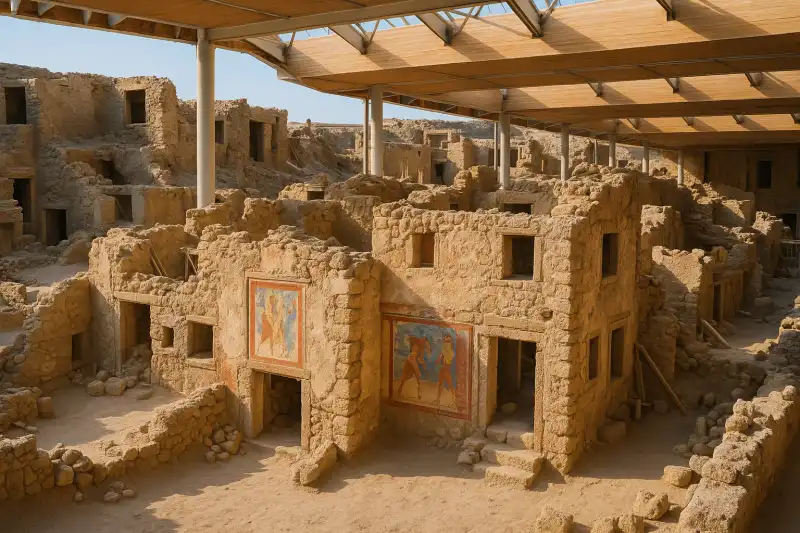
Minoan / CycladicExplore Akrotiri, the Bronze Age Minoan city buried under volcanic ash on Santorini around 1613 BCE ...
Ancient Akrotiri (Santorini)
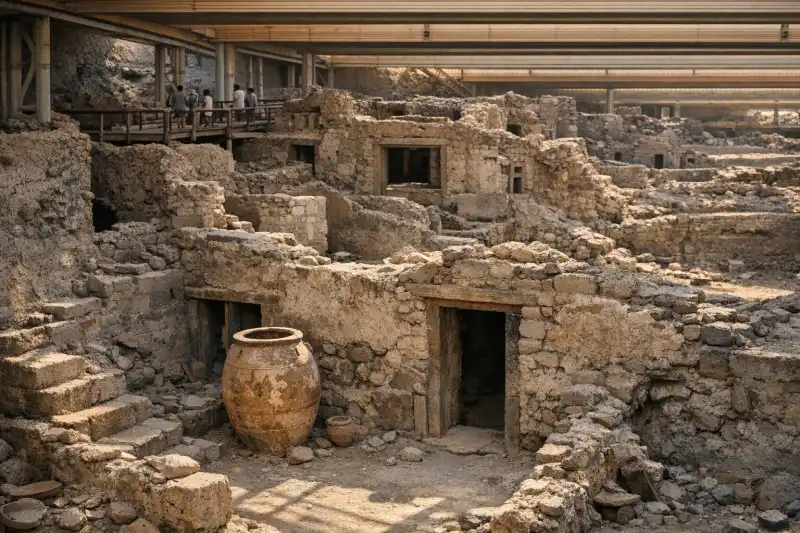
Explore Ancient Akrotiri, the breathtaking Bronze Age settlement preserved in volcanic ash on Santor...
Ancient Kamiros
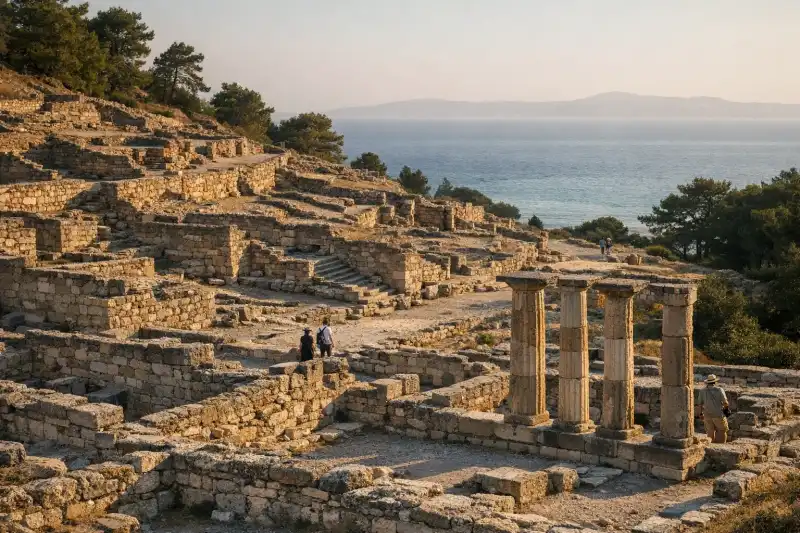
Ancient GreekExplore Ancient Kamiros, a remarkably preserved Hellenistic city on Rhodes offering terraces, temple...