Quick Info
Curated Experiences
Iwate Prefecture Archaeological and Jomon Culture Full-Day Tour
Japan Jomon Period History and Culture Experience
Hachimantai and Northern Tohoku Ancient Ruins Tour
Nestled amid the lush, forested landscape of northern Honshu, the Goshono Jomon Site offers a fascinating window into prehistoric Japan. Located in Ichinohe Town, Iwate Prefecture, this significant archaeological park preserves the remnants of a mid-Jomon period settlement dating back more than 4,000 years. With its atmospheric reconstructed pit dwellings and evocative burial mounds, it is one of Japan’s best-preserved examples of Jomon culture—a prehistoric era that flourished long before the rise of emperors, samurai, or even rice cultivation. Today, the Goshono Jomon Site stands as both an evocative time capsule and a lively center for public archaeology, recognized as part of the “Jomon Prehistoric Sites in Northern Japan” UNESCO World Heritage inscription.
Unlike many archaeological sites that are simply holes in the ground, Goshono immerses visitors in the world of the people who once lived here. Imagine peering into ancient sunken houses, walking narrow paths between mossy mounds that once concealed ancestors, and exploring a modern museum displaying ritual clay figurines—dogu—whose enigmatic smiles have endured across millennia. Standing quietly beneath towering beech and oak trees, one is transported to a time when hunting and gathering sustained lively communities bound together by ritual, festival, and the cycles of nature. As the morning mist hugs the river flats or the golden glow of late summer bathes the fields of Ichinohe, the landscape echoes with stories preserved in soil and memory. For anyone curious about the roots of Japanese civilization, the Goshono Jomon Site is an invitation to step back into a distant chapter of human life—where art, tradition, and ingenuity laid the earliest foundations for today’s Japanese society.
History
The Jomon Period: Dawn of Japanese Prehistory
Japan’s Jomon period (c. 14,000–300 BCE) is renowned for its early and enduring hunter-gatherer culture, defined by the distinctive cord-marked pottery (from ‘jomon’—meaning “cord pattern”) that graces archaeological sites across the archipelago. Unlike the rice-farming societies that followed, Jomon people relied predominantly on wild plants, nuts, fish, and game, creating some of the world’s earliest ceramic vessels and ritual objects. As populations grew, settlements like Goshono appeared in fertile river valleys—places that offered abundant resources alongside opportunities for cultural sophistication and spiritual expression.
Goshono’s Settlement and Growth (c. 2500–2000 BCE)
The site at Goshono flourished during the mid-Jomon period, a phase sometimes called the “golden age” of prehistoric Japan. Archaeological excavations beginning in the late 20th century revealed the remains of over 800 pit dwellings, organized into clusters, with the largest housing as many as 50 to 100 people. These sunken houses—dug into the soil and topped with thatched roofs—offered warmth in winter and cool retreats in summer. Scattered between the dwellings archaeologists uncovered communal burial mounds and numerous hearths, alongside artifacts such as polished stone tools, bone implements, clay figurines, and elaborately decorated pottery. These finds suggest that Goshono was not merely an isolated hamlet but a thriving settlement at the core of ancient regional networks.
While some dwellings were homes, others likely served ceremonial or social functions. The large central plaza, ringed by houses, may have hosted seasonal gatherings, rituals of renewal, and feasts that marked the cycles of nature. Evidence of trade—exotic materials and pottery styles—indicates that Goshono’s residents interacted with other Jomon communities, sharing ideas and objects across northern Honshu. Burial mounds and unique dogu figurines testify to a complex spiritual life, focused on ancestor veneration, fertility, and protection.
Rediscovery and Preservation in Modern Japan
Goshono largely slumbered beneath the fields of Ichinohe until the 1980s, when archaeological attention to the region intensified amid highway construction and urban expansion. As more layers were peeled away, it became clear that the site’s scale, preservation, and wealth of artifacts made it exceptional. Efforts to record, preserve, and reconstruct the Goshono settlement launched a new era: local authorities and scholars collaborated to create an archaeological park, complete with a museum, interpretive trails, replica dwellings, and educational programs. In 2021, Goshono was included with 16 other locations as part of the UNESCO World Heritage-listed “Jomon Prehistoric Sites in Northern Japan,” cementing its status as a treasure of global significance.
Today, Goshono is not only a window onto the distant past but a vibrant center for community engagement, school field trips, academic research, and hands-on experiences for all ages. Its story, once buried by centuries of silence, is now told through careful preservation, educational initiatives, and the quiet testimony of the landscape itself—a testament to both the people who lived here millennia ago and those who safeguard their memory today.
Key Features
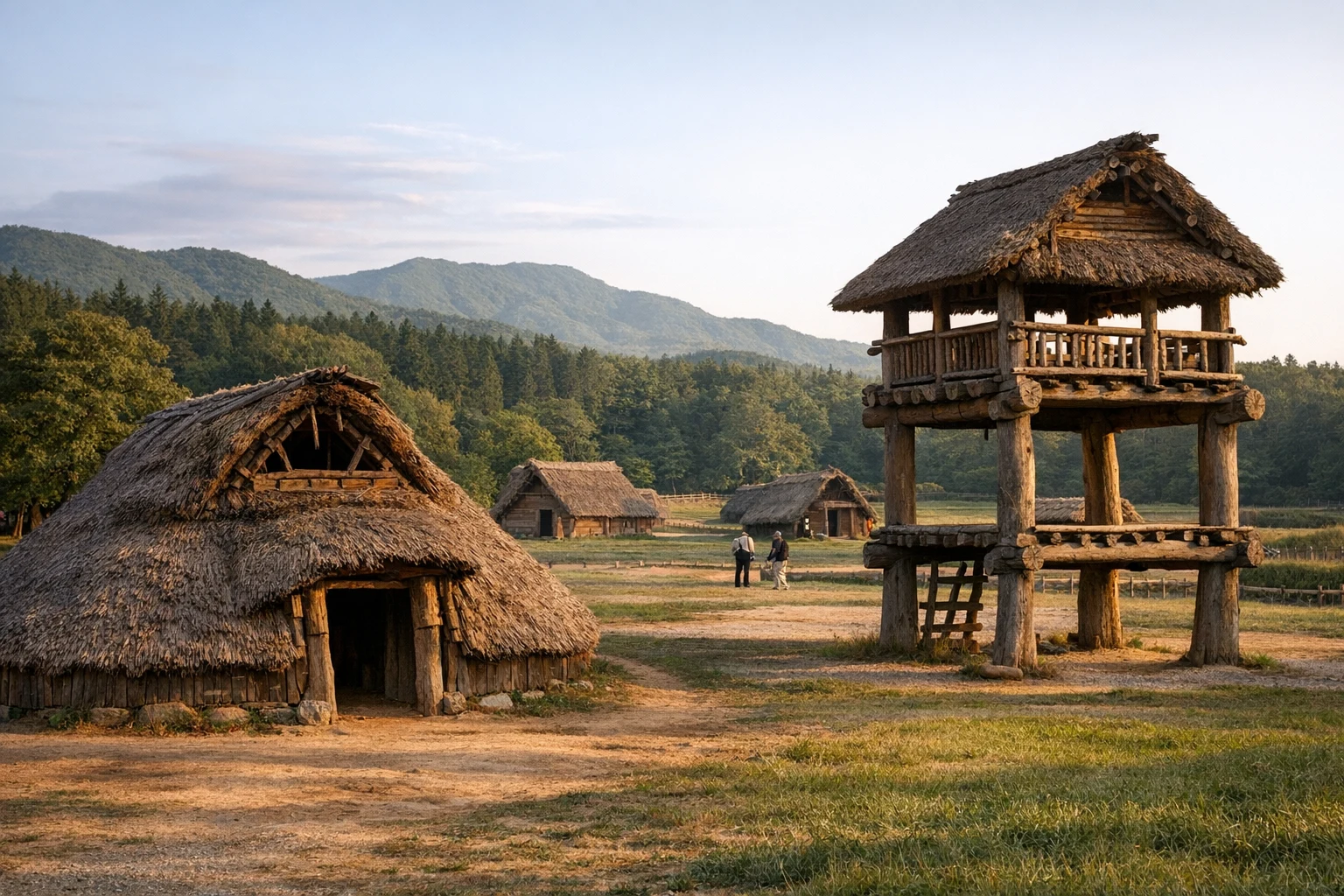
One of the most striking aspects of Goshono Jomon Site is its landscape: a broad sweep of green, punctuated by forest, carefully reconstructed pit dwellings, and earth mounds rising gently above the grass. The site’s centerpiece is the large cluster of reconstructed Jomon-era houses. With their characteristic circular shapes, low entryways, and thatched conical roofs, these dwellings evoke a village that once bustled with laughter, conversation, and daily routine. Visitors can step inside some of these structures, discovering sunken hearths where meals were prepared and fires kindled against the cold. The darkness and earth smell inside, mingled with filtered shafts of daylight, powerfully evoke the domestic reality of 4,000 years past.
A second key feature is the array of burial mounds known as “kofun”—though pre-dating the famous imperial tombs of later times, these mounds served as sacred places where community members laid their dead to rest. Often found nearby are ritual dogu figurines, mysterious clay effigies whose exact purpose is debated but whose intricate designs suggest roles in fertility rites, healing, or prayers for protection. Alongside burial sites, large communal hearths and open plazas hint at festival gatherings, storytelling, or ceremonies linked to nature’s cycles.
The on-site museum is a treasure trove of Jomon culture, displaying original and replica pottery, stone axes, bone fishhooks, polished beads, and sumptuous artifacts that speak of both practical life and spiritual imagination. Particularly impressive are the dogu figurines—small, stylized female forms with exaggerated features, thought by scholars to represent mother goddesses, ancestors, or shamanic figures. Detailed dioramas reconstruct ancient scenes: houses lit by hearth-fires, villagers crafting pottery, and hunters returning with deer or salmon. Interactive panels and multilingual interpretation allow both adults and children to follow the site’s discovery, excavation, and painstaking reconstruction.
Throughout the park are interpretive trails and signs (in Japanese, with English translations) that guide visitors through the settlement’s history. For the hands-on-minded, the site offers seasonal workshops where guests can make Jomon-style pottery, try ancient fire-lighting techniques, or create simple jewelry from clay and stone. Such activities bring tangible, memorable connection to the people who once called Goshono home.
Finally, the site’s natural setting cannot be overlooked. The surrounding forest—home to beech, oak, and maple—recreates the environment Jomon people relied upon. In spring and summer, the area bursts with bird song, wildflowers, and green canopy; in autumn, golden and crimson leaves floor the ancient paths. This serene landscape lends added depth to a visit, rooting human history firmly within the rhythms of the land itself.
Getting There
Reaching the Goshono Jomon Site requires a journey into the quieter reaches of northern Honshu, rewarding travelers seeking both history and scenic beauty. The most convenient access point for international and domestic visitors is via Morioka City, Iwate Prefecture’s capital, or even directly from Tokyo.
From Tokyo, board the Tohoku Shinkansen (bullet train) bound for Hachinohe or Morioka. Alight at Ninohe Station (approximately 2.5–3 hours; fares start at ¥13,000 one way for an unreserved seat). From Ninohe, frequent JR Hanawa Line trains connect to Ichinohe Station (about 10 minutes; ¥240). Alternatively, local buses or taxis—available in front of the station—can be taken directly to Goshono Park (8 kilometers; the taxi fare is approximately ¥2,000–¥2,500 and takes about 15 minutes). For those driving, ample parking is available on-site, and rental cars can be arranged in Morioka, Ninohe, or Ichinohe.
If arriving from Morioka City, local and rapid trains run frequently to Ninohe (about 1.5 hours; ¥2,590). Several coach lines also link Morioka with Ichinohe Town. For the most flexibility, especially with larger groups or families, renting a car is advisable as rural rail and bus schedules may be limited, particularly on weekends or outside peak tourist seasons. The site itself is well-signposted in Japanese and English, with clear public maps and convenient access for both private vehicles and public transport users.
Once at the archaeological park, the visitor center and museum are easily accessible from the entrance, and comprehensive on-site guidance ensures an enjoyable, informative exploration. All major paths are wheelchair-accessible, and staff at the museum are ready to provide directions or additional information in Japanese and, often, English.
When to Visit
Goshono Jomon Site is open year-round, each season imbuing the park with its own unique charm. The most popular time to visit is late spring (May–June) and autumn (late September–early November), when the beech and maple forests burst into vibrant color and the weather is generally dry and pleasantly cool. During these months, the reconstructed dwellings and outdoor features are at their most atmospheric, framed by thick green foliage or brilliant fall leaves. Spring’s mild weather fosters pleasant walking, while festival days often feature living history demonstrations, crafts, and outdoor performances.
Summer (July–August) brings lush greenery and a lively feel, as local children attend summer workshops and the wildflowers are in full bloom. However, expect moderate humidity and the possibility of afternoon showers. If you are sensitive to heat, plan your visit for early morning or late afternoon—most site facilities are shaded, and the museum provides air-conditioned relief.
Winter (December–March) transforms Goshono into a quiet, snow-clad landscape. Some outdoor features may be partially covered or less accessible in deep snow, but the museum remains open, and the frosty tranquility offers an enchanting, reflective setting. Dress warmly, as Iwate’s winters can be severe, with temperatures dipping below freezing and frequent snowfalls. For the dedicated traveler seeking solitude and a sense of ancient mystery amidst the snows, winter has its particular allure.
Whichever season you choose, be sure to check the official park and museum hours prior to your trip, as holiday closures and seasonal variations may apply. If you hope to participate in hands-on activities—such as pottery making or fire-lighting—ahead booking is recommended, especially during school holidays or festival periods. In all seasons, Goshono Jomon Site offers a unique journey into Japan’s prehistoric heart.
Quick Facts
| Feature | Details |
|---|---|
| Location | Ichinohe Town, Iwate Prefecture, Japan |
| UNESCO Status | Jomon Prehistoric Sites in Northern Japan (inscribed 2021) |
| Main Period | Mid-Jomon (c. 2500–2000 BCE) |
| Key Attractions | Reconstructed dwellings, burial mounds, museum, dogu figurines |
| General Admission | Adults ~¥300; discounts for students/children; some experiences extra |
| Accessibility | Wheelchair-accessible paths, accessible facilities |
| Closest Transport Hub | Ninohe Station (Tohoku Shinkansen, JR Hanawa Line) |
| Address | Goshono, Ichinohe Town, Ninohe District, Iwate Prefecture, Japan |
| Official Website | https://goshono-iseki.com/en/ |
| Opening Hours | 9:00–17:00 (last admission ~16:30; seasonal changes possible) |
Frequently Asked Questions
What is the best way to reach Goshono Jomon Site from Tokyo?
The easiest route is to take the Tohoku Shinkansen to Ninohe Station, then a taxi or local bus to Ichinohe and Goshono Jomon Site.
Is there an entrance fee for Goshono Jomon Site?
General admission is around 300 yen for adults, with discounts for students and children. Fees may be updated seasonally, so check before visiting.
What facilities are available at Goshono Jomon Site?
The park has a museum, reconstructed dwellings, restrooms, parking, a café, and accessible walking paths.
Can visitors participate in hands-on activities?
Yes, the site offers hands-on experiences such as pottery making, fire starting, and Jomon-era crafts, especially for groups or during special events.
How much time should I allocate for a typical visit?
Two to three hours is recommended to explore the archaeological remains, museum exhibits, and reconstructed dwellings at a relaxed pace.
Nearby Ancient Sites
Himeji Castle Japan Travel Guide 2026: The White Heron Castle
Japanese FeudalVisit Himeji Castle, Japan's most beautiful original castle. Explore the White Heron keep, defensive...
Heijo Palace Site
Nara Period JapanWalk the vast grounds of Japan's 8th-century imperial capital in Nara — a UNESCO World Heritage Site...
Dazaifu Government Office Ruins
Yamato Japan / Nara–Heian StateAncient administrative heart of Kyushu, the Dazaifu Government Office Ruins preserve Japan's 7th-cen...