Quick Info
At a glance
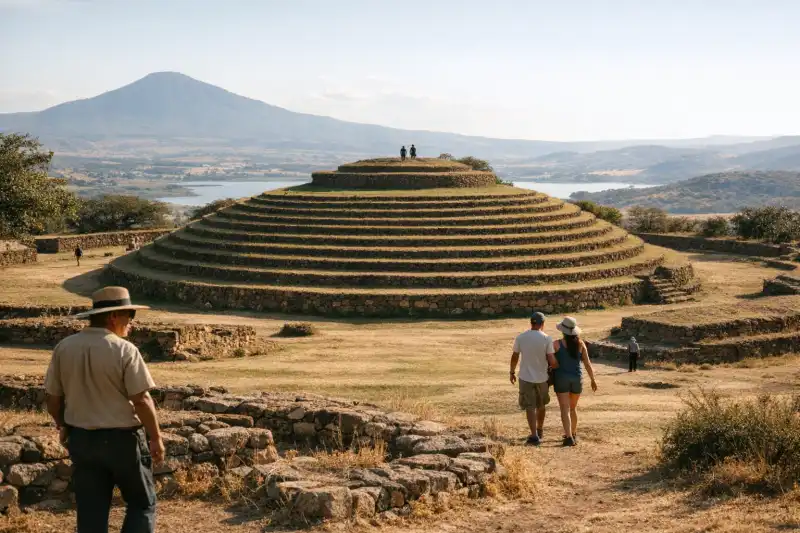
Guachimontones in Mexico rises from the rolling landscape of Jalisco with a silhouette unlike almost any other ancient site in Mesoamerica. Instead of the angular pyramid profiles many travelers associate with pre-Columbian ruins, this archaeological complex surprises visitors with broad circular platforms, ringed terraces, and a ceremonial design that feels both geometric and mysterious. Set near the modern town of Teuchitlán and within reach of Guadalajara, the site combines intellectual fascination with a peaceful rural setting of hills, fields, and wide skies.
For many visitors, the first impression is one of order and intention. The site sits within a larger cultural landscape that once supported a sophisticated society now known as the Teuchitlán tradition, a regional civilization that flourished in western Mexico long before Spanish arrival. Guachimontones is the most famous expression of that tradition, and it challenges old assumptions that western Mexico lacked monumental ceremonial centers comparable to better-known regions farther east and south. Here, architecture was conceived around circles and ceremonial spaces rather than the rectilinear plazas more common at Maya or central Mexican cities.
That difference is exactly what makes Guachimontones so memorable. It is not simply another ruin to photograph, but a place that expands a traveler’s understanding of ancient Mexico. Between the site museum, the reconstructed interpretation of local culture, and the open archaeological zone itself, visitors can trace the lives of communities who built, traded, worshiped, and buried their dead in this valley over many centuries. Guachimontones rewards careful walking, slow observation, and a willingness to look beyond the familiar postcard image of Mesoamerican pyramids.
History
Early settlement in the Teuchitlán valley
The story of Guachimontones begins long before the principal ceremonial circles were constructed. The Teuchitlán valley, with access to fertile land, nearby water sources, and routes into other parts of western Mexico, attracted settled communities in deep antiquity. Archaeological evidence shows that people in this region were already developing village life, agriculture, and social organization during the Formative period. Over time, those communities became more complex, and ceremonial practices grew in scale and sophistication.
Western Mexico was once underestimated in broader narratives of ancient Mesoamerica, partly because monumental remains here were less widely excavated and publicized than those of central Mexico or the Maya region. Yet the communities of Jalisco, Nayarit, and Colima sustained rich traditions of architecture, shaft tomb burials, ritual sculpture, and long-distance exchange. Guachimontones emerged out of this cultural setting, rooted in local innovation rather than imitation of outside powers.
Rise of the ceremonial center
The main construction phases at Guachimontones are generally placed between about 300 BCE and 900 CE, with the site reaching its greatest importance in the centuries around the turn of the first millennium. During this era, the Teuchitlán tradition developed a highly distinctive style of ceremonial architecture centered on circular stepped structures surrounded by concentric rings. These were not isolated monuments but part of a carefully planned ceremonial landscape that also included residential areas, ballcourts, plazas, terraces, and elite compounds.
The most recognizable buildings, often called guachimontones, consisted of a central altar or pyramid encircled by raised platforms. Scholars believe these spaces were used for public ritual, social display, and possibly ceremonies linked to lineage identity, cosmology, and seasonal cycles. The emphasis on circularity may have had symbolic meaning, perhaps connected to movement, community order, or sacred models of the universe, though some interpretations remain debated.
The society that built Guachimontones was not a small, isolated village community. Archaeology indicates substantial regional organization, craft production, and participation in trade networks. Materials and ideas moved through western Mexico and beyond. The site’s scale suggests leaders who could mobilize labor and maintain ceremonial authority over a broad area.
Exchange, power, and everyday life
Guachimontones flourished in a world of interaction. Western Mexico was connected through exchange networks that circulated obsidian, shell, ceramics, and prestige goods. The communities here also developed a recognizable funerary tradition, especially the shaft tomb culture associated with much of ancient Jalisco and neighboring states. Although shaft tombs are not the defining visible feature of Guachimontones today, the broader cultural world of the site included elaborate burial practices that reflected social distinction and belief in an afterlife.
The population living around the ceremonial core likely included farmers, craft specialists, ritual authorities, and local elites. Maize agriculture formed part of the subsistence base, supplemented by beans, squash, and other local resources. Houses and domestic areas around the site remind visitors that Guachimontones was not just a sacred center but part of a lived landscape. Ceremonial events would have drawn communities together, reinforcing social bonds and political relationships.
Decline and rediscovery
Like many ancient sites, Guachimontones did not remain a thriving ceremonial center forever. By around 900 CE, major occupation and monumental use had declined. The reasons were probably multiple: shifts in political power, environmental stress, changing trade routes, or transformations in ritual life. Rather than a single catastrophic end, the site likely experienced a gradual loss of central importance.
In later centuries, the ruins remained part of the local landscape, though their original history faded from living memory. Modern archaeological interest grew significantly in the twentieth century, and research by scholars including Phil Weigand helped bring the Teuchitlán tradition into wider academic and public awareness. Excavation, conservation, and museum interpretation transformed Guachimontones from a little-known set of earth-covered mounds into one of Mexico’s most intriguing archaeological destinations.
Today, Guachimontones stands as both a recovered ancient center and a corrective to older ideas about western Mexico. It demonstrates that the region supported complex ceremonial urbanism with architectural forms found nowhere else on such a scale. For visitors, that historical rediscovery is part of the experience: you are not only seeing ruins, but also witnessing a chapter of ancient Mexico that has only relatively recently entered the mainstream historical imagination.
Key Features
The defining feature of Guachimontones is, of course, its circular ceremonial architecture. The largest and most visually arresting structure is often known as Circle 2, where a central stepped cone or altar rises within a ring of platforms. Standing near it, you can appreciate how radically different this composition is from the square pyramids of sites like Chichén Itzá or Cholula. The space appears designed for movement around a center, for gatherings oriented in a circular pattern, and for spectatorship that emphasizes enclosure rather than frontal display. This layout gives the site a distinct rhythm and harmony that photographs never fully capture.
As you walk the archaeological zone, the concentric planning becomes clearer. Platforms form complete or partial rings, and the spaces between them feel intentional, as if choreographed for ritual approach and communal participation. Scholars have linked these circular compounds to ceremonies involving poles, dancing, music, and elite performance. Some interpretations connect the architecture to the volador tradition, in which participants descend from a tall pole in ritual flight, though precise links between surviving traditions and ancient practice remain cautious matters of interpretation. Even so, the architectural setting strongly suggests performance and spectacle.
Guachimontones is not only about circles. The site also includes a ballcourt, reminding visitors that the Mesoamerican ballgame extended into western Mexico and formed part of a broad ceremonial world shared across many regions. Ballcourts were spaces of ritualized competition, political messaging, and cosmological symbolism. At Guachimontones, the ballcourt helps place the site within wider Mesoamerican traditions while the circular complexes affirm its local uniqueness.
Another key feature is the relationship between the ruins and the surrounding landscape. Low hills and open valley terrain create a sense of spaciousness, and the site’s elevated points offer views across agricultural land toward the nearby lake area. This setting is not incidental. Ancient builders likely chose and shaped the location with attention to visibility, movement, and environmental resources. The scenery also makes a present-day visit especially pleasant, since the site feels less hemmed in by urban growth than some more famous archaeological destinations.
The Guachimontones Interpretation Center, often visited before or after the ruins, is an essential part of understanding the site. The museum provides context on the Teuchitlán tradition, regional trade, architecture, agriculture, and burial customs. Artifacts, reconstructions, and explanatory panels help visitors imagine what the ceremonial circles once looked like in active use. Without this interpretive layer, the site can seem visually striking but historically elusive. With it, the structures become legible as products of a coherent regional civilization.
One of the quieter strengths of Guachimontones is scale. It is large enough to feel important and architecturally ambitious, yet compact enough for most travelers to absorb in a single visit without fatigue. You can walk from one major feature to another while still having time to stop, look, and notice details: the angle of a terrace, the curve of a platform, the way earth and stone merge into the contours of the hillside. This manageable size makes the site especially rewarding for travelers who prefer thoughtful exploration over checklist tourism.
The preservation state is another notable characteristic. Guachimontones does not offer towering intact temples, and some visitors expecting dramatic vertical ruins may initially find it understated. But that understatement is part of its authenticity. The restored and stabilized forms make the architectural logic visible without turning the place into a reconstruction theme park. Earth, stone, grass, and contour still dominate the visual experience. Instead of being overwhelmed by monumental height, you become attentive to layout, planning, and ceremonial geometry.
Finally, Guachimontones has a rare power to reshape expectations. Many travelers arrive knowing little about the ancient cultures of western Mexico and leave with a far broader sense of Mesoamerican diversity. The site’s greatest feature may be this intellectual surprise. It expands the map of ancient Mexico, showing that innovation did not flow in just one direction and that local traditions could produce architectural ideas as distinctive and sophisticated as any in the hemisphere.
Getting There
Guachimontones is easiest to reach from Guadalajara, the major transport hub of Jalisco. By car, the journey usually takes about 1 to 1.5 hours depending on traffic and your starting point in the city. Rental cars are widely available in Guadalajara, and a one-day rental commonly starts around MXN 700 to 1,400 before fuel, insurance, and tolls. Driving gives the most flexibility, especially if you want to combine Guachimontones with Tequila, the agave landscape, or small towns in the area.
Public transport is possible but slower. From Guadalajara, travelers often take a bus toward Teuchitlán or nearby towns, then continue by local taxi. Bus fares are generally modest, often around MXN 60 to 120 each way depending on the route and operator. From Teuchitlán, a taxi to the archaeological zone may cost roughly MXN 80 to 150. Because schedules can change and return services may be limited later in the day, it is best to start early and confirm the last departures.
Private tours are a convenient middle option. Many guided day trips from Guadalajara include hotel pickup, transport, and a guide, often combining Guachimontones with Tequila or regional attractions. Prices vary widely, but shared tours may begin around MXN 1,200 to 2,500 per person, while private excursions cost more. If you value historical explanation and hassle-free logistics, a guided trip is often the best choice.
Once you arrive, expect some walking between the museum and the archaeological area. Wear comfortable shoes, carry water, and prepare for strong sun, especially outside the cooler months.
When to Visit
The best time to visit Guachimontones is generally during the dry season, from about November to April, when skies are clearer, paths are easier to walk, and daytime conditions are more comfortable for exploring exposed archaeological features. Temperatures in Jalisco are often warm rather than extreme, but the open setting means the sun can feel intense even in winter. Morning visits are especially pleasant, offering softer light for photography and a calmer atmosphere before midday heat.
The late spring months, particularly April and May, can be hotter and drier. If you visit then, bring plenty of water, a broad-brimmed hat, and sunscreen. Starting early is wise, since shade on the site is limited. The advantage of these months is that they can offer excellent visibility and fewer weather-related disruptions, though the landscape may appear browner than in the rainy season.
From roughly June through October, rain becomes more likely, often arriving in afternoon showers. The countryside can look greener and more dramatic during this period, which adds beauty to the wider setting. However, muddy patches, slick surfaces, and heavier humidity can make walking less comfortable. If you travel in the rainy season, mornings remain the safest window, since storms are often more common later in the day.
Weekdays usually provide a quieter experience than weekends and Mexican holiday periods, when domestic tourism may increase. If your main goal is reflection, photography, or unhurried study of the site’s layout, aim for a weekday morning in the dry season. If you are combining Guachimontones with regional culture, festivals, or a broader Jalisco itinerary, any season can work as long as you plan around heat and rain. The site rewards good timing, but its unusual architecture makes it worthwhile year-round.
| Quick Facts | Details |
|---|---|
| Location | Near Teuchitlán, Jalisco, Mexico |
| Nearest major city | Guadalajara |
| Cultural tradition | Teuchitlán tradition |
| Main period | c. 300 BCE-900 CE |
| Famous for | Circular stepped ceremonial complexes |
| Best for | History lovers, archaeology travelers, day trips from Guadalajara |
| Suggested visit length | 2-4 hours |
| Typical access | Car, guided tour, or bus plus taxi |
| Terrain | Open-air archaeological zone with uneven walking surfaces |
| What to bring | Water, sun protection, comfortable shoes, cash |
Guided tours: worth it?
Self-guided works here, but a guide can add real value if you want the ruins explained as a living place rather than just a sequence of monuments.
Best for
- First-time visitors who want context, not just photos
- Short visits where a planned route saves time
When to go self-guided
Go independently if you prefer setting your own pace, reading as you go, and checking official hours or ticket rules directly before you arrive.
What I’d avoid
Skip paid tours that bundle unrelated stops you do not actually want. The best option should either save meaningful planning time or add historical context you would miss on your own.
Guachimontones and Tequila Day Trips
Useful when: transport or pickup logistics matter
Guadalajara to Guachimontones Tours
Useful when: you want to compare guided formats before deciding
Teuchitlan Archaeological Site Experiences
Useful when: you want to compare guided formats before deciding
Some tour links are affiliate links, which may earn Ancient Travel a small commission at no extra cost to you. I try to surface options that make practical sense for the site—not just anything bookable.
Frequently Asked Questions
Where is Guachimontones located?
Guachimontones is in the municipality of Teuchitlán in the state of Jalisco, Mexico, about an hour west of Guadalajara.
What is Guachimontones famous for?
The site is best known for its rare circular stepped pyramids and concentric ceremonial architecture associated with the Teuchitlán tradition.
How much time do you need to visit Guachimontones?
Most travelers spend 2 to 4 hours between the interpretation museum, the main archaeological zone, and the surrounding viewpoints.
Can you visit Guachimontones as a day trip from Guadalajara?
Yes. Guachimontones is one of the easiest archaeological day trips from Guadalajara and is commonly paired with Tequila or the agave landscape.
Is Guachimontones suitable for families?
Yes, though paths can be sunny and uneven. Bring water, sun protection, and comfortable shoes for walking between the museum and ruins.
What should I bring to Guachimontones?
Carry water, a hat, sunscreen, sturdy footwear, and some cash for local transport, snacks, or small entrance-related purchases.
Nearby Ancient Sites
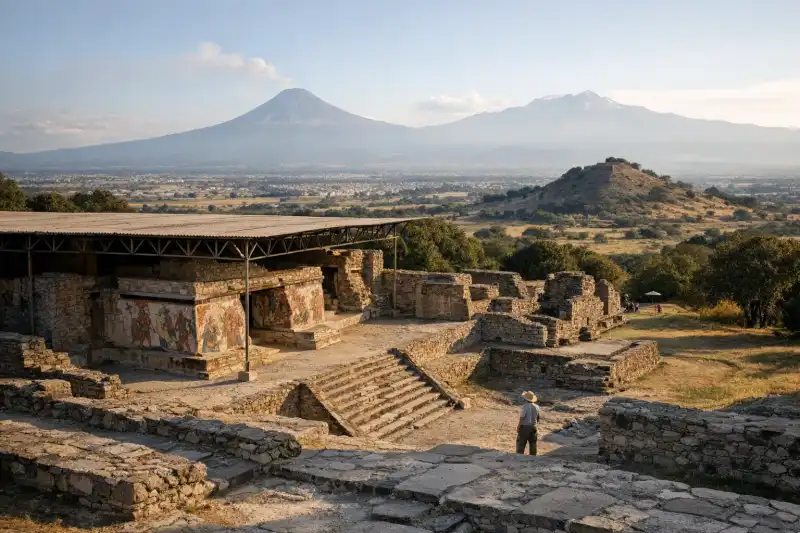
Cacaxtla
Olmeca-Xicalanca and broader Epiclassic Mesoamerican traditionsExplore Cacaxtla in Mexico, a hilltop archaeological site famed for vivid murals and Epiclassic hist...
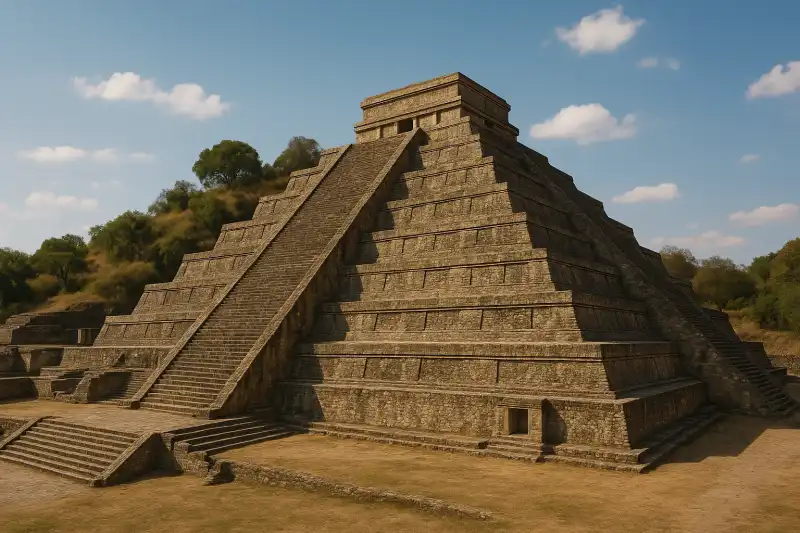
Great Pyramid of Cholula Travel Guide 2026: Tlachihualtepetl Essentials
Preclassic and Postclassic MesoamericanPlan a smart visit to the Great Pyramid of Cholula with key context, timing advice, and practical fi...
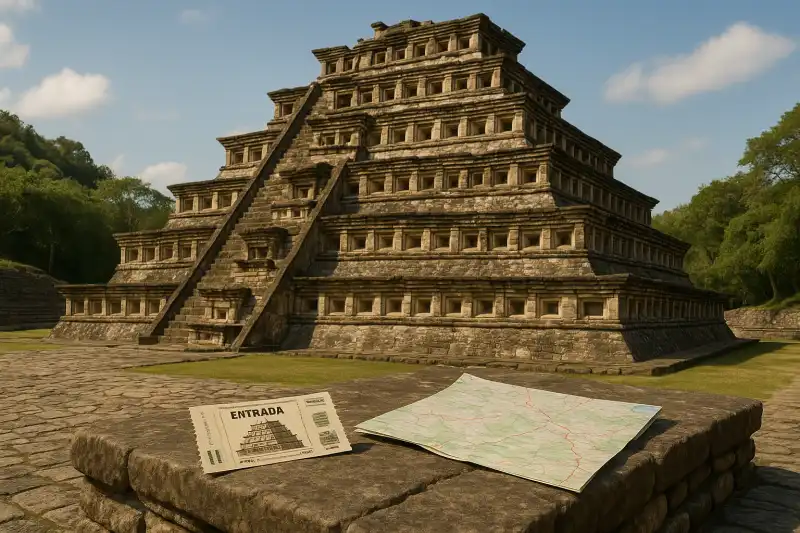
El Tajin Travel Guide 2026: Pyramid of the Niches, Tickets, and Route Planning
Classic VeracruzPlan a smoother El Tajin visit with practical transport timing, key structures to prioritize, and re...