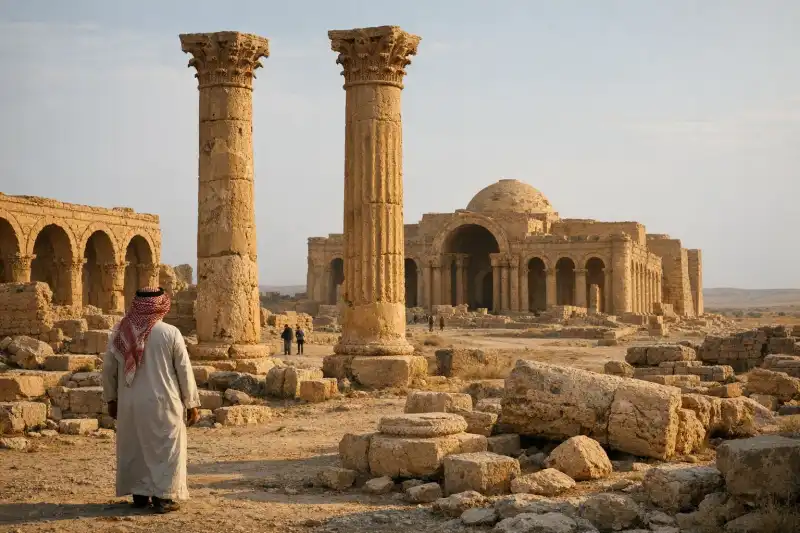
Quick Info
At a glance
Hatra in Iraq rises from the desert with a kind of stern grandeur that feels almost theatrical. Long before a visitor reaches its sanctuaries and stone walls, the site announces itself through scale: a circular fortified city standing in open country, shaped by heat, distance, and the ambitions of rulers who understood both trade and defense. In this landscape of ochre earth and wide sky, Hatra seems less like a ruin absorbed by time and more like a place still holding its ground.
That first impression matters, because Hatra was built to impress. It was a caravan city, a religious center, and a stronghold on the edge of great imperial spheres. The architecture tells that story immediately. Massive ramparts define the city’s outline, while temples and monumental arches hint at wealth and cosmopolitan connections. Here, influences from the Parthian world met local Mesopotamian traditions, Arab patronage, and echoes of classical forms from farther west. The result is not a copy of another ancient city, but a distinctive urban world with its own character.
For travelers interested in ancient Iraq, Hatra offers something rare: a site where military power, sacred architecture, and frontier politics all remain visible in stone. Even in ruin, it conveys order and ceremony. Walking through its gates and into its sacred precinct, you can imagine merchants, priests, archers, and envoys moving through the city under a relentless sun, surrounded by temples dedicated to a diverse pantheon and protected by walls designed to resist empire.
History
Early foundations in the desert frontier
Hatra likely emerged in the late 2nd or 1st century BCE, during a period when northern Mesopotamia lay between competing centers of power. Its location was strategic. The city stood in the Jazira, the broad region between the Tigris and Euphrates rivers, on routes linking Mesopotamia with Syria and Arabia. That position allowed Hatra to develop as a commercial and religious hub, especially for caravans moving goods across difficult terrain.
From the beginning, Hatra appears to have been more than a simple oasis settlement. Its circular plan, powerful defenses, and ceremonial architecture suggest deliberate urban planning and substantial resources. The city belonged broadly to the Parthian sphere, but it was not merely a provincial outpost. Instead, it operated with a notable degree of local autonomy. Inscriptions and artistic remains point to rulers who adopted royal language and patronized temples, presenting themselves as protectors of both city and cult.
Its multicultural identity was one of its strengths. Hatra lay in a zone where Aramaic, Arab, Iranian, and Mesopotamian traditions mixed. Local religion reflected that variety, with deities from different backgrounds worshipped in monumental sanctuaries. This blend did not weaken the city; it helped define its role as a meeting point between worlds.
Growth under Parthian influence
Hatra flourished most clearly between the 1st and 2nd centuries CE. During this period, the Parthian Empire dominated much of Iran and Mesopotamia, often confronting Rome for control of frontier territories. Hatra benefited from that geopolitical tension. As a fortified city aligned with Parthian interests but governed locally, it could serve as a buffer, a marketplace, and a regional center of authority.
The city’s wealth is visible in the scale of its construction. Defensive walls, towers, gateways, and a grand sacred precinct required sustained investment. Temples were built and embellished with columns, iwans, statues, and decorative stonework. Hatra’s rulers likely drew revenue from trade, taxation, agriculture in the surrounding zone, and pilgrimage linked to its sanctuaries.
This was also the period in which the city became famous for resistance. Roman emperors campaigning in Mesopotamia encountered Hatra as a formidable obstacle. Its fortifications, combined with the harsh desert environment and the difficulty of maintaining sieges far from stable supply lines, made it unusually hard to conquer.
Roman sieges and Hatra’s reputation
Hatra’s greatest fame in antiquity came from its successful resistance to Rome. The emperor Trajan, during his eastern campaign in the early 2nd century CE, is associated with operations in the region, though details are not always clear in surviving sources. More securely, the emperor Septimius Severus besieged Hatra twice in the late 2nd and early 3rd centuries CE, and both attempts failed.
These failures enhanced the city’s prestige. Hatra was not simply a local town surviving on the margins; it became a symbol of resilience. Its walls, built in concentric defensive lines and strengthened by numerous towers, were among the strongest in the region. Archers on the ramparts, ample supplies, and the difficulty of desert warfare all favored the defenders. For Rome, Hatra was a stubborn frontier challenge. For local elites, successful defense was a powerful source of legitimacy.
Ancient authors sometimes framed the city in dramatic terms, emphasizing both its strength and its wealth. Such accounts may exaggerate, but archaeology confirms that Hatra was no ordinary settlement. Its architecture and inscriptions point to a city confident in its identity and political importance.
Fall to the Sasanians
Hatra’s fortunes changed in the 3rd century CE with the rise of the Sasanian Empire, which replaced the Parthians in Iran and sought firmer control over Mesopotamia. The new imperial order was more centralized and more aggressive toward frontier powers that had previously enjoyed flexibility.
Tradition holds that Hatra eventually fell to the Sasanian ruler Shapur I, or during the early Sasanian offensives of the mid-3rd century CE. Later legends, including tales of betrayal from within, grew up around the city’s fall. While such stories are difficult to verify, they show how deeply Hatra’s resistance entered historical memory. A city that had held out against Rome was expected to require treachery or exceptional force to be overcome.
After its capture, Hatra declined rapidly. Its political role disappeared, trade patterns shifted, and the great sanctuaries ceased to function as they had before. Unlike cities continuously rebuilt through late antiquity and the medieval period, Hatra was largely abandoned, which in one sense preserved it. What survived was not a heavily reworked urban center but the stone skeleton of a specific historical moment.
Rediscovery and modern significance
Modern archaeological work brought Hatra back into wider attention, especially in the 20th century. Scholars recognized it as one of the most important surviving cities of the Parthian and early Roman frontier world. Its inscriptions, sculpture, and architecture offered rare evidence for regional identities often overshadowed by the better-known narratives of Rome and Persia.
UNESCO later inscribed Hatra as a World Heritage Site, acknowledging both its artistic uniqueness and its historical importance. In recent decades, the site has also become a symbol of the fragility of cultural heritage in conflict zones. Damage, neglect, and periods of insecurity have threatened the ruins, but Hatra remains one of Iraq’s most remarkable ancient places. Its survival matters not only for Iraqi history, but for understanding how ancient cities on imperial frontiers created cultures of their own.
Key Features
The most striking feature of Hatra is its overall plan. Unlike the irregular sprawl of many ancient settlements, Hatra has a deliberate circular form, enclosed by robust walls that immediately communicate military strength. The city’s defenses include ramparts, towers, and gates arranged to control access across an exposed landscape. Even in ruin, the geometry is legible. You can sense the planners’ intention to create a city that was both symbolically ordered and practically secure.
Inside this fortified shell lies the sacred heart of Hatra: the monumental temple complex. This is where the site becomes especially memorable. Large iwans, broad courtyards, and soaring facades create an architecture of ceremony rather than domestic intimacy. The buildings are designed to frame processions, gatherings, and acts of worship on a public scale. Instead of one simple temple cella hidden at the end of a narrow approach, Hatra offers layered spaces with openness, height, and theatrical progression. The effect is both eastern and cosmopolitan, difficult to reduce to a single tradition.
The architecture reveals Hatra’s cultural blend. Columns and capitals may suggest classical influence at first glance, but the buildings are not Greco-Roman copies. Their forms are adapted to local needs and combined with Mesopotamian and Iranian elements. The great arched iwans are especially important, anticipating later architectural traditions across the Middle East. They create spaces that feel monumental without depending on the same design language found in Mediterranean temples. At Hatra, frontality matters. Facades are staged for impact, with deep shadows and strong verticals emphasizing sacred power.
Sculptural remains add another dimension. Statues and reliefs from Hatra depict rulers, nobles, priests, and deities in a style that is formal, frontal, and highly distinctive. Figures often appear with large eyes, intricate dress, and a controlled, almost timeless stillness. These works are not striving for classical naturalism. Instead, they communicate authority, piety, and status through presence and symbolism. For visitors, this helps explain the city’s atmosphere: Hatra was a place of ritual display, where power was meant to be seen.
The temples themselves reflected a plural religious environment. Deities worshipped at Hatra included local, Mesopotamian, Arab, and broader Near Eastern divine figures. This was not unusual on a frontier crossed by traders and shaped by multiple political traditions, but Hatra preserves this diversity unusually well. The sacred precinct was therefore not just a cluster of buildings. It was a statement that the city stood at a crossroads of identities and drew strength from that position.
The walls deserve lingering attention too. Ancient fortifications often become background scenery once travelers reach the main monuments, but at Hatra they are central to understanding the site. Their thickness, scale, and repeated towers explain how the city resisted siege. Walking near them, you see how the open plain offered little cover to attackers. The defenses worked with the landscape, turning exposure into an advantage. This military logic is inseparable from the city’s political history.
Another feature that sets Hatra apart is the quality of preservation in the surviving stone architecture. Although much has been lost, enough remains to show volume and silhouette. You are not looking only at foundations traced on the ground. Arches stand, walls rise, and sanctuaries still hold space in a way many ancient cities no longer do. This makes Hatra particularly rewarding for travelers who want to visualize how an ancient ceremonial center functioned.
Finally, the setting itself is a feature. Hatra is inseparable from the desert horizon around it. The emptiness beyond the walls clarifies why the city had to be self-contained, fortified, and symbolically powerful. It stood as an island of cult, commerce, and authority in a harsh environment. That contrast between enclosure and openness, monument and emptiness, is one of the reasons Hatra leaves such a lasting impression.
Getting There
Hatra is in Nineveh Governorate in northern Iraq, and most travelers approach it from Mosul, the nearest major city commonly used as a base. Road conditions, checkpoints, and access rules can change, so it is wise to arrange transport locally through a trusted guide, hotel, or driver rather than relying on improvised connections. Independent self-driving may be possible for some travelers, but local knowledge is strongly recommended.
From Mosul, a private car is usually the most practical option. Depending on road conditions and route, the drive can take roughly 2.5 to 3.5 hours each way. Hiring a car with driver for a day often gives the best flexibility, especially if you want time on site without worrying about return logistics. Prices vary with season, fuel costs, and security conditions, but a full-day private hire may range from about $80 to $150 USD. Negotiating in advance and confirming waiting time is important.
Shared transport to towns nearer the site may exist intermittently, but it is generally not the easiest or most reliable choice for visitors on a schedule. If available, minibuses or shared taxis from Mosul toward nearby districts can be less expensive, often in the $10 to $25 USD range for segments, but you would still need onward local transport to the ruins. For most international visitors, this extra complexity outweighs the savings.
Travelers coming from Baghdad usually connect first to Mosul by domestic flight or long-distance road travel, then continue overland. Domestic flights can fluctuate widely in price, but fares of roughly $60 to $150 USD are common depending on booking window and route. Always check current advisories, site opening status, and permit requirements before setting out.
When to Visit
The best time to visit Hatra is generally from March to April and from October to November, when temperatures are warm but usually manageable for walking in open terrain. These shoulder seasons offer the most pleasant balance of clear light, moderate heat, and more comfortable conditions for exploring a largely unshaded archaeological site. Morning visits are especially rewarding, with softer light on the stone and fewer difficulties from midday sun.
Summer, from roughly June through September, can be extremely hot. In the exposed desert setting around Hatra, temperatures may rise high enough to make long walks tiring or unsafe, especially in the early afternoon. If you must visit in summer, arrive as early as possible, carry more water than you think you need, wear sun protection, and plan for a shorter stay focused on the main monuments. Heat and glare can also flatten the visual experience, making details harder to appreciate.
Winter can be a good alternative for travelers who prefer cooler weather. Daytime temperatures are often comfortable, and the low-angle light can be beautiful for photography. However, mornings may be chilly, and occasional rain or wind can make the site feel harsher than expected. The open plain offers little shelter, so layering clothing helps.
Whenever you go, keep in mind that Hatra is best experienced when you can move slowly. Avoid the hottest hours, bring sturdy footwear, and allow enough time not only for the temple complex but also for the walls and the broader setting. The mood of the place changes with the sun, and a rushed visit rarely does justice to its scale.
| Quick Facts | Details |
|---|---|
| Location | Nineveh Governorate, Iraq |
| Ancient Role | Fortified religious and caravan city |
| Main Period | 1st century BCE to 3rd century CE |
| Cultural Context | Parthian, Mesopotamian, Arab, and frontier influences |
| UNESCO Status | World Heritage Site |
| Best For | Ancient architecture, frontier history, desert landscapes |
| Time Needed | 2 to 4 hours on site |
| Nearest Major City | Mosul |
| Ideal Visit Season | Spring and autumn |
| Site Highlights | Temple complex, iwans, city walls, gates, sculpture |
Guided tours: worth it?
A guide can be genuinely useful at Hatra, especially if you want help with transport, timing, tickets, or understanding a large site without losing half the day to logistics.
Best for
- First-time visitors who want context, not just photos
- Travelers who want transport, timing, or entry logistics handled
- Short visits where a planned route saves time
When to go self-guided
Go independently if you already have transport and tickets sorted, enjoy moving at your own pace, and are comfortable checking the latest official rules before you arrive.
What I’d avoid
Skip paid tours that bundle unrelated stops you do not actually want. The best option should either save meaningful planning time or add historical context you would miss on your own.
Iraq archaeology and heritage tours
Useful when: you want to compare guided formats before deciding
Mosul and Nineveh cultural tours
Useful when: you want to compare guided formats before deciding
Mesopotamia historical sites tours
Useful when: you want to compare guided formats before deciding
Some tour links are affiliate links, which may earn Ancient Travel a small commission at no extra cost to you. I try to surface options that make practical sense for the site—not just anything bookable.
Frequently Asked Questions
Where is Hatra located?
Hatra is in northern Iraq in Nineveh Governorate, in a desert steppe area southwest of Mosul.
Why is Hatra important?
Hatra was a major fortified city of the Parthian period, known for its powerful walls, temples, and artistic blend of Greco-Roman, Mesopotamian, and eastern influences.
Is Hatra a UNESCO World Heritage Site?
Yes, Hatra is a UNESCO World Heritage Site recognized for its exceptional preservation and cultural significance.
Can tourists visit Hatra independently?
Access conditions can change, so travelers should check current security guidance, local permissions, and transport arrangements before planning an independent visit.
What is the best time of year to visit Hatra?
Spring and autumn are generally the most comfortable times to visit because daytime temperatures are milder than in summer.
How much time do you need at Hatra?
Most visitors should allow at least two to three hours to walk the main enclosure, see the temple complex, and appreciate the city walls and gates.
Nearby Ancient Sites
Babylon
Babylonian and MesopotamianExplore Babylon in Iraq, the famed Mesopotamian city of kings, temples, and legends on the Euphrates...
Amman Citadel Jordan Guide 2026: Temple of Hercules & Ancient Rabbah
Ammonite-Roman-UmayyadExplore Jordan's ancient citadel overlooking modern Amman. Discover the Temple of Hercules, Umayyad ...
Baalbek: Rome's Mightiest Temple Complex in Lebanon's Beqaa
Roman / PhoenicianExplore Baalbek's colossal Roman temples, including the best-preserved Temple of Bacchus. Discover t...