Quick Info
At a glance
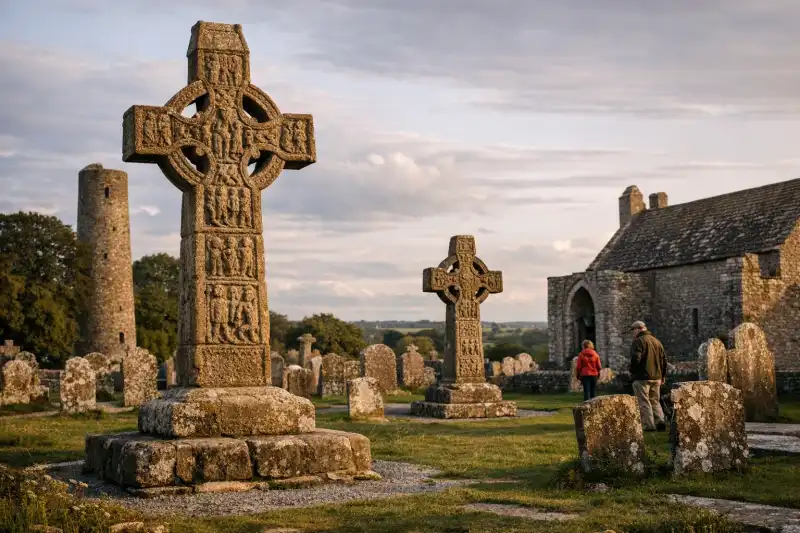
The High Crosses of Kells in Ireland stand at the heart of one of the country’s most evocative early medieval landscapes, where carved stone, monastic memory, and small-town life still meet in remarkably direct ways. In County Meath, not far from the great ceremonial centers of the Boyne Valley, Kells preserves a cluster of monumental crosses that speak to a period when monasteries were not only religious communities but also centers of scholarship, art, politics, and regional influence. For many visitors, Kells is forever associated with the famous illuminated manuscript known as the Book of Kells, yet the standing sculpture outside is just as compelling: weathered figures, intricate panels, and giant stone arms rising above grass and graves.
Visiting the site today is a quieter experience than a major museum stop, and that is part of its appeal. The crosses are woven into the town rather than isolated from it, so a trip here feels like discovering a living historical setting rather than entering a sealed archaeological park. You can walk through the old churchyard, look up at the surviving round tower, and see how the crosses still define sacred space more than a thousand years after they were raised. Even in Ireland, a country rich in monastic ruins and medieval stonework, the High Crosses of Kells hold a special place for the scale of their carving, the importance of their iconography, and the way they connect art, faith, and landscape in one compact but unforgettable site.
History
Early monastic Kells
The story of the High Crosses of Kells begins with the monastery that gave them meaning. Kells developed into an important ecclesiastical center in the early medieval period, most famously linked with the Columban tradition. According to tradition and historical interpretation, monks associated with Iona settled here in the wake of Viking disruption in the Irish Sea world. By the early 9th century, Kells had become a leading monastery with strong spiritual and political significance.
In early medieval Ireland, monasteries were not remote, purely contemplative institutions. They were places of worship, learning, manuscript production, craftwork, and regional authority. A major monastery like Kells attracted patrons, pilgrims, clergy, and artisans. It also needed visible markers of prestige and devotion. Monumental crosses answered that need perfectly. They framed sacred ground, proclaimed Christian stories in stone, and demonstrated the resources and artistic ambition of the community that commissioned them.
The town itself grew out of this religious foundation. Although much of the monastic enclosure has changed over the centuries, the surviving elements still suggest the importance of the original establishment. The high crosses were part of a larger sacred complex that would once have included churches, boundary features, workshops, burial grounds, and spaces for preaching and ceremonial gathering.
The creation of the high crosses
Most scholars date the great crosses at Kells to roughly the 9th and 10th centuries, during the high point of monumental stone carving in Ireland. This was the era when freestanding crosses, often ringed and heavily sculpted, became some of the finest expressions of Insular Christian art. They translated themes known from manuscripts and metalwork into large public monuments.
The crosses at Kells were not made simply as grave markers. They were statements in stone. Their surfaces carried biblical scenes, ornamental interlace, geometric motifs, and figurative carving intended to instruct, commemorate, and inspire. In a society where literacy was limited, carved imagery had enormous communicative power. A cross in a monastic setting could serve as a focus for prayer, public devotion, processions, and teaching.
Kells became especially distinguished because of the scale and number of its crosses. Though some are damaged and others have been moved or protected over time, the site still preserves the impression of a richly sculpted monastic center. Each cross had its own program and visual identity, but together they formed part of an integrated sacred landscape.
Viking-age pressures and medieval continuity
Like many Irish monasteries, Kells existed in a time of instability as well as creativity. The Viking age brought raids, shifting power, and the need for communities to protect both their people and treasured objects. Yet monastic life persisted, adapted, and in some places flourished. The carving of the crosses at Kells reflects this resilience. Rather than a fragile or collapsing culture, they reveal an institution investing in ambitious religious art even amid external pressures.
Kells remained important through the later medieval period, though the character of ecclesiastical organization in Ireland gradually changed. Reforms, political realignments, and evolving church structures altered the role of older monastic settlements. Buildings decayed, were rebuilt, or disappeared. Some monuments fell, weathered, or were reused. The crosses endured because of their sheer mass and sacred significance, but they did not pass through the centuries untouched.
Antiquarian interest and modern preservation
From the 18th and 19th centuries onward, antiquarians, artists, and early archaeologists increasingly documented Ireland’s high crosses, recognizing them as major works of national heritage. Kells drew special attention because of its connection to early Christian scholarship and because the sculptural remains were still so striking. Drawings, measurements, and later photographs helped preserve details that continued weathering might obscure.
Modern conservation has had to balance access with protection. Exposure to rain, frost, biological growth, and air pollution can slowly soften carved surfaces. As a result, some Irish high crosses have been moved indoors or sheltered with replicas left outside. At Kells, preservation efforts and interpretation have sought to retain the atmosphere of the site while making its significance legible to visitors.
Today the High Crosses of Kells are appreciated both as religious monuments and as masterpieces of early medieval European sculpture. They reward close looking, because their value lies not just in age but in artistry: every surviving panel and fragment gives insight into the world that produced them.
Key Features
What makes the High Crosses of Kells so memorable is not a single monument but the way several elements combine to create a distinctly Irish sacred setting. The crosses themselves are the obvious focus. Rising from the churchyard and adjacent spaces, they have the commanding presence of public monuments yet retain the intimacy of hand-carved devotional objects. Their massive shafts, ringed heads, and relief panels invite both distant admiration and close inspection. Depending on the light, the carvings can seem boldly graphic or almost ghostly, their figures emerging from stone worn by a millennium of weather.
The most celebrated among them is often called the Market Cross, a richly decorated example associated with some of the finest sculptural work at Kells. Even where details have softened, the monument still conveys extraordinary ambition. Biblical scenes, ornamental patterns, and structural balance all work together in a design that is both theological and deeply artistic. It stands as a reminder that early medieval Ireland produced monumental art of international importance, not only illuminated manuscripts but also stone sculpture on a grand scale.
Other crosses at Kells are no less intriguing for being fragmentary or less ornate. Their value lies partly in comparison: by moving from one to another, visitors can see different levels of preservation, different decorative priorities, and perhaps different dates or workshops. Some carvings emphasize human figures and scriptural narrative; others lean more heavily on abstract ornament. The variation helps reveal that the tradition was not formulaic. These were sophisticated commissions, adapted to place and purpose.
The setting of the crosses is equally important. They are linked to the old monastic enclosure, whose surviving traces include the round tower and churchyard. The round tower, a familiar feature of many Irish monastic sites, adds vertical drama and anchors the site firmly in the early Christian landscape of Ireland. Even if the original monastery is no longer complete, the combination of tower, graveyard, and crosses allows visitors to read Kells as a layered sacred precinct rather than a collection of isolated objects.
Another defining feature is the relationship between Kells and the wider story of Insular art. Visitors often arrive because of the Book of Kells, even though the manuscript is now in Dublin. The stone crosses help complete that picture. They demonstrate that the same world capable of producing dazzling manuscript pages also carved complex religious imagery into sandstone for public display. Interlace, symbolic composition, and narrative density all carry over from one medium to another. Seeing the crosses makes the artistic culture of early medieval Ireland feel more three-dimensional and civic.
The human scale of the visit also stands out. Unlike some ancient sites that require long walks through open countryside, the High Crosses of Kells are integrated into an accessible town environment. That accessibility does not diminish their atmosphere. In fact, it sharpens it: schoolchildren, parish life, local traffic, and casual walkers continue to circulate around monuments first raised in a monastic age. Few places make continuity so visible. Kells is not a ruin abandoned by history; it is a town still shaped by it.
Finally, the site’s weathered surfaces are themselves part of the experience. A first-time visitor may expect crisp carvings and be surprised by how much depends on patience and angle of view. But this is exactly what gives the crosses their depth. They are not pristine reconstructions. They have survived centuries of rain and ritual, neglect and reverence. Looking closely becomes an act of interpretation. A face, a fold, a border pattern, or a biblical scene gradually emerges, and with it comes a sense of direct contact with the medieval sculptor’s hand.
Getting There
Kells is one of the easier historic towns in Ireland to reach from Dublin, making the High Crosses of Kells a practical day trip even without a car. By road, the journey from central Dublin usually takes about 1 hour to 1 hour 20 minutes depending on traffic, mainly via the M3. A rental car offers the most flexibility if you plan to combine Kells with other Boyne Valley sites. Expect fuel and toll costs of roughly €15-€25 for a return day trip, depending on vehicle and route.
Public transport is also workable. Bus Éireann and other regional coach services connect Dublin with Kells from major departure points such as Busáras or Dublin Airport routes passing through the region. One-way fares are commonly around €10-€18, with return fares varying by operator and advance booking. Travel time is usually 1 hour 15 minutes to 1 hour 45 minutes. Once in Kells, the high crosses are within walking distance of the town center, so there is no need for an additional taxi unless mobility is a concern.
If you are coming from elsewhere in Meath or from the Boyne Valley, local roads make Kells easy to fold into a heritage itinerary with passage tombs, medieval ruins, and historic estates. Guided day tours from Dublin sometimes include broad “Ancient East” or Boyne Valley circuits; however, not all stop long enough for a detailed look at the crosses, so check itineraries carefully.
Parking in Kells is generally straightforward compared with larger tourist centers. Allow a few euros for town-center parking if required, though some areas may offer free or time-limited spaces. Comfortable walking shoes are recommended, especially in wet weather, as churchyard ground can be uneven.
When to Visit
The best time to visit the High Crosses of Kells is from late April through early October, when longer daylight hours and milder weather make it easier to appreciate the sculpture and linger in the churchyard. May and June are especially appealing: the grass is bright, the town is lively without peak-season crowding, and soft daylight often reveals carved details better than harsh midsummer sun. July and August bring the warmest conditions, with daytime temperatures commonly around 17-22°C, but they can also mean more visitors on regional heritage routes.
Spring and autumn are ideal for travelers who want atmosphere without busier summer patterns. In September, the light can be excellent for photography, and the site feels calm and reflective. Autumn rain is common, but mist and shifting clouds can suit the monument’s medieval character surprisingly well. Bring a waterproof layer, because even short showers can sweep through quickly.
Winter visits are absolutely possible and have their own rewards. The crosses look dramatic in low-angle light, and you may have the site nearly to yourself. The main drawbacks are colder temperatures, shorter days, and more frequent wet or windy conditions. Fine carved details are harder to study if surfaces are dark with rain, so a dry winter morning is better than a stormy afternoon.
For the best experience in any season, aim for early morning or late afternoon. Midday can flatten the carvings visually, while angled light helps relief work stand out. If you are interested in photography or close visual study, avoid heavy rain and carry a lens cloth. Kells is compact enough that even a short visit can be rewarding, but a calm hour in good light will reveal much more than a rushed stop in poor weather.
| Quick Facts | Details |
|---|---|
| Site name | High Crosses of Kells |
| Location | Kells, County Meath, Ireland |
| Historical period | Early medieval, mainly 8th-10th centuries CE |
| Cultural context | Irish Christian monastic sculpture |
| Best known for | Monumental carved stone high crosses linked to a major monastery |
| Nearby landmark | The round tower and historic churchyard at Kells |
| Suggested visit length | 45 minutes to 1.5 hours |
| Good base for visitors | Kells, Navan, or Dublin |
| Best season | Late spring to early autumn |
| Suitable for day trip from Dublin | Yes |
Guided tours: worth it?
Most travelers can visit High Crosses of Kells independently. Compare a tour only if you want a tighter history-focused visit, easier logistics, or a guide who can answer questions on the spot.
Best for
- Short visits where a planned route saves time
When to go self-guided
Go independently if you prefer setting your own pace, reading as you go, and checking official hours or ticket rules directly before you arrive.
What I’d avoid
Skip paid tours that bundle unrelated stops you do not actually want. The best option should either save meaningful planning time or add historical context you would miss on your own.
Kells and County Meath Day Tours
Useful when: you want to compare guided formats before deciding
Boyne Valley and Kells Tours
Useful when: you want to compare guided formats before deciding
Ancient Ireland Tours from Dublin
Useful when: transport or pickup logistics matter
Some tour links are affiliate links, which may earn Ancient Travel a small commission at no extra cost to you. I try to surface options that make practical sense for the site—not just anything bookable.
Frequently Asked Questions
What are the High Crosses of Kells?
The High Crosses of Kells are monumental carved stone crosses associated with the medieval monastery at Kells in County Meath, Ireland. They are among the most important examples of Irish early Christian sculpture.
Where are the High Crosses of Kells located?
They stand in and around the historic monastic enclosure at Kells, County Meath, roughly an hour’s drive northwest of Dublin.
Do you need a ticket to see the High Crosses of Kells?
The crosses can usually be viewed from the churchyard area without a major admission barrier, though access to associated heritage attractions or visitor exhibitions nearby may involve an entry fee.
How long should I spend at the High Crosses of Kells?
Most visitors spend 45 minutes to 1.5 hours exploring the crosses, churchyard, round tower, and nearby heritage interpretation.
When is the best time to visit the High Crosses of Kells?
Late spring through early autumn offers the best light and weather, but early morning or late afternoon is ideal for quieter views and better visibility of the carvings.
Are the High Crosses of Kells suitable for families?
Yes. The site is compact, centrally located in Kells, and easy to combine with other family-friendly stops in the Boyne Valley and County Meath.
Nearby Ancient Sites
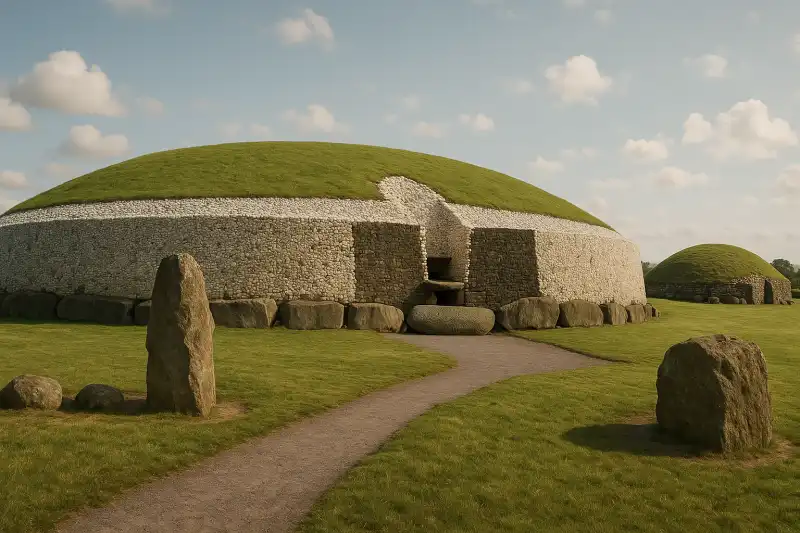
Boyne Valley Passage Tombs Travel Guide 2026: Newgrange, Knowth, and Dowth Visit Strategy
Neolithic IrelandPlan your first Boyne Valley passage tombs visit with practical timing, Brú na Bóinne access flow, a...
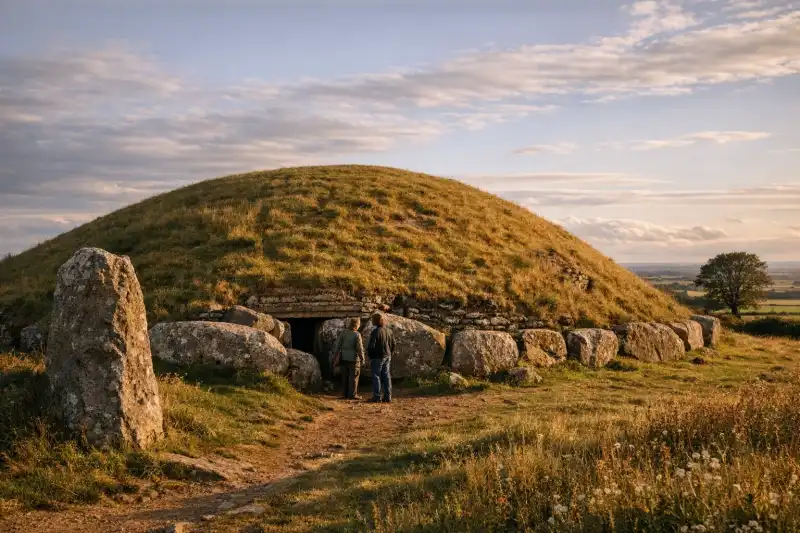
Dowth
Neolithic communities of Brú na BóinneAncient passage tomb in Ireland's Boyne Valley, famed for Neolithic art, winter light, and sweeping ...
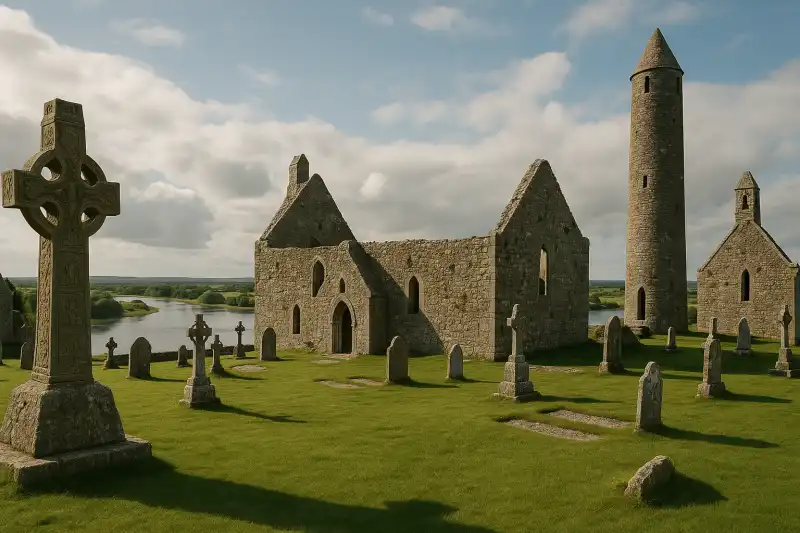
Clonmacnoise Travel Guide 2026: Monastic Ruins, High Crosses, and River Shannon Context
Early Medieval IrelandPlan a first visit to Clonmacnoise with practical timing, monastic-site context, and clear route adv...
Dublin Castle Travel Guide 2026: State Apartments, Viking Layers, and City-Center Route
Medieval and Early Modern IrelandPlan a first visit to Dublin Castle with practical timing, ticket strategy, and clear context on the...