Quick Info
Curated Experiences
Full Day Tour: Huacas del Sol y de la Luna, Chan Chan and Huanchaco
Moche Route Private Tour: Huaca de la Luna and Trujillo
Northern Peru Archaeology Circuit: Moche and Chimu Sites
Here is the 240-word introduction in AncientTravel style:
Five kilometers south of Trujillo on Peru’s northern coast, the Huacas de Moche — Huaca del Sol and Huaca de la Luna — rise from the coastal desert as the largest surviving monuments of the Moche civilization, a state-level society that dominated the region from roughly 100 to 800 CE. Huaca del Sol, the larger of the two structures, once contained an estimated 143 million hand-stamped adobe bricks and served as the political and administrative center of Moche power. Huaca de la Luna, 500 meters to the east across a buried urban quarter, functioned as a ceremonial and religious complex — its interior platforms sealed and rebuilt at least five times over several centuries, each new construction layer encasing the last, preserving an extraordinary stratigraphic record of Moche ritual life.
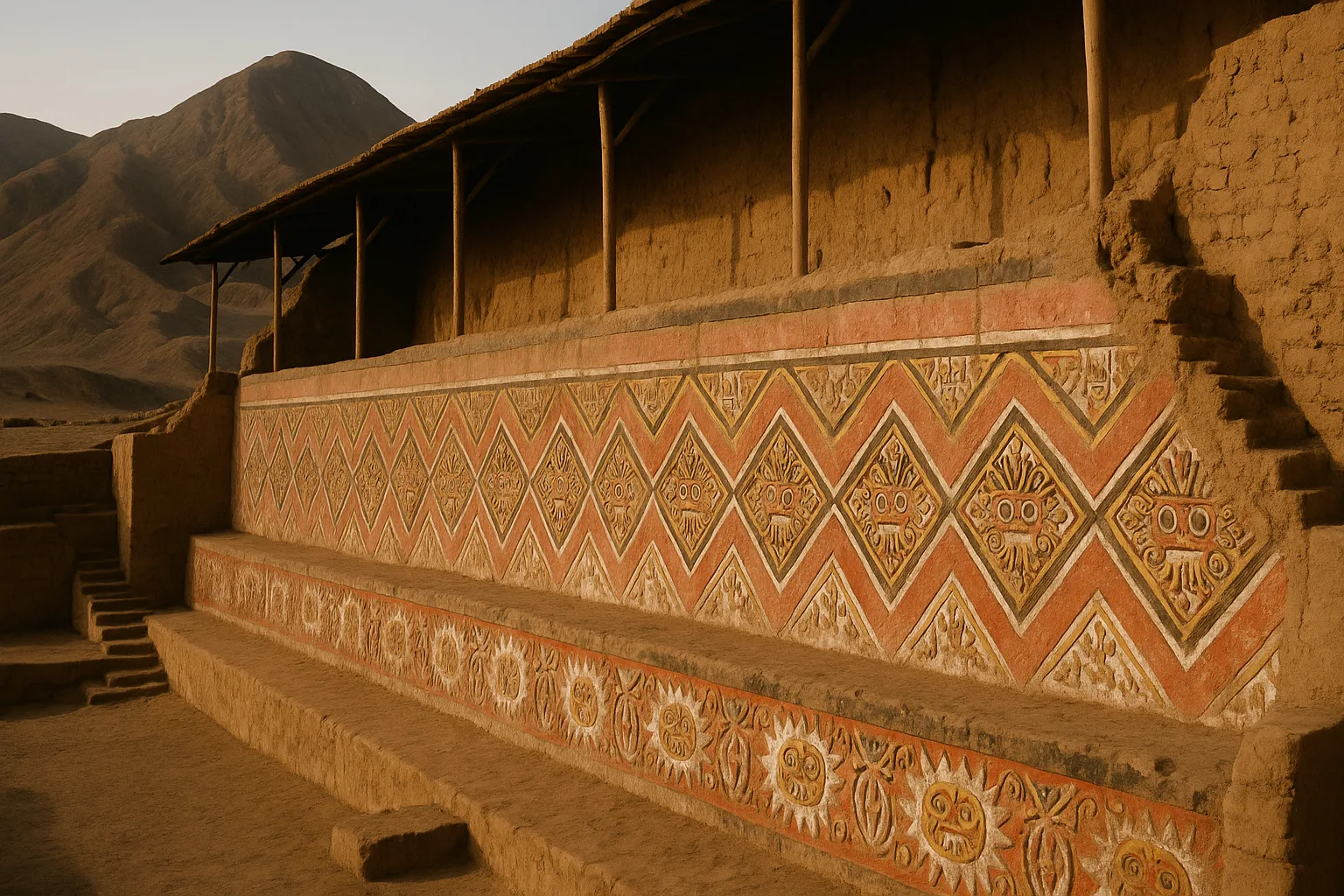
What makes Huaca de la Luna exceptional is not scale alone but iconographic richness. Its excavated façades reveal polychrome murals depicting Ai Apaec, the fanged deity central to Moche cosmology, repeated across entire walls in high relief. Sacrificial plazas, elaborate burial platforms, and a well-curated on-site museum allow visitors to move from raw archaeology into interpreted meaning without leaving the complex.
This guide covers the paired pyramids’ history, their key monuments and the museum circuit, practical access from Trujillo and Huanchaco, and how to combine the Huacas with Chan Chan for a full northern Peru archaeology day.
History: Moche Power on Peru’s North Coast
Origins of the Moche State (c. 100–300 CE)
The Moche civilization emerged along the arid coastal valleys of northern Peru at a time when the desert and the sea defined both the challenge and the resource base of Andean life. Drawing on earlier Cupisnique and Salinar traditions, the Moche developed into a sophisticated polity that controlled a string of river valleys from the Lambayeque region in the north to the Nepeña valley to the south. At the center of this world stood the Moche Valley itself, where construction of two massive adobe platforms—later known as Huaca del Sol and Huaca de la Luna—began as early as the first century CE. These structures were not raised in a single campaign but accumulated across generations, each new layer burying its predecessor in a deliberate act of renewal and consecration.
Ritual Power and the Warrior-Priest Complex
The Moche state was organized around a ruling class of warrior-priests whose authority fused military dominance with sacred legitimacy. Elaborate tombs at Sipán and other sites confirm that elite individuals were buried with gold, copper, ceramic vessels, and sacrificial offerings that mirror scenes depicted on the famous Moche fine-line pottery. At Huaca de la Luna, polychrome murals portray the Decapitator deity—a fanged being associated with sacrifice—alongside processions of bound captives. Archaeological evidence of actual human sacrifice at the base of the platform confirms these murals were not merely symbolic: ritual killing of war prisoners formed a cornerstone of Moche political theology, publicly demonstrating the ruler’s ability to mediate between the human world and the supernatural.
Expansion, Fragmentation, and Late Moche Decline (c. 600–800 CE)
By the sixth and seventh centuries CE, the Moche state faced mounting stresses. Extended drought cycles linked to El Niño events disrupted the irrigation agriculture on which the coastal valleys depended. Internal tensions between northern and southern Moche polities appear to have fractured political unity, producing distinct regional styles visible in ceramics and monumental architecture. New construction at Huaca de la Luna continued into the late Moche period, but the scale and coherence of earlier centuries gave way to more localized patterns. By roughly 800 CE the site had been largely abandoned, its plazas silted over and its murals sealed beneath windblown sand.
Chimu Succession and Regional Memory
The vacuum left by the Moche’s decline was eventually filled by the Chimu state, whose capital Chan Chan rose just a few kilometers to the northwest. The Chimu inherited irrigation systems, craft traditions, and likely oral histories from their Moche predecessors, grafting new administrative ambitions onto a landscape already shaped by centuries of Moche investment. When the Inca absorbed the Chimu around 1470 CE, the great adobe mounds at the Moche Valley were already ancient ruins, venerated perhaps as ancestral landmarks in a region whose memory of coastal power stretched back more than a millennium.
The Key Monuments: What to See at Huaca del Sol and Huaca de la Luna
The Huacas de Moche complex sits roughly five kilometers southeast of Trujillo’s city center, where the Moche River once ran closer to the ceremonial platforms before centuries of shifting channels and desert encroachment reshaped the landscape. Two massive adobe structures dominate the site, separated by what was once an active urban zone. Understanding what each monument offers—and what access looks like today—helps you make the most of limited time.
Huaca de la Luna: The Mural Temple
Huaca de la Luna is the centerpiece of any visit. Built in successive phases over roughly seven centuries, the pyramid was constructed by entombing one platform inside the next, each new layer sealing the murals of the previous era. Archaeologists have peeled back portions of these outer shells to reveal extraordinary polychrome relief friezes depicting Ai Apaec, the Moche fanged deity associated with sacrifice and regeneration, alongside processional warriors, decapitated prisoners, and layered geometric borders in ochre, cream, and turquoise. The exposed sections are protected beneath tensile canopies, and guided walkways allow close inspection of some of the most intact pre-Columbian painted surfaces in all of the Americas. The murals are not decoration—they functioned as theological statements visible to participants in ritual ceremonies conducted on the summit plaza.
Huaca del Sol: Scale and Restricted Access
Across the dry inter-site zone, Huaca del Sol is a more imposing structure by sheer mass. At its peak the platform may have contained over 140 million adobe bricks, making it one of the largest pre-Columbian constructions in South America. Spanish colonial mining operations in the seventeenth century diverted the Moche River directly against the monument to extract buried gold, destroying roughly two-thirds of the original structure. What remains is still visually striking from the exterior, but active excavation and conservation priorities mean public access is significantly more restricted than at Huaca de la Luna. Most visitors view Huaca del Sol from observation points rather than walking its surface.
The Site Museum and Ceremonial Plaza
The Museo Huacas de Moche sits at the site entrance and should not be rushed. It houses skeletal remains of sacrificial victims found in the plaza between the two pyramids, ceramic vessels that illustrate Moche naturalistic portraiture, and interpretive displays that reconstruct the spatial logic of ceremonies. The plaza between the huacas was the zone where crowds assembled, where prisoners were displayed before ritual sacrifice, and where the physical and spiritual authority of Moche lords was performed. Walking this space with the museum context sharpens what would otherwise feel like open desert.
Architecture and Construction Logic
Moche builders worked with sun-dried adobe bricks stamped with maker’s marks—a detail that has allowed archaeologists to trace labor organization across regions. The platforms were not built by slaves but through a labor tribute system called mit’a, in which communities contributed work as a form of political participation. The resulting platforms were intentionally massive and visible for kilometers across the coastal plain, functioning as permanent advertisements of institutional power. Each successive platform buried and consecrated what came before, creating a palimpsest of Moche political history that excavation continues to decode.
Getting There: Transportation and Access from Trujillo/Huanchaco
The Huacas de Moche complex sits roughly 5 km southeast of central Trujillo and about 8 km from Huanchaco, making it easy to reach by multiple options.
From Trujillo City Center
Taxi: The most straightforward option. Negotiate a fare before departing — expect to pay S/10–15 (roughly $3–4 USD) one way from the Plaza de Armas. Ask drivers to wait or arrange a return pickup, as taxis back to the city can be scarce at the site entrance.
Combi/Colectivo: Shared minibuses labeled “Huacas de Moche” or “La Campiña” depart from Avenida España near the market. Fare is approximately S/1.50–2 ($0.40–0.55 USD) each way. Journey time is 20–30 minutes depending on traffic. Ask the driver to drop you at the Huaca de la Luna entrance road; it’s a short walk from the main stop.
From Huanchaco
Taxis from Huanchaco run S/15–20 ($4–5.50 USD) one way. Many travelers combine a morning at the huacas with an afternoon at Huanchaco, asking the taxi to wait during their visit — budget S/40–50 ($11–14 USD) for a round-trip with wait time.
Tour Packages
Organized day tours from Trujillo hotels bundle transport, a guide, and often Chan Chan in the same circuit. These typically run $35–50 USD per person and eliminate all logistics at once — the recommended approach for first-time visitors.
Practical Information
Admission: Entry to Huaca de la Luna and the on-site museum circuit is approximately S/15–20 (USD $4–5) for foreign visitors. Combination tickets that include Huaca del Sol viewpoint access may cost slightly more; confirm pricing at the gate. Children under 12 typically enter free or at reduced rates.
Hours: The site generally opens daily from 9:00 AM to 4:00 PM, with last entry around 3:30 PM. Hours can shift slightly during Peruvian public holidays, so confirm with your hotel or the site directly the morning of your visit.
Museum Circuit: The Museo Huacas de Moche sits adjacent to Huaca de la Luna and is included in standard admission. It houses excavated ceramics, sacrificial offering contexts, and high-quality interpretive panels explaining Moche cosmology and the Decapitator deity iconography visible on the platform friezes. Budget 30–45 minutes here before or after your pyramid tour.
What to Bring: Sun protection is essential — the desert coastal plain offers zero shade between structures. Bring a hat, sunscreen (SPF 50+), at least one liter of water per person, and closed-toe shoes for uneven adobe surfaces. A camera with a zoom lens helps capture mural detail without crossing barriers.
When to Visit: Seasonal Considerations
Huaca de la Luna sits in the coastal desert outside Trujillo, where the Humboldt Current keeps conditions remarkably stable year-round. That said, season and time of day still matter for comfort and photography.
December–March: Austral Summer
Daytime temperatures climb into the high 20s Celsius (low 80s°F). The sky is often hazy with coastal fog that diffuses midday light — workable for photography but occasionally flat. Visit before 10 a.m. to avoid the worst heat on the open pyramid platforms.
April–May: Shoulder Season
One of the more pleasant windows. Temperatures moderate, tour group volumes drop after Easter week, and light quality improves as the marine layer thins. A strong choice for independent travelers who want manageable crowds without sacrificing visibility.
June–September: Austral Winter
The coolest, driest stretch. Morning garúa (coastal mist) can linger until mid-morning but typically clears by the time the site opens fully. Afternoon light at Huaca de la Luna is excellent for capturing the relief details on the painted friezes. This is the peak season for Peruvian domestic tourism, so some organized tour traffic increases.
October–November: Second Shoulder
Transitional months bring moderate temperatures and lower organized-tour pressure than high winter. Often overlooked, this window offers a good balance of light, crowd levels, and comfort — particularly useful if combining with an inland drive toward highland sites.
How to Combine Huaca del Sol and Huaca de la Luna with Nearby Sites
The Huacas de Moche sit at the center of the densest concentration of pre-Columbian archaeology on Peru’s north coast, making them a natural anchor for a multi-site itinerary. Most visitors pair them with at least one additional stop the same day, and a well-sequenced circuit can cover two or three major sites without feeling rushed.
Huacas + Chan Chan (most popular combination): The classic Trujillo day. Spend your morning at Huaca de la Luna — light is better for the polychrome reliefs before noon — then transfer north to Chan Chan for the afternoon. The two sites represent successive north-coast civilizations: Moche ceremonialism followed by Chimu urban planning on a massive scale. The contrast in architectural logic — ritual platform versus administrative city — makes each site sharper in context. Budget an hour for Chan Chan’s Tschudi Palace complex plus transit. Huanchaco beach is a natural end point for sunset and ceviche.
Huacas + El Brujo (archaeology-focused day): For visitors with a strong interest in Moche iconography, El Brujo offers a compelling counterpart. The complex includes Huaca Cao Viejo, with its own intact Moche friezes, and the Museo Cao, which houses the Lady of Cao — one of the most significant archaeological finds in the Americas. El Brujo is roughly 60 km northwest of Trujillo (about 90 minutes each way), so this pairing works better as a dedicated day rather than a rushed double. Organized tours occasionally link both sites.
Three-site circuit: Ambitious travelers can hit Huacas, Chan Chan, and El Brujo across two days, using Trujillo or Huanchaco as a base. This gives you the full Moche-to-Chimu arc of northern Peru’s pre-Columbian story without shortcuts.
Quick Facts
| Field | Details |
|---|---|
| Civilization | Moche, later Chimu and Inca influence in region |
| Period | c. 100-1532 CE |
| Established | c. 100 CE Moche ceremonial complex |
| Typical Visit Time | 2-3 hours (site + museum) |
| Best Combined With | Chan Chan and Huanchaco |
| Preservation Note | Access focus is on Huaca de la Luna for conservation reasons |
Explore More Ancient Sites in Peru
After the Moche pyramids, compare northern Peru’s later adobe urbanism at Chan Chan, then contrast coastal construction traditions with highland Inca stonework at Sacsayhuaman and Machu Picchu.
Frequently Asked Questions
Can you visit both Huaca del Sol and Huaca de la Luna?
Visitors primarily access Huaca de la Luna and the museum circuit, where conservation and interpretation are focused. Huaca del Sol has more restricted access due to preservation concerns and historical damage.
How much time should I plan for the site?
Plan 2-3 hours for Huaca de la Luna plus the museum if visiting independently. A combined day tour with Chan Chan and Huanchaco usually runs 7-9 hours total.
Is it better to visit independently or with a guide?
A guide is strongly recommended here because iconography and ritual sequencing in the murals are complex. Without context, many of the most important political-religious details are easy to miss.
What is the best season to visit near Trujillo?
The coast is visitable year-round, but austral winter and shoulder months often offer cooler daytime conditions. Summer can be warmer and brighter, which is great for photography if you avoid midday glare.
Can this site be combined with Chan Chan in one day?
Yes, and that is the most efficient archaeology day in Trujillo. Most travelers start with Huaca de la Luna in the morning, then continue to Chan Chan and finish at Huanchaco.
Nearby Ancient Sites
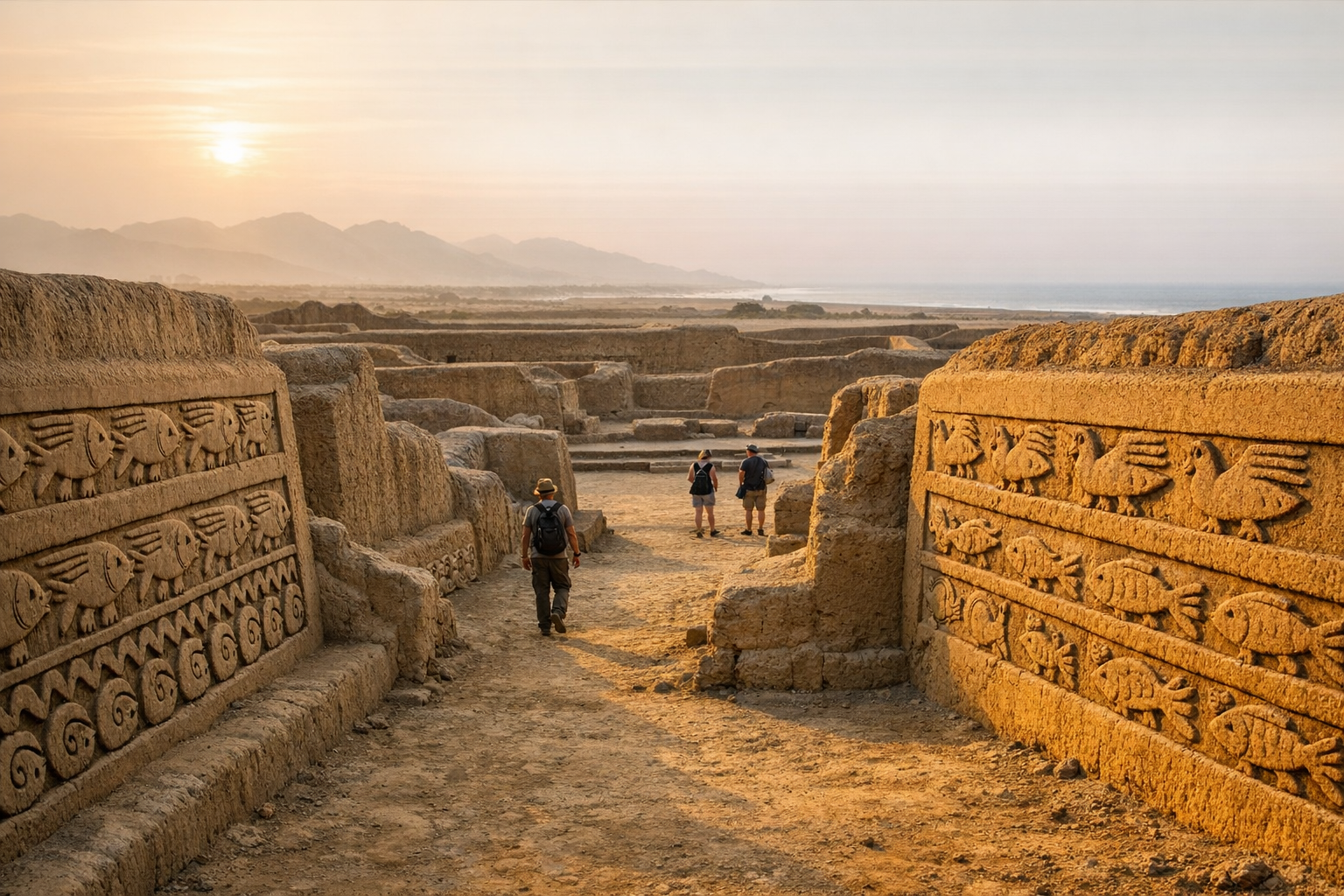
Chan Chan Peru Guide 2026: Chimu Capital & Adobe Citadels
ChimuExplore Chan Chan near Trujillo — the largest pre-Columbian city in the Americas. Discover the Chimu...
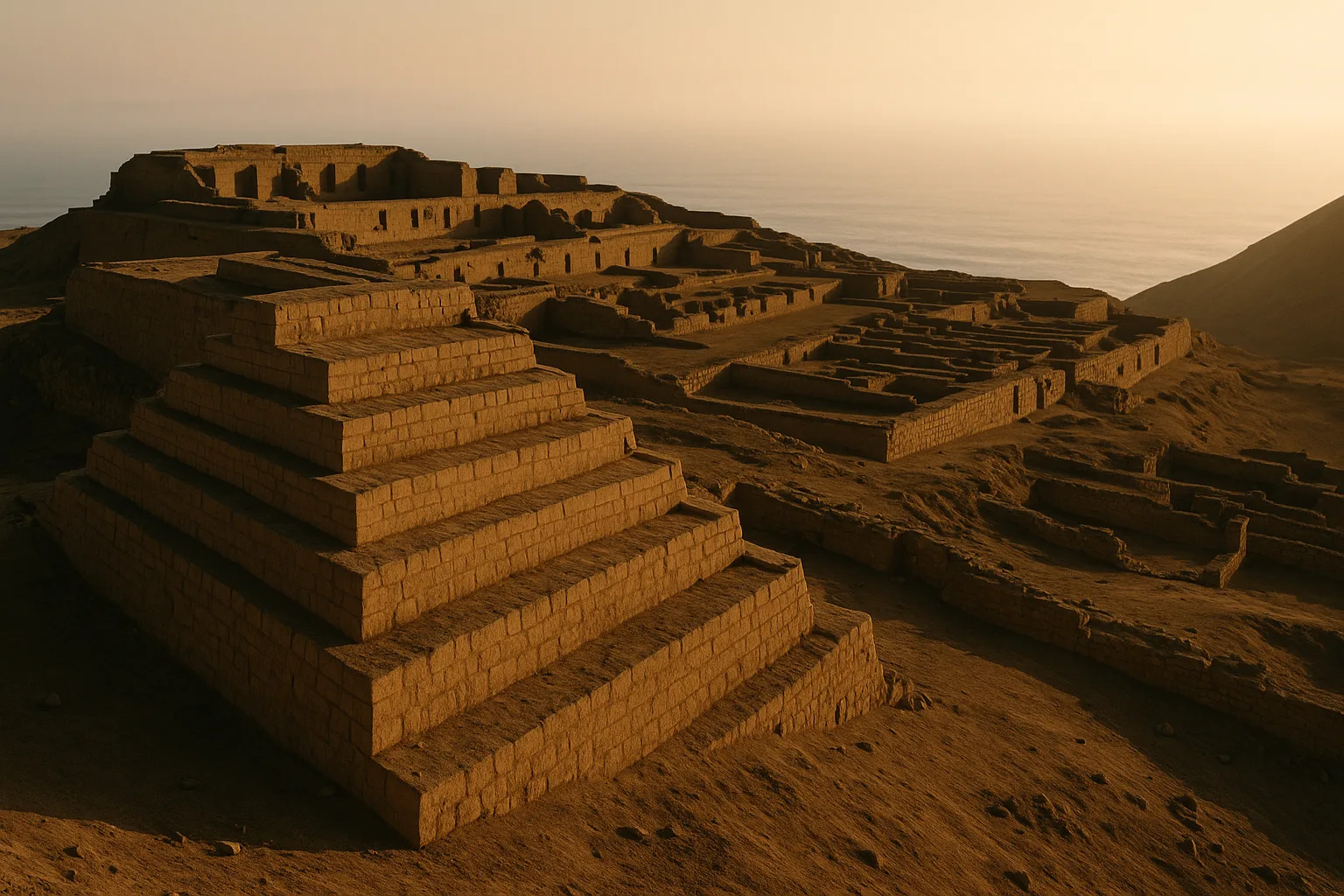
Pachacamac Peru Guide 2026: Oracle Temple, Pilgrimage Roads & Lima Coast
Lima-Wari-Ychsma-IncaExplore Pachacamac near Lima: ancient oracle temples, multi-civilization coastal history, practical ...