Quick Info
Curated Experiences
Lima City Tour with Huaca Pucllana and Historic Center
Private Miraflores and Huaca Pucllana Archaeology Tour
Lima Archaeological Circuit: Huaca Pucllana and Pachacamac
Here is the 240-word introduction:
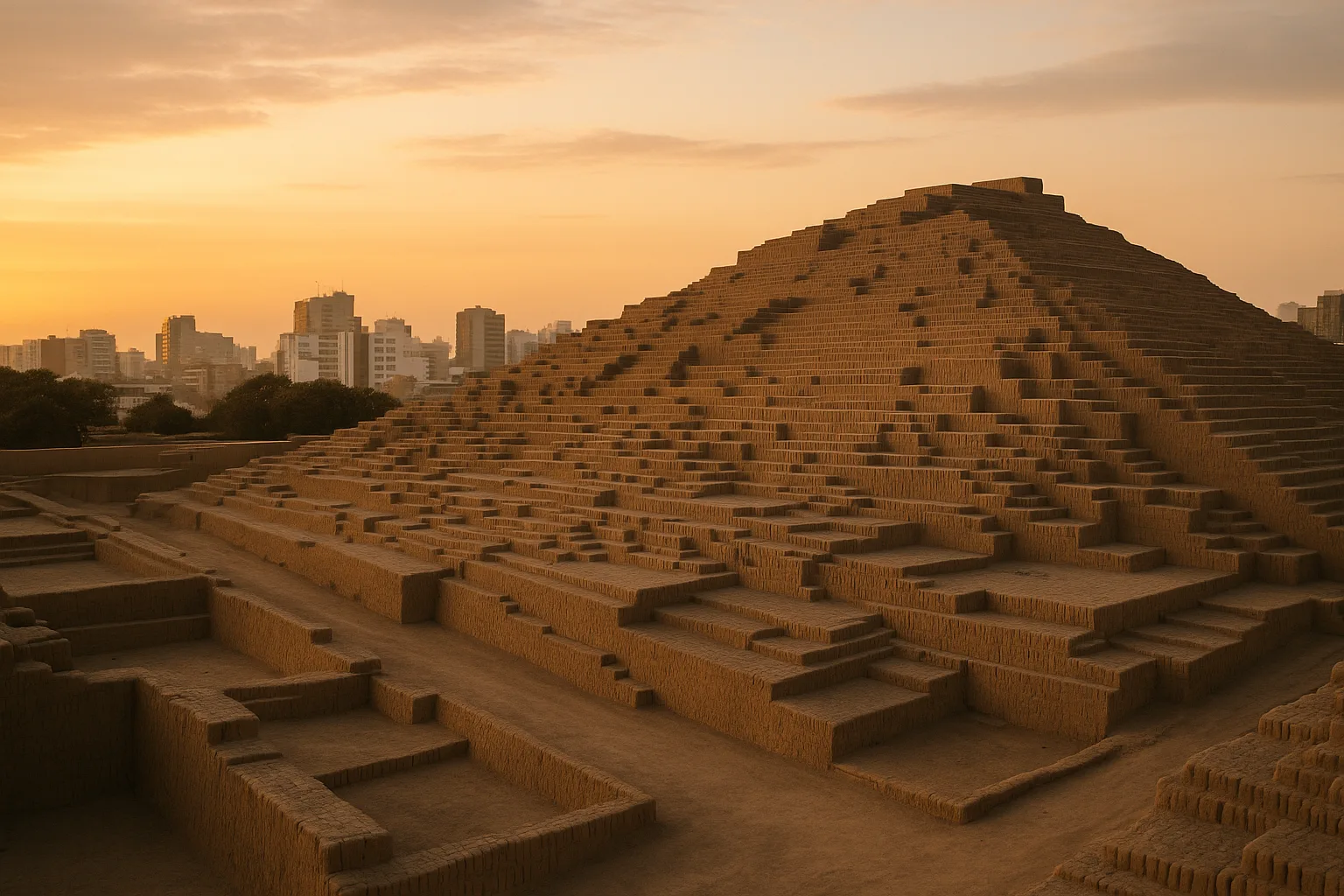
Rising seven stories above the Miraflores residential grid in central Lima, Huaca Pucllana is one of the most improbable archaeological sites in the Americas: a massive pre-Inca adobe pyramid that survived centuries of urban encroachment to stand today as an active excavation zone surrounded on all sides by apartment buildings, restaurants, and city traffic. Built and expanded by the Lima Culture between roughly 500 and 700 CE, the stepped pyramid served as a ceremonial and administrative center for a coastal society that flourished in the Rímac and Lurín valleys long before Inca expansion reorganized the Peruvian coast.
What makes Huaca Pucllana genuinely remarkable is not just its survival but its continued revelation. Archaeologists have been working the site since the 1980s, and the excavation is ongoing — visitors on guided tours walk past active dig trenches, freshly exposed adobe brickwork, and storage areas where recently unearthed ceramics are being catalogued. The on-site museum displays mummies, textiles, and ceramics recovered from the complex, while the restaurant operating at the site’s perimeter has made the pyramid a fixture of Lima’s culinary scene.
For travelers building a Peru itinerary around pre-Columbian history, Huaca Pucllana fills a specific and important gap: it represents the coastal urban tradition of adobe monumentalism that developed independently of highland stone architecture. A visit here, combined with a day trip to Pachacamac or a future journey to Caral, gives Lima its proper weight as the center of a long and complex ancient history.
History: Adobe Pyramid in a Growing Metropolis
Origins of the Lima Culture (c. 200–700 CE)
Huaca Pucllana began taking shape around 500 CE under the hands of the Lima Culture, a sophisticated coastal society that flourished in the river valleys between the Chillón and Lurín rivers long before Inca expansion reached the coast. Lima Culture people were accomplished fishers, weavers, and administrators who organized labor at a scale that could raise a stepped pyramid in the heart of what is now one of South America’s largest cities. Their construction material of choice was the adobe brick—hand-molded from alluvial clay and set in the distinctive “bookshelf” stacking pattern visible throughout the pyramid’s surviving terraces. This technique distributes seismic stress more effectively than solid courses, a pragmatic solution for a region that sits on active fault lines.
A Ceremonial and Administrative Hub
The pyramid itself was not a tomb or a place of passive worship. Excavations have recovered evidence of repeated feasting events, the deliberate smashing of fine ceramics, and offerings of camelid textiles—behaviors consistent with cyclical ritual renewal rather than a one-time dedicatory act. Administrators likely coordinated tribute collection and redistribution from platforms on the upper terraces, making Huaca Pucllana simultaneously a religious theater and a practical center of regional governance. Its position on what was then the edge of cultivated fields gave priests and officials clear sight lines toward the sea and the agricultural hinterland alike.
Ychsma Reuse and Inca Integration
When Lima Culture influence faded around 700 CE, the Ychsma people—who held coastal dominion across much of this valley network—absorbed Huaca Pucllana into their own ceremonial landscape. Burials from the Ychsma period found on the pyramid’s flanks point to continued sacred significance even as the site’s administrative functions evolved. By the late fifteenth century, Inca expansion brought new administrative frameworks to the coast. The Inca incorporated existing coastal huacas rather than erasing them, and Huaca Pucllana received offerings consistent with imperial ancestor veneration, adding a final pre-colonial chapter to a structure already more than nine hundred years old.
Colonial Destruction and Modern Rediscovery
Spanish colonial land grants turned much of the surrounding terrain into agricultural plots and, later, urban parcels. Large sections of the pyramid were quarried for building material or simply leveled. Systematic archaeological excavation began in earnest only in 1981, and ongoing fieldwork continues to expose new burial contexts and refine the site’s chronology. Today roughly a third of the original complex has been cleared and stabilized, giving visitors a partial but vivid window into one of Lima’s oldest urban predecessors.
The Key Monuments: What to See at Huaca Pucllana
Huaca Pucllana is not a single building but a layered complex of ceremonial plazas, storage structures, and a massive stepped pyramid that together reveal the ambitions of a civilization that flourished on Peru’s central coast for roughly a thousand years. The guided circuit moves through distinct zones, each offering a different lens on Lima Culture and later Ychsma occupation.
The Great Pyramid
The centerpiece of the site is the seven-tiered adobe pyramid rising roughly 22 meters above the surrounding neighborhood. Built from millions of handmade adobe bricks arranged in a distinctive “bookshelf” pattern—rows of bricks set vertically rather than laid flat—the structure was designed to absorb seismic stress, a practical innovation on one of the world’s most active tectonic margins. The pyramid’s summit was reserved for ritual use and administrative functions; access for the general population was tightly controlled. Looking across its terraced flanks today, you can trace the incremental construction logic: each platform added mass and authority over generations, transforming a modest ceremonial mound into the defining landmark of a regional polity.
The Ceremonial Plazas and Offering Zones
Flanking the pyramid are a series of open plazas that functioned as staging grounds for public ritual. Excavations have uncovered concentrated deposits of ceramics, textile fragments, and food remains that archaeologists interpret as the residue of periodic feasting and offering events, likely tied to agricultural cycles and the rhythms of the Pacific fishing season. Several areas preserve in-situ evidence of deliberate structured deposits—clusters of objects placed with clear intention rather than discarded—suggesting organized priestly or administrative oversight of these ceremonies. The scale of the plazas implies that large numbers of people gathered here, making Huaca Pucllana a civic as well as a sacred space.
The On-Site Museum
A compact but well-curated museum at the site entrance provides essential context before or after the pyramid circuit. Displays include original ceramics recovered from excavations, textile samples showing Lima Culture weaving techniques, and skeletal remains from burials found within the complex. One of the most striking exhibits presents the remains of human sacrifices discovered in offering contexts, interpreted as part of elite funerary practice. Interpretation panels are available in Spanish and English, and the museum does a particularly good job connecting the stratigraphy of different occupation layers—Lima, Ychsma, and Inca—to the visible architecture outside.
Ychsma and Inca Modifications
The complex you walk through is not purely Lima Culture. After roughly 800 CE, the Ychsma people took over and modified portions of the site, and later the Inca incorporated it into their administrative network following their coastal expansion in the fifteenth century. Look for subtle differences in construction technique and spatial organization in the upper zones: Inca interventions tend toward tighter stonework and more rigidly rectilinear planning, contrasting with the organic adobe growth of earlier phases. This layering of distinct cultures within a single monument makes Huaca Pucllana unusually rich for visitors interested in how Andean civilizations negotiated and inherited sacred space across centuries.
Getting There: Transportation and Access
Huaca Pucllana sits in the heart of Miraflores, one of Lima’s most accessible districts, making it straightforward to reach from most parts of the city.
From Miraflores
If you are already staying in Miraflores, the site is likely within walking distance. The pyramid is located on Calle General Borgoño, roughly a 5–15 minute walk from Kennedy Park or the Larcomar clifftop. No transport needed.
From San Isidro
Taxi or rideshare (Uber, InDriver, Cabify) runs S/8–14 (USD 2–4) and takes 10–20 minutes depending on traffic along Javier Prado or Arequipa Avenue.
From Centro Histórico
Allow 30–50 minutes by taxi or rideshare; fares typically run S/18–28 (USD 5–8). Lima’s notorious congestion on Arequipa Avenue can extend this significantly during peak hours (7–9 AM and 5–8 PM). Budget an extra 15–20 minutes as a buffer before guided tour slots.
From Barranco
Rideshare from Barranco takes 15–25 minutes and costs S/10–18 (USD 3–5). A taxi hailed on the street may be slightly cheaper but confirm the fare before entering.
Practical Notes
- Rideshare apps (Uber and InDriver) are strongly recommended over street taxis for transparent pricing.
- Bus routes along Arequipa Avenue pass within a few blocks but involve unreliable timing.
- Street parking is limited; ride-in, ride-out is the easiest approach.
Practical Information
Admission: Entry to Huaca Pucllana is approximately S/15 (around USD 4) for adults and S/5 for students with valid ID. Children under 12 typically enter free. Tickets are purchased at the site entrance on Calle General Borgoño, Miraflores.
Hours: The site is open Tuesday through Sunday, roughly 9:00 AM to 5:00 PM (last entry around 4:00 PM). The complex is closed on Mondays for maintenance. Evening guided visits are sometimes offered on weekends — check current schedules at the site or with your hotel concierge.
On-Site Museum: A small but well-curated museum displays ceramics, textiles, and ritual objects recovered during ongoing excavations, providing essential context before your circuit walk.
Restaurant: The Huaca Pucllana Restaurant operates on-site and is considered one of Lima’s best-regarded dining experiences, with tables overlooking the illuminated pyramid after dark. Reservations are strongly recommended for dinner.
What to Bring: Comfortable walking shoes with grip (adobe surfaces can be uneven), a light jacket for Lima’s coastal humidity, sunscreen, and water. Photography is permitted throughout the open circuits.
When to Visit: Seasonal Considerations
Summer: December to April
Lima’s summer brings its warmest temperatures, typically 24–28 °C (75–82 °F), with low humidity and occasional clear skies. This is the most comfortable season to walk the open pyramid terraces and photograph the adobe platforms in direct sun. Crowds rise during January school holidays, so book guided slots in advance.
Garúa Season: May to November
From May onward, Lima’s coastal fog—locally called garúa—settles over Miraflores, keeping daytime highs around 14–18 °C (57–64 °F). Skies stay grey but rarely produce actual rain. The site remains fully operational, and visitor numbers drop significantly, making this the quietest period for a relaxed, unhurried visit.
Best Photography Windows
Late afternoon light in summer cuts through coastal haze and casts long shadows across the stepped terraces. In garúa months, overcast skies produce even, diffused light that eliminates harsh glare on pale adobe surfaces—well-suited to detail photography of the excavation zones.
Practical Timing Tips
Weekday mornings (Tuesday through Friday, opening at 9 AM) are consistently quietest year-round. Avoid long weekends in July (Fiestas Patrias) and school holiday peaks in January. Evening visits until 5 PM work well in summer. Lima rarely has weather severe enough to close the site, so cancellations due to conditions are uncommon.
How to Combine Huaca Pucllana with Nearby Sites
Huaca Pucllana fits naturally into a broader Lima archaeology itinerary, and its Miraflores location makes it easy to pair with both urban and day-trip destinations.
Within Lima: Start your morning at Huaca Pucllana, then spend the afternoon walking Miraflores and Barranco. The clifftop Larcomar shopping complex sits minutes away, and Barranco’s colonial streetscapes and bohemian galleries make a relaxed counterpoint to the ancient pyramid. From Barranco, it is a short taxi ride to Surco’s Museo Larco Herrera annex or to the Museo de Arte de Lima in the Historic Center.
Pachacamac Day Trip: The most logical archaeological pairing is Pachacamac, roughly 30 kilometers south of Lima along the Panamericana Sur. This sprawling sanctuary complex represents a later coastal tradition—Ychsma and eventually Inca—and its scale dwarfs Huaca Pucllana. Several operators offer combined circuits visiting both sites in a single day (see the Lima Archaeological Circuit tour above), which allows you to trace coastal Peruvian religion from the Lima Culture through to Spanish contact in one efficient loop.
Caral for Deep-Time Context: If your schedule allows an overnight, Caral sits about 180 kilometers north of Lima in the Supe Valley. As one of the oldest urban centers in the Americas, it provides a striking chronological bookend—Caral was already ancient when Huaca Pucllana’s builders were laying their first adobe courses. Most travelers visit Caral on an organized day tour from Lima, though the drive is long.
Recommended Sequence: Huaca Pucllana (Lima base) → Pachacamac (day trip south) → Caral (day trip north) → highland Peru by bus or flight.
Before leaving, spend five extra minutes at the upper perimeter overlook and compare the pyramid profile against Miraflores high-rises beyond the site wall. That juxtaposition clarifies Huaca Pucllana’s real significance: this was never an isolated monument in empty desert, but an active political-religious node embedded in a dense human landscape that has shifted shape for 1,500 years.
Quick Facts
| Field | Details |
|---|---|
| Civilization | Lima, later Ychsma, then Inca administration |
| Period | c. 500-1532 CE |
| Established | c. 500 CE ceremonial adobe center |
| Typical Visit Time | 1-1.5 hours |
| Best Combined With | Miraflores walk, Barranco, Pachacamac day trip |
| Elevation | Near sea level in coastal Lima |
Explore More Ancient Sites in Peru
After Huaca Pucllana, move south to Pachacamac for a larger coastal sanctuary context, then contrast those adobe traditions with highland imperial stonework at Sacsayhuaman and Machu Picchu. For deep-time urban complexity on the coast, plan ahead for Caral.
Frequently Asked Questions
How much time do you need at Huaca Pucllana?
Most visitors need 60-90 minutes for the guided archaeological circuit and small on-site museum. Add another hour if you plan to dine at the site restaurant or combine with nearby Miraflores walking stops.
Can you visit Huaca Pucllana without a guide?
Visits to the core pyramid zones are typically guided in scheduled groups, which helps protect fragile adobe architecture and keeps flow orderly. Independent access is generally limited to designated perimeter viewpoints and museum areas.
Is Huaca Pucllana worth visiting if you are going to bigger sites like Machu Picchu?
Yes. Huaca Pucllana represents a different chapter of Peruvian history: pre-Inca coastal statecraft and adobe monumentalism, right inside modern Lima. It complements highland stone architecture by showing how distinct ecological zones shaped different building traditions.
What is the best time of day to visit Huaca Pucllana?
Late afternoon and early evening are ideal, when Lima's light is softer and coastal haze can produce dramatic contrast on the adobe terraces. Morning visits are usually quieter, especially outside weekends and school holiday periods.
How do you get to Huaca Pucllana from central Lima?
From Miraflores, most travelers can reach the site in 5-15 minutes by taxi or rideshare. From Centro Histórico or San Isidro, allow 25-45 minutes depending on traffic. Lima traffic is highly variable, so add buffer time before fixed tour slots.
Nearby Ancient Sites
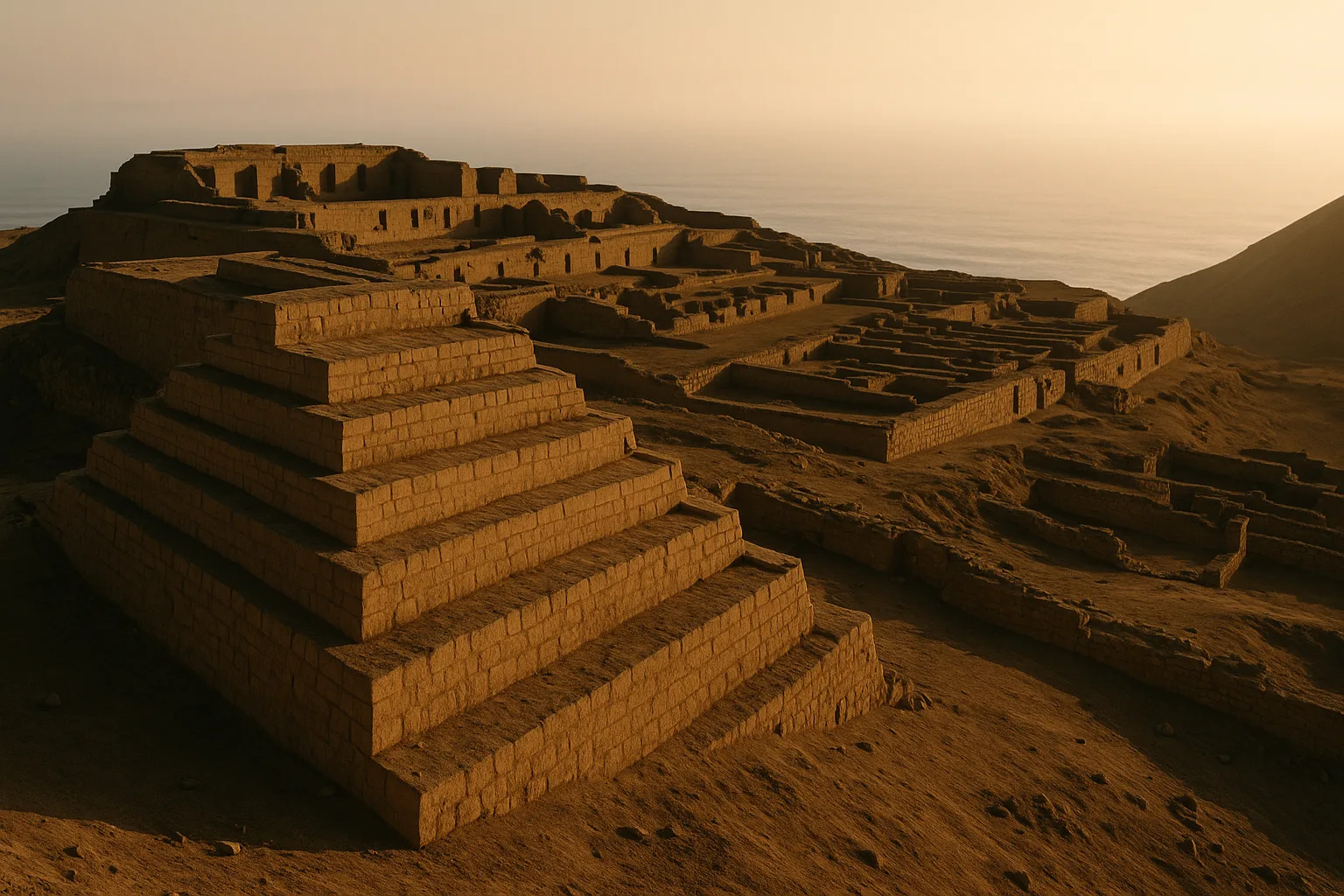
Pachacamac Peru Guide 2026: Oracle Temple, Pilgrimage Roads & Lima Coast
Lima-Wari-Ychsma-IncaExplore Pachacamac near Lima: ancient oracle temples, multi-civilization coastal history, practical ...
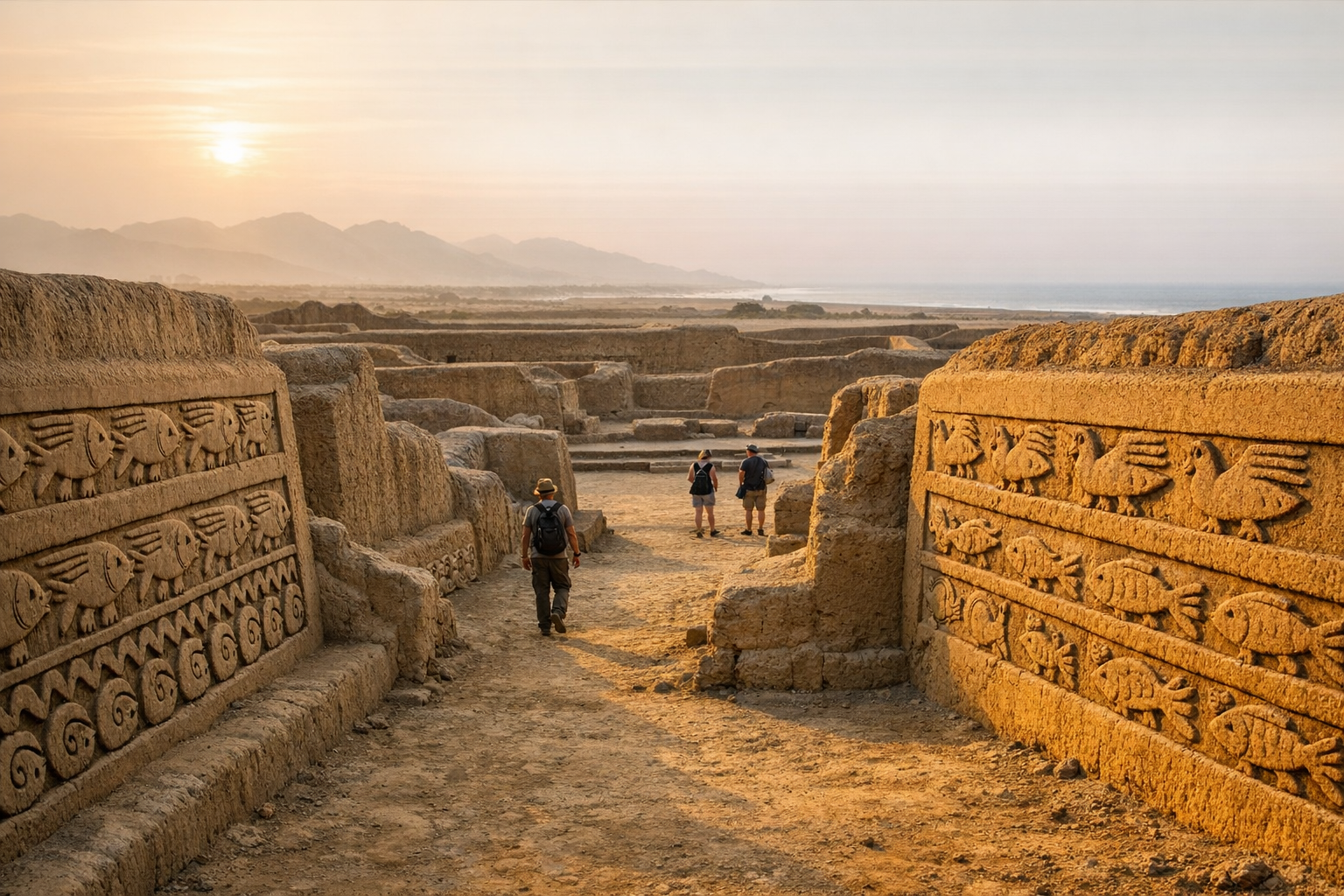
Chan Chan Peru Guide 2026: Chimu Capital & Adobe Citadels
ChimuExplore Chan Chan near Trujillo — the largest pre-Columbian city in the Americas. Discover the Chimu...