Quick Info
At a glance
Inariyama Tumulus in Japan sits quietly among the grassy rises of the Sakitama Kofun Cluster in Saitama Prefecture, yet its calm surface conceals one of the most consequential archaeological discoveries in the country. At first glance, it may appear to be simply an ancient earthen mound, softened by weather and centuries of changing landscape. But this was once a monumental statement of status and power, built for a member of the regional elite during the Kofun period, when large burial mounds reshaped plains and river basins across the Japanese archipelago. Today, visiting Inariyama Tumulus means stepping into the formative centuries of early Japanese statehood, a time when local rulers, warrior elites, ritual authority, and emerging political networks began to bind regions together.
The site is most famous for the remarkable iron sword unearthed here, an object whose inscription offered historians a rare written thread connecting archaeology to early political history. That sword made Inariyama far more than a local tomb. It turned the mound into a landmark for understanding how 5th-century power worked in eastern Japan and how regional leaders related to the Yamato court. For travelers, the appeal lies in this unusual combination: an atmospheric burial landscape, accessible from Tokyo, and a site whose significance reaches far beyond its modest modern appearance. Inariyama is not a ruin of towering walls or carved temples. Its power is subtler, rooted in earth, memory, and the fragile survival of evidence from a world still only partly understood.
History
H3 The Kofun Period and the rise of elite tombs
Inariyama Tumulus belongs to Japan’s Kofun period, generally dated from the 3rd to the 7th century CE. The era takes its name from the kofun themselves: burial mounds built for rulers and high-ranking elites. These tombs varied in shape and scale, but many were immense engineering projects requiring labor coordination, landscape planning, and strong political authority. Their construction signaled status in life and prestige in death.
By the 5th century, when Inariyama was likely built, burial mounds had become one of the clearest visual markers of elite identity across much of Japan. The Sakitama area in present-day Saitama Prefecture emerged as an important center in the Kanto region, suggesting both wealth and political significance. The people buried in mounds like Inariyama were not isolated local chiefs in a simple sense. They were part of a widening network of alliances, rivalries, ritual practices, and military relationships linking regional powers with the growing Yamato polity in central Japan.
The mound itself reflects that environment. Its very existence indicates a society capable of mobilizing resources and labor on behalf of a powerful lineage. Burial goods found in tombs of this class often included weapons, horse gear, ornaments, and prestige objects, all of which communicated rank and connections. Inariyama’s place within a larger cluster of tombs is equally important: elite authority in the area was not represented by one grave alone, but by an entire funerary landscape.
H3 Construction, burial, and prestige in the 5th century
Archaeologists date Inariyama Tumulus to the later 5th century CE, when the use of large burial mounds was closely tied to claims of lineage and political legitimacy. The mound was built as a funerary monument for an individual of very high status, probably part of a local ruling family that exercised authority over surrounding lands and communities.
The exact ritual sequence is not fully recoverable, but comparisons with other kofun suggest a carefully organized burial program. The dead were interred with grave goods chosen not only for personal use or symbolic protection, but also to project social standing into the afterlife. Weapons emphasized martial identity, ornaments signaled prestige, and imported or technically sophisticated items underscored participation in far-reaching exchange networks. In Kofun-period society, burial was public theater as much as private mourning.
The Sakitama Kofun Cluster as a whole demonstrates the prominence of this region during the 5th and 6th centuries. While the Yamato state was consolidating influence elsewhere, eastern Japan was far from peripheral. Inariyama and neighboring mounds suggest that this zone contained elites powerful enough to build monumental tombs and important enough to be integrated into wider political systems. The landscape still hints at that hierarchy: low green mounds mark what was once a domain of concentrated authority.
H3 Excavation and the discovery of the inscribed sword
Inariyama Tumulus entered national historical consciousness through archaeological excavation in the 20th century. The breakthrough came with the discovery of grave goods that included an iron sword bearing a gold-inlaid inscription. This find was extraordinary. Written records for 5th-century Japan are scarce and often preserved only in later chronicles, so an inscribed object from an excavated tomb provided direct evidence from the period itself.
The inscription names a lineage and refers to service under a great king, widely associated with the Yamato ruler known in scholarly discussions as Wakatakeru. This connection immediately drew attention because it illuminated relationships between regional elites and central authority. Rather than viewing ancient Japan as a loose scatter of unrelated chiefdoms, historians could point to material proof of political ties, loyalty, and recognition extending across regions.
The sword also showed the sophistication of metalworking and the importance of inscribed prestige objects as carriers of identity and memory. It was not merely a weapon. It was a statement of ancestry, service, and legitimacy. For archaeologists, epigraphers, and historians, the find became one of the most important artifacts ever recovered from a Japanese kofun.
H3 Inariyama Tumulus in modern scholarship and heritage
Since its excavation, Inariyama Tumulus has played a major role in debates about the formation of the early Japanese state. Scholars have used the site to examine regional power structures, military culture, funerary ritual, and the spread of political influence from the Yamato core into eastern Japan. The tomb’s finds continue to be discussed in relation to identity, literacy, and the uses of inscribed objects in elite society.
Today, Inariyama is protected as part of a broader archaeological landscape rather than treated as an isolated monument. That context matters. The mound is best understood within the Sakitama Kofun Cluster, where multiple burial monuments together reveal patterns of status and chronology. Museums and interpretation in the area help bridge the gap between the subdued appearance of the surviving mounds and the dramatic importance of their contents.
For visitors, this modern stage of the site’s history is part of the experience. Inariyama is a place where scholarship has profoundly changed public understanding. What appears to be a grassy rise in a park-like setting is actually one of the key witnesses to Japan’s 5th century. Its importance was not obvious until excavation, study, and comparison brought the buried evidence to light. That transformation—from mound to historical testimony—is central to why Inariyama matters.
Key Features
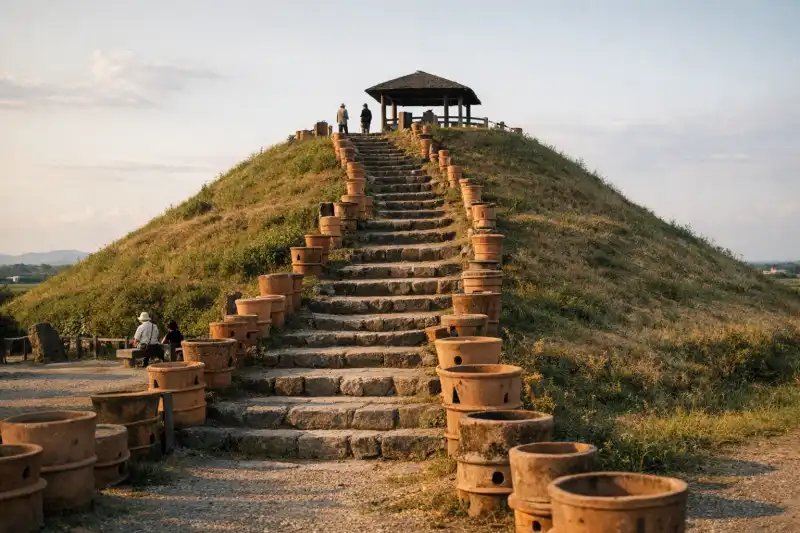
The first thing most visitors notice about Inariyama Tumulus is its restraint. Unlike masonry ruins or temple complexes, a kofun survives primarily as shaped earth. The mound’s form is the feature, and understanding it requires a shift in perception. You are not looking for standing walls or ornate facades; you are reading contours in the landscape. Inariyama’s profile, scale, and position within the wider cluster communicate the ambition of its builders. Even in its weathered state, the mound remains an engineered monument rather than a natural hillock.
Its location within the Sakitama Kofun Cluster is one of its greatest strengths. The surrounding area allows visitors to place Inariyama in a funerary landscape of related elite tombs. This broader context reveals that the mound was part of a system of ranked burials, not a solitary grave. Walking the area gives a sense of how memory and political prestige were embedded into terrain. The spacing of mounds, their varying sizes, and the openness of the plain all help explain why this region was suitable for monumental funerary display.
The site’s most celebrated feature, though physically absent from the mound itself, is the inscribed iron sword discovered during excavation. For many travelers, the intellectual excitement of Inariyama lies in this artifact. The sword is a key to the entire site. It carries personal and political information in the form of inscription, connecting one burial to the larger history of early Japanese rulership. If you visit the local museum displays associated with the Sakitama area, the interpretation of this object adds depth to what you see outdoors. The mound then becomes more than a shape in grass; it becomes the burial place of a person whose world can be partially reconstructed.
The grave goods from Inariyama also point to a martial and aristocratic culture. Swords, ornaments, and elite equipment were not random possessions. They formed a vocabulary of status. Such objects suggest a society in which authority depended on lineage, military capability, ritual legitimacy, and participation in exchange networks. The archaeological record of the tomb reveals these layers indirectly, through material choices. Visitors who engage with the museum interpretation often come away with a stronger sense of how the dead were represented in Kofun-period Japan.
Another key feature is the quietness of the modern setting. Inariyama is not overwhelmed by urban development in the way some ancient sites are. The atmosphere encourages slow observation. You can walk around the mound, notice the slope of its sides, imagine the labor involved in piling and shaping earth, and consider how striking it must once have appeared when newly made. Freshly constructed kofun were not inert green rises. They would have had sharper edges, more visible surfaces, and a stronger visual command over the surrounding land.
Interpretive infrastructure in the area, especially when combined with museum exhibits, helps make the site legible to non-specialists. This is crucial because the significance of Inariyama is archaeological rather than theatrical. The tomb rewards informed attention. Signage, maps, and contextual exhibits can transform a brief stop into a meaningful visit, especially for travelers interested in early Japan, burial ritual, or state formation.
Finally, Inariyama’s greatest feature may be the tension between modest appearance and immense historical weight. Many famous ancient sites impress through scale or decoration. Inariyama impresses through implication. Its mound is the shell of a political world; its artifacts preserve names, affiliations, and ambitions from a period where evidence is limited. This contrast gives the place unusual power. The site asks visitors to imagine rather than simply admire, to reconstruct rather than consume. For historically minded travelers, that makes Inariyama one of Japan’s most rewarding lesser-known ancient destinations.
Getting There
Inariyama Tumulus is located in Gyoda, Saitama Prefecture, and is feasible as a day trip from Tokyo. The most convenient rail approach is usually to take a JR line or private railway north toward the Gyoda or Kumagaya area, depending on your chosen route. From central Tokyo, total one-way rail costs often fall in the roughly ¥1,200 to ¥2,200 range, with travel times of about 1.5 to 2.5 hours depending on connections. From the nearest stations, you can continue by local bus, taxi, bicycle rental, or on foot if you do not mind a longer walk.
Local buses may cost around ¥200 to ¥400 one way, though schedules can be limited, especially outside peak commuting hours. Taxis are the easiest final leg if you want to maximize time at the site; expect a short ride from a nearby station to cost roughly ¥1,000 to ¥2,500 depending on distance and traffic. Rental cars are useful if you plan to combine the Sakitama Kofun Cluster with other sites in Saitama. Parking is generally easier in this region than in major city centers.
If you enjoy cycling, some visitors prefer to rent a bicycle near the station and explore the cluster at a relaxed pace. This is often one of the best options in good weather because the kofun landscape is more enjoyable when approached slowly. Before traveling, check current museum opening hours, local transit timetables, and any area maps published by tourism or heritage offices. The mound itself may be simple to see, but advance planning makes the experience far smoother.
When to Visit
Spring and autumn are generally the best times to visit Inariyama Tumulus. In spring, temperatures are mild, the grass is fresh, and the wider landscape can feel especially inviting for walking between mounds and museum stops. Late March through May is often pleasant, though weekends and holiday periods may bring more domestic visitors. Autumn, particularly October through November, offers crisp air, good visibility, and comfortable conditions for exploring an open archaeological site.
Summer is possible but less ideal for many travelers. Saitama can be hot and humid, and because kofun visits involve time outdoors with limited shade in some areas, midday heat can make the experience tiring. If you visit in summer, try to arrive early, bring water, and combine the outdoor portion with indoor museum time during the hottest hours. Winter visits can be rewarding for those who prefer quiet. The cooler air and reduced foliage sometimes make mound outlines easier to appreciate, although the atmosphere is more subdued.
Rain affects the site differently than it would a temple or castle. Since Inariyama is fundamentally an earthen monument in an open setting, wet weather can make paths less pleasant and reduce the enjoyment of walking the cluster. For photography, clear mornings or late afternoon light often work best, bringing definition to the mound’s contours. If your interest is archaeological rather than scenic, any season can work, but spring and autumn offer the best balance of comfort, visibility, and atmosphere.
| Quick Facts | Details |
|---|---|
| Site name | Inariyama Tumulus |
| Location | Gyoda, Saitama Prefecture, Japan |
| Cultural context | Kofun-period elite burial mound |
| Estimated date | 5th century CE |
| Best known for | Gold-inlaid inscribed iron sword |
| Wider landscape | Sakitama Kofun Cluster |
| Best visit length | 1.5 to 3 hours |
| Best seasons | Spring and autumn |
| Nearest major city access | Tokyo day trip |
| Visit style | Outdoor archaeological site with nearby museum interpretation |
A visit to Inariyama Tumulus rewards patience and curiosity. This is not a site that reveals itself in a single dramatic glance. Its significance emerges gradually, through landscape, context, and the extraordinary discoveries linked to its burial chamber. For travelers interested in how early Japan took shape, the mound offers something rare: direct contact with the material world of the 5th century and with one of the key artifacts that helps explain it. Inariyama is a place where earth, inscription, and memory meet, preserving a chapter of Japanese history that might otherwise have remained almost silent.
Guided tours: worth it?
Most travelers can visit Inariyama Tumulus independently. Compare a tour only if you want a tighter history-focused visit, easier logistics, or a guide who can answer questions on the spot.
Best for
- Short visits where a planned route saves time
When to go self-guided
Go independently if you prefer setting your own pace, reading as you go, and checking official hours or ticket rules directly before you arrive.
What I’d avoid
Skip paid tours that bundle unrelated stops you do not actually want. The best option should either save meaningful planning time or add historical context you would miss on your own.
Saitama day tours and cultural experiences
Useful when: you want to compare guided formats before deciding
Tokyo to Saitama historical sites tours
Useful when: you want to compare guided formats before deciding
Japan kofun and archaeology tours
Useful when: you want to compare guided formats before deciding
Some tour links are affiliate links, which may earn Ancient Travel a small commission at no extra cost to you. I try to surface options that make practical sense for the site—not just anything bookable.
Frequently Asked Questions
What is Inariyama Tumulus?
Inariyama Tumulus is a kofun-era burial mound in Saitama Prefecture, Japan, best known for elite grave goods and an inscribed iron sword that transformed the study of early Japanese history.
Where is Inariyama Tumulus located?
It is located in Gyoda, Saitama Prefecture, within the Sakitama Kofun Cluster, a major concentration of ancient burial mounds north of Tokyo.
Why is Inariyama Tumulus important?
The tomb is especially important because archaeologists discovered an iron sword bearing a long inscription that links regional rulers to the emerging Yamato state, making it one of the key written sources for Japan's 5th-century political world.
Can you go inside Inariyama Tumulus?
Visitors generally experience the mound and its setting from the exterior landscape and nearby museum interpretation rather than entering the burial chamber itself.
How much time should I allow for a visit?
Allow around 1.5 to 3 hours if you want to walk the mound area, explore the wider Sakitama Kofun Cluster, and visit the local museum displays connected to the site.
Is Inariyama Tumulus easy to visit from Tokyo?
Yes. It can be visited as a day trip from Tokyo by rail and local bus, taxi, bicycle, or rental car, though the final leg is easier if you plan transport in advance.
Nearby Ancient Sites
Asuka Historical Sites
Yamato CourtDiscover Asuka's ancient tombs, Buddhist temples, and enigmatic stone monuments — Japan's cradle of ...
Fujiwara Palace Ruins
Early Japanese imperial stateDiscover Japan’s Fujiwara Palace Ruins, the vast remains of the first fully planned imperial capital...
Heijo Palace Site
Nara Period JapanWalk the vast grounds of Japan's 8th-century imperial capital in Nara — a UNESCO World Heritage Site...