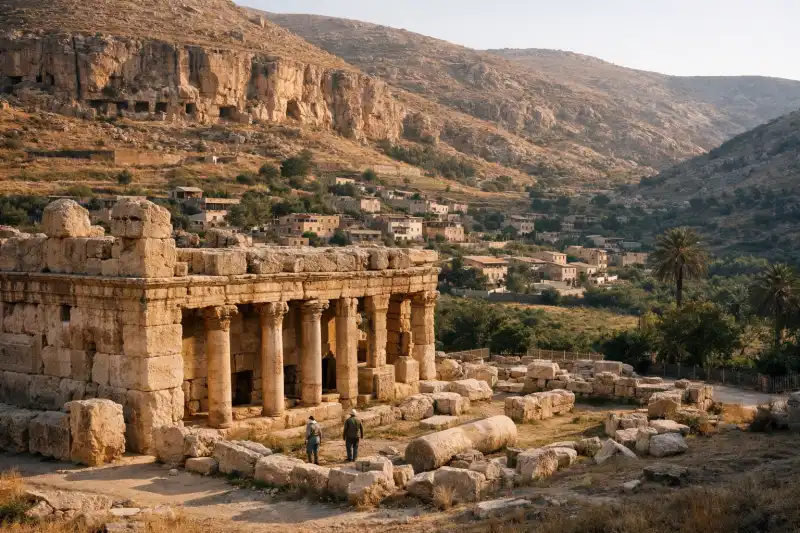
Quick Info
At a glance
Iraq al-Amir in Jordan feels unlike many of the country’s better-known archaeological destinations. Instead of a desert fortress, a grand Roman street, or a hilltop citadel, you arrive in a green valley west of Amman where orchards, springs, and limestone hills create a softer setting for ancient ruins. At the center stands Qasr al-Abd, a monumental Hellenistic building whose heavy stone blocks, carved beasts, and isolated position have fascinated travelers for generations. The surrounding landscape matters just as much as the structure itself: this was not simply a single monument, but part of an elite rural estate designed to command land, water, and agricultural wealth.
For visitors based in the Jordanian capital, Iraq al-Amir offers a rewarding contrast to the urban archaeology of Amman. The road leaves behind busy neighborhoods and descends into a broad valley where the atmosphere shifts almost immediately. Here, ancient ambition survives in fragments: a palace-like building standing beside a pool, caves cut into the hillside, traces of inscriptions, and the wider memory of the Tobiad family who once shaped this estate. The site is compact enough for a short visit, yet layered enough to reward anyone interested in politics, architecture, and the blending of local and Hellenistic traditions. Iraq al-Amir is not Jordan’s largest ruin, but it is one of its most distinctive, precisely because it combines monumental stonework with a surprisingly pastoral landscape.
History
Hellenistic Jordan and the rise of the Tobiads
The story of Iraq al-Amir begins in the Hellenistic age, after the conquests of Alexander the Great reshaped the eastern Mediterranean and Near East. In the centuries that followed, Jordan became part of a region influenced by shifting dynasties, especially the Ptolemies and Seleucids. Local elites adapted to these political realities, and among the most prominent were the Tobiads, a powerful family remembered in Jewish historical traditions and later classical references.
Iraq al-Amir is generally associated with Hyrcanus of the Tobiad family, who is thought to have established an impressive estate in this valley during the 3rd or early 2nd century BCE. The location was not accidental. The valley had fertile land, water sources, and strategic access to the highlands around modern Amman. For an aristocratic family seeking both comfort and authority, it offered ideal conditions. The estate announced status through architecture while also functioning within an agricultural landscape that could support wealth and patronage.
Building Qasr al-Abd
Qasr al-Abd, usually translated as the “Castle of the Slave” or “Palace of the Servant,” is the most visible survivor of this ambitious project. Scholars generally interpret it as a large Hellenistic villa or palace, though debate continues over its precise purpose. Its grand scale, decorative sculpture, and unusual placement within a water-rich setting suggest a structure meant to impress. It may have served as a residence, ceremonial retreat, or prestigious center of an estate rather than a military fortification.
Construction techniques reveal exceptional ambition. Massive limestone blocks were finely cut and assembled into a two-story building, a rare type in the region. Carved lions, panthers, and eagles gave the exterior a dramatic symbolic program, while the building’s relationship to surrounding water features may have enhanced the effect of reflections and movement. The architecture is not purely Greek in spirit nor entirely local; instead, it reflects the cultural hybridity of Hellenistic Jordan, where imported forms were reworked by regional patrons and craftsmen.
Interruption, decline, and later reuse
The building appears never to have reached full completion, or at least not to have enjoyed a long and stable life in the form its patrons intended. Ancient political instability likely played a role. The Tobiad family operated within a volatile environment shaped by dynastic rivalry, local tensions, and changing regional alliances. If Hyrcanus was indeed the patron, his political fortunes may have affected the fate of the estate.
There is also evidence that the structure suffered from seismic activity, a recurring force in the history of the Levant. Earthquakes damaged many ancient sites in Jordan, and Qasr al-Abd’s heavy masonry would have been especially vulnerable. Over time, the building fell out of elite use, and the valley entered new phases of occupation under later powers, including the Romans and subsequent local communities. As often happens with ancient monuments, parts of the site were repurposed, neglected, or absorbed into the agricultural life of the area.
Caves, inscriptions, and modern archaeology
One of the most intriguing elements of Iraq al-Amir lies in the nearby caves carved into the hillside. These chambers, some with inscriptions linked to the Tobiad name, strengthen the connection between the estate and the family known from ancient texts. They add a more intimate dimension to the monumental story told by Qasr al-Abd. While the palace announces power in open space, the caves preserve traces of occupancy and identity within the cliff itself.
Modern archaeological work has clarified much about the site while leaving several questions unresolved. Excavations and architectural studies have helped reconstruct the building’s plan and highlighted the sophistication of its masonry and sculpture. Conservation efforts have also made the monument more accessible to visitors. Yet Iraq al-Amir remains partly enigmatic, which is part of its appeal. It does not present a simple narrative of rise and fall; instead, it offers a glimpse into a world where regional elites experimented with architecture, prestige, and landscape in ways that still feel distinctive within Jordan’s ancient heritage.
Key Features
The first and most unforgettable feature of Iraq al-Amir is Qasr al-Abd itself. The structure rises in pale stone, broad and low, with a massiveness that feels almost oversized for the gentle valley around it. Unlike hilltop fortresses that dominate from above, this building commands attention through presence rather than elevation. Even in partial ruin, the precision of the masonry is impressive. The blocks are huge, carefully dressed, and fitted in a way that immediately conveys expense, labor, and elite ambition. Visitors often notice that the building feels both familiar and strange: recognizable as part of the Hellenistic world, yet unlike the temples, theaters, and colonnaded streets more commonly associated with that period.
The sculptural decoration is among the site’s most striking details. Carved felines and other animal figures appear integrated into the architecture, lending the building a symbolic and theatrical quality. These creatures are not mere ornament. They help transform the structure into a statement of wealth and power, perhaps even a stylized landscape where architecture and nature are deliberately intertwined. The surviving carvings also suggest that the original visual effect must have been richer than what remains today. One can imagine light playing across newly finished stone, water reflecting the façade, and sculpted animals animating the edges of the building.
The relationship between the palace and water is another defining feature. Iraq al-Amir sits in a valley known for springs and cultivation, and Qasr al-Abd appears to have been associated with a large pool or water installation. This setting is critical to understanding the monument. Rather than isolating architecture from the environment, the estate seems to have used water as part of its display. In a region where control of water was always economically and symbolically important, a grand building framed by pools and fertile land would have communicated both refinement and authority. For modern visitors, this makes the site feel unexpectedly serene compared with Jordan’s more arid archaeological landscapes.
The caves in the hills above the valley offer a very different but equally important experience. Reached by looking beyond the main monument, these rock-cut spaces connect the estate to lived occupation and family identity. The cliff face contains chambers that are less monumental than Qasr al-Abd but arguably more personal. Their inscriptions are especially significant because they help anchor the site historically and tie it to the Tobiad family. For travelers interested in the evidence behind archaeological interpretation, the caves provide exactly that: a reminder that the story of Iraq al-Amir rests not only on architectural style but also on textual and epigraphic clues.
The wider landscape deserves attention as a feature in its own right. Iraq al-Amir is one of those ancient sites where the setting is not just background scenery but part of the archaeology. The valley’s greenery, the agricultural fields, and the enclosing limestone hills all help explain why an elite estate would be developed here. Even the approach contributes to the experience. As you move into the area from Amman, the transition from urban plateau to cultivated valley gives a sense of entering a deliberate retreat. The monument makes more sense when seen as part of this environment.
Finally, there is the site’s scale and atmosphere. Iraq al-Amir is not overwhelming in size, which can be a virtue. Visitors can absorb it without exhaustion, and the limited footprint encourages closer observation. Instead of rushing from one major ruin to another, you have time to study the stonework, imagine the unfinished ambitions of its builders, and appreciate the contrast between monumentality and quiet countryside. It is a site best enjoyed slowly, with attention to details that might be lost in busier, more crowded destinations.
Getting There
Iraq al-Amir is one of the easiest ancient excursions from Amman. By car or taxi, the site is usually 35 to 50 minutes from the city center, depending on traffic and your starting point. The simplest option is to hire a ride-hailing car or taxi from Amman. A one-way trip typically costs around 12 to 20 Jordanian dinars, while a driver waiting and returning with you may charge 25 to 40 dinars depending on negotiation time and the season. If you want flexibility to stop at viewpoints or nearby villages, arranging a private driver for half a day is often the most comfortable choice.
Rental cars work well too, especially for travelers already planning to explore around Amman. Roads are generally straightforward, though local signage can be inconsistent, so offline maps are useful. Parking near the site is usually uncomplicated. Driving also makes it easier to combine Iraq al-Amir with the Amman Citadel, Bethany Beyond the Jordan, or countryside stops west of the capital.
Public transport is possible but less convenient. Shared minibuses and service taxis may run toward villages in the area from transport hubs in Amman, but schedules can be irregular and may require local guidance. Fares are inexpensive, often under 2 to 3 dinars each way, but this option can add significant waiting time and may still leave you with a walk or a short taxi ride to the archaeological zone.
Most visitors find that a half-day trip from Amman offers the best balance of ease and value. Bring water, some cash for transport, and a phone with maps downloaded in advance.
When to Visit
Spring is the most appealing season for many travelers visiting Iraq al-Amir. From roughly March to May, the valley is often at its greenest, with mild temperatures that make walking comfortable and photography especially rewarding. This is the best time to appreciate how unusual the setting is within Jordan. Daytime temperatures are generally pleasant, often ranging between 18°C and 28°C, though mornings can still be cool. Wildflowers and fresh vegetation add to the atmosphere, making the site feel less austere than many desert monuments.
Autumn, especially October and November, is another excellent window. The heat of summer fades, the light becomes softer, and the countryside remains attractive for short outdoor visits. For travelers who prefer fewer seasonal crowds than spring can bring to Jordan overall, autumn often provides a calmer experience. Temperatures are usually comfortable enough for leisurely exploration without the fatigue that intense midday sun can cause.
Summer visits are possible, particularly because Iraq al-Amir is close to Amman and does not require a long overland journey. However, midday can become hot, with temperatures often above 30°C. If visiting in June through August, aim for early morning or the last few hours of afternoon. The open grounds around Qasr al-Abd offer limited shade, so hats, sunscreen, and extra water are essential.
Winter can be peaceful and atmospheric, especially on clear days when the valley looks fresh after rain. Yet conditions are less predictable. Temperatures may be cool, and occasional rain can make paths muddy. If you visit from December to February, check the forecast, wear sturdy shoes, and plan some flexibility into your schedule. In every season, weekday mornings usually offer the quietest experience.
| Quick Facts | Details |
|---|---|
| Location | Iraq al-Amir, west of Amman, Jordan |
| Main highlight | Qasr al-Abd, a rare Hellenistic palace or estate building |
| Historical era | Primarily Hellenistic, around the 3rd-2nd century BCE |
| Associated family | The Tobiads, especially Hyrcanus in traditional attribution |
| Landscape | Fertile valley with springs, fields, and limestone hills |
| Time needed | 1-2 hours on site |
| Best base | Amman |
| Best seasons | Spring and autumn |
| Access style | Best reached by taxi, private driver, or rental car |
| Why it stands out | Monumental Hellenistic architecture in an unexpectedly green rural setting |
Iraq al-Amir rewards travelers who enjoy places that are powerful without being overdeveloped or overexplained. It lacks the scale of Jordan’s headline destinations, yet that is part of its strength. Here, the appeal lies in atmosphere, context, and the unusual survival of a Hellenistic elite estate in a valley setting. Qasr al-Abd is impressive on its own, but the fuller experience comes from reading the building together with the caves, the water, and the cultivated landscape around it. For anyone interested in the variety of Jordan’s ancient past, Iraq al-Amir offers a visit that is both manageable and memorable—close to Amman, easy to fit into an itinerary, and distinct enough to stay with you long after the trip ends.
Guided tours: worth it?
A guide can be genuinely useful at Iraq al-Amir, especially if you want help with transport, timing, tickets, or understanding a large site without losing half the day to logistics.
Best for
- Travelers who want transport, timing, or entry logistics handled
- Short visits where a planned route saves time
When to go self-guided
Go independently if you already have transport and tickets sorted, enjoy moving at your own pace, and are comfortable checking the latest official rules before you arrive.
What I’d avoid
Skip paid tours that bundle unrelated stops you do not actually want. The best option should either save meaningful planning time or add historical context you would miss on your own.
Amman to Iraq al-Amir day tours
Useful when: you want to compare guided formats before deciding
Jordan archaeology tours including Iraq al-Amir
Useful when: you want to compare guided formats before deciding
Private tours from Amman to Iraq al-Amir and nearby sites
Useful when: you want flexible timing or a private guide
Some tour links are affiliate links, which may earn Ancient Travel a small commission at no extra cost to you. I try to surface options that make practical sense for the site—not just anything bookable.
Frequently Asked Questions
What is Iraq al-Amir best known for?
Iraq al-Amir is best known for Qasr al-Abd, a rare and dramatic Hellenistic palace in Jordan, as well as nearby caves with ancient inscriptions.
How far is Iraq al-Amir from Amman?
Iraq al-Amir lies about 20 to 25 kilometers west of central Amman, and the drive usually takes around 35 to 50 minutes depending on traffic.
Do I need a guide to visit Iraq al-Amir?
A guide is not strictly necessary, but hiring one or visiting with a driver can add useful context about the Tobiad family, the architecture, and the valley landscape.
How much time should I spend at Iraq al-Amir?
Most visitors spend 1 to 2 hours exploring Qasr al-Abd, the surrounding grounds, and, if accessible, the nearby cave area.
Is Iraq al-Amir suitable as a half-day trip?
Yes. Because it is close to Amman, Iraq al-Amir works very well as a half-day excursion, though many travelers combine it with other sites in the region.
When is the best time of year to visit Iraq al-Amir?
Spring and autumn are the most comfortable seasons, with mild temperatures and better conditions for walking around the site and valley.
Nearby Ancient Sites
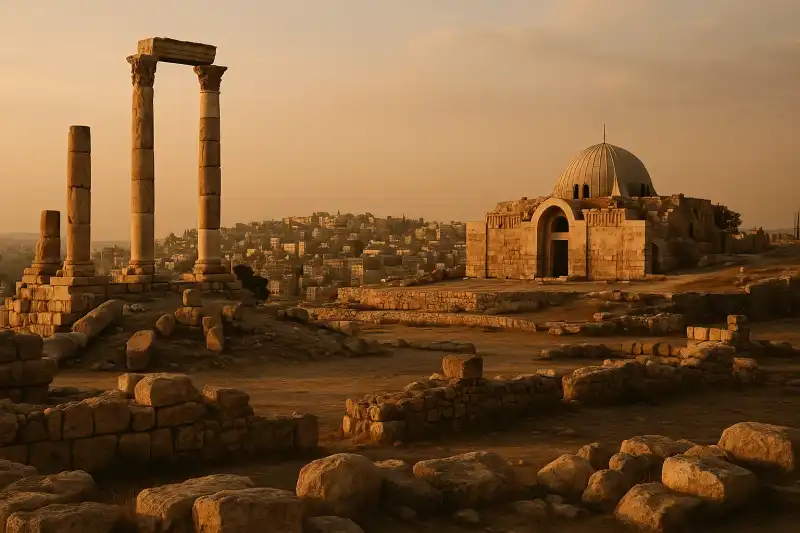
Amman Citadel Jordan Guide 2026: Temple of Hercules & Ancient Rabbah
Ammonite-Roman-UmayyadExplore Jordan's ancient citadel overlooking modern Amman. Discover the Temple of Hercules, Umayyad ...
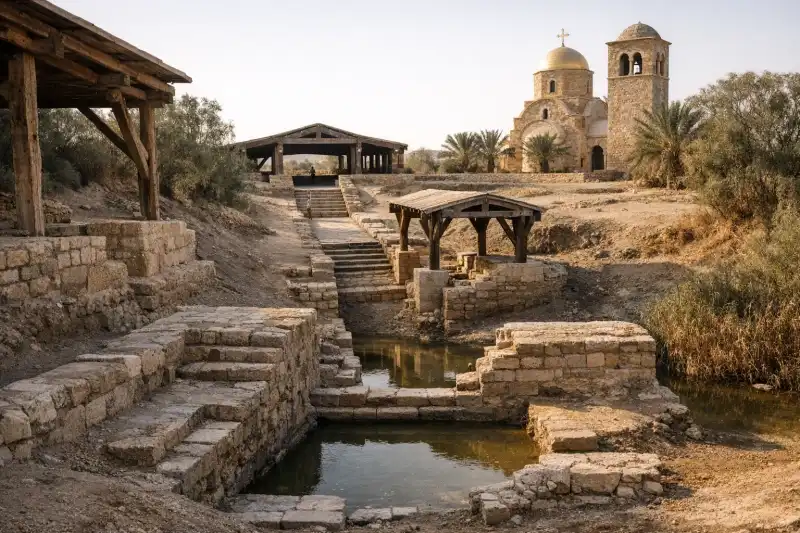
Bethany Beyond the Jordan
Bethany Beyond the Jordan in Jordan is an archaeological and religiously significant site believed t...
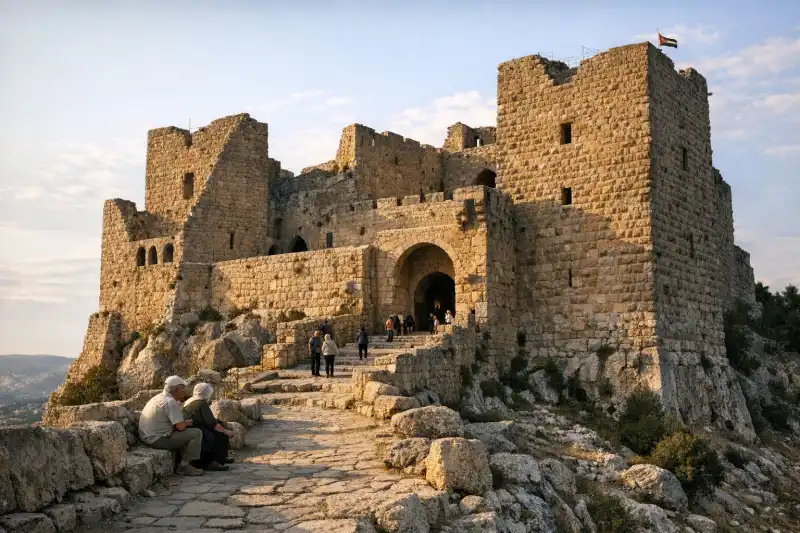
Ajloun Castle
Ajloun Castle in Jordan is a 12th-century Muslim fortress renowned for its strategic hilltop locatio...