Quick Info
At a glance
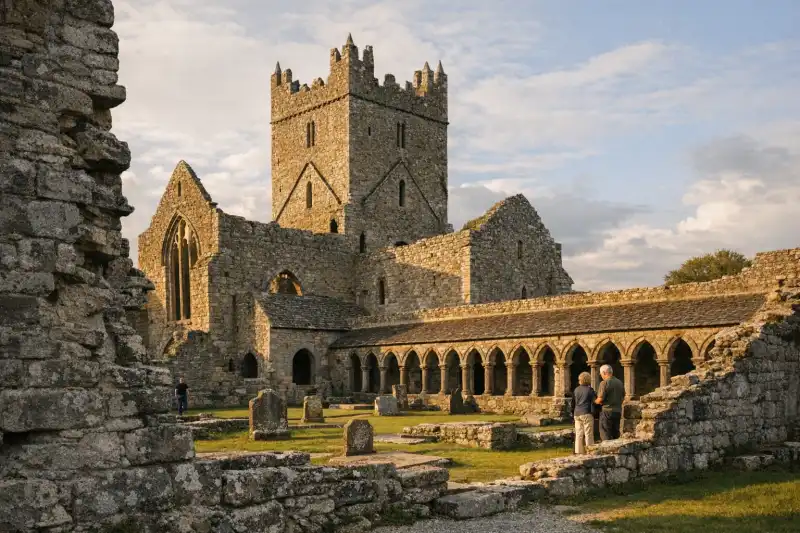
Jerpoint Abbey in Ireland stands in a quiet fold of the County Kilkenny countryside, where low stone walls, green fields, and the gentle rhythm of the River Nore landscape create an unexpectedly serene backdrop for one of the country’s finest medieval monastic ruins. Even before you step through the remains of its church and cloister, the site has a stillness that feels distinctly monastic: open, calm, and shaped by centuries of prayer, labor, and weather. Unlike some larger Irish monuments that impress mainly through scale, Jerpoint Abbey draws visitors in through detail. Here, carved capitals, worn effigies, traceried windows, and long lines of arcades tell their own story, rewarding anyone willing to slow down and look closely.
Founded in the 12th century and associated with the Cistercian order, the abbey became an important religious center in medieval Leinster. Its surviving architecture reflects both austere monastic planning and a remarkable taste for sculpture, especially in the cloister where carved figures, animals, and symbolic motifs still survive in abundance. The result is a site that feels intimate rather than overwhelming, making it especially appealing to travelers who enjoy places where history is read in stone at close range. A visit to Jerpoint Abbey is not simply a stop to admire ruins; it is an opportunity to enter a carefully ordered medieval world, one where faith, craftsmanship, and community life once shaped every hour of the day.
History
Early foundation in the 12th century
Jerpoint Abbey was founded in the later 12th century, traditionally dated to around 1160, during a period when reforming monastic orders were expanding across Ireland. The Cistercians, who emphasized discipline, simplicity, manual labor, and a return to a stricter interpretation of the Rule of Saint Benedict, established monasteries in rural areas where they could create self-sufficient religious communities. Jerpoint’s setting in fertile land near important routes through Kilkenny was ideal for such a foundation. The abbey was linked with patronage from powerful local rulers, including the Kingdom of Osraige and, later, Anglo-Norman interests after their arrival in Ireland.
Like other Cistercian houses, Jerpoint would have been planned as a working monastery rather than simply a church with attached buildings. The monks needed farmland, water, workshops, storage, and accommodation, all organized around spiritual routine. Their day was structured by prayer offices, communal meals, reading, and agricultural management. While the Cistercian ideal called for restraint in decoration, actual Irish monastic life often blended imported architectural forms with local artistic traditions, and Jerpoint would eventually become a striking example of that balance.
Growth and medieval prosperity
From the late 12th into the 13th century, Jerpoint Abbey expanded and prospered. Much of what visitors see today belongs to this main medieval building phase, when the church, cloister, and associated ranges were laid out in durable stone. The abbey benefited from landed income, agricultural production, and donations from local elites who sought spiritual prestige, burial rights, or memorial association with the monastery. In medieval Europe, abbeys were not isolated from society; they were major landholders, centers of literacy, and institutions woven into local politics and economy.
Jerpoint’s architecture developed during this period in ways that reveal changing tastes. Elements of Romanesque solidity gave way to Gothic forms such as pointed arches and larger windows. Yet the abbey is especially memorable for its sculptural program. The cloister arcade includes carved figures that may represent saints, clerics, lay patrons, and symbolic beings. These carvings suggest both devotional purpose and a desire to commemorate those connected to the abbey. They also show that medieval Cistercian practice in Ireland could be more visually expressive than the order’s earliest ideals might imply.
The monastery’s prosperity was never entirely secure. Medieval Ireland was marked by political shifts, local rivalries, and changing patterns of patronage. But Jerpoint remained a significant religious house for centuries, and its survival in such a substantial form indicates the importance it held within the region.
Later Middle Ages and changing fortunes
In the 14th and 15th centuries, Jerpoint Abbey continued as a functioning monastery, though the wider world around it was changing. Ireland experienced warfare, fluctuating lordship, ecclesiastical reform, and periodic economic strain. Religious houses often adapted by rebuilding, adding tombs and chapels, and strengthening ties with local families. Jerpoint’s surviving tomb sculpture and memorial monuments point to continued use as a sacred and prestigious burial place. For local patrons, burial within or near a monastery offered spiritual benefits and public status.
The artistic richness of Jerpoint’s cloister and funerary monuments may owe much to this later medieval environment, when commemoration became a major part of monastic visual culture. The abbey was no longer simply a place where monks lived apart from the world; it was also a place where the memory of regional power, lineage, and piety could be set in stone.
Dissolution and decline
The great turning point came in the 16th century with the suppression of monasteries under the Tudor state. Like many religious houses in Ireland and Britain, Jerpoint Abbey was dissolved, and its formal monastic life ended. Once the resident community disappeared and institutional support was withdrawn, buildings that had been carefully maintained began to deteriorate. Roofs were lost, stone was reused, and exposed elements weathered over time.
Yet Jerpoint never vanished completely. Its church walls, cloister arcades, and carved details remained prominent in the landscape, preserving the outline of the medieval complex. Antiquarians, historians, and later heritage authorities recognized its importance, and conservation efforts gradually stabilized the ruins. Today, visitors encounter Jerpoint not as a complete monastery but as an evocative shell whose surviving features still communicate both the order of monastic life and the artistic ambition of the community that built it.
Key Features
What makes Jerpoint Abbey so memorable is the balance between architectural clarity and intimate detail. Even in ruin, the overall plan remains readable. You can still sense how the church connected to the cloister, how the various monastic ranges framed a central open court, and how daily life moved between prayer, work, and contemplation. This legibility gives the site an unusual accessibility. You do not need to be an architectural specialist to understand its purpose; the structure of monastic life is embedded in the stone layout itself.
The church is one of the abbey’s most commanding surviving elements. Its long nave, crossing, and transept arrangement suggest the importance of communal worship, while the surviving arches and window forms hint at the transition from Romanesque massiveness to Gothic refinement. Looking up through roofless spaces to the Irish sky, it is easy to imagine how dramatic the interior would once have felt, with liturgical sound carrying along the stone surfaces. The absence of the roof paradoxically sharpens the sense of scale, allowing modern visitors to appreciate the vertical aspirations of the medieval builders.
The cloister is the true heart of Jerpoint Abbey and the feature for which it is most celebrated. Cloisters in monasteries were more than decorative courtyards: they were circulation spaces, places for reading and meditation, and symbols of ordered spiritual life. At Jerpoint, the surviving arcade is remarkable for the number and quality of its carvings. Figures of monks, bishops, knights, and possibly local patrons appear among foliage, animals, and ornamental motifs. Some are worn nearly smooth; others retain enough detail to suggest faces, garments, and gestures. These carvings reward close observation and repeated passes. What seems uniform at first glance gradually becomes a gallery of individual expressions and symbolic references.
Another notable feature is the series of medieval tombs and effigies associated with the abbey. Funerary sculpture gives Jerpoint an added human dimension. These were not anonymous stones but memorials intended to preserve names, identities, and hopes for salvation. The presence of such monuments reminds visitors that the abbey served not just monks but a wider community of lay benefactors and elites. In this sense, Jerpoint functions as both monastic ruin and sculptural archive of medieval Kilkenny society.
The chapter house area and the domestic ranges, although less complete than the church and cloister, are equally important for understanding how the community operated. The chapter house would have been a place of governance, daily reading, confession of faults, and decision-making. Refectory and dormitory areas, now fragmentary, point to the practical routines of communal life. At Jerpoint, these spaces are not reconstructed in elaborate modern fashion; instead, visitors piece them together from walls, thresholds, and alignments. That slight ambiguity is part of the site’s appeal, encouraging imagination without overwhelming the ruins with interpretation.
The quality of masonry across the abbey also deserves attention. Even weathered surfaces show the confidence of the original construction, from the rhythm of arcades to the shaping of columns and capitals. The stone changes character depending on light and season: soft gray on an overcast day, almost golden in evening sun, dark and dramatic after rain. Because the site is relatively open and not crowded by urban development, these visual changes matter. Jerpoint feels connected to its landscape, and the architecture seems to emerge naturally from the earth around it.
Perhaps the most distinctive feature, however, is atmosphere. Many historic sites are impressive; fewer are quietly absorbing. Jerpoint’s scale allows for personal discovery. You can stand in the cloister and hear birds, wind, and distant rural sounds rather than traffic. That quiet helps the carvings, tombs, and empty windows speak more clearly. The abbey is beautiful not because it is complete, but because enough survives to create a vivid sense of what was once here.
Getting There
Jerpoint Abbey is located near Thomastown in County Kilkenny, making it an easy excursion from Kilkenny city and a manageable stop on a southeastern Ireland road trip. The simplest way to arrive is by car. From Kilkenny, the drive is usually around 20 to 25 minutes, covering roughly 18 kilometers. Car rental is often the most practical option for travelers exploring rural heritage sites in Ireland, and parking is generally available on site. If you are driving from Dublin, allow about 1 hour 45 minutes to 2 hours depending on traffic; fuel costs for a day trip vary, but many travelers should budget around €20 to €35 in fuel for a return journey from Kilkenny, and more from Dublin.
Public transport is possible but less direct. The nearest main access point is Thomastown, which can be reached by Irish Rail from Dublin Heuston or from Waterford on routes serving Kilkenny line stations. Rail fares vary by booking time and class, but typical one-way fares from Dublin to Thomastown often fall in the €15 to €30 range if booked in advance. From Thomastown station, Jerpoint Abbey is about 3 to 4 kilometers away, so most visitors take a taxi. Expect a short taxi ride to cost roughly €10 to €15 each way, though prices can vary.
Bus options may connect you to Thomastown or Kilkenny, but schedules are less convenient for some international visitors, especially outside peak travel periods. If you are based in Kilkenny and do not want to rent a car, a taxi directly to the abbey is straightforward and can cost around €25 to €40 each way depending on time and company. Guided regional tours occasionally include Jerpoint Abbey, which can be a good value if you plan to combine several Kilkenny sites in one day.
When to Visit
Jerpoint Abbey can be rewarding in any season, but the experience changes noticeably with weather, daylight, and visitor numbers. Late spring through early autumn is usually the best overall time to visit. From May to September, longer days and milder conditions make it easier to appreciate the site’s outdoor spaces, especially the cloister and carved arcades. Summer brings the greenest landscape and the most reliable opening patterns, but it also means more visitors, particularly during weekends and school holidays. Even then, Jerpoint rarely feels as crowded as Ireland’s most famous tourist landmarks.
Spring is an especially appealing season for travelers who prefer quieter conditions. The surrounding fields are bright and fresh, the air is often cool but comfortable, and the lower visitor volume allows for a more reflective visit. Autumn also suits the abbey well. Softer light and changing colors in the countryside can add depth to the stone textures, and the slightly quieter atmosphere feels fitting for a monastic ruin.
Winter visits are possible, but they require more planning. Opening hours may be reduced, rain is more frequent, and the exposed nature of the ruins can make a windy day feel very cold. On the other hand, if you catch a dry winter afternoon, the abbey can feel especially atmospheric, with stark stone against a pale sky and very few people around.
For photography, early morning and late afternoon offer the best light, especially when the low sun emphasizes carvings and architectural relief. If you want a peaceful visit, aim for weekday mornings outside the busiest summer period. Always check official opening hours in advance, since heritage schedules in Ireland can be seasonal.
| Quick Facts | Details |
|---|---|
| Location | Near Thomastown, County Kilkenny, Ireland |
| Province | Leinster |
| Founded | 12th century |
| Original Function | Cistercian monastery |
| Best Known For | Cloister carvings, medieval tombs, church ruins |
| Nearest Town | Thomastown |
| Nearest Major City | Kilkenny |
| Typical Visit Length | 45 minutes to 1.5 hours |
| Best Time to Visit | Late spring to early autumn |
| Access Style | Best reached by car or taxi from Thomastown/Kilkenny |
Jerpoint Abbey is one of those places that proves grandeur does not always depend on scale. Its power lies in texture, proportion, and continuity: the way carved stone still holds traces of medieval faith, the way an open cloister can still suggest enclosure, and the way a ruined church can remain coherent enough to carry memory across centuries. For travelers interested in Ireland beyond postcard castles and dramatic coastlines, Jerpoint offers something more meditative. It is a site of close looking, where every column and effigy invites a second glance.
It also serves as an excellent introduction to the richness of inland Irish heritage. County Kilkenny is often celebrated for its medieval city, but Jerpoint reveals another side of that history, rooted in monastic life, rural patronage, and artistic craftsmanship. Because the site is manageable in size, it works equally well for first-time visitors to Irish ruins and for specialists who want to study sculpture, burial practice, and monastic planning in detail. You leave with a strong sense not just of what Jerpoint was, but of how it functioned in its landscape and community.
If you can, give yourself time to move slowly through the cloister and church rather than treating the abbey as a quick photo stop. The more patiently you explore, the more the place reveals. Jerpoint Abbey is not simply a beautiful ruin in Ireland; it is a carefully layered record of devotion, ambition, loss, and survival, preserved in one of the country’s most quietly compelling historic settings.
Guided tours: worth it?
Most travelers can visit Jerpoint Abbey independently. Compare a tour only if you want a tighter history-focused visit, easier logistics, or a guide who can answer questions on the spot.
Best for
- Short visits where a planned route saves time
When to go self-guided
Go independently if you prefer setting your own pace, reading as you go, and checking official hours or ticket rules directly before you arrive.
What I’d avoid
Skip paid tours that bundle unrelated stops you do not actually want. The best option should either save meaningful planning time or add historical context you would miss on your own.
Kilkenny and Jerpoint Abbey Tours
Useful when: you want to compare guided formats before deciding
County Kilkenny Medieval Sites Tours
Useful when: you want to compare guided formats before deciding
Ireland Monastic Sites Tours
Useful when: you want to compare guided formats before deciding
Some tour links are affiliate links, which may earn Ancient Travel a small commission at no extra cost to you. I try to surface options that make practical sense for the site—not just anything bookable.
Frequently Asked Questions
Where is Jerpoint Abbey located?
Jerpoint Abbey is in County Kilkenny in southeastern Ireland, near the village of Thomastown, in the province of Leinster.
Do you need a ticket to enter Jerpoint Abbey?
Yes, Jerpoint Abbey is generally a ticketed heritage site managed by the Office of Public Works, with seasonal opening hours and admission charges.
How much time should you allow for a visit?
Most visitors spend 45 minutes to 1.5 hours exploring the cloister, church ruins, carvings, and interpretive displays.
What is Jerpoint Abbey famous for?
It is best known for its exceptionally well-preserved cloister sculptures, medieval tombs, and the atmospheric remains of a Cistercian abbey founded in the 12th century.
Can you visit Jerpoint Abbey from Kilkenny as a day trip?
Yes, Jerpoint Abbey is an easy day trip from Kilkenny by car or taxi, and it is often combined with nearby attractions in Thomastown and the Nore Valley.
Is Jerpoint Abbey suitable for families?
Yes, families can enjoy the open-air ruins and carved details, though surfaces can be uneven and visitors should supervise children around stonework and steps.
Nearby Ancient Sites
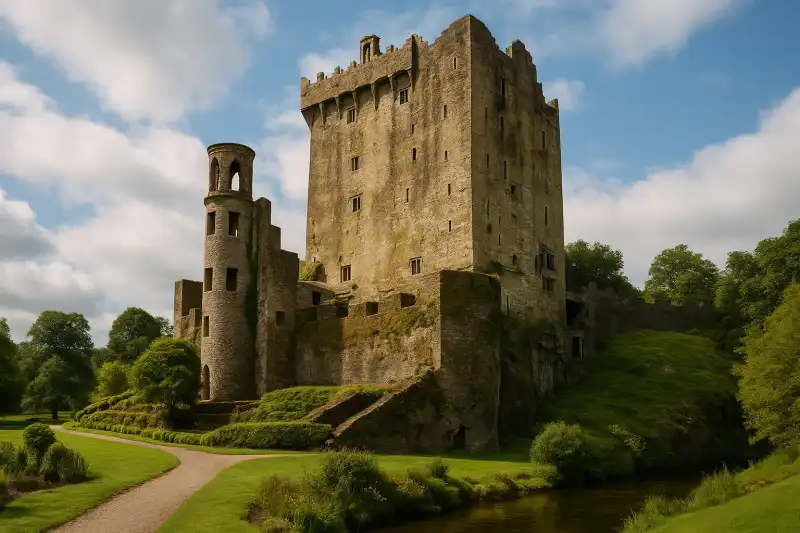
Blarney Castle Travel Guide 2026: Cork Day-Trip Timing, Gardens, and Stone Access
Medieval IrelandPlan a practical first visit to Blarney Castle with timing for the Stone queue, garden route priorit...
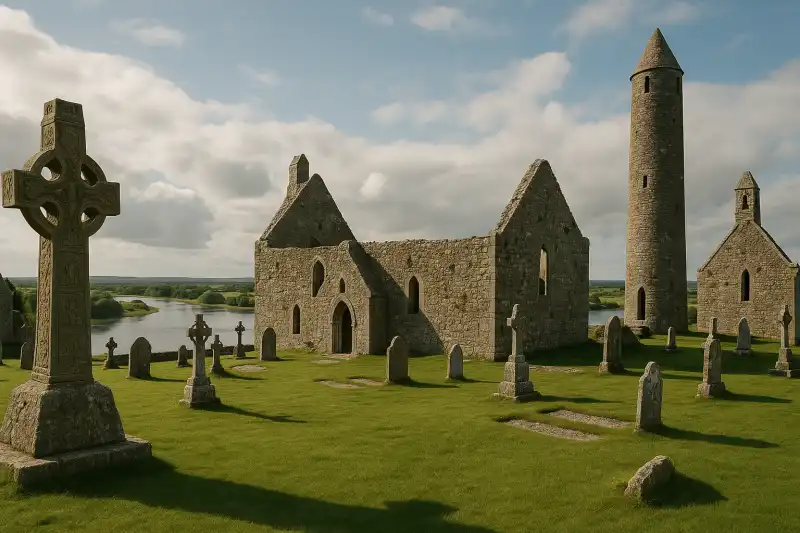
Clonmacnoise Travel Guide 2026: Monastic Ruins, High Crosses, and River Shannon Context
Early Medieval IrelandPlan a first visit to Clonmacnoise with practical timing, monastic-site context, and clear route adv...
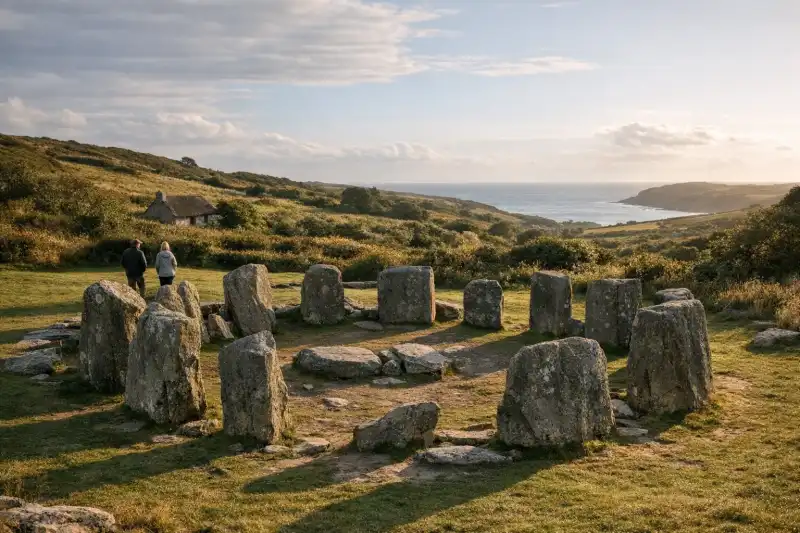
Drombeg Stone Circle
Bronze Age communities of prehistoric IrelandExplore Drombeg Stone Circle in Ireland, a remarkably preserved Bronze Age monument set in the rolli...