Quick Info
Curated Experiences
Karnak and Luxor Temples Half-Day Tour
Karnak Sound and Light Show with Dinner
East and West Banks Full-Day Tour from Luxor
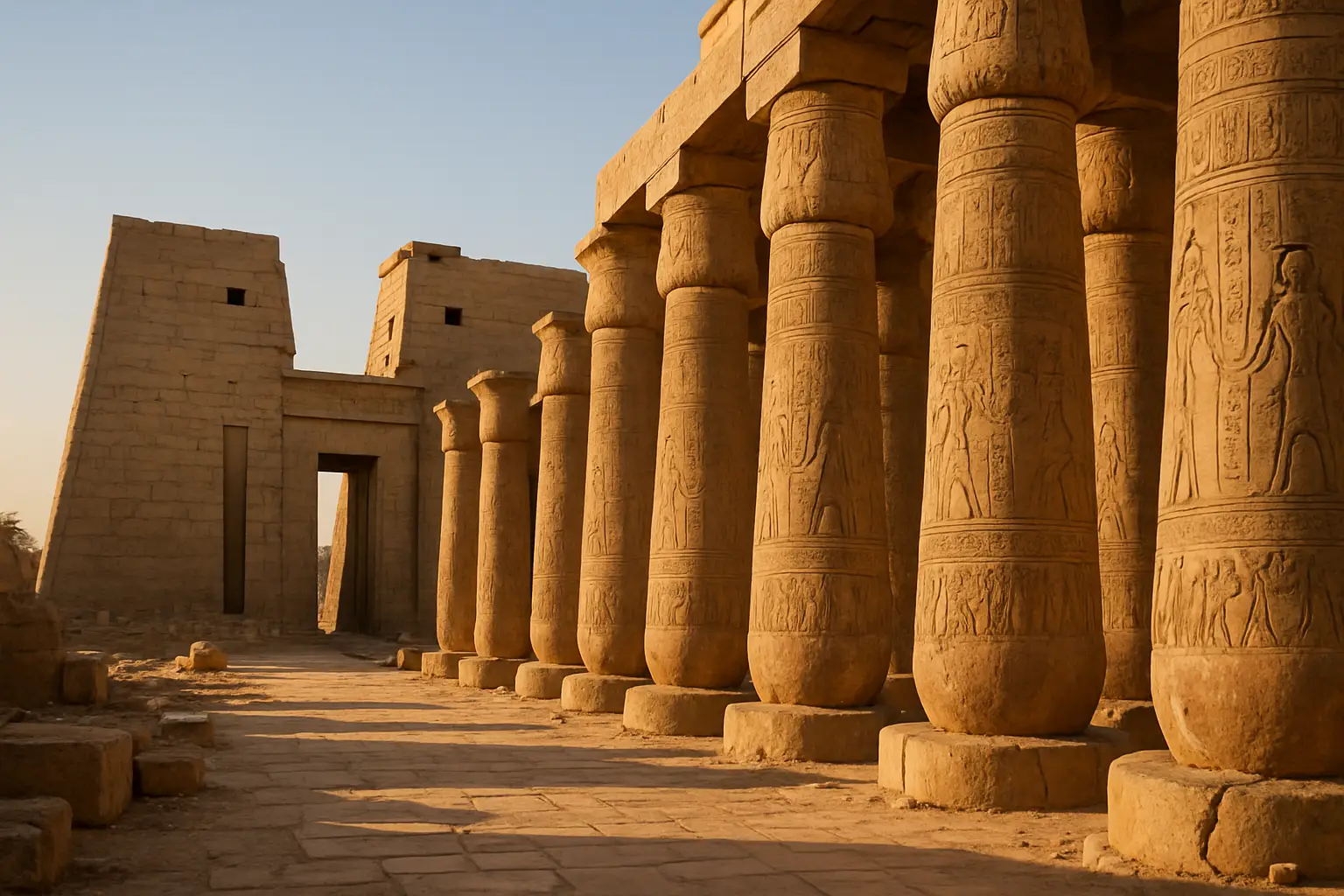
Nothing in Egypt prepares you for the Hypostyle Hall. You pass through the First Pylon — 43 meters of sandstone gateway — cross a broad courtyard, step through the Second Pylon, and the world changes. One hundred and thirty-four columns rise around you in a forest of stone so dense that the far end vanishes. The central columns soar 23 meters to open papyrus capitals wider than a car. The side columns, shorter at 15 meters, press in with closed bud capitals as if the architects designed the space to suggest a papyrus marsh at the moment of creation, when the world emerged from primordial water and the first plants pushed toward the sky. Every surface is carved. Light filters through high clerestory windows in shafts that crawl across the hieroglyphs as the hours pass. This is not architecture in any ordinary sense. It is controlled disorientation — a deliberate recreation of a cosmic event, built in stone by pharaohs who believed the divine and the human could meet in the right space.
Karnak is not a temple. It is a city of temples — a 100-hectare precinct of pylons, hypostyle halls, obelisks, and sacred lakes that accumulated over two thousand years as each successive pharaoh added his monuments to those of his predecessors. Thirty pharaohs inscribed their names on these walls. An estimated 80,000 workers and priests once moved through these precincts daily. The result is the largest religious complex ever built by human hands, and the most complete surviving record of how ancient Egyptian power expressed itself through sacred architecture.
This guide covers what you need to know to visit Karnak well: which features deserve your time, how to manage the heat and crowds, and why the 6 AM opening is the single most important piece of practical advice you will receive about this site.
Historical Context
Karnak began modestly around 2055 BCE as a small shrine to Amun, a local Theban deity whose name translates as “the hidden one.” For centuries, Amun remained a minor god among many in the Egyptian pantheon. Then Theban princes overthrew the rulers of the north, united Egypt, and inaugurated the Middle Kingdom. Amun’s fortunes rose with Thebes itself. By the New Kingdom, when Egypt’s pharaohs had conquered Nubia, Syria, and Palestine, the spoils of empire flowed back to Thebes and Amun’s priesthood grew fabulously wealthy. His temple grew to match.
The theological innovation that made Amun supreme was his merger with Ra, the ancient sun god, to become Amun-Ra: simultaneously hidden and radiant, invisible and all-illuminating. As Egypt’s chief deity during the New Kingdom’s centuries of greatness, Amun-Ra’s temple at Karnak became the kingdom’s religious and political heart. The inner sanctuary held his golden cult statue, tended daily by priests who fed, clothed, and performed ritual ablutions for the divine image. Pharaohs demonstrated their legitimacy by constructing additions — each new pylon, obelisk, or hall a physical testament to devotion and power.
The result is an architectural palimpsest unlike anything else on earth. Thutmose I’s early pylons abut Hatshepsut’s obelisks, which stand beside the Hypostyle Hall of Seti I and Ramesses II, which open onto courtyards added centuries later by Late Period pharaohs and Ptolemaic rulers of Greek descent. Two thousand years of ambition compressed into a single sacred precinct, where the ancient Egyptians’ name for the complex — Ipet-Isut, “Most Select of Places” — proves to have been less boast than understatement.
The complex continued to evolve through the Ptolemaic and early Roman periods, with new gateways and modifications added as late as the 1st century CE. Earthquakes, Nile floods, and the eventual rise of Christianity gradually brought active worship to an end, but the sheer mass of Karnak’s stonework ensured its survival while lesser temples dissolved.
What to See
The Hypostyle Hall
Karnak’s defining feature and the most overwhelming interior space in ancient architecture. Built by Seti I and completed by Ramesses II between approximately 1290 and 1220 BCE, the hall packs 134 sandstone columns into 5,000 square meters. The twelve central columns stand 23 meters tall with open papyrus capitals; the 122 flanking columns reach 15 meters with closed bud capitals. Every column surface is covered in carved reliefs — Seti I offering to the gods on the northern columns, Ramesses II doing the same in his more emphatic style to the south. Light entered through stone clerestory grilles in the central aisle, filtering the Egyptian sun into moving shafts that tracked across the hieroglyphs as the day progressed.
Visit at the 6 AM opening for the experience the architects intended: raking morning light catching the papyrus capitals, the hall empty and silent, the columns emerging from dimness like something alive. Allow at least 30 minutes to walk through, look up, and simply absorb the scale. Midday robs the hall of its atmosphere; morning gives it back.
The Avenue of Sphinxes
The 2.7-kilometer processional way that once linked Karnak to Luxor Temple, lined with more than a thousand ram-headed sphinxes sacred to Amun. Egyptian authorities have spent decades excavating and restoring this avenue, and substantial sections are now walkable. Walking it connects you to the Opet Festival, the most important religious event in the Egyptian calendar, when Amun’s golden barque was carried by priests from Karnak to Luxor Temple while the population of Thebes lined the route with incense and music. The avenue was politics and religion made stone. Approach Karnak from the south if possible to experience the ceremonial weight of the ancient sacred way.
Hatshepsut’s Obelisks
Hatshepsut, who ruled Egypt for two decades as pharaoh in her own right, erected two massive obelisks of Aswan granite at Karnak, claiming they were quarried and raised in just seven months. One has fallen and lies broken on its side, offering close access to the extraordinary precision of the hieroglyphic cutting. The other still stands at 29 meters — the tallest ancient obelisk still in its original position anywhere in the world. Her successor Thutmose III later walled both obelisks within a stone enclosure, possibly to obscure her legacy, but the enclosure inadvertently preserved the gilded tips from weather and theft. Read Hatshepsut’s own inscription: “Now my heart turns this way and that, as I think what the people will say — those who shall see my monuments in years to come.”
The Sacred Lake
At 130 by 77 meters, Karnak’s sacred lake represented the Nun — the primordial watery void from which Egyptian mythology held that creation first emerged. Priests purified themselves in its waters before conducting rituals. During festivals, Amun’s golden barque was sailed across its surface in ceremonies symbolizing the sun god’s nightly journey through the underworld. Sacred geese were kept on its banks, associated with Amun’s mythological manifestation as the goose that laid the cosmic egg.
Today the lake offers the most peaceful vantage in the complex: still water reflecting the pylon walls, framed by palm trees, where you can rest on stone benches and watch the light change. Come here in the late afternoon when the crowds thin and the water turns copper.
The Festival Hall of Thutmose III
Beyond the sanctuary of Amun, deeper in the complex, stands a hall architecturally unlike anything else at Karnak. Instead of massive columns, it features slender tent-pole columns tapering at the base, thought to imitate the wooden poles of a military tent — fitting for Thutmose III, the most militarily successful pharaoh in Egyptian history, who personally led seventeen campaigns into Asia. In a side chamber, Thutmose inscribed the exotic plants and animals he encountered on his foreign campaigns — lotus, iris, elephant, giraffe — creating what Egyptologists call the “botanical garden room.” The images are delicate, surprisingly naturalistic, and utterly unlike the formal theological reliefs covering the rest of Karnak.
The Temple of Khonsu
In the southwestern corner of the precinct, away from the crowds, the Temple of Khonsu is dedicated to the moon god and son of Amun. Smaller than the Hypostyle Hall but unusually complete, it preserves an intact sequence of gateway, hypostyle hall, antechamber, and sanctuary — allowing you to understand the logic of Egyptian temple design as a progression from public to private, bright to dim, the world of humans to the presence of the god. Carved reliefs at eye level still carry traces of original paint. Most visitors rush past it. Those who stop are rewarded with a quality of silence and intimacy that Karnak’s larger spaces do not offer.
Timing and Seasons
October through April offers the most comfortable conditions — daytime temperatures of 25 to 30 degrees Celsius with cool mornings and evenings. This is high season, meaning larger crowds from mid-morning through early afternoon, but the complex is large enough that density disperses quickly once you move past the Hypostyle Hall.
May through September is brutally hot, with temperatures reaching 40 to 48 degrees Celsius by midday. In these months, visiting at the 6 AM opening and departing by 9 AM is not a suggestion but a safety measure. The site is mostly exposed stone with minimal shade outside the Hypostyle Hall.
The golden hours of 6 to 8 AM and 4 to 6 PM are optimal for both photography and comfort regardless of season. Morning light enters the Hypostyle Hall through the clerestory windows at a low angle, catching carved surfaces in relief and creating the atmospheric conditions the ancient designers intended. Late afternoon turns the sacred lake to copper and bathes the pylons in warm amber.
The Sound and Light Show runs on select evenings (approximately $30 to $45, often combined with dinner). The narration is theatrical, but illuminated pylons and columns against a dark sky carry a power that daytime visits do not replicate.
Tickets, Logistics and Getting There
Karnak sits 3 kilometers north of downtown Luxor on the east bank. Taxis cost 20 to 40 EGP ($0.75 to $1.50 USD) each way — negotiate the price before getting in and agree on a pickup time for the return. Horse-drawn caleches cover the same route for 50 to 100 EGP and offer a more atmospheric ride through Luxor’s streets. Walking the Corniche takes 30 to 40 minutes and is pleasant in cool weather but inadvisable in summer heat. Organized half-day tours ($35 to $50) include both Karnak and Luxor Temple with guided commentary and hotel pickup.
Foreign adults pay 200 EGP (approximately $6.50 USD). Students with an ISIC card pay 100 EGP. The complex opens at 6 AM year-round and closes at 7 PM in summer, 5:30 PM in winter. Arriving at opening is strongly recommended for both comfort and photography.
The main Amun Precinct — containing the Hypostyle Hall, Sacred Lake, obelisks, and most major features — is covered by the standard ticket. The Mut Precinct, accessible through a gate in the south wall, is less visited and adds another hour for those interested in Karnak’s quieter corners. The Open Air Museum near the First Pylon requires a separate ticket of 50 EGP and contains reassembled shrine structures worth seeing if time allows.
Practical Tips
- Arrive at 6 AM. The quality of light in the Hypostyle Hall during the first hour after opening is incomparably better than at any other time of day, and the relative absence of tour groups transforms the experience entirely.
- Bring at least two liters of water per person, more in summer. Most of the site is exposed stone with no shade or vendor access once you pass the First Pylon.
- Sun protection — hat, sunglasses, SPF 50+ sunscreen — is essential in every season. The reflected heat from stone surfaces intensifies sun exposure.
- Wear shoes with solid soles. The walking surfaces include uneven stone, sand, and reconstructed paving. The site covers substantial ground, and you will walk 2 to 3 kilometers in a thorough visit.
- Carry cash for the entry ticket, optional Open Air Museum, tram, and tips. Card payment is not reliably available.
- A licensed guide ($20 to $40 for a half-day) transforms Karnak from impressive to comprehensible. Without context, the accumulated two thousand years of construction can read as a bewildering jumble. A good guide narrates the chronological layering and explains the theological purpose behind each structure.
- Do not rush through the Hypostyle Hall to check it off your list. Sit on a column base, look up, and let the scale register. Five focused minutes of stillness here are worth more than an hour of hurried walking through the rest of the complex.
Suggested Itinerary
6:00 AM — Arrive at Karnak as it opens. Purchase your ticket and enter through the First Pylon.
6:10 AM — Cross the First Courtyard. Note the unfinished mudbrick construction ramps on the inner face of the First Pylon, frozen in the state they occupied when Egypt’s temple-building era ended. Walk the sacred scarab beetle statue at the courtyard’s center.
6:20 AM — Enter the Hypostyle Hall through the Second Pylon. Spend 30 to 40 minutes here in the morning light. Walk the central aisle to appreciate the 23-meter columns, then explore the side aisles where the 15-meter closed-bud columns press in more intimately.
7:00 AM — Continue through the Third Pylon to Hatshepsut’s standing obelisk and the fallen obelisk lying on its side nearby. Read the hieroglyphic inscriptions at close range on the fallen stone.
7:20 AM — Pass the sanctuary area and explore the Festival Hall of Thutmose III, including the botanical garden room with its carved exotic plants.
7:45 AM — Walk to the Sacred Lake. Rest on the stone benches and take in the view of the pylons reflected in the water.
8:00 AM — Visit the Temple of Khonsu in the southwestern corner for its intact temple sequence and quiet atmosphere.
8:30 AM — Exit through the First Pylon and explore the Avenue of Sphinxes at Karnak’s southern approach if time permits.
9:00 AM — Depart Karnak. Continue to Luxor Temple in the late afternoon or evening for the floodlit experience.
Total visit time: approximately 2.5 to 3 hours.
Nearby Sites
Luxor Temple — Connected to Karnak by the Avenue of Sphinxes, Luxor Temple sits 3 kilometers south on the east bank. The natural pairing is Karnak in the morning and Luxor Temple in the evening, when floodlights transform the colonnade into one of Egypt’s most beautiful sights. A taxi between the two costs 20 to 40 EGP.
Valley of the Kings — The royal necropolis on the west bank, where the pharaohs who built Karnak were buried. A complete Luxor itinerary dedicates one day to the east bank (Karnak and Luxor Temple) and one day to the west bank (Valley of the Kings, Hatshepsut Temple, Colossi of Memnon). The public ferry crosses the Nile in 10 minutes for 5 EGP.
Temple of Hatshepsut at Deir el-Bahri — The terraced mortuary temple of Egypt’s most powerful female pharaoh, built into the cliff face on the west bank. Hatshepsut’s obelisks at Karnak and her temple at Deir el-Bahri together tell the story of a ruler whose ambition matched any pharaoh’s. A 20-minute taxi ride from the west bank ferry landing.
Luxor Museum — A thoughtfully curated collection on the Corniche between Karnak and Luxor Temple, displaying artifacts from both temples and the Theban necropolis. The Luxor Cache Hall contains statues discovered buried at Karnak in 1989. Allow 1 to 2 hours; entry is 160 EGP.
Two Thousand Years of Stone
Karnak is not a single statement. It is a conversation carried on in stone across two millennia — each pharaoh responding to his predecessors, each addition altering the meaning of everything built before it. Thutmose I’s modest pylons set the terms. Hatshepsut’s obelisks raised them. Seti I and Ramesses II’s Hypostyle Hall overwhelmed everything that came before and made further escalation nearly impossible. And still the building continued, pylon by pylon, courtyard by courtyard, until the civilization that had sustained the conversation for two thousand years finally fell silent.
What survives is not a ruin in the ordinary sense. It is the accumulated physical evidence of how an entire civilization talked to its gods, and the evidence is still legible to anyone willing to walk slowly, look carefully, and give the stone the time it earned.
Discover More Ancient Wonders
- Luxor Temple: The elegant temple on the east bank, connected by the Avenue of Sphinxes
- Valley of the Kings: Royal tombs cut into the west bank cliffs
- Pyramids of Giza: Egypt’s iconic monuments, built a millennium before Karnak’s foundations
- Great Sphinx of Giza: The Old Kingdom guardian of the Giza plateau
For practical preparation, see our beginner’s guide to visiting ancient sites and our Egypt travel planning guide.
Quick Facts
| Attribute | Details |
|---|---|
| Location | Luxor (ancient Thebes), east bank of the Nile, Egypt |
| Country | Egypt |
| Region | Luxor |
| Ancient Name | Ipet-Isut (“Most Select of Places”) |
| Civilization | Ancient Egyptian |
| Historical Period | c. 2055 BCE—100 CE |
| Established | c. 2055 BCE |
| UNESCO Status | Part of Ancient Thebes World Heritage Site (1979) |
| Construction Span | Approximately 2,000 years |
| Site Area | 100 hectares (247 acres) |
| Coordinates | 25.7188, 32.6573 |
| Distance from Luxor | 3 km north; 10 minutes by taxi |
| Best Time | October—April; visit at 6 AM opening |
| Entry Fee | 200 EGP (~$6.50 USD); students 100 EGP |
| Opening Hours | 6 AM—7 PM (summer); 6 AM—5:30 PM (winter) |
| Suggested Stay | 2—3 hours minimum; half-day for enthusiasts |
Frequently Asked Questions
How do I get to Karnak from Luxor?
Karnak is 3 km north of Luxor on the east bank. Taxis cost 20-40 EGP ($0.75-1.50 USD). Horse-drawn carriages (caleches) offer a touristy but atmospheric option. Walking is possible (30-40 minutes) but not recommended in summer heat. Most hotels can arrange transport or you can join an organized tour including both Karnak and Luxor temples.
How much time do I need at Karnak?
Plan 2-3 hours for a thorough visit. This allows time to explore the Hypostyle Hall, Sacred Lake, multiple temple complexes, and absorb the site's enormous scale. Serious Egyptology enthusiasts may want a full morning. Combine with Luxor Temple (3 km south) for a complete east bank experience.
What is the Hypostyle Hall?
The Hypostyle Hall is Karnak's most famous feature—a forest of 134 massive sandstone columns covering 5,000 square meters. The central columns stand 23 meters tall with open papyrus capitals; the side columns are 15 meters with closed bud capitals. Built by Seti I and Ramesses II, it represents ancient Egyptian architecture at its most ambitious. Walking through it is awe-inspiring.
When is the best time to visit Karnak?
Early morning (6-8 AM) offers cooler temperatures, soft light through the Hypostyle Hall columns, and fewer tour groups. Late afternoon (4-6 PM) provides golden light and thinner crowds. Avoid midday (10 AM-3 PM) when heat and crowds peak. Winter (November-February) offers the most pleasant weather overall.
What is the Avenue of Sphinxes?
The Avenue of Sphinxes is a 2.7-kilometer processional way connecting Karnak Temple to Luxor Temple. Lined with over 1,000 sphinx statues, this sacred path was used for religious processions between the two temples. Restoration is ongoing; sections are now walkable, creating a magnificent approach to Karnak from the south.
Is the Karnak sound and light show worth it?
The sound and light show narrates Karnak's history while illuminating key structures. It's atmospheric but the narration can be melodramatic. Best for visitors with limited time who can't visit during daylight, or those wanting a different perspective on the temple. Book the show with dinner for a complete evening experience.
Nearby Ancient Sites
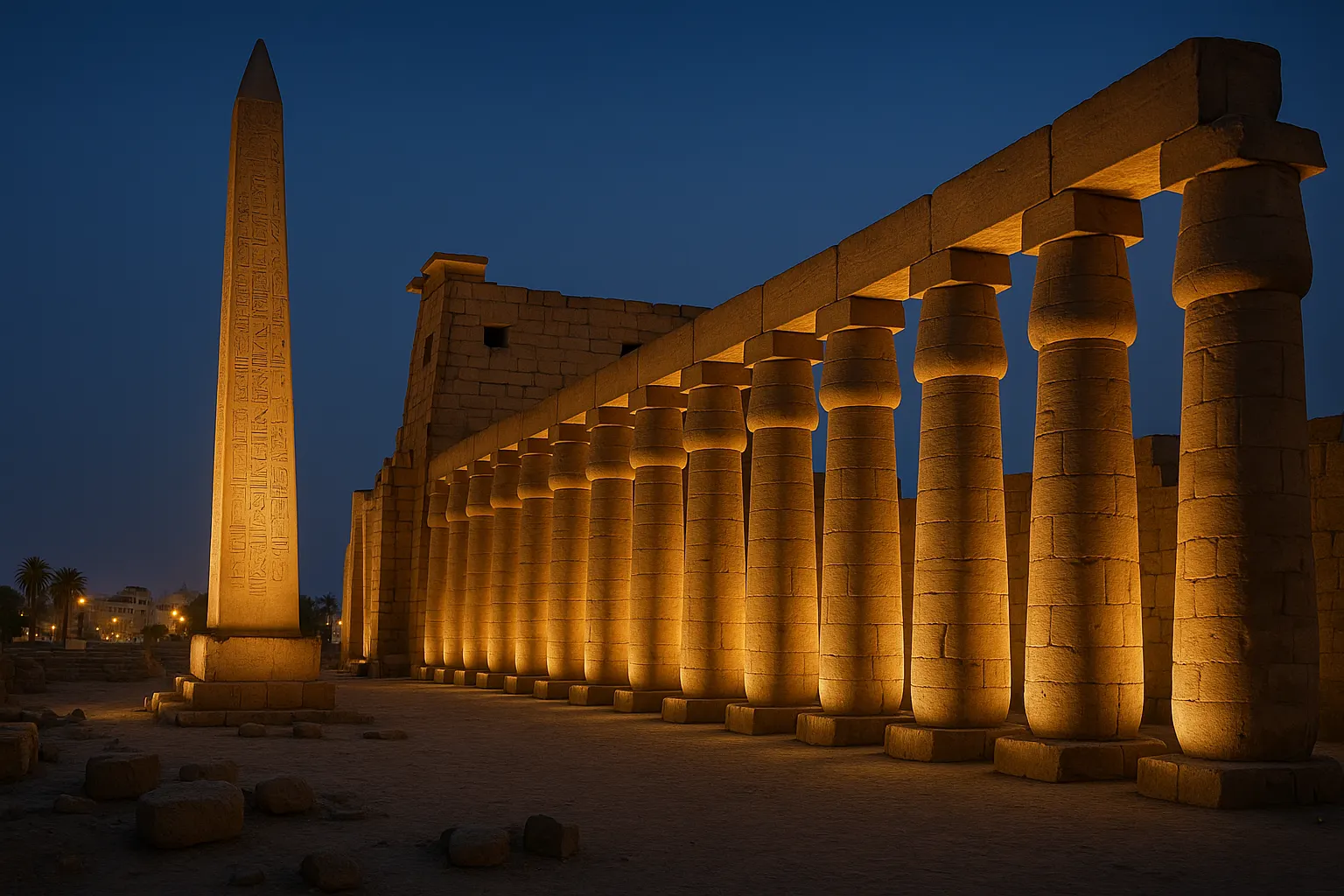
Luxor Temple Egypt Travel Guide 2026: The Elegant Temple of Luxor
Ancient EgyptianVisit Luxor Temple, the most elegant temple in Egypt. Discover the Avenue of Sphinxes, Colonnade of ...
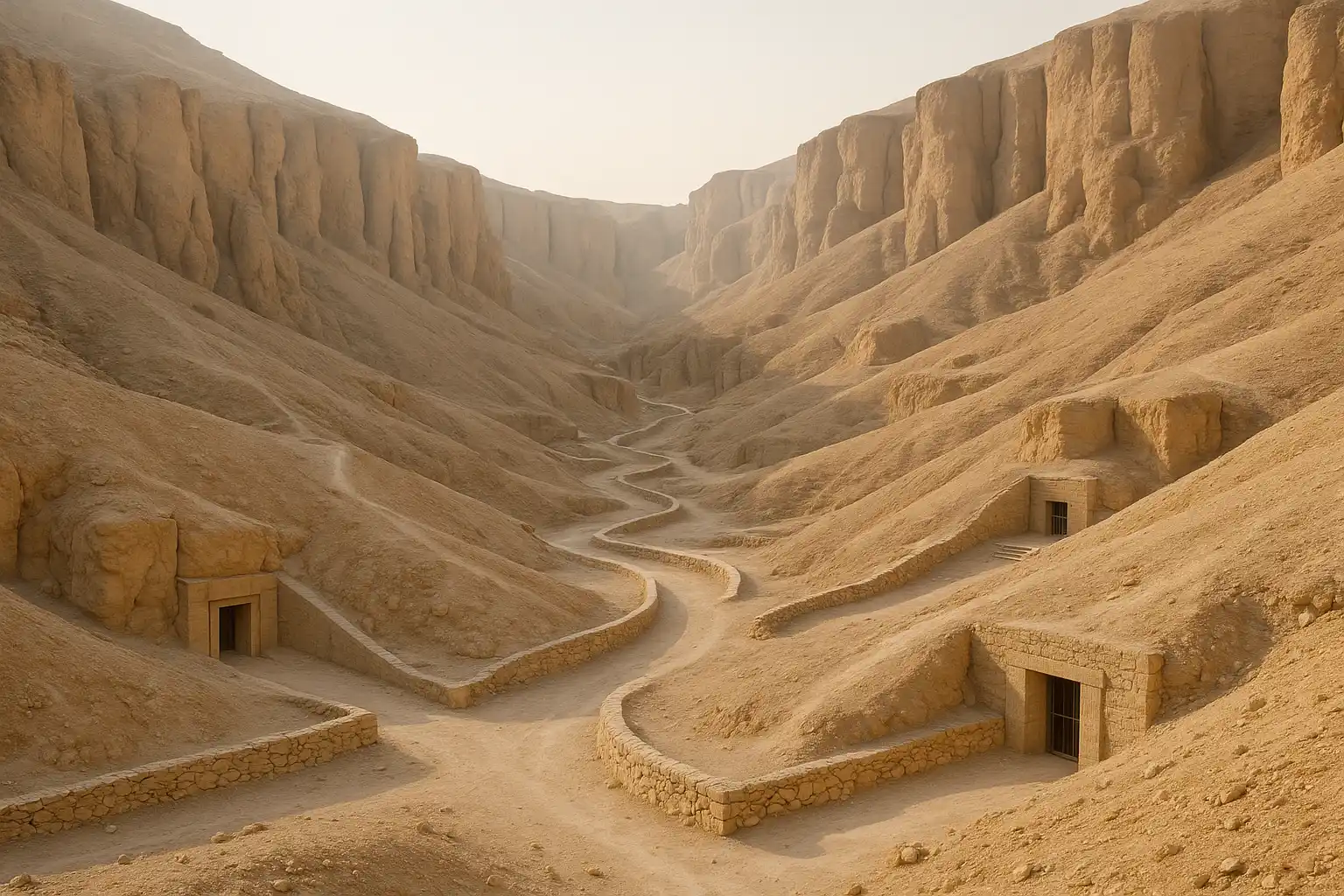
Valley of the Kings Egypt Travel Guide 2026: Royal Tombs of the Pharaohs
Ancient EgyptianExplore the Valley of the Kings where Tutankhamun and Ramesses were buried. Our guide covers tomb se...
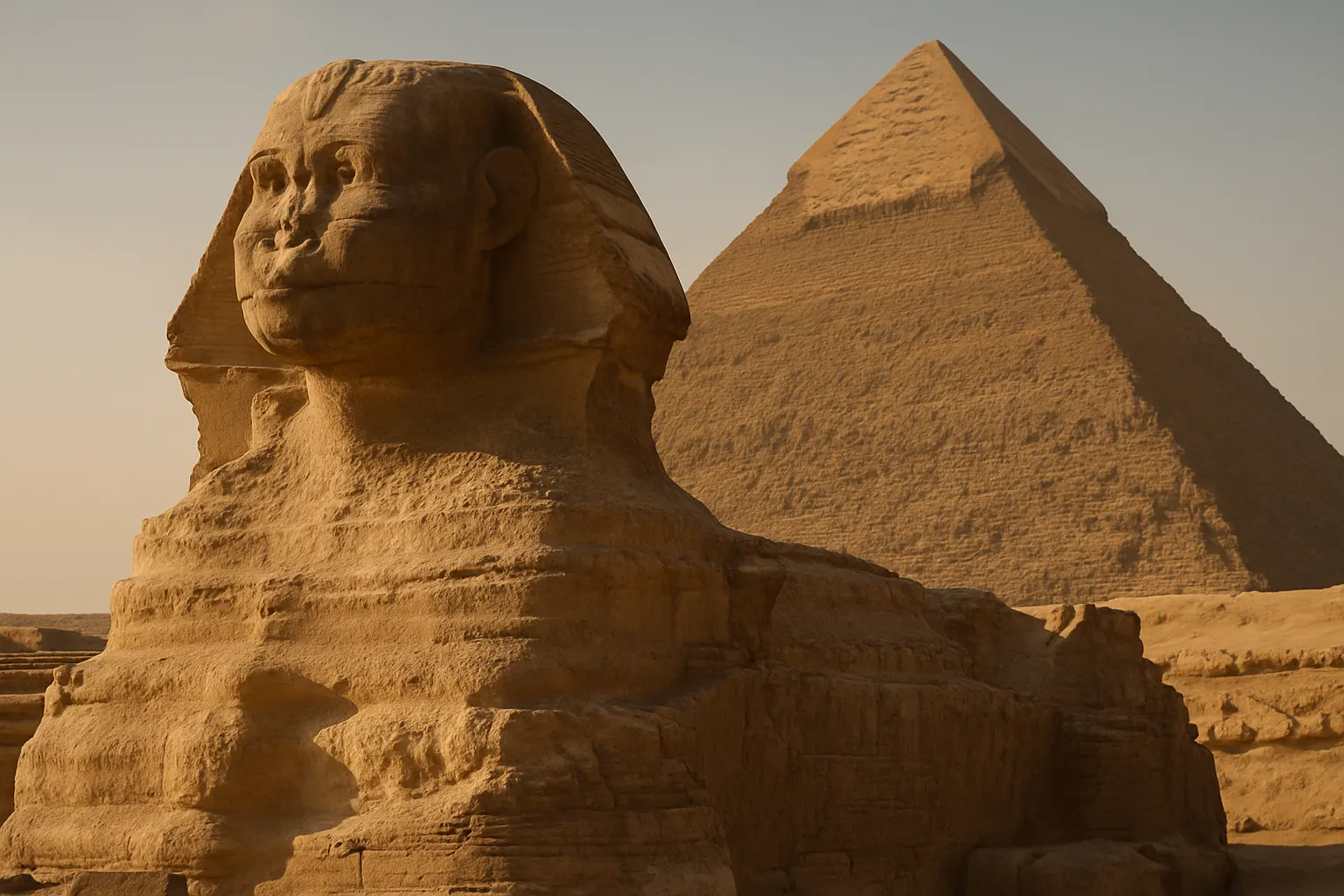
Great Sphinx of Giza Egypt Travel Guide 2026: Guardian of the Pyramids
Ancient EgyptianVisit the Great Sphinx, Egypt's enigmatic limestone guardian. Our guide covers the Sphinx's history,...