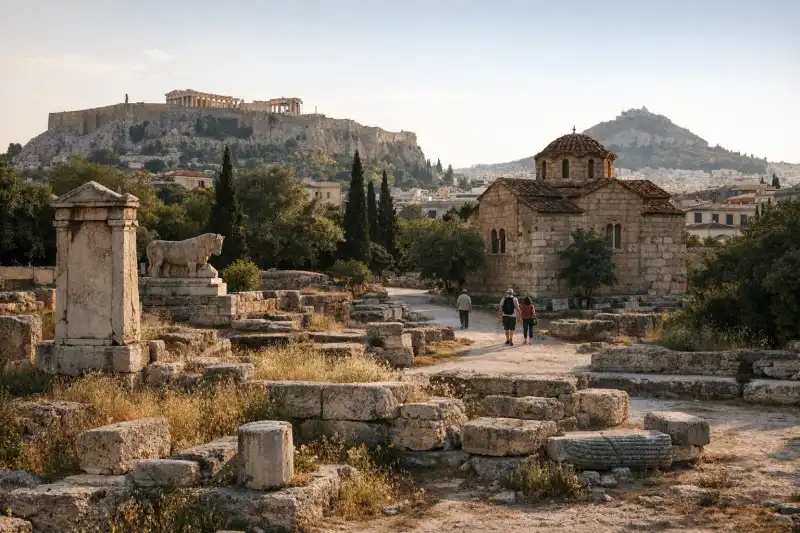
Quick Info
At a glance
Kerameikos in Greece is one of Athens’ most moving archaeological landscapes, a place where the practical life of the ancient city met ritual, memory, and death. While many travelers rush first to the Acropolis or the Ancient Agora, Kerameikos rewards those who want to understand Athens at ground level: how people entered the city, where they buried their dead, and how public roads, defensive walls, and family commemoration shaped civic identity. Set just beyond the core of the modern center, the site feels unexpectedly calm. Trees soften the outlines of ruined walls, stelae rise from the earth like pages of stone, and the trace of the Eridanos River reminds visitors that ancient Athens was never only marble and monuments, but also water, craft, traffic, and grief.
The name itself comes from the area’s association with potters and ceramic workers, yet Kerameikos is best known today as the city’s principal ancient cemetery. Here, roads once led outward from Athens toward Eleusis and the wider Greek world, while funeral processions moved in the opposite direction, carrying the dead to burial plots beside these symbolic routes. The result is a site that is both urban and sacred. Kerameikos tells the story of classical Athens through gates, walls, tombs, inscriptions, and sculpture, offering a more intimate counterpart to the grandeur of the city’s hilltop temples. For visitors, it is one of the best places in Athens to see how ancient life and ancient death existed side by side.
History
Early settlement and the potters’ quarter
Kerameikos takes its name from the kerameis, or potters, who occupied this low-lying district of ancient Athens. The presence of clay-rich ground and nearby water helped make the area suitable for ceramic production, and in early antiquity it developed as a working quarter beyond the political and sacred high points of the city. Even before it became famous as a cemetery, this district had practical significance. Its roads, workshops, and open space tied it to the everyday economy of Athens.
By the early first millennium BCE, burial activity had already become established here. As Athens grew, the area outside the city center naturally became a place where the dead could be interred beyond residential zones. The overlap of industry, access routes, and burial use was not unusual in the ancient Mediterranean, but in Kerameikos it evolved into something especially important because of the district’s location near the city’s principal western approaches.
Archaic and Classical development
During the Archaic period, Kerameikos emerged as the chief cemetery of Athens. Families erected markers over graves, some modest and others increasingly elaborate, reflecting both personal remembrance and social standing. Alongside individual burials, the area took on broader civic meaning as roads leading from the city passed through it. Funeral monuments placed beside these routes ensured that the dead remained visible to the living, and remembrance became part of the urban experience.
The Persian sack of Athens in 480 BCE disrupted the city profoundly, but reconstruction in the fifth century BCE transformed Kerameikos into a still more monumental zone. Under Themistocles, Athens rebuilt and strengthened its fortifications, and the district became home to major gateways in the city wall. The Dipylon Gate, the largest and most important entrance to Athens, and the nearby Sacred Gate shaped movement in and out of the city. Processions to Eleusis passed through here, and public funerals for war dead also gave the area civic prominence.
In the Classical period, Kerameikos became a place where Athenian ideals were expressed in stone. Gravestones and funerary reliefs often showed the deceased in poignant domestic scenes: farewells, handclasps, seated figures, attendants, or horses. These monuments balanced restraint and emotion, turning family memory into a public art form. Yet over time, sumptuary concerns and shifting politics affected burial display, and not all periods permitted equally lavish expression.
Hellenistic and Roman continuity
Kerameikos continued in use through the Hellenistic period, though the character of Athens changed as Macedonian and later Roman power reshaped the Greek world. The cemetery remained important, and older monuments shared space with new burials and altered commemorative habits. Roman Athens, while no longer politically dominant, retained immense cultural prestige, and Kerameikos stayed embedded in the city’s landscape of memory.
The site also preserved traces of repeated adaptation. Gates were repaired, routes changed, and monuments were reused or damaged. Flooding from the Eridanos and the accumulated effects of centuries of urban life altered the area physically. What visitors see today is therefore not a frozen classical scene, but a layered record of long use and reuse extending far beyond the age of Pericles.
Decline, burial, and rediscovery
As late antiquity and the medieval centuries transformed Athens, much of ancient Kerameikos gradually disappeared beneath alluvium, later construction, and the shifting life of the city. Tombs collapsed, sculptures were broken or buried, and the once-famous cemetery faded from view. Yet that burial also helped preserve parts of the archaeological record.
Systematic excavations began in the late nineteenth and early twentieth centuries, especially under the German Archaeological Institute, bringing to light the city walls, gates, grave precincts, inscriptions, and sculptural masterpieces now associated with the site. Archaeologists uncovered not just isolated monuments but the broader spatial logic of Kerameikos: roads, boundary markers, river, defenses, and burial zones. This made it possible to understand the area as one of the clearest surviving windows into ancient Athenian topography.
Today Kerameikos stands as both an archaeological park and a scholarly treasure. It is essential for understanding the civic geography of Athens, the social language of funerary art, and the ways in which ancient Greeks connected memory, identity, and urban space.
Key Features
Kerameikos is remarkable because it combines several kinds of ancient evidence in one compact site. Rather than presenting a single temple or stand-alone monument, it reveals an entire environment where roads, walls, water, graves, and ritual movement intersected. This gives the visit an unusual sense of depth. You are not simply looking at ruins; you are moving through a landscape structured by passage and remembrance.
The most famous feature is the cemetery itself. Grave markers, family enclosures, and sculpted monuments line the ancient approaches, and even where originals have been replaced by casts for protection, the emotional power remains strong. Funerary stelae from Kerameikos are among the finest expressions of Attic relief sculpture. Their scenes are often quiet rather than dramatic: a seated woman holding jewelry, a young athlete, a cavalryman, or two figures clasping hands in farewell. The restraint of these images is part of their force. They suggest loss through gesture and posture rather than spectacle, making the cemetery feel deeply human even after more than two millennia.
Equally significant are the fortifications and gates. The Dipylon Gate once formed the principal entrance to ancient Athens from the northwest, and its remains still convey scale and strategic importance. This was not merely an opening in the wall, but a carefully designed urban threshold controlling movement into the city. Nearby, the Sacred Gate marked the route of the Sacred Way toward Eleusis, linking Kerameikos to one of the most important religious journeys in ancient Greece. Standing among these remains, visitors can imagine processions, traders, foreign arrivals, soldiers, and funeral corteges all passing through the same space.
Another defining element is the Eridanos River, modest today but crucial to the site’s original setting. Its course reminds visitors that ancient Athens was shaped by natural features as much as by architecture. The river contributed to the low-lying, sometimes marshy character of the district and helps explain both settlement patterns and preservation conditions. In Kerameikos, landscape is not background; it is part of the archaeological story.
The on-site museum adds a vital interpretive layer. Small enough to visit without fatigue yet rich in quality, it displays original grave monuments, sculpture, ceramics, and inscriptions recovered from the area. The museum allows visitors to appreciate details that weathered outdoor remains can no longer easily show. Faces, drapery folds, horse tack, lettering, and painted traces become more legible indoors, giving context to what is seen in the open-air site. It also helps explain why Kerameikos mattered beyond burial alone: pottery, civic decrees, and excavated finds illuminate the district’s industrial and urban life.
One of the most rewarding aspects of Kerameikos is its atmosphere. Unlike some of Athens’ busiest landmarks, it often feels contemplative. There is room to pause, study alignments, and notice how the city wall cuts across the terrain or how tombs relate to the roads. The modern city is never far away, yet inside the archaeological enclosure the noise seems to soften. That contrast enhances the experience. Kerameikos is still Athens, but an older, quieter one.
Visitors interested in historical topography will find the site especially satisfying because so much here depends on orientation. Looking toward the gates, the roads, and nearby districts allows you to understand Kerameikos as a node in a larger urban system connecting the Agora, the Acropolis area, and routes westward from the city. For photographers, the best images often come not from isolated monuments but from layered compositions: tombs in the foreground, walls beyond, trees and the museum behind, and occasionally the hints of modern Athens rising outside the perimeter. Kerameikos rewards patience, careful reading of signs, and a willingness to imagine movement through space rather than only admire single objects.
Getting There
Kerameikos is located just northwest of central Athens and is one of the easier archaeological sites in the city to reach by public transport. The most convenient option is the Athens Metro. Kerameikos station on Line 3 is a short walk from the archaeological entrance, and a standard single urban ticket typically costs about €1.20 to €1.40 depending on current pricing and fare policy. If you are already exploring central Athens, the site is also walkable from Monastiraki, Thissio, or the Ancient Agora area in roughly 15 to 25 minutes, depending on your route.
Taxis are widely available across Athens and can be practical if you are arriving from farther neighborhoods, the coast, or a hotel with limited transit access. A short taxi ride from Syntagma Square or central districts usually costs around €5 to €8 in normal traffic, though this can rise with congestion or late-night surcharges. Ride-hailing apps operate in Athens as well and may make pickup easier.
From Athens International Airport, the simplest route is usually Metro Line 3 toward the city center. The airport fare is much higher than a regular urban ticket, generally around €9 one way for a standard adult airport journey. You can also take the suburban rail or airport bus into central Athens and continue by Metro or on foot.
Because Kerameikos is often paired with nearby attractions such as the Ancient Agora or Acropolis area, many visitors build it into a walking day. Wear sturdy shoes, as paths can be uneven, and carry water in warmer months. Checking current opening hours before departure is wise, especially if you plan a late-afternoon visit.
When to Visit
The best time to visit Kerameikos is spring or autumn, when Athens is warm but not overwhelmingly hot and the light is especially kind to stone, grass, and sculpture. From March to May, the site often feels fresh and open, with mild temperatures that make slow exploration easy. September through November is similarly pleasant, and these months are excellent for combining Kerameikos with long walking itineraries around central Athens.
Summer is entirely possible, but midday heat in Athens can be intense, especially from late June through August. Kerameikos has some shade, yet much of the visit takes place outdoors in exposed areas. If you go in summer, aim for the first opening hour or later in the afternoon when the sun is lower and the site feels calmer. Bring a hat, sunscreen, and more water than you think you need.
Winter has advantages too. Cooler temperatures make walking comfortable, and the lower visitor numbers can enhance the site’s reflective atmosphere. Rain is possible, and wet ground may make some paths less pleasant, but winter light can be beautiful for photography and the museum becomes an especially welcome part of the visit. If your priority is quiet, winter is one of the best seasons.
Time of day matters almost as much as season. Early morning usually offers softer light, fewer people, and a stronger sense of the site as a cemetery and sacred threshold rather than just another stop on a crowded sightseeing circuit. Late afternoon is also attractive, especially if you want to continue on foot toward nearby neighborhoods for dinner afterward. Whenever you go, allow enough unhurried time to visit both the outdoor remains and the museum together.
| Quick Facts | Details |
|---|---|
| Location | Athens, Attica, Greece |
| Type | Ancient cemetery, city gate complex, and archaeological site |
| Best Known For | The principal cemetery of ancient Athens and the Dipylon Gate |
| Historical Periods | Archaic, Classical, Hellenistic, Roman |
| Nearest Metro | Kerameikos (Line 3) |
| Typical Visit Duration | 1–2 hours |
| On-Site Museum | Yes |
| Good Combined Visits | Ancient Agora, Acropolis, central Athens walking routes |
| Best Seasons | Spring and autumn |
| Atmosphere | Quiet, reflective, historically rich |
Guided tours: worth it?
Most travelers can visit Kerameikos independently. Compare a tour only if you want a tighter history-focused visit, easier logistics, or a guide who can answer questions on the spot.
Best for
- Short visits where a planned route saves time
When to go self-guided
Go independently if you prefer setting your own pace, reading as you go, and checking official hours or ticket rules directly before you arrive.
What I’d avoid
Skip paid tours that bundle unrelated stops you do not actually want. The best option should either save meaningful planning time or add historical context you would miss on your own.
Athens Ancient Sites Tours
Useful when: you want to compare guided formats before deciding
Kerameikos Athens Tours
Useful when: you want to compare guided formats before deciding
Athens Archaeological Walking Tours
Useful when: you want to compare guided formats before deciding
Some tour links are affiliate links, which may earn Ancient Travel a small commission at no extra cost to you. I try to surface options that make practical sense for the site—not just anything bookable.
Frequently Asked Questions
What is Kerameikos?
Kerameikos is an important archaeological site in Athens, Greece, known as both the city’s ancient potters’ quarter and its principal cemetery outside the classical city walls.
Is Kerameikos worth visiting in Athens?
Yes. Kerameikos offers a quieter, more reflective alternative to the Acropolis, with city walls, funerary monuments, sacred roads, and an excellent small museum.
How much time do you need at Kerameikos?
Most visitors spend 1 to 2 hours exploring the open-air ruins and museum, though history enthusiasts may want longer.
Can you visit Kerameikos with the same ticket as other Athens sites?
Ticketing policies change, but Kerameikos is sometimes included in combination archaeological passes for Athens. Always check the official Hellenic Ministry of Culture or site ticket office before visiting.
How do you get to Kerameikos?
Kerameikos is easy to reach by Metro via Kerameikos station on Line 3, and it is also walkable from Monastiraki, Thissio, and the Ancient Agora area.
What can you see at Kerameikos?
Visitors can see sections of the Themistoclean walls, the Dipylon Gate, the Sacred Gate, the Eridanos River area, grave monuments, and artifacts in the on-site museum.
Nearby Ancient Sites
Acropolis Travel Guide 2026: Parthenon, Tickets, and Best Time
Ancient GreecePlan an efficient Acropolis visit with practical ticket timing, key monuments, and museum pairing ti...
The Complete Acropolis Athens Travel Guide: Temples
Ancient GreecePlan the perfect visit to the Acropolis of Athens with our 2026 guide. Discover the Parthenon, best ...
Ancient Agora of Athens Travel Guide 2026: Route, Tickets, and Context
Classical GreekPlan a better Ancient Agora visit with practical timing, monument priorities, and clear historical c...