Quick Info
Curated Experiences
Kiyomizudera and Higashiyama Walking Tour
Kyoto Morning Tour: Kiyomizudera and Fushimi Inari
Kyoto Kimono Experience and Temple Tour
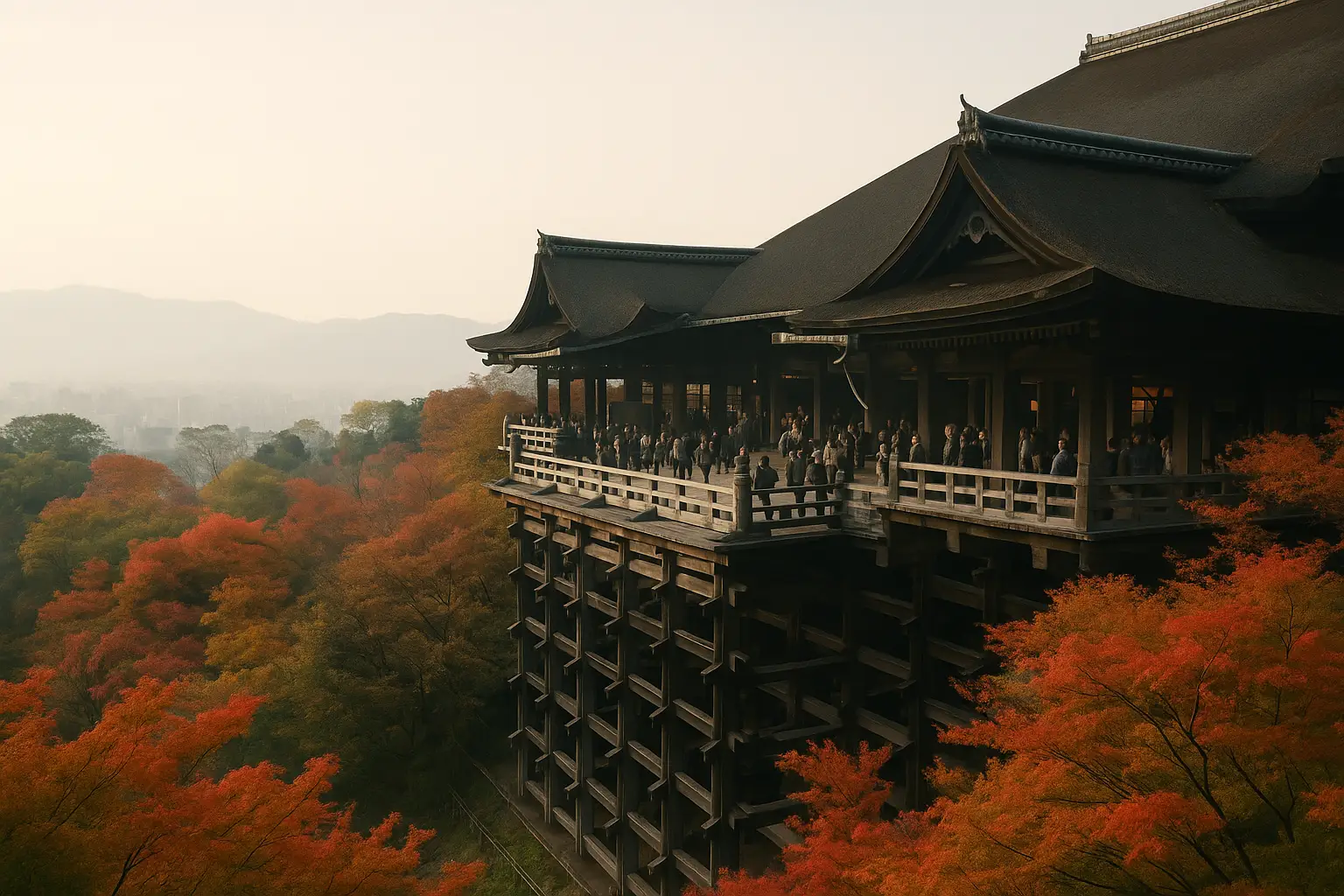
The wooden platform extends beyond the edge of the hillside as if it has forgotten the earth is supposed to end there. Thirteen meters below, the canopy of the valley drops away toward Kyoto. The 139 zelkova and cypress pillars holding you above that drop are joined without a single nail, their interlocking timber frames flexing slightly underfoot in a way that reminds you the entire structure is alive to the wind and the mountain. Standing on the stage of Kiyomizudera, the Pure Water Temple, with the city grid spread below and the mountains ringing the ancient capital at the horizon, you understand viscerally why the Japanese language turned this place into a metaphor: to jump from Kiyomizu’s stage means to commit fully, to take the leap from which there is no return.
Kiyomizudera has occupied this eastern hillside since 778 CE — over a decade before Kyoto was established as the imperial capital. Pilgrims, poets, and emperors have climbed this slope for twelve centuries, drawn by the same combination of engineering ambition, sacred water, and panoramic authority that draws visitors today. The current main hall dates to 1633, restored in 2020, but the site’s continuity is unbroken. The waterfall that gave the temple its name still flows. The stage still reaches out over the valley. The approach through the Higashiyama district’s preserved lanes remains one of Kyoto’s finest walks.
This is not merely one of Japan’s most photographed sites. It is one of its most honestly spiritual ones, a place where architecture takes a leap of faith and invites you to stand at the edge with it.
Historical Context
The founding story begins with a monk named Enchin who in 778 CE received a vision directing him to seek a waterfall in the eastern hills. He found it — a cascade of impossibly clear water tumbling from the Higashiyama range — and recognized it as sacred. He built the first temple on the hillside above, naming it Kiyomizudera: the Temple of Pure Water. When Kyoto was established as the imperial capital in 794 CE, the temple was already a functioning sanctuary.
The Kita-Hosso Buddhist sect maintained the site and shaped its doctrinal character through centuries of fire and rebuilding. Japanese wooden architecture is inherently vulnerable to flames, and Kiyomizudera burned and was reconstructed repeatedly, each time preserving the temple’s sacred continuity while renewing its physical form. The current main hall was built in 1633 under the patronage of Tokugawa Iemitsu, the third Tokugawa shogun, who poured governmental resources into restoring sacred sites as an act of public piety and political legitimacy.
A comprehensive restoration completed in 2020 renewed the roof and structural timbers while keeping the Tokugawa-era design intact. The building visitors stand in today represents seventeenth-century craftsmanship in a twelfth-century tradition, on an eighth-century site. The water, the hillside, and the view over the city that first drew Enchin to this slope are unchanged. The temple that honors them has been made and remade for nearly thirteen hundred years.
The temple’s popular resonance in Japanese culture goes beyond religion. During the Edo period, a folk belief held that anyone who survived a jump from the 13-meter stage would have their wish granted. Historical records suggest that over 200 people actually jumped between 1694 and 1864, with a survival rate of about 85 percent — the thick tree canopy below apparently cushioned the fall. The practice was banned in 1872, but the proverb Kiyomizu no butai kara tobioriru endures as one of the most common expressions in everyday Japanese.
What to See
The Wooden Stage (Butai)
The main hall extends beyond the hillside using kake-zukuri (overhang) construction, a method the temple’s carpenters perfected over generations. The platform floats 13 meters above the valley floor, held entirely by interlocking timber frames without a single iron fastener. The same joinery technique that eliminated nails also gives the structure calibrated flexibility: the platform absorbs lateral shocks from earthquakes, swaying slightly rather than cracking. The 139 pillars are constructed from zelkova and cypress selected for exceptional durability. They have darkened with centuries of exposure, acquiring a silvered, nearly mineral quality that makes the structure seem to belong to the hillside as naturally as the trees. Walk out to the edge. The city opens below in a grid of streets, temple rooftops, the distant mountains, and the green margins where urban sprawl dissolves back into forest. Photographers should note that the temple faces east, so morning light illuminates the main hall most effectively.
Otowa Waterfall
Below the main hall, reached by a covered walkway descending along the hillside, the waterfall that drew Enchin to this place still flows. Otowa-no-taki divides into three streams as it falls into a stone pool. Each carries a different blessing: longevity, success in study, and fortunate love. Visitors line up to hold long-handled cups beneath each channel. The rule is that you may drink from only one stream — to drink from all three is considered greedy, an imposition that cancels the blessings rather than multiplying them. The water is pure spring water, perfectly safe to drink, and has been flowing without interruption for over 1,200 years. Arrive early or late in the afternoon to reduce the queue time.
Jishu Shrine
Set within the temple precinct but functioning as an independent Shinto sanctuary, Jishu Shrine is dedicated to the deity of love and matchmaking. Two stones sit 18 meters apart in the courtyard. Walk from one to the other with your eyes closed: if you arrive unaided, your search for love will succeed; if a friend guides you, you will find love but only with help. The ritual packs an elegant observation about love into a thirty-second walk. Most visitors laugh when they miss, veering dramatically off course. But the laughter carries an edge, because the stakes feel real. This is a place where the line between ceremony and sincerity disappears entirely.
Seasonal Night Illuminations
Three times each year, Kiyomizudera extends its hours and illuminates the main hall, hillside, and surrounding trees with soft artificial light. The spring illumination in late March and early April lights cherry blossoms hovering against the dark sky. The summer edition in August coincides with Obon, the Buddhist festival of the dead. The autumn illumination throughout November turns maple trees every shade from pale yellow to deep crimson against the lit facade. Night illuminations run until 9:00 PM with separate admission of 400 JPY.
The Higashiyama Approach
The final approach to the temple is always on foot, up the stone-paved lanes of Ninenzaka and Sannenzaka — the Two-Year Slope and Three-Year Slope, named for the misfortune said to befall anyone who stumbles on them. Traditional wooden buildings line both sides: tea houses, pottery shops, confectioners selling yatsuhashi and matcha sweets. Walking these streets before 8:00 AM, when the shopkeepers are only beginning to arrange their displays, is to experience something increasingly rare in heavily visited Japan: the sensation of arriving somewhere before the crowd has defined what it should feel like.
Timing and Seasons
The temple opens at 6:00 AM and closes at 6:00 PM, with seasonal variations and extended hours during night illuminations. The 6:00 to 8:00 AM window delivers the fewest crowds, the cleanest light on the east-facing main hall, and the chance to hear monks chanting before tour groups arrive. This is consistently the best time regardless of season.
Spring from late March through early April brings cherry blossoms to the hillside — the scene is extraordinary, but crowds peak as much as anywhere in Kyoto. Temperatures average 50 to 65°F (10 to 18°C). Autumn in November offers spectacular maple foliage turning the entire slope crimson and gold, with temperatures around 45 to 60°F (7 to 15°C). Both seasons are equally crowded and equally worth it. Summer reaches 85 to 95°F (29 to 35°C) with high humidity, but evenings bring the special illuminations. Winter visits reward with clear skies, uncrowded lanes, and temperatures of 35 to 50°F (2 to 10°C), revealing Kiyomizudera stripped to its essential architectural gravity.
Avoid weekends year-round if possible, and especially during cherry blossom season and November autumn peak. The narrow approach streets become genuinely congested during these windows.
Tickets, Logistics and Getting There
Admission is 400 JPY (approximately $2.80 USD) for adults and 200 JPY for elementary and junior high students. This covers the main hall, wooden stage, and temple grounds including Otowa Waterfall. Seasonal night illuminations require separate admission of 400 JPY.
Kyoto City Bus 100 or 206 from Kyoto Station to the Kiyomizu-michi or Gojo-zaka stop takes 15 minutes and costs 230 JPY ($1.60 USD), followed by a 10-minute uphill walk through the Higashiyama lanes. The Keihan Line to Kiyomizu-Gojo Station is a good alternative, particularly if arriving from Osaka or incorporating Gion into the same outing. Walking from central Kyoto takes 20 to 30 minutes through scenic streets and is genuinely enjoyable. Taxis can approach the base but not the final pedestrian-only section. Plan to walk the last 10 minutes regardless of how you arrive.
Practical Tips
- Arrive at 6:00 AM if you want the temple essentially to yourself. By 9:00 AM the approach streets are filling; by 11:00 AM they are packed.
- The temple faces east. Morning light falls directly on the main hall, making before 10:00 AM the best photography window.
- The approach through Ninenzaka and Sannenzaka is as rewarding as the temple itself. Do not skip it in favor of a taxi to the base.
- Long-handled cups are provided at Otowa Waterfall. Drink from one stream only: longevity, academic success, or fortunate love. Sanitizing stations are available.
- Comfortable walking shoes are essential. The approach is uphill, the temple grounds involve stairs, and the stone-paved lanes can be slippery when wet.
- Night illumination tickets are separate from daytime admission. The evening experience is markedly different and genuinely worthwhile, especially in autumn.
- There is no cloakroom at the temple. Travel light.
Suggested Itinerary
6:00 AM — Arrive at the temple gate at opening. Enter through the Nio Gate and walk directly to the main hall and wooden stage. Spend 20 minutes absorbing the view and the quiet before crowds arrive.
6:30 AM — Descend to Otowa Waterfall. The queue at this hour is minimal. Choose your stream and drink.
6:45 AM — Visit Jishu Shrine. Attempt the love-stone walk. Return to the main hall for a second look in shifting morning light.
7:15 AM — Exit the temple and walk slowly down through the Higashiyama district. Ninenzaka and Sannenzaka are at their most atmospheric before the shops fully open.
7:45 AM — Continue west toward Kodaiji Temple (400 JPY, 30 to 40 minutes), which opens at 9:00 AM. Browse the traditional streets while waiting.
9:00 AM — Visit Kodaiji Temple, then continue to Yasaka Shrine (free) and the edge of Gion.
10:00 AM — Breakfast or early lunch in the Gion restaurant district. Total morning: approximately 4 hours covering Kiyomizudera, Higashiyama, Kodaiji, and Gion.
Nearby Sites
Kinkakuji Temple — The Golden Pavilion in northwest Kyoto represents a completely different architectural tradition from Kiyomizudera’s hillside engineering. The two sites together provide the most comprehensive Kyoto temple experience, covering Zen garden aesthetic and mountain-temple drama in a single day.
Himeji Castle — Japan’s finest surviving feudal castle, 45 minutes from Kyoto by shinkansen. A natural second-day destination after a Kyoto temple itinerary.
Itsukushima Shrine — The floating torii gate on Miyajima Island, where architecture and water meet in a manner that rhymes with Kiyomizudera’s relationship between building and hillside.
Fushimi Inari Shrine — The tunnel of vermilion torii gates south of central Kyoto pairs well with Kiyomizudera for a full day that moves from mountain temple to mountain shrine. Many guided tours combine the two sites.
Standing at the Edge
Kiyomizudera asks something simple of its visitors: step out onto the stage and look. The city is below. The mountains are beyond. The pillars beneath you have held this platform above the valley for four centuries without a single nail. Somewhere below the stage, the waterfall that named this place continues to pour from the hillside exactly as it did when a wandering monk followed a vision to this spot in 778 CE. The water does not care about the temple. The temple was built to honor the water. Standing on the stage, feeling the slight give of the cypress planks, hearing the wind move through the valley, you understand that the leap Kiyomizudera asks you to take is not physical. It is the leap of attention, of arriving somewhere ancient and allowing it to be exactly what it is.
Discover More Ancient Wonders
- Kinkakuji Temple — The Golden Pavilion reflected in Kyoto’s Mirror Pond
- Himeji Castle — Japan’s most beautiful original castle, unchanged since the 17th century
- Itsukushima Shrine — The floating torii gate rising from the tidal sea on Miyajima Island
- Plan your Kyoto visit with our beginner’s guide to visiting ancient sites
- Capture the wooden stage with our guide to photographing ruins
Quick Facts
| Attribute | Details |
|---|---|
| Location | Higashiyama district, Kyoto, Japan |
| Country | Japan |
| Region | Kyoto |
| Civilization | Japanese Buddhist (Kita-Hosso) |
| Historical Period | 778 CE–present |
| Established | 778 CE |
| UNESCO Status | World Heritage Site (1994, Historic Monuments of Ancient Kyoto) |
| Current Buildings | Reconstructed 1633; restored 2020 |
| Entry Fee | 400 JPY adults (~$2.80 USD); 200 JPY students |
| Hours | 6:00 AM–6:00 PM (extended seasonally) |
| Best Time | Early morning year-round; late March–April (sakura); November (foliage) |
| Distance from Kyoto Station | ~3 km; 15 min by bus + 10 min walk |
| Elevation | 242 meters (794 feet) |
| Suggested Stay | 2–4 hours (temple and Higashiyama district) |
| Coordinates | 34.9949, 135.785 |
Frequently Asked Questions
How do I get to Kiyomizudera from Kyoto Station?
Take Kyoto City Bus 100 or 206 to Kiyomizu-michi or Gojo-zaka stops (15 minutes, 230 JPY/$1.60 USD), then walk 10 minutes uphill. Alternatively, take the Keihan Line to Kiyomizu-Gojo Station (5-minute walk). Walking from central Kyoto takes 20-30 minutes through scenic Higashiyama. Taxis can approach the temple base but not the top—expect to walk the final steep approach. The uphill walk is part of the traditional experience and passes through charming preserved streets.
What is the famous wooden stage at Kiyomizudera?
The main hall's wooden stage (butai) extends 13 meters over the hillside, supported by 139 towering wooden pillars using traditional joinery without nails. Built using the kake-zukuri (overhang) method, it offers spectacular views over Kyoto city and is the temple's most photographed feature. The expression 'to jump off the stage at Kiyomizu' (Kiyomizu no butai kara tobioriru) means to take the plunge on an important decision—an Edo period reference to a belief that surviving the 13-meter jump would grant your wish.
How much time do I need at Kiyomizudera?
Plan 1.5-2 hours for the temple complex including the main hall, wooden stage, Otowa Waterfall, and Jishu Shrine. Add 1-2 hours for exploring the surrounding Higashiyama district with its preserved streets, shops, and restaurants. Many visitors spend half a day (3-4 hours total) combining the temple with nearby Kodaiji Temple, Yasaka Shrine, and the historic streets between Gion and Kiyomizu. The approach through Ninenzaka and Sannenzaka is as rewarding as the temple itself.
When is the best time to visit Kiyomizudera?
Early morning (6 AM opening) offers fewer crowds and beautiful sunrise views. Spring cherry blossom season (late March–early April) illuminates the hillside in pink. Autumn (November) provides spectacular fall colors that made Kiyomizudera famous. Summer evenings feature special illuminations. The temple faces east, so morning light illuminates the main hall beautifully. Avoid weekends and Japanese holidays when the narrow approach streets become packed with visitors.
How much does it cost to visit Kiyomizudera?
Entry to the temple complex is 400 JPY ($2.80 USD) for adults, 200 JPY ($1.40 USD) for elementary and junior high students. This includes access to the main hall, wooden stage, and Otowa Waterfall. The surrounding Higashiyama district is free to explore. Special night illuminations (seasonal) cost 400 JPY. Budget approximately 500-800 JPY ($3.50-6 USD) per person including traditional snacks from shops along the approach.
What is special about Otowa Waterfall?
Otowa Waterfall (Otowa-no-taki) is the sacred waterfall that gives the temple its name ('Pure Water Temple'). Three streams of water fall into a pool below the main hall, each said to provide different benefits: longevity, success in school, and fortunate love. Visitors use cups on long poles to drink from the streams. Drinking from all three is considered greedy—choose your priority. The water has been flowing for over 1,200 years and remains the temple's spiritual heart.
Nearby Ancient Sites
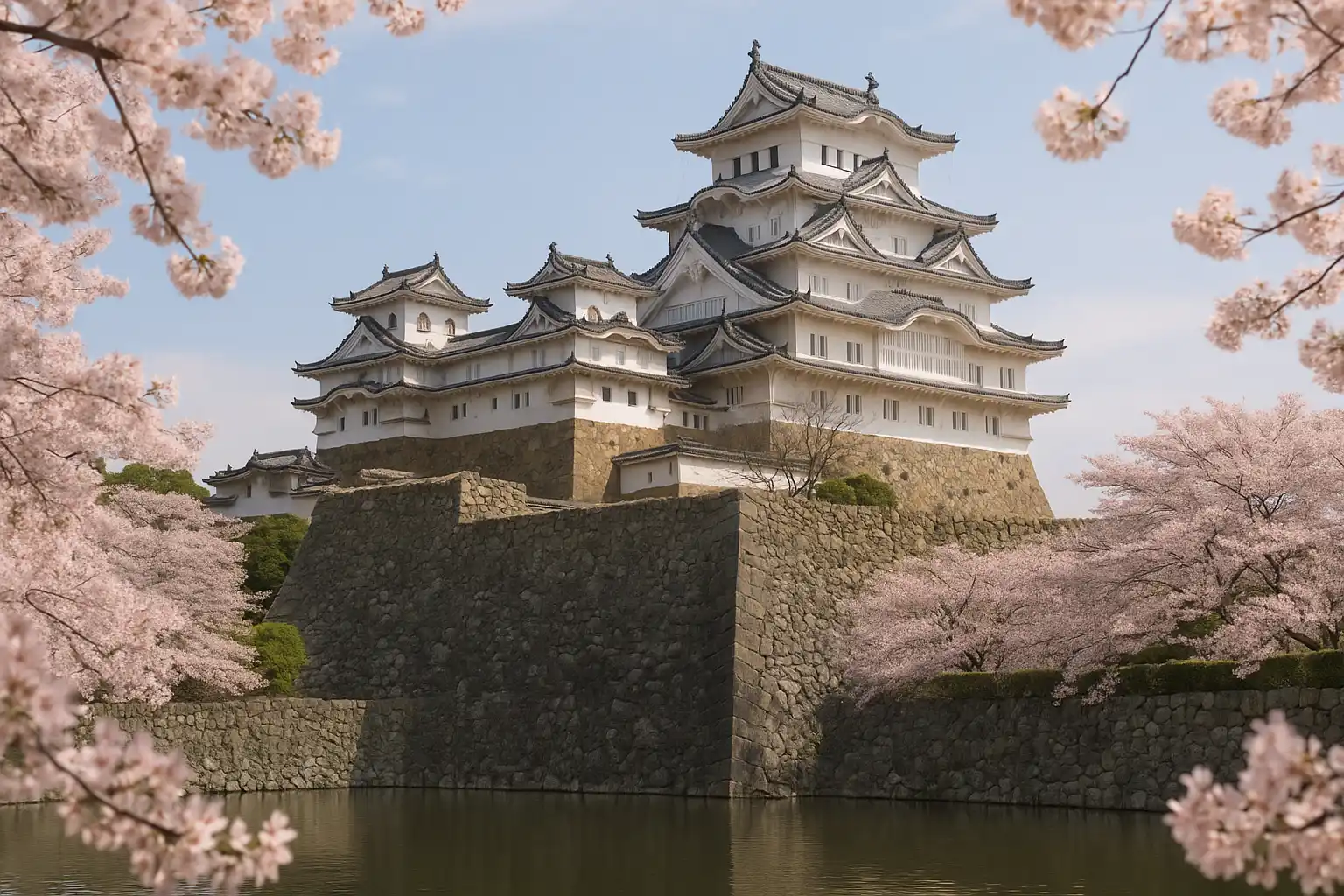
Himeji Castle Japan Travel Guide 2026: The White Heron Castle
Japanese FeudalVisit Himeji Castle, Japan's most beautiful original castle. Explore the White Heron keep, defensive...
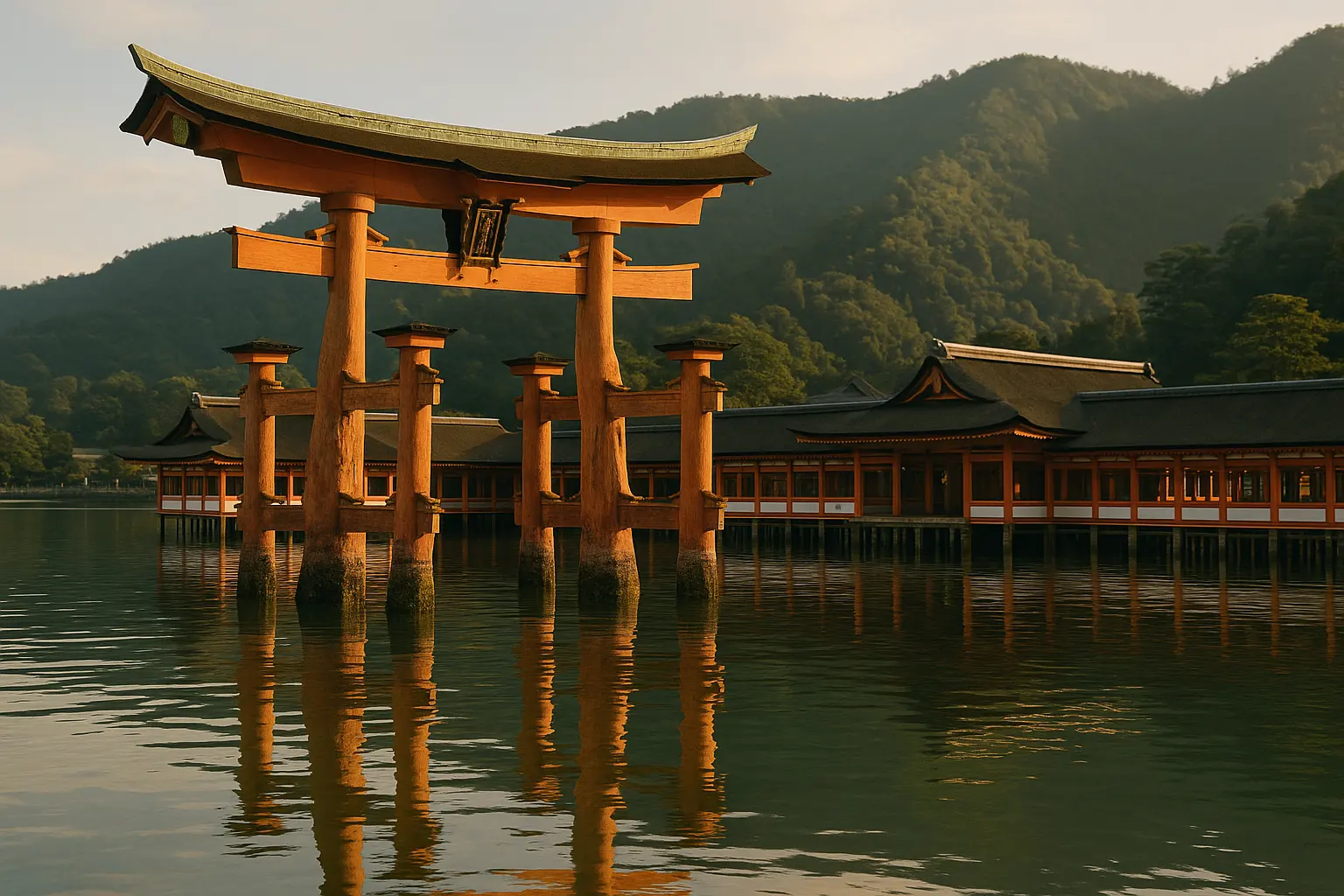
Itsukushima Shrine Japan Travel Guide 2026: The Floating Torii Gate
Japanese ShintoVisit Itsukushima Shrine on Miyajima Island, famous for its floating torii gate. Discover the shrine...
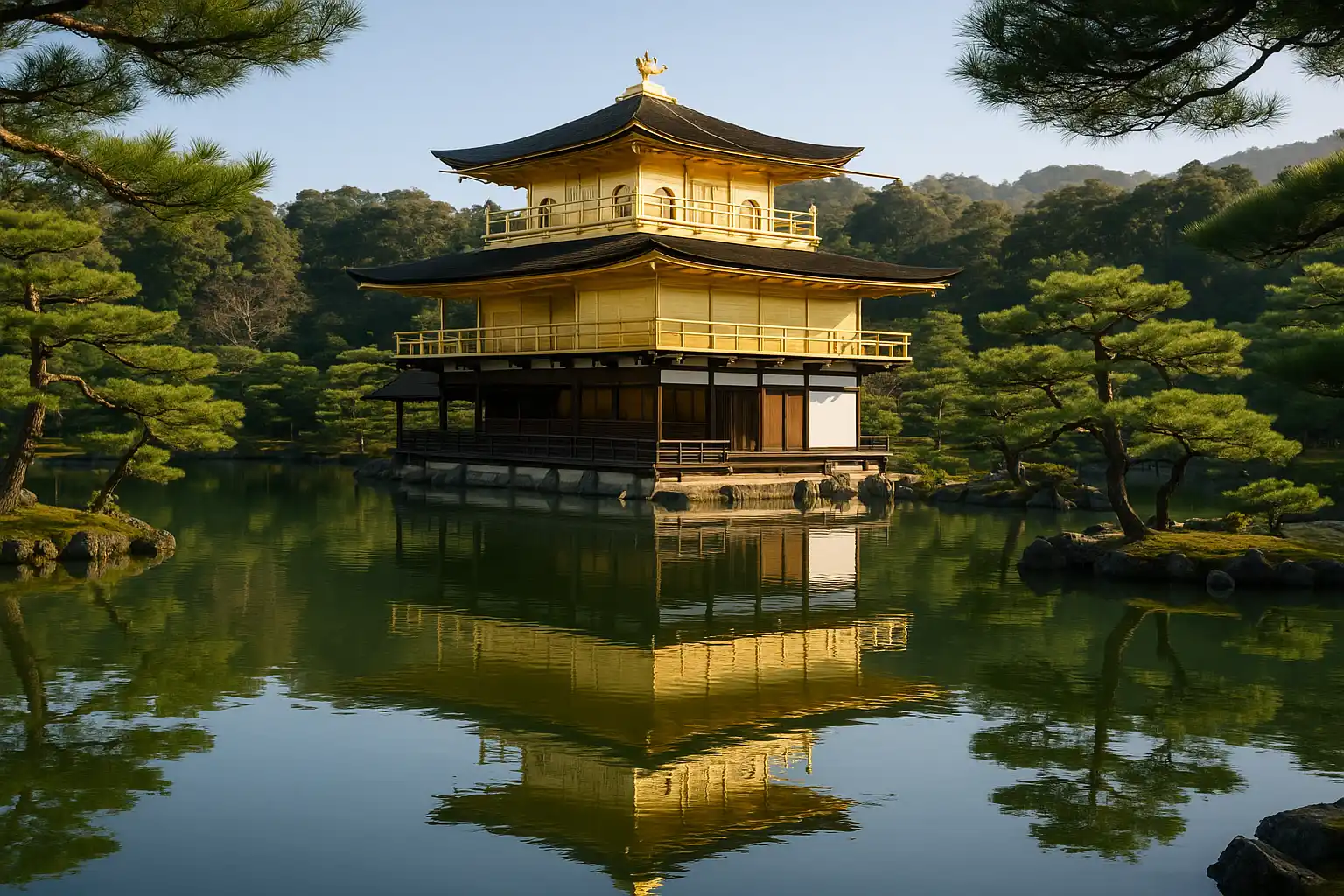
Kinkakuji Temple Japan Travel Guide 2026: Kyoto's Golden Pavilion
Japanese Zen BuddhistVisit Kinkakuji, the Golden Pavilion, Kyoto's most iconic Zen temple. Discover the gold-leaf covered...