Quick Info
Curated Experiences
Knossos Palace Skip-the-Line Guided Walking Tour
Knossos Palace and Heraklion Archaeological Museum Tour
Where Myth and History Intertwine
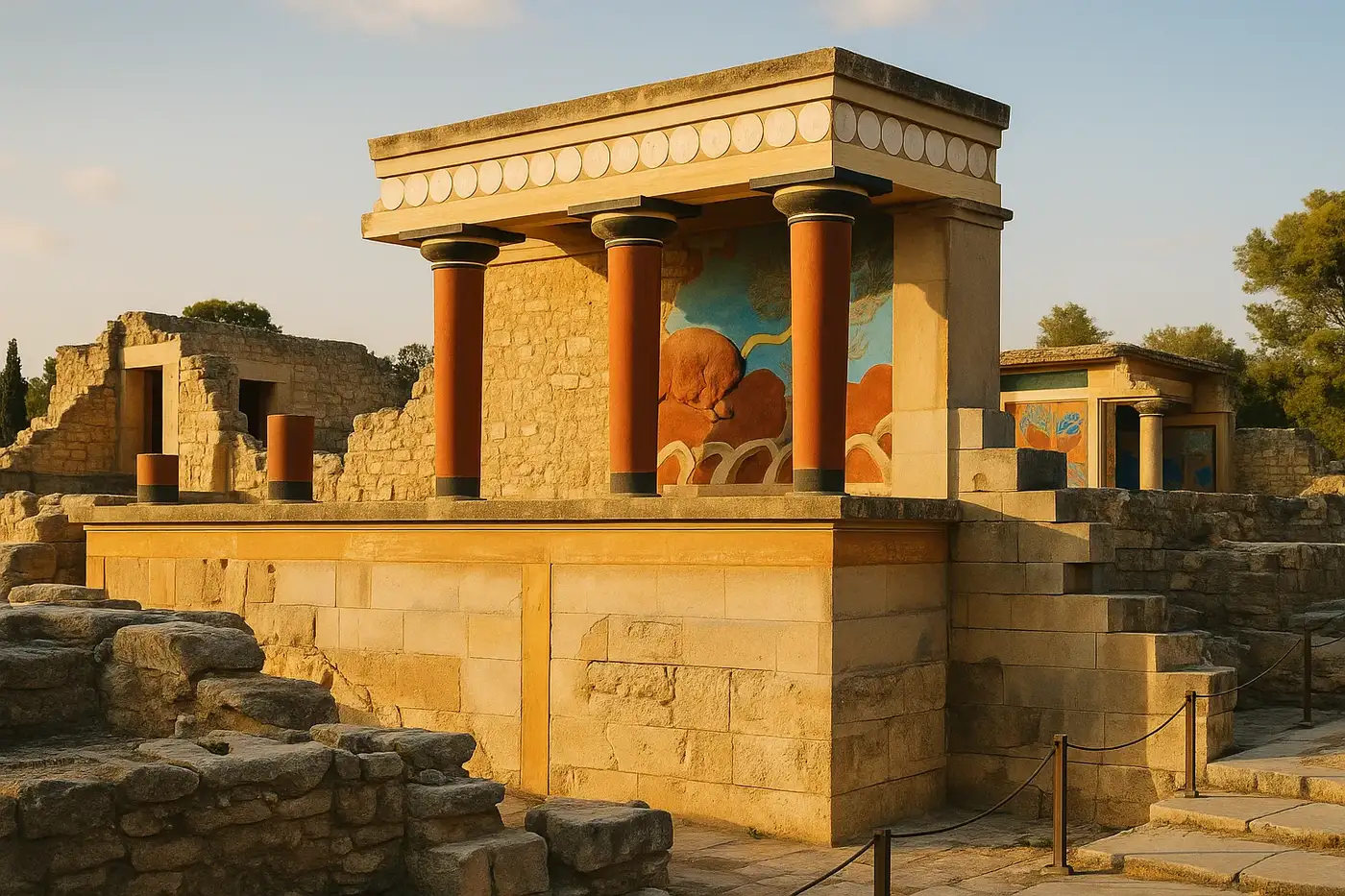
Just five kilometers from Heraklion’s bustling port, on a low hill above vineyards and olive groves, lies the archaeological site that changed our understanding of European history—the Palace of Knossos, ceremonial and administrative center of the Minoan civilization and arguably the oldest city in Europe. Here, 4,000 years ago, a sophisticated culture developed writing, built palace complexes of staggering complexity, traded across the Mediterranean, and created art of such vitality that it still astonishes today. Knossos is also the setting for one of mythology’s most enduring tales: the Labyrinth that housed the Minotaur, the thread given by Ariadne to Theseus, and the fatal flight of Icarus. Whether these stories emerged from the palace’s maze-like layout or the Minoans’ apparent mastery of the sea, Knossos occupies a unique place at the crossroads of history and legend. The controversial reconstructions by British archaeologist Sir Arthur Evans—painted columns, reconstructed rooms, speculative restorations—make Knossos unlike any other archaeological site in Greece. This is not a ruin preserved in arrested decay but a creative interpretation of ancient life, challenging visitors to distinguish what the Minoans built from what Evans imagined. Love it or question it, Knossos is essential—a portal to a civilization that predates classical Greece by a millennium and set the stage for everything that followed.
The Minoan World: Europe’s First Great Civilization
The Minoan civilization, named by Arthur Evans after the mythical King Minos, represents the earliest advanced culture in European history. Flourishing on Crete from approximately 3000 to 1450 BCE, the Minoans developed writing systems, sophisticated architecture, and maritime technology that made them the dominant power of the Aegean world. Their influence extended across the Mediterranean, with Minoan artifacts found as far away as Egypt, Syria, and the Greek mainland.
The Minoans were primarily a maritime people, their prosperity built on trade rather than conquest. They exported olive oil, wool, and the products of skilled craftsmen—including the fine textiles for which they were renowned throughout the ancient world. In return, they imported copper from Cyprus, ivory from Egypt, and gold from various sources. This commercial network brought not only wealth but also cultural influences that shaped Minoan art and religion.
The civilization’s decline remains partially mysterious, though archaeological evidence suggests a combination of natural disasters (including the massive volcanic eruption on nearby Thera/Santorini) and invasions by Mycenaean Greeks from the mainland. By 1450 BCE, Mycenaeans had established themselves at Knossos, adopting Minoan culture while imposing their own administrative systems, including the Linear B script that represents the earliest known form of Greek language.
The Palace of Knossos: A Labyrinth of Rooms
The palace complex at Knossos covers approximately 20,000 square meters and contains over 1,300 rooms arranged on multiple levels around a central courtyard. This was not merely a royal residence but an administrative center, religious sanctuary, and economic hub that organized the lives of thousands of subjects throughout Crete. The complexity of the architecture—staircases, corridors, storage areas, and ceremonial spaces packed into a dense urban fabric—may have inspired the Labyrinth myth that has clung to the site for three millennia.
The palace was built and rebuilt multiple times over its 600-year history, with each reconstruction adding layers to an already complex structure. The final form, which visitors see today (in Evans’s reconstruction), represents the culmination of Minoan architectural achievement, with features like the Grand Staircase demonstrating engineering capabilities that would not be matched in Europe for centuries.
Storage was a particular concern of palace design. The famous Magazines (storage rooms) contained massive pithoi—giant ceramic jars that held olive oil, wine, and grain collected as tribute from throughout Crete. These stores represented not only economic wealth but also political power, as control of food distribution allowed the palace elite to maintain their social position and fund elaborate building projects.
Sir Arthur Evans: The Controversial Reconstructor
The Knossos that visitors experience today is as much the creation of Sir Arthur Evans as it is of the ancient Minoans. Evans excavated the site between 1900 and 1931, uncovering the palace and surrounding city while simultaneously embarking on an ambitious program of reconstruction that remains controversial among archaeologists. Unlike most archaeological sites, where ruins are preserved as found, Evans restored walls, columns, and even entire rooms based on his interpretation of how the palace might have looked.
The Evans Controversy: Unlike Pompeii or Ephesus where ruins are preserved as found, Knossos was reconstructed by Sir Arthur Evans (1900–1931):
- Debate: Did Evans create an accurate restoration or an Edwardian fantasy?
- Impact: Concrete structures, speculative colors, reinforced walls make Knossos look “newer” than it is
- Advantage: Visitors can visualize palace as functioning building rather than rubble
- Criticism: Mixes ancient and modern indistinguishably; some reconstructions speculative
The Result: Whether you find Evans’s work enlightening or problematic, Knossos offers an intellectually engaging experience that pure preservation cannot match. Visitors must actively distinguish ancient from modern, making archaeology accessible and thought-provoking.
The Throne Room: Seat of Minoan Power
The so-called Throne Room represents one of the most evocative spaces at Knossos, though scholars debate whether it actually served as a royal audience chamber or had religious functions instead. The room features a gypsum throne flanked by painted griffin frescoes, with a sunken area in front that may have held water for ritual purification. Evans interpreted this as the seat of King Minos himself, though modern archaeologists suggest it may have been used by priestesses rather than kings.
The griffin frescoes that dominate the walls show mythical creatures—part eagle, part lion—that were associated with divine protection in Minoan iconography. Their presence in this room suggests that whoever sat upon the throne did so with religious as well as political authority. The careful reconstruction of these frescoes by Evans’s team, based on scattered fragments, provides insight into Minoan artistic techniques and color preferences.
The sunken lustral basin in front of the throne adds to the room’s mysterious atmosphere. Similar basins appear throughout the palace, always associated with ceremonial spaces rather than practical water storage. They likely served purification rituals that prepared participants for religious ceremonies or royal audiences, marking transitions between ordinary and sacred space.
The Grand Staircase: Engineering Marvel of the Bronze Age
The Grand Staircase stands as one of the most impressive architectural features at Knossos, a monumental four-flight construction that descends four stories through the palace’s complex massing. This was not merely functional circulation but a ceremonial processional route that would have conveyed visitors through increasingly sacred or exclusive spaces as they climbed from the lower levels to the palace’s heart.
The staircase’s engineering demonstrates sophisticated understanding of structural principles. Despite the weight of the massive palace above, the stair construction has remained stable for nearly 4,000 years. The light wells that illuminated the descent prevented the underground passages from feeling oppressive, while the surrounding storerooms and chambers created opportunities for display of wealth and power at each landing.
Evans reconstructed significant portions of the staircase, and visitors can now walk the same route that Minoan courtiers once followed. The experience of climbing these ancient steps, surrounded by reconstructed columns and walls painted in Evans’s characteristic colors, evokes the palace’s original grandeur while raising questions about the boundary between authentic archaeology and creative interpretation.
The Queen’s Megaron: Dolphins and Decoration
The Queen’s Megaron (great hall) preserves some of the most famous imagery from Knossos, including the dolphin fresco that has become an icon of Minoan art. This residential suite, located on the palace’s eastern side, features elaborately decorated walls, a light well for illumination, and connections to bathroom facilities that demonstrate Minoan concern for comfort and hygiene.
The dolphin fresco that gives the room its popular name depicts marine creatures swimming amidst sponges and seaweed, rendered in the fluid, naturalistic style characteristic of Minoan art. The original fresco is now displayed in the Heraklion Archaeological Museum, with a copy installed at the site. This marine imagery may reflect the Minoans’ connection to the sea that surrounded Crete and provided their wealth, or it may carry religious significance connected to goddess worship.
The room’s decoration includes other notable features, including a frieze showing decorative patterns and what Evans interpreted as a “lily prince” figure. Whether these represent specific individuals, generic courtiers, or religious imagery remains debated among scholars. The overall effect, however, conveys the sophisticated aesthetic sensibilities of Minoan elite culture, where even private residential spaces received elaborate artistic treatment.
The Storage Magazines: Pithari and Palace Economy
The Storage Magazines at Knossos reveal the economic foundations of Minoan palace society. These long corridors, lined with massive pithoi (storage jars), held the agricultural produce collected from throughout Crete as tribute or taxation. The scale of storage—capable of holding enough food to support thousands of people—testifies to the centralized economic control exercised from Knossos.
The pithoi themselves are remarkable artifacts, some standing more than two meters tall and capable of holding hundreds of liters of oil or grain. Their manufacture required specialized pottery workshops and considerable skill in ceramic technology. Many bear administrative inscriptions in Linear A (the undeciphered Minoan script) that recorded contents, origins, or destinations—evidence for the sophisticated bureaucratic systems that managed palace resources.
This redistribution economy, where agricultural surplus flowed to the center and was then redistributed to support specialized craftspeople, religious personnel, and administrative staff, formed the foundation of Minoan civilization. The palace’s ability to store and distribute resources created dependencies that maintained social hierarchy while enabling the cultural achievements visible in frescoes, crafts, and architecture.
The Theater: Theatral Area and Processional Ways
The so-called Theater at Knossos differs significantly from later Greek and Roman theaters, consisting of a paved area with steps or benches along one side rather than the semicircular seating familiar from classical antiquity. This “Theatral Area” likely served ceremonial and processional functions rather than dramatic performance, providing a space where crowds could gather to watch religious rituals or royal appearances.
The area connects to the Processional Way, a paved route that led from the palace to the surrounding town. This pathway would have seen religious processions, military parades, and the comings and goings of merchants and officials that animated Minoan political life. The careful construction of this route, with its pavement and drainage systems, demonstrates the infrastructure investment that made palace-centered urbanism possible.
Modern visitors can stand in the Theatral Area and imagine the ceremonies that once took place here—priests in ceremonial dress, offerings carried toward temple sanctuaries, perhaps bull-leaping athletes performing for assembled crowds. Though the precise functions of this space remain debated, its central position in the palace complex attests to its importance in Minoan public life.
The Minotaur Myth: Theseus, Ariadne, and the Labyrinth
Knossos’s Legendary Advantage:
While other archaeological sites offer impressive ruins, Knossos delivers something rarer: the tangible intersection of archaeology and mythology. This is the Labyrinth—whether or not Evans’s reconstructions capture the original, the myth of the Minotaur, Theseus, and Ariadne’s thread gives Knossos a narrative power unmatched by any other Bronze Age site in Europe.
The Myth Connection:
The Minotaur Story:
- King Minos of Crete, son of Zeus and Europa, ruled from Knossos
- Poseidon sent a white bull as sign of favor; Minos refused to sacrifice it
- In punishment, Minos’s wife Pasiphae fell in love with the bull
- Their offspring: the Minotaur, half-man, half-bull, imprisoned in the Labyrinth
- Athens forced to send seven youths and seven maidens annually as tribute
- Theseus volunteered, slew the Minotaur with help of Ariadne’s thread
Archaeological Echoes:
- The palace’s maze-like layout with 1,300 rooms may have inspired the Labyrinth myth
- Bull imagery throughout Minoan art—bull-leaping frescoes, bull-head rhytons, horns of consecration
- Double axe (labrys) symbol—possible origin of “labyrinth” (house of the double axe)
- Throne room may represent the seat of Minos himself
Heraklion Archaeological Museum: Treasures of Minoan Art
No visit to Knossos is complete without exploring the Heraklion Archaeological Museum, which houses the finest collection of Minoan art in the world. Located in Heraklion’s city center, the museum displays the original frescoes, artifacts, and sculptures that were removed from the palace for preservation and study.
Museum Masterpieces:
- The Bull-Leaping Fresco — Acrobat vaulting over bull; captures Minoan athletic ritual
- The Prince of the Lilies Fresco — Young man with crown of lilies and peacock feathers
- The Snake Goddess figurines — Iconic Minoan fertility figures with exposed breasts and snakes
- The Phaistos Disc — Mysterious fired clay disc with undeciphered script
- The Bull’s Head Rhyton — Serpentine libation vessel with rock-crystal eyes
- Linear B tablets — Earliest Greek writing; palace administration records
- Gold bee pendant — Masterpiece of Minoan jewelry from Malia
- Kamares ware pottery — Exquisite Middle Minoan ceramics with polychrome decoration
Practical Guide: Tickets, Tours, and Timing
Essential Planning FAQs
How do I get to Knossos?
Bus #2 from Heraklion center (frequent; €1.50; 20 minutes). Taxi from Heraklion (€10–15; 10 minutes). Rental car (parking at site; €3). Organized tour from Heraklion or beach resorts (€30–60 with guide). Many visitors combine Knossos with the Heraklion Archaeological Museum, reachable by same bus line.
Should I visit Knossos with or without a guide?
Strongly recommended with a guide unless you’re very familiar with Minoan archaeology. The site’s reconstructed nature creates confusion about what is ancient vs. Evans’s work. A licensed guide (€100–150 for 1.5 hours; can be shared) explains the controversies, points out original features, and brings the palace to life. Audio guides available at entrance (€5) are adequate but less engaging.
How long do I need at Knossos and the museum?
Plan 2 hours at Knossos (palace is large and requires walking) plus 2 hours at the Heraklion Archaeological Museum (essential companion visit). That’s a half day. Add lunch in Heraklion for a full day. Do not skip the museum—the original frescoes and artifacts provide context the site cannot.
What is the best time to visit Knossos?
Spring (April–May) when wildflowers bloom around the site and temperatures are mild. September–October also excellent with warm sea for post-visit swimming. Summer is extremely hot and crowded—arrive at 8 AM opening to avoid heat and tour groups. Winter is quiet but occasional rain makes reconstructed steps slippery.
Is Knossos suitable for children?
Yes, with caveats. The Minotaur myth fascinates children, making this an educational highlight. However: the site involves uneven terrain and many stairs (not stroller-friendly); summer heat is dangerous for young children; the reconstructed palace can be confusing without context. Best for ages 6+ with preparation via mythology stories.
Quick Facts
| Attribute | Details |
|---|---|
| Location | Crete, Greece |
| Country | Greece |
| Region | Crete |
| Civilization | Minoan |
| Historical Period | c. 3000–1450 BCE |
| Established | c. 1900 BCE (palace) |
| Coordinates | 35.2980, 25.1630 |
Explore More Ancient Sites
Discover other fascinating ancient destinations:
- Acropolis of Athens: The birthplace of democracy
- Delphi: The mystical oracle sanctuary
- Mycenae: The legendary fortress that succeeded Minoan Crete
- Ephesus: The magnificent Roman city in Turkey
For complete Greece travel planning, see our Greece Ancient Sites Guide.
|-----------|---------| | Location | 5 km southeast of Heraklion, northern Crete, Greece | | Ancient Name | Knossos (Κνωσσός); Ko-no-so in Linear B | | UNESCO Status | World Heritage Site (2025) - Minoan Palatial Centres | | Peak Period | 1700–1450 BCE (Neopalatial period) | | Destruction | Multiple destructions; final c. 1350 BCE | | Excavator | Sir Arthur Evans (1900–1931); Minos Kalokairinos (earlier) | | Palace Size | 20,000 square meters; 1,300+ rooms | | Best Time | April–May, September–October | | Entry Fee | €15 (site only); €20 combined with Heraklion Museum | | Suggested Stay | Half day with museum |
Frequently Asked Questions
Is Knossos worth visiting?
Absolutely. Knossos is one of Europe's most important archaeological sites—the center of the Minoan civilization that predates classical Greece by 1,000 years. Sir Arthur Evans's controversial restorations make it more accessible than most ruins, helping you visualize the palace as a functioning building. Combine with the Heraklion Archaeological Museum (10 minutes away) which houses the original frescoes.
How long does it take to visit Knossos?
Allow 2-3 hours for the site itself. Add 1.5-2 hours if you include the Heraklion Archaeological Museum, which is essential context for Knossos—it houses most of the original frescoes, pottery, and artifacts excavated from the site. Together they make for a compelling full half-day.
Are the Knossos frescoes original?
The frescoes at Knossos are reproductions—the originals are in the Heraklion Archaeological Museum. This is one reason visiting both sites is so important. Arthur Evans commissioned copies to be displayed in situ so visitors could appreciate the palace's painted decoration in context, but the actual 3,500-year-old pigments are safely preserved in the museum.
Can you visit Knossos on a cruise day stop?
Yes. The port of Heraklion is just 5 km from Knossos, making it ideal for a half-day cruise excursion. Take a taxi (10-15 minutes), spend 2 hours at Knossos, and optionally stop at the Archaeological Museum before returning to port. Book guided tours in advance in peak season as entry can queue.
What is the connection between Knossos and the Minotaur myth?
The palace's labyrinthine layout—1,300+ rooms on multiple levels—likely inspired the myth of the Labyrinth built by Daedalus to house the Minotaur. The double axe symbol (labrys) found throughout Knossos may be the origin of the word 'labyrinth.' The bull was also sacred to Minoans, evidenced by fresco scenes of bull-leaping athletes. Whether King Minos was historical or mythical, Knossos clearly inspired the legend.
Nearby Ancient Sites
The Complete Acropolis Athens Travel Guide: Temples
Ancient GreecePlan the perfect visit to the Acropolis of Athens with our 2026 guide. Discover the Parthenon, best ...
Delphi: The Navel of the Ancient World and Greece's Most
Ancient GreeceExplore Delphi, Greece's most mystical archaeological site. Walk the Sacred Way, discover the Oracle...
Mycenae, Greece: The Citadel of Legend and Home of Agamemnon
Mycenaean GreeceExplore Mycenae, the legendary citadel of King Agamemnon and one of Greece's most important archaeol...